






Bottom has rebounded 3x, how did Lighter take off?


- Core Thesis: The price of Lighter (LIT), a decentralized perpetual exchange, has surged over 3x in the past three months, driven by a confluence of fundamental narratives including compliance progress, a strategic partnership with Robinhood, a reshaped token economic model, and optimized token holder structure.
- Key Factors:
- Compliance Progress: Lighter’s founder joined the CFTC’s Innovation Advisory Committee and initiated the application for a U.S. on-chain derivatives trading license, highlighting its "U.S.-based" compliance advantages and differentiating it from the offshore risks of competitors like Hyperliquid.
- Channel Expansion: Deeply integrated with Robinhood Wallet, Lighter serves as the default execution layer and liquidity engine for its perpetual contracts, granting Robinhood’s vast user base direct access to Lighter’s services.
- Tokenomics: Protocol revenue is fully used to buy back and permanently burn LIT tokens, with a cumulative buyback of approximately 15.5 million tokens (6.26% of circulating supply), a burn intensity exceeding that of Hyperliquid. Additionally, ecosystem token staking rewards (targeting 6% APR) have been introduced.
- Token Holder Structure: Bottom-fishing turnover was completed during the prior downturn, shifting token distribution from loose dispersion to concentrated accumulation. The market structure has switched from sell-pressure dominance to being priced by incremental capital, with short covering amplifying price elasticity.
- Market Performance: LIT is currently trading at 2.65 USDT, up 19.4% in the last 24 hours, and has rebounded over 3x from its low of 0.78 USDT in the past three months.
Original: Odaily Planet Daily (@OdailyChina)
Author: Azuma (@azuma_eth)
Token price performance of decentralized Perp DEX project Lighter (LIT) has been quite strong recently.
According to OKX market data, as of 14:30 today, LIT was trading at 2.65 USDT, up 19.4% in 24 hours. Calculated from its historical low of 0.78 USDT in early April, LIT has achieved a strong rebound of over 3 times in the past three months.
Considering Lighter's recent developments in regulation, products, and tokens, LIT's strong price performance can be attributed to the simultaneous resonance of multiple fundamental narratives.
Compliance Progress: Narrative Advantage of a "US-Based" Exchange
The first main driver of Lighter's recent strength is the rapid clarification of its compliance path.
This is particularly evident when comparing Lighter with its biggest competitor, Hyperliquid (HYPE). The latter has long held the top spot in the on-chain Perp DEX赛道, but its offshore nature is often viewed as a potential compliance risk, especially against the backdrop of gradually tightening US regulatory frameworks, implying persistent policy uncertainty.
In contrast, Lighter's positioning leans more towards being a "trading infrastructure endogenous to the US regulatory system." As a US-based project, Lighter is actively embedding itself within the regulatory framework, thereby gaining a new "compliance premium."
During the Q1 investor conference call in early April, Lighter founder and CEO Vladimir Novakovski explicitly stated that the company has initiated the application process for an on-chain derivatives trading license in the United States. Vladimir remarked bluntly: "To serve traditional financial institutions like Citadel, having a license is unrealistic without one."
Yesterday, Novakovski again stated on X that he has become a member of the U.S. Commodity Futures Trading Commission's (CFTC) Innovation Advisory Committee. The market significance of this is far greater than its surface-level title. The CFTC's Innovation Advisory Committee essentially serves as an "institutional buffer layer" between regulators and market participants, responsible for providing policy advice to the CFTC at the intersection of technology, law, and finance. Under current regulatory trends, This new role for Vladimir means Lighter is not just "adapting to regulation" but can participate in the early stages of rulemaking.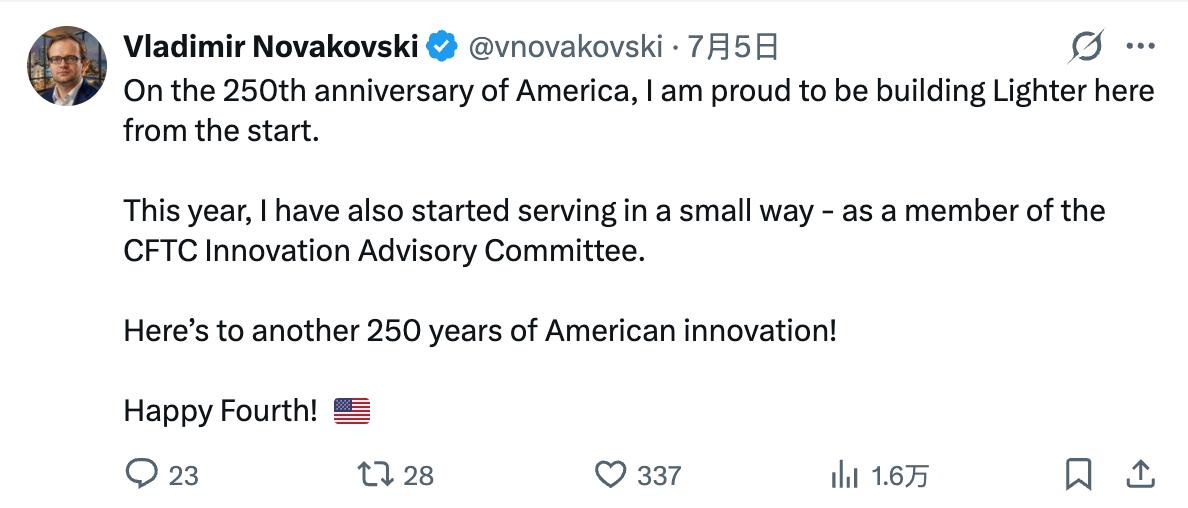
Additionally, another notable piece of information is that incoming Federal Reserve Chairman Warsh disclosed holding some LIT in his financial disclosure before taking office. While this doesn't imply Warsh will use his position to favor Lighter, this "potential policy network connection" still reinforces the market's pricing imagination regarding Lighter's compliance resource advantages.
New Channel Access: Deep Integration with Robinhood
Beyond compliance progress, the second key variable in Lighter's recent surge is the opening of new distribution channels, particularly its deep integration with Robinhood.
Last week, Robinhood and Lighter jointly announced that Robinhood Wallet now supports a native perpetual trading entry point powered by Lighter, allowing users to trade perpetual contracts and tokenized stock assets directly within the wallet, using USDG as the quote asset.
As an investor in Lighter, the market had previously anticipated some form of cooperation between Robinhood and Lighter. However, some users also worried that Robinhood might choose to build its own perpetual product, creating a competitive relationship with Lighter. But the latest announcement means Robinhood ultimately chose to integrate its perpetual contract trading capabilities with Lighter.
For Lighter, this signifies a qualitative shift in its role — it is no longer just an independent DEX but is gradually becoming the default execution layer and liquidity engine within the Robinhood Wallet ecosystem, giving Robinhood's vast user base more convenient access to its services.
Prominent trader Ansem, who recently gained attention due to his own Meme token's surge, also gave high praise: "The collaboration between Lighter and Robinhood looks like they're aiming for something big."

Tokenomics Reshaped: All Repurchased Tokens Burned
Another major recent move by Lighter was the official announcement on July 1st of an update to its tokenomics model, further strengthening the pricing logic of LIT as a "cash-flow-driven asset."
In this update, Lighter explicitly allocates all protocol revenue to repurchase LIT and upgraded the buyback mechanism from "programmatic buying" to "permanent burning." As of that time, Lighter had cumulatively repurchased approximately 15.5 million LIT, accounting for about 6.26% of the circulating supply, and plans to execute its first on-chain burn after the end of Q2.
Simultaneously, LIT's staking mechanism was redesigned. After initial subsidies from pre-TGE revenue, the team announced the gradual introduction of ecosystem tokens for staking rewards, targeting an annualized yield of around 6%. Under the current staking scale of approximately 125 million LIT, this corresponds to an annual distribution of about 7.5 million tokens.
Under this framework, LIT's economic model begins to present a relatively clear structure: On one end, sustained protocol revenue ➡️ full buyback and burn ➡️ contraction of circulating supply; on the other end, staking rewards for long-term holders ➡️ directed distribution in the form of ecosystem tokens.
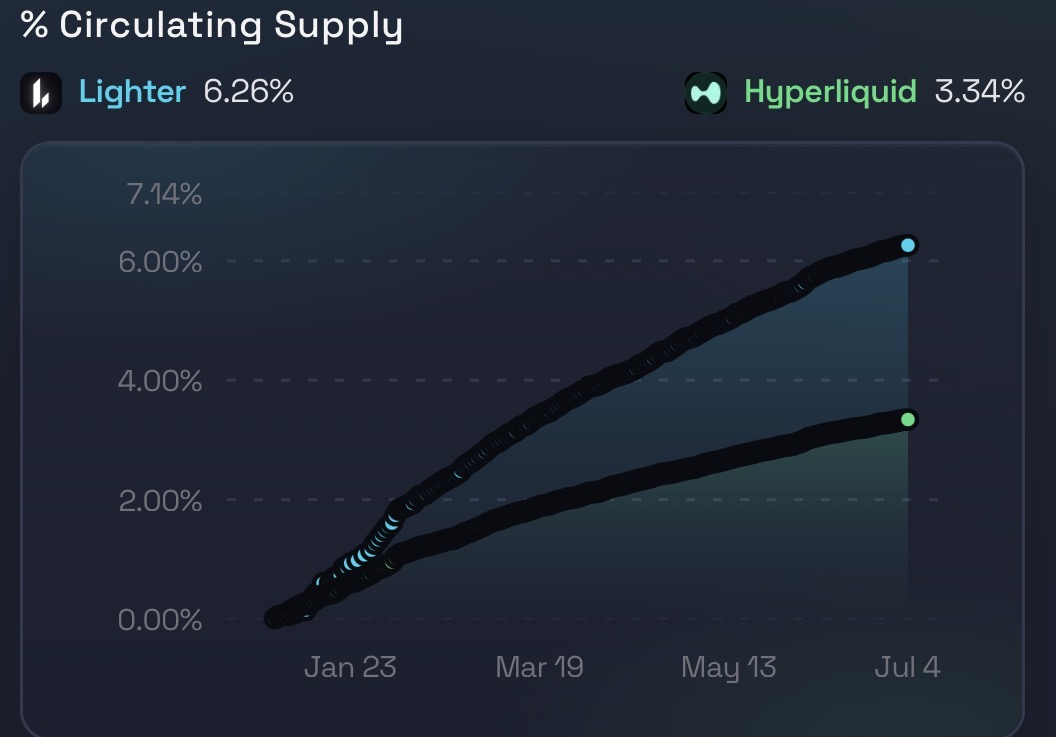
Data analyst tracking the Perp DEX赛道 ajey.lit posted a comparison of buyback data for LIT and HYPE, revealing quite surprising results. Compared to HYPE, which has long emphasized revenue and buybacks, LIT's repurchase intensity is relatively stronger — As of now, the number of tokens repurchased by Lighter accounts for approximately 6.26% of the circulating supply, significantly higher than Hyperliquid (HYPE)'s ~3.34%; calculated based on the ratio of buyback amount to market cap, Lighter's buyback ratio is about 4%, also higher than the latter's ~1.8%.
Shift in Token Distribution: Handover Complete, Lighter Load Makes for Easier Pump
Looking at the three lines of compliance, distribution, and tokenomics together, LIT's rise is not driven by a single catalyst but is a typical process of "delayed pricing + collective revaluation."
The prerequisite for all this is that LIT's bottom-level tokens have been thoroughly washed out during the previous sustained decline.
Since LIT's TGE, affected by the overall sluggish cryptocurrency market, intense competition in the Perp DEX赛道, and continuous exits by early airdrop recipients, LIT formed a typical downward selling pressure structure. Simultaneously, market makers and long-term capital completed sustained accumulation at low levels, causing the tokens to gradually shift from "loosely distributed" to "concentrated accumulation." This process can essentially be understood as a bottom-level handover.
As Lighter's fundamentals gradually improve, LIT's market structure has shifted from being "dominated by sellers and breakout pressure" to being "dominated by incremental capital pricing." Under this structural change, marginal improvements in fundamentals truly begin to be amplified. Furthermore, this structure was superimposed by concentrated short positions. During prolonged periods of sideways trading and bearish expectations, some short positions accumulated. When the price started breaking through key ranges, market liquidity showed significant asymmetry — limited selling pressure above, while short covering became a new source of buying pressure, thus amplifying price elasticity.
In summary, LIT's current rally should not be understood as driven by a single factor but by the combined effect of three layers: First, fundamentals moving from uncertainty to verifiability; second, the token distribution structure shifting from sell-pressure dominance to completed handover; third, short positions and liquidity structure reversely amplifying elasticity.
LIT didn't "suddenly become strong"; it's just gradually being "repriced."


