






Ethereum hình thành ba trung tâm quyền lực, mạch sống thương mại nằm trong tay các cá voi ETH


- Quan điểm cốt lõi: Bằng cách tách biệt hoạt động kinh doanh, thành lập hai tổ chức độc lập là Ethlabs và Ethereum Institutional, Ethereum Foundation đã giải quyết mâu thuẫn giữa tính trung lập của chính mình và thương mại hóa, chuyển giao nghiên cứu phát triển công nghệ và quảng bá thương mại cho các thực thể bên ngoài. Sự thành bại của cấu trúc này phụ thuộc rất nhiều vào biến động giá ETH và sự hỗ trợ tài chính từ các cá voi nắm giữ.
- Các yếu tố then chốt:
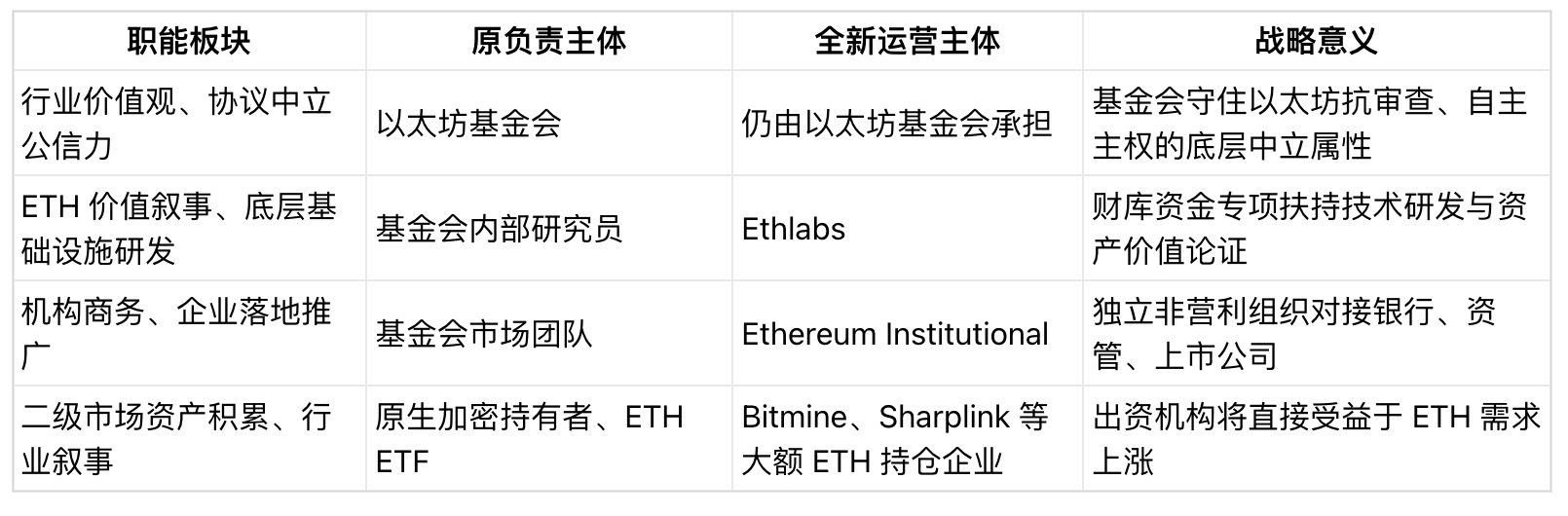
- Hai tổ chức mới có trách nhiệm rõ ràng: Ethlabs chịu trách nhiệm hoàn thiện cơ sở hạ tầng lớp nền và câu chuyện tiền tệ của ETH, giải quyết những lo ngại của các tổ chức khi tham gia; Ethereum Institutional toàn quyền giới thiệu các dịch vụ token hóa và stablecoin của Ethereum tới các ngân hàng và công ty quản lý tài sản.
- Nguồn tài trợ và lợi ích gắn kết sâu sắc: Bitmine (nắm giữ 5,7 triệu ETH) và Sharplink (nắm giữ 887.000 ETH) cùng sở hữu khoảng 5,46% tổng lượng ETH lưu hành, là nhà đầu tư của hai tổ chức này, và lợi nhuận tài chính của họ liên quan trực tiếp đến sự phát triển của hệ sinh thái Ethereum.
- Sự ra đi liên tục của lãnh đạo cấp cao và định vị lại vai trò của Quỹ: Ít nhất tám giám đốc điều hành đã rời đi trong năm tháng qua; Cương lĩnh mới năm 2026 của Quỹ xác định rõ Quỹ chỉ đóng vai trò là người bảo vệ các lý tưởng về chủ quyền tự chủ, quyền riêng tư và bảo mật, không còn đảm nhận các chức năng thương mại.
- Tiến bộ công nghệ và nút thắt hiệu suất: PeerDAS đã tăng dung lượng dữ liệu của mạng lớp 2 lên khoảng mười lần, nhưng báo cáo dự đoán TPS của mainnet Ethereum sẽ vẫn dưới 100 giao dịch trước năm 2034; Thông lượng mạng lớp 2 sẽ cần đến năm 2029 mới có thể vượt qua Solana.
- Sự khác biệt lớn về triển vọng thị trường: Citibank đã hạ mục tiêu giá ETH 12 tháng xuống còn 2.240 USD, với kịch bản giá xuống là 1.094 USD; Trong khi đó, Standard Chartered vẫn giữ quan điểm rằng ETH có thể chạm mức 4.000 USD vào cuối năm 2026, phản ánh sự bất ổn định trong ngắn hạn.
Original author: Gino Matos
Original translation: Chopper, Foresight News
On July 1, Ethereum Institutional was established, consolidating the marketing efforts of the Ethereum Foundation into a single team responsible for promoting Ethereum's tokenization and stablecoins to banks and asset management companies.
Ethlabs, which debuted a few days earlier, was founded by five former senior researchers from the Ethereum Foundation, focusing on two main directions: improving on-chain settlement efficiency and perfecting the monetary narrative of ETH.
Bitmine, Sharplink, and Ethereum co-founder Joe Lubin jointly provided funding for both new organizations.
The establishment of these two new institutions coincides with a continuous loss of senior talent within the Ethereum Foundation. On June 18, co-Executive Director Hsiao-Wei Wang announced her departure. Prior to this, Tomasz Stańczak had already submitted his resignation. Over the past five months, at least eight senior executives have left the Ethereum Foundation.
Back in March 2026, the Ethereum Foundation released a new functional mandate, redefining its role: solely as a guardian of sovereign autonomy, censorship resistance, open-source code, privacy, and security—not positioning itself as Ethereum's parent company, nor holding ultimate decision-making power over the protocol. This positioning deliberately leaves a business gap, delegating commercial implementation work to external institutions.
Ethlabs takes on the technology R&D and asset value narrative, responsible for perfecting the underlying infrastructure and building the complete logic of ETH as a monetary asset, thereby alleviating institutional concerns about entering the Ethereum ecosystem. Ethereum Institutional is entirely responsible for business development, converting industry interest into real deployed capital by establishing industry forums, maintaining institutional connections, and customizing promotional strategies.
The core reason both teams operate independently from the Foundation is that the Foundation’s neutral positioning cannot accommodate commercial work. If a neutral standard-setting body were to simultaneously act as ETH’s promotional team and corporate sales department, it would directly harm its own credibility.
Thus, Ethereum's three-part power structure has taken shape. The Foundation is responsible for legitimacy and long-term protocol value, Ethlabs handles ETH's value capture and technology R&D, and Ethereum Institutional manages corporate business development.
Ethereum Institutional revealed that the team has already connected with over 500 tier-1 banks, global asset managers, sovereign wealth funds, custodians, and market infrastructure providers. Its Ethereum Institutional Summit hosted over 150 senior financial executives, representing a total assets under management of $250 trillion. This immense industry resource is a core reason for the official decision to split these functions and establish independent institutions rather than housing them as a subsidiary of the Foundation.
Outsourcing corporate business and ETH value promotion to external institutions addresses the disconnect in the Foundation’s execution capabilities. However, it also means that giants holding vast amounts of ETH and commanding massive balance sheets now control the communication channels to Wall Street. Convenience and independence are opposing forces, and Ethereum has chosen convenience.
Supporting Ethereum's Wall Street strategy are enterprises holding massive amounts of ETH
Bitmine currently holds 5.7 million ETH, representing 4.7% of the total ETH circulating supply. Combined with cash and marketable securities, its total assets amount to $9.8 billion. Sharplink holds 886,725 ETH and increased its position by 10,000 ETH on June 28 at an average price of $1,611.
Together, the two institutions hold a total of 6.59 million ETH, or 5.46% of the 120.7 million circulating supply. At current prices, the total value of their holdings is nearly $10.6 billion. Bitmine itself has a market cap of $6.55 billion, and Sharplink's market cap exceeds $1 billion.
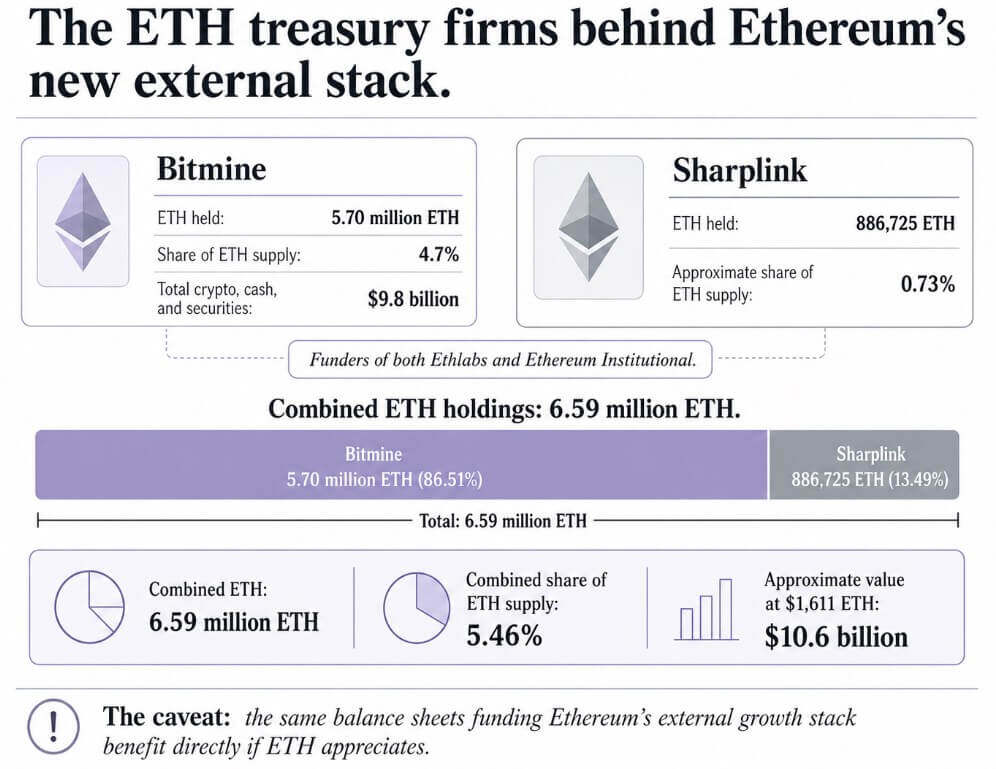
If this business split model succeeds, the two funding enterprises will directly benefit: improved underlying infrastructure and more mature institutional business will drive up market demand for ETH. Given their enormous holdings, even slight fluctuations in ETH will result in hundreds of millions of dollars in asset value changes on their books. Ethereum co-founder Joe Lubin, supporting both non-profit institutions, sits at the core of this interest system, while the financial returns of Bitmine and Sharplink are deeply tied to the development of the Ethereum ecosystem.
PeerDAS has already been launched, capable of increasing data availability capacity for Layer 2 networks by approximately ten times. Glamsterdam, planned for the second half of 2026, aims to achieve base-layer scaling, parallel transaction processing, and larger block payloads.
An academic report from June 2026 showed that transaction throughput on both the mainnet and Layer 2 networks has doubled. The median mainnet fee dropped from over $2 to below $0.02, while Layer 2 fees decreased by over 95%, reaching as low as $0.0015.
The report also provided long-term performance forecasts: Ethereum's mainnet will still process fewer than 100 transactions per second by 2034. Layer 2 throughput will not surpass Solana until March 2029, but by then, Layer 2 fees will be significantly lower than its competitors. Whether Ethereum can attract institutional entry relies almost entirely on Layer 2 scaling and the implementation of industry standards—precisely the core work scope of Ethlabs.
ETH's Price Trajectory Will Determine the Ultimate Outcome of This Structure
The bullish argument is that Ethereum already has considerable scale. Ethereum currently hosts a $157 billion stablecoin market cap, accounting for over half of the global stablecoin total. DeFi total value locked stands at $37.2 billion, representing 62% of the entire industry. RWA.xyz data shows tokenized real-world assets on Ethereum are worth $15.8 billion, with the total market for this sector at $31.52 billion, firmly placing Ethereum in the leading position among public chains.
Citibank predicts the global tokenized real-world asset market will expand from the current $17 billion to $5.5 trillion by 2030, with a lower bound of $2.7 trillion and an upper bound of $8.2 trillion. If Ethlabs continues to iterate on infrastructure and Ethereum Institutional can convert its relationships into actual deployed capital, holdings giants like Bitmine and Sharplink will become early industry beneficiaries. Ethereum could become the default settlement layer for compliant digital assets, and the value of ETH assets would rise accordingly.
The bearish argument begins with price. Citibank lowered its 12-month price target for ETH from $3,175 to $2,240, citing weak ETF demand and negative inflows, setting its bear case for ETH at $1,094.
Standard Chartered holds a completely opposite view, insisting ETH could reach $4,000 by the end of 2026. The significant divergence in expectations between the two major institutions reflects the uncertainty in the short-term market outlook.
If ETH remains weak for an extended period, the stock prices of Bitmine and Sharplink will continue to trade at a discount relative to their asset holdings, and their ability to fund the two non-profit institutions will steadily decrease. Even if Ethlabs and Ethereum Institutional can maintain operations, their funding stability will significantly decline. The market will increasingly question whether the core purpose of establishing these two institutions was to pump ETH's price rather than building real, usable institutional-grade infrastructure.
Regulatory developments favor a bullish narrative but cannot guarantee price increases. The US GENIUS Stablecoin Act passed in 2025 established a federal regulatory framework for stablecoins. A consortium including Visa, Mastercard, and Coinbase subsequently launched the Open USD stablecoin. Improved regulatory frameworks will bring institutional settlement volume to all public chains, not just Ethereum as a unique benefit. McKinsey's forecast is more conservative, predicting a token market size of around $2 trillion by 2030, starkly contrasting with Citi's high expectations, highlighting the vast disagreement over the industry's growth potential.
Conclusion
By splitting its functions and establishing two independent institutions, Ethereum has resolved the inherent conflict between the Foundation's neutrality and commercialization. However, as both institutions are funded entirely by enterprises holding massive amounts of ETH, this structure has both pros and cons.
On the positive side, with specialized institutions focusing on infrastructure and connecting with Wall Street, Ethereum has the potential to become the universal settlement layer for tokenized finance. On the risk side, this ecosystem expansion is entirely tied to the balance sheets of these holdings giants, meaning ETH's price trajectory directly determines the availability of funding. Both scenarios will coexist. The price of ETH one year from now will determine which trend dominates.


