






ByteDance employee quits after making 30 million yuan from stock trading — just how crazy is this stock market rally?


- Key Point: A rumor about a ByteDance employee achieving financial freedom through stock trading reflects the current global stock market frenzy, where the sentiment of “investing as a substitute for working” has become a widespread zeitgeist, particularly resonating among employees of major tech companies.
- Key Elements:
- A rumored ByteDance employee reportedly made 30 million yuan from stock trading, achieving financial freedom, and claiming that the odds of getting rich through investing are far higher than getting promoted within a company.
- ByteDance itself, as a successful case study, has an internal valuation ranging from $330 billion to $480 billion, directly exposing its employees to the logic of asset revaluation.
- ByteDance has urban legends like the “Beijing Stock Trader,” whose typical path involves turning a principal of 80,000 yuan into tens of millions through stock trading.
- Global stock markets are in a historic frenzy: It has become normal for the A-share market to have a single-day turnover exceeding 3 trillion yuan; South Korean investors have even surrendered insurance policies to go all-in on semiconductor stocks.
- The AI bull market has persisted for three years without breaking: Nvidia's market cap has surged from $500 billion to over $5 trillion, with AI-related stocks contributing approximately 80% of the S&P 500's total gains for the year.
- The prevailing sentiment of the era is “work as a side hustle, investing as the main event,” and global stock markets are expected to remain in a frenzy of gains through the first half of 2026.
Original Author: Jia Liu, Zhang Sheng Beatz
The post about "ByteDance employee made 30 million by stock trading" went viral.
The rumored protagonist is the group owner of an early internal US stock investment group at ByteDance.
According to rumors, he achieved financial freedom through investing and left two final words on his last day: Working can only maintain your current life, only investing can lead to a better one; the probability of achieving financial freedom through investing is far greater than climbing to a 4-1 level at ByteDance.
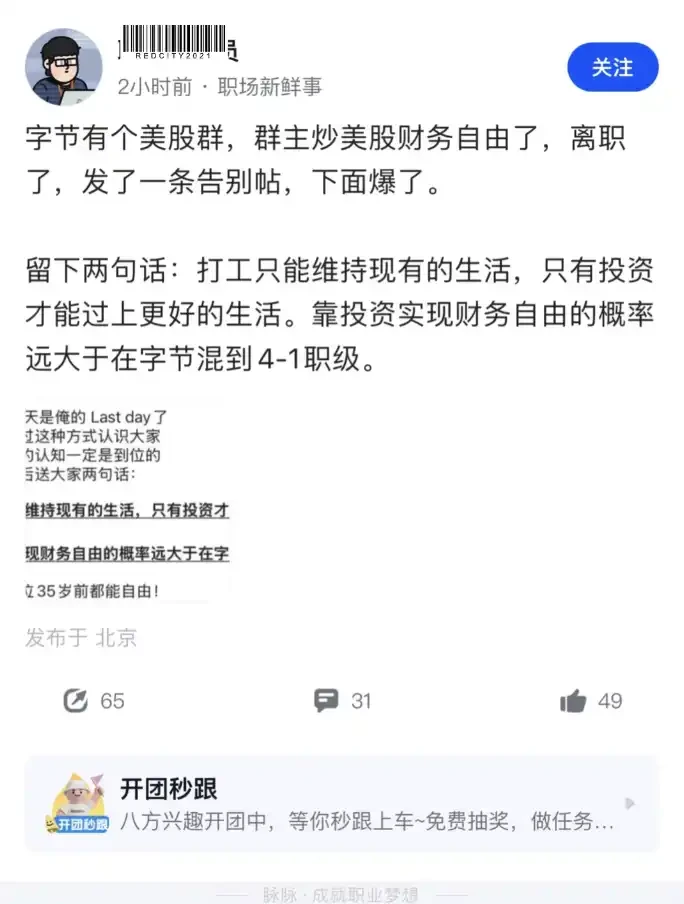
Stories of financial freedom are always so inspiring.
It is said that some ByteDance colleagues couldn't handle it on the spot, immediately taking out loans and going all-in on stocks.

The narrative for big tech companies used to be simple. Join a high-growth company, earn a high cash income, wait for stock options to appreciate, and achieve wealth transition through promotions and the company's IPO. ByteDance itself is one of the most successful examples of this narrative. Business Insider reported last year that ByteDance valued itself at approximately $330 billion during employee share buybacks, with Fidelity's valuation even higher; subsequent secondary transactions pushed ByteDance's implied valuation to around $480 billion. In other words, from the moment they join, ByteDance employees are not just dealing with "work," but also valuations, options, buybacks, liquidity, and asset revaluation.
So the stock trading guru even gave up ByteDance's options. He didn't think much of them.
This isn't ByteDance's first urban legend.
Last year, there was a trader ID "Beijing Trader" also from ByteDance, known in the community as "God Bei." In stock market communities and multiple financial reposts, the common narrative about him is: entered the market in 2007, went through the typical trial-and-error phase of retail investors early on, and later grew a principal of about 80,000 RMB to tens of millions. An article reposted on NetEase summarized his path as "from 80k to 50 million".
The current stock market conditions are truly historic. Not just in the US, but globally. In the A-share market, single-day trading volumes exceeding 3 trillion RMB on the Shanghai and Shenzhen exchanges have become the norm, something unimaginable during the last bull run. The South Korean stock market is even more explosive, with Koreans cashing out pensions and insurance money to go all-in on SK Hynix.
At the end of November 2022, ChatGPT launched. From that moment on, Wall Street has been waiting for the AI bubble to burst.
But three and a half years later, this market trend hasn't ended; instead, it is accelerating and expanding. Nvidia's market cap surged from around $500 billion in early 2023 to over $5 trillion, weathering the DeepSeek shock, the US-Iran conflict, and inflation rebounds. After every pullback, it was pushed to new highs by even stronger earnings reports and larger capital expenditures. By 2025, AI-related stocks contributed approximately 80% of the S&P 500's annual gains.
And in the first half of 2026, global stock markets are still in a frenzy of gains.
After all, the sentiment of this generation is: work is increasingly becoming a side hustle, while stock trading and investing are the main focus.


