






Vietnamese translation: Thượng nguồn đất hiếm đã tăng hết đà? Bộ Thương mại trừng phạt 10 doanh nghiệp Mỹ, chênh lệch kỳ vọng thực sự có thể nằm ở hạ nguồn


- Quan điểm chính: Ngày 22 tháng 6 năm 2025, Bộ Thương mại Trung Quốc đã đưa 10 thực thể Mỹ (bao gồm MP Materials) vào danh sách kiểm soát xuất khẩu. Hành động này đã được thị trường cổ phiếu A-share ngành đất hiếm định giá một phần, cổ phiếu tài nguyên thượng nguồn đã tăng đủ, trong khi vùng trũng định giá tương đối của các chuỗi trung nguồn và hạ nguồn như vật liệu từ tính và máy bay không người lái có thể chứa đựng cơ hội giao dịch đáng chú ý hơn.
- Các yếu tố chính:
- Danh sách kiểm soát tập trung vào ba lĩnh vực: quân sự, máy bay không người lái và đất hiếm. MP Materials và USA Rare Earth là các mục tiêu cốt lõi. Động thái này nhằm cắt đứt kênh tiếp cận hàng hóa lưỡng dụng của Trung Quốc đối với các doanh nghiệp Mỹ, qua đó nâng cao tính khan hiếm của các doanh nghiệp Trung Quốc.
- Cổ phiếu thượng nguồn đất hiếm A-share (Bắc Phương Rare Earth 52,9 NDT, Quảng Sạ Hữu Sắc 115 NDT) đã gần mức cao nhất trong một năm. Đợt kiểm soát này chủ yếu là xác nhận xu hướng chứ không phải khởi điểm tăng mới, giao dịch tiếp nối ở vùng cao có tỷ lệ rủi ro/lợi nhuận không tốt.
- Trung nguồn và hạ nguồn vật liệu từ tính đất hiếm (Đại Địa Hùng 30,7 NDT, Chính Hải Vật liệu Từ tính 13,7 NDT) đang ở vùng định giá thấp trong một năm, tụt hậu đáng kể so với thượng nguồn. Trong đó, Đại Địa Hùng, với ngành chính là vật liệu từ tính quân sự, phù hợp nhất với chủ đề quân bị của danh sách kiểm soát, có mối liên quan mạnh nhất.
- Trung Hàng không không người lái (44 NDT, gần mức thấp nhất một năm) là công ty dẫn đầu về máy bay không người lái quân sự, chịu ảnh hưởng từ Red Cat trong danh sách. Tuy nhiên, định giá cao và đặc điểm doanh thu theo chu kỳ khiến nó khó có thể tăng trưởng ổn định; động lực cốt lõi là các đơn đặt hàng thương mại quân sự sau này.
- Cổ phiếu Mỹ bị điểm danh (MP, Red Cat) không hoàn toàn là tin xấu một chiều, vì việc kiểm soát có thể kích hoạt Bộ Quốc phòng Mỹ tăng cường hỗ trợ và đơn đặt hàng. Định giá thực tế cần chờ xác nhận khi thị trường mở cửa, nhà đầu tư cần theo dõi diễn biến sau khi giao dịch bắt đầu.
Original author: David
On June 22, the Ministry of Commerce issued Announcement No. 23 of 2026, adding 10 US entities, including AeroVironment, Red Cat Holdings, and MP Materials, to the export control list, prohibiting the export of dual-use items to them; on the same day, another 46 US companies were added to the government procurement restriction list.
(Author's note: Dual-use items refer to goods, technologies, and services that have both civilian and military uses or contribute to enhancing military potential.)
This marks another round in the normalization of China's rare earth countermeasures since October 2025. The 10 named US companies are primarily concentrated in the three sectors of defense, drones, and rare earths.
The two most prominent names on the list are MP Materials and USA Rare Earth, both pillars of the US rare earth industry. The market's first reaction to China's move against them was that it would benefit the A-share rare earth sector: if the competition is stifled, domestic players gain more scarcity and value.
The question is, since rare earth stocks have risen from last October to the point where upstream leaders are now near their yearly highs, is it too late to react now?
If so, where could the money flow next?
This Ministry of Commerce control list impacts more than just the rare earths sector. While the fully-priced rare earth sector may still have catalysts ahead, some overlooked off-the-beaten-path segments might not yet be on anyone's radar.
We attempt to sort out the potentially affected areas and map them onto price coordinates for your reference.
Key Conclusions
① A-share rare earth upstream stocks have already priced in gains; this new control measure is not a fresh catalyst.
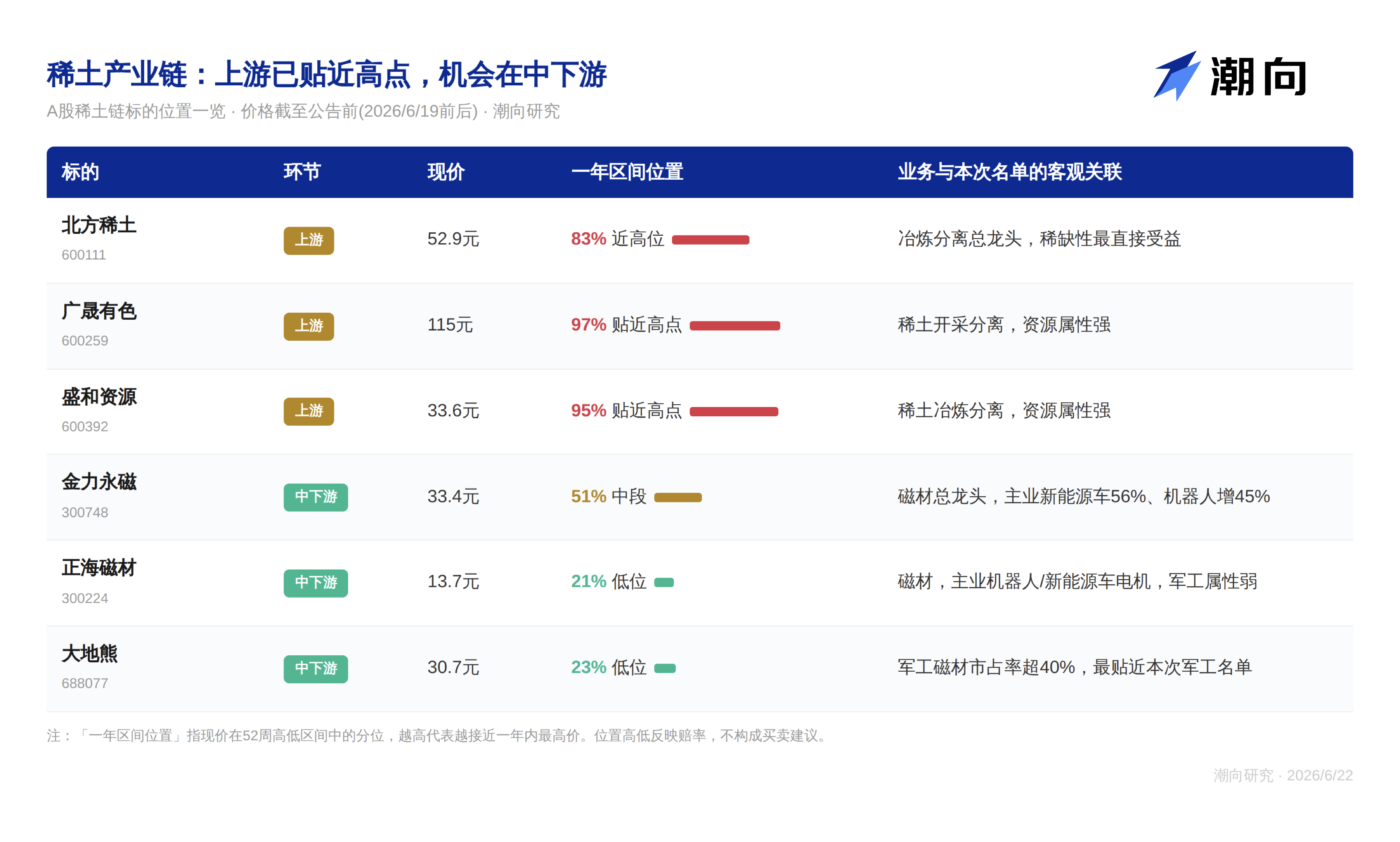
Northern Rare Earth's current price of 52.9 yuan is only about 20% away from its one-year high of 63.6 yuan; Guangcheng Nonferrous Metals at 115 yuan and Shenghe Resources at 33.6 yuan are also near their one-year highs. These upstream resource stocks have been on an upward trend since last October, and the 'rare earth countermeasure benefit' logic has largely been priced in. For the upstream rare earth sector, this control measure is more of a reconfirmation of the trend than a new starting point for an upswing.
② The relatively underpriced areas are the mid-to-downstream rare earth magnet sector and the drone supply chain.
Within the rare earth chain, valuations in the mid-to-downstream sectors are significantly lower than upstream:
In the magnet sector, Earth-Panda Advanced Magnetic Material at 30.7 yuan and Zhenghai Magnetic Material at 13.7 yuan are still near the lower bound of their one-year range, with gains significantly lagging behind upstream resource stocks. The drone sector, corresponding to Red Cat and Teal Drones on the control list, is even quieter, with AVIC (China) UAS hovering near its one-year low, attracting limited market attention. The pricing progress across different segments of the same event is not uniform.
③ The named US stocks don't necessarily constitute a unilateral negative; market reaction needs to be verified after the opening bell.
MP Materials and USA Rare Earth are core players in the US domestic rare earth supply chain, with MP having the backing of the US Department of Defense as a shareholder.
For such companies, China's export controls and US policy support are two concurrent forces, and their impact direction isn't necessarily aligned. None of the three stocks were trading at lows before the announcement. As the announcement was made on Monday before the US market opened, their true pricing reaction awaits market confirmation.
Investors holding relevant positions should closely monitor post-opening trends.
Why Do Export Controls Benefit Domestic Rare Earths?
Many might find this counterintuitive at first glance: banning exports means fewer deals for Chinese companies, so how is it beneficial?
The key lies in the direction of the controls. This ban prevents China from selling rare earth-related items to those 10 US companies, cutting off the supply sources for these American firms, not China's raw material procurement.
China possesses the most complete global chain for rare earths, from mining and smelting/separation to magnet manufacturing, achieving self-sufficiency without relying on US imports. This means the announcement doesn't affect the upstream of Chinese suppliers; they can continue production and exports as usual.
The ones truly constrained are on the US side.
Companies like MP Materials and USA Rare Earth want to bypass China and build their own supply chains, but they still depend on China for separation technology, equipment, and some intermediate materials. By throttling the competition, it inversely enhances the scarcity and bargaining power of Chinese manufacturers in the global rare earth landscape. This is the real reason the market interprets it as a positive for A-share rare earth stocks.
Upstream Rare Earth Stocks Have Rallied, Funds Haven't Reached Downstream Yet
Let's clarify the chain. Rare earths mined from ores undergo smelting and separation to become raw materials like praseodymium neodymium oxide – this is the upstream, handled by companies like Northern Rare Earth, Guangcheng Nonferrous, and Shenghe Resources.
These raw materials are then processed into NdFeB permanent magnet materials and installed into various motors – this constitutes the mid-to-downstream, where players like JL Mag Rare-Earth, Zhenghai Magnetic Material, and Earth-Panda operate.
Upstream sells raw materials; downstream sells magnetic materials.
In this current market trend, capital is primarily concentrated upstream. Northern Rare Earth at 52.9 yuan, Guangcheng Nonferrous at 115 yuan, and Shenghe Resources at 33.6 yuan are all near their one-year highs. The logic is straightforward: every time rare earths' strategic importance is emphasized, the first to benefit are the upstream players who hold mines and smelting capacity – their scarcity is tangible and visible.
I believe this control event is a positive in the same direction for the upstream, but prices have already largely absorbed this expectation. Entering now feels like chasing momentum at high levels, with poor risk-reward odds.
Moving downstream to magnetic materials, the pricing progress is noticeably slower.
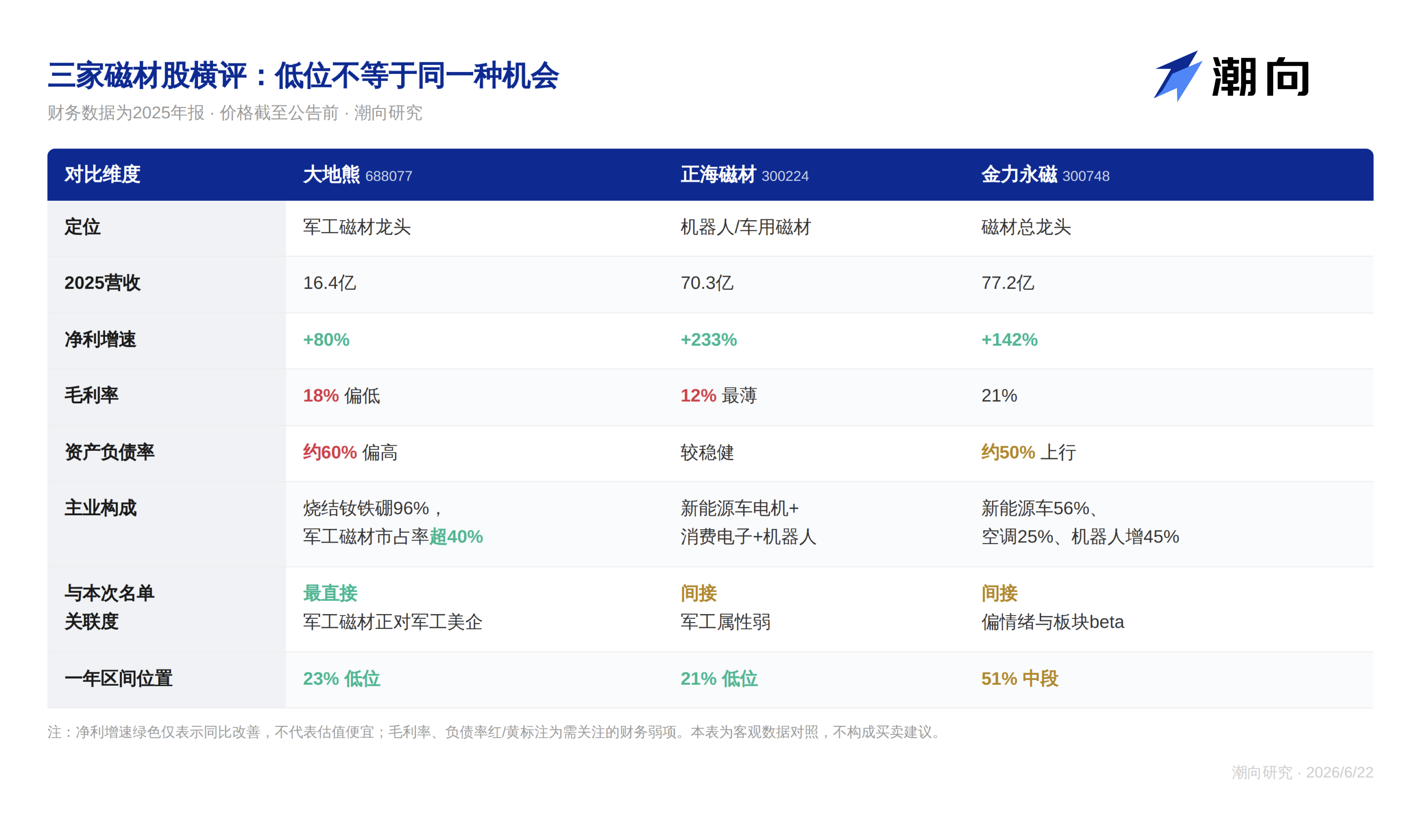
Among the three leading magnet companies, JL Mag, with 7.7 billion yuan in revenue and doubled net profit, has seen its stock price rise over 90% in 2025, already at a high position. However, Zhenghai Magnetic Material and Earth-Panda are still stuck near the lower end of their one-year price range, failing to keep pace with upstream gains.
There's an often-overlooked context here:
Since the second half of 2025, China has actually relaxed exports of magnetic materials to the US. For instance, JL Mag's US sales reached 500 million yuan for the year, a 40% increase; both Zhenghai and Earth-Panda also obtained export licenses to the US. China's addition of 10 new entities to the control list is a precise action within the framework of 'allowing ordinary commercial customers while specifically cutting off certain defense entities', not a comprehensive embargo.
Consequently, the impact on the financial statements of these magnet companies is limited.
The 10 restricted US companies were never part of their primary customer base. The real revenue for JL Mag and Zhenghai Magnetic Material comes from new energy vehicles and robot motors, with little connection to US defense exports.
This control measure is more of a sentiment boost for magnet stocks than a source of tangible orders. However, what I find genuinely noteworthy in the rare earth downstream is whether any business aligns closely with the defense theme of this list.
In this regard, Earth-Panda aligns better than the other two.
Earth-Panda has a smaller market cap, with 2025 revenue of 1.6 billion yuan and net profit of 57.4 million yuan, but it is a major domestic supplier of defense-grade magnetic materials. Public data shows it holds over 40% of this market share, with products used in equipment like aircraft engines and missiles. This directly corresponds to the defense and drone US companies named on the control list, forming the most direct narrative link between it and this event.
However, a strong narrative doesn't mean safety: its financials show a gross margin of only 18% and a debt ratio approaching 60%, making its profitability and financial safety cushion thinner than peers. Combined with its small market cap, its stock price can rise quickly but also fall sharply.
It's suitable for those who can tolerate volatility and value the 'purest theme play', but not for acting as a stable core holding.
Zhenghai Magnetic Material represents a different type. Its net profit more than doubled in 2025, indicating a stronger turnaround than Earth-Panda, but the driving force comes from humanoid robots and new energy vehicle motors, bearing little relation to this military list. Its low valuation is more about the humanoid robot story not being fully priced in by the market yet.
So, reading along the rare earth line, the upstream and downstream are in two different situations.
The upstream holds resources with the most tangible scarcity, but prices have already run up on the good news, now it's a high-level chase. The downstream magnet sector is still at lower valuations; Earth-Panda aligns better with the defense list, but at the cost of a small market cap and weaker finances. Zhenghai Magnetic Material is cheap, but its relevance is low.
Drones: The List Touches This Area, But No Direct Benefit
Red Cat Holdings and its subsidiary Teal Drones on the control list are US manufacturers of military reconnaissance and strike drones, exactly the kind of military drone suppliers the US wants to foster as alternatives to Chinese products.
The market might naturally think of the A-share military drone sector, but the bullish logic here might differ from that for rare earths. It won't generate direct orders for any specific Chinese drone company. Instead, it highlights the 'US-China confrontation over military drones,' prompting the market to reassess the strategic value and export competitiveness of domestic military drones.
Following this thread to find corresponding targets in A-shares, the most relevant in terms of business is AVIC (China) UAS.
AVIC (China) UAS is a leading manufacturer of large military drones in China, with its core product being the Wing Loong series of reconnaissance/strike drones. Drone systems account for over 90% of its main revenue, primarily exported through military trade, making it a mainstay of China's military drone exports.
In terms of business relevance, it is indeed in the same arena as the named US drone companies, making it the most directly related stock on this theme.
Its current price of 44 yuan is in the lower end of its one-year range, but this level results from a decline from its highs, not from an uninitiated upward move.
Its 2025 financial report shows that performance surged with a significant increase in military trade orders, with Q1-Q3 revenue growing over threefold year-on-year, pushing the stock price to 48 yuan. The current pullback likely reflects a cooldown after these gains materialized.
It's important to note that military trade revenue is highly dependent on single large orders. Revenue in 2024 fell 70% year-on-year, leading to a loss, before rebounding strongly in 2025. This 'boom or bust' characteristic means judging its value based on price position alone is unreliable; the real variable is the signing and delivery pace of subsequent military trade orders. Valuation-wise, the company's P/E ratio has been in the tens for a long time, so it doesn't constitute an undervalued play.
Export Restrictions Are Not Entirely Negative for Corresponding US Stocks
This is the biggest concern for holders of the relevant US stocks, and the answer might differ from intuition: not necessarily.
The most significant names on the export control list, MP Materials and USA Rare Earth, are central pillars of the US effort to reduce dependence on Chinese rare earths. MP is the only vertically integrated rare earth producer of scale in the US, having received an equity investment from the US Department of Defense in 2025, making it a clear beneficiary of national strategic support. This identity defines its dual-sided situation:
China cuts off its access to Chinese dual-use items, but due to supply chain security considerations, the US government might conversely grant it more orders and subsidies.
Prices before the announcement also support this assessment. MP, USA Rare Earth, and Red Cat Holdings were not trading at lows before the control news broke, suggesting the market did not pre-sell them as simple 'victims' of potential sanctions.
Of course, the ultimate outcome awaits the market's verdict. Since the announcement was made on Monday before the US market opened, and whether the sanctions are read as a material negative or offset by support expectations, the answer will only come from trading activity after the market opens.


