Ethereum 2026 Q1 Review: On-Chain Activity Hits Record Highs, Tokenized Assets Lead the Industry


- Core Insights: In Q1 2026, Ethereum’s on-chain usage scale (monthly active users, transaction volume, throughput) set new historical highs. However, the dollar-denominated asset scale and fees contracted simultaneously, presenting a divergence of "rising volume, falling prices." This stems from the reduction in transaction costs driven by proactive scaling (e.g., the Fusaka upgrade and Blob parameter optimization), coupled with the accelerated deployment of tokenized assets by institutions, solidifying Ethereum’s core status as the global financial settlement layer.
- Key Elements:
- On-chain usage scale hit new highs: 13.2 million monthly active users (+53.5% QoQ), 200.4 million transactions (+38% QoQ), and TPS of 25.78 (+41.2% QoQ), all setting records.
- Asset scale and revenue declined: Total value locked at $316.2 billion (-11% QoQ), ETH fully diluted market cap at $290 billion (-30.3% QoQ), total ecosystem fees at $2 billion (-16.9% QoQ), and mainnet fees at $39.9 million (-47.9% QoQ).
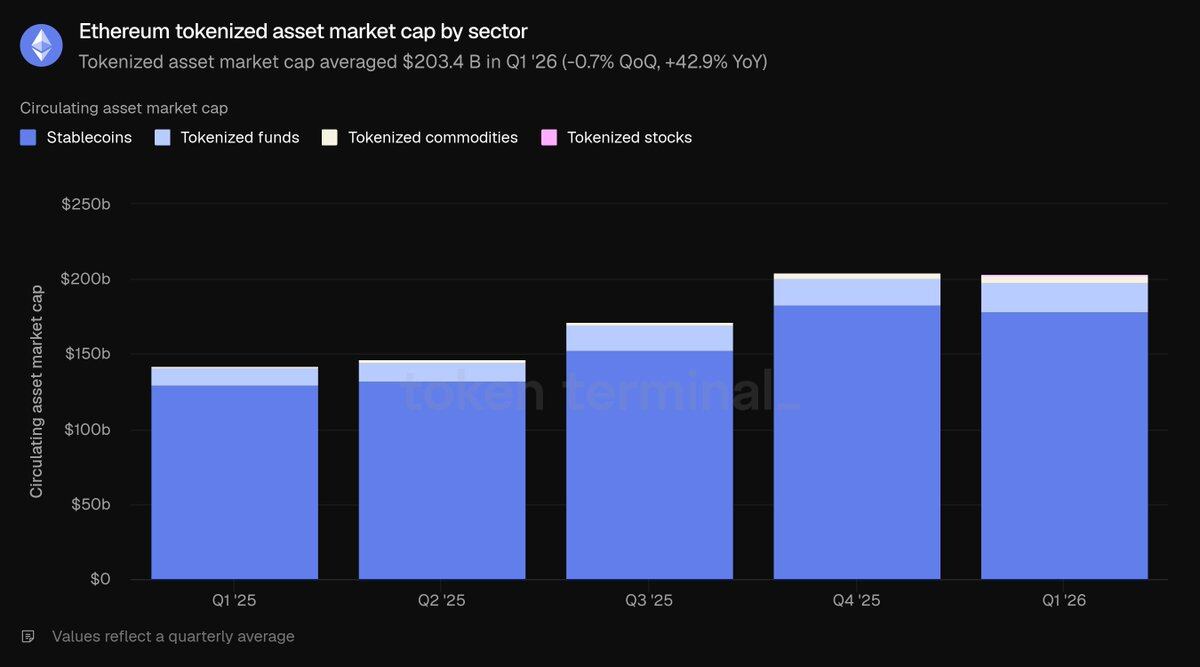
- Tokenized asset categories diverged: Stablecoins $178.9 billion (-2.3% QoQ), tokenized funds $19.4 billion (+4.9% QoQ), commodities $4.7 billion (+60% QoQ), and equities $365.1 million (+16.5% QoQ). Ethereum dominates all sub-sectors among the top five public chains.
- Scaling strategy drives cost reduction: Blob scaling increases block capacity, leading to a 38% increase in total transactions while fees shrink by nearly half, illustrating the Jevons paradox; the team anticipates long-term demand growth will offset short-term revenue losses.
- Institutional deployment accelerates: BlackRock, JPMorgan, Fidelity, and others issue on-chain funds; a consortium of 12 European banks prepares compliant euro stablecoin, positioning Ethereum as the preferred institutional settlement network.
- Staking and holder metrics remain healthy: ETH staking ratio rises to 0.31, and the number of unique holder addresses reaches 292.8 million (+8.1% QoQ), indicating long-term user confidence remains unshaken during market downturns.
- Ecosystem structure and advantages: Ethereum accounts for 71% of total value locked, 79.2% of lending, 61.8% of stablecoins, 73% of tokenized funds, and 84% of commodities among the top five public chains. Liquidity, composability, and institutional use cases create formidable barriers.
Original Author: Token Terminal
Original Translation: Saoirse, Foresight News
Ethereum serves as the core underlying settlement layer for on-chain assets, relying on ETH for transaction fees and staking to maintain network security. Traditional finance suffers from slow settlement, excessive intermediaries, and high counterparty risk, whereas tokenized assets and stablecoins offer on-chain solutions. With relevant regulations maturing between 2025 and 2026, conditions are ripe for institutions to formally deploy on-chain operations.
Various stablecoins, tokenized funds, commodities, and on-chain stocks are issued and settled on Ethereum. Layer 2 networks divert transactions but ultimately return to Layer 1 for final settlement, allowing ETH to continuously accumulate value. By market capitalization, Ethereum remains the world's largest platform for tokenized assets, operated by the Ethereum Foundation and developer community. Teams like Etherealize are specifically tasked with onboarding traditional financial institutions, driving institutional capital inflow. The Ethereum ecosystem showed a polarized trend in Q1 2026. The following is a detailed breakdown based on full data from Token Terminal.
Q1 2026 presented a starkly contrasting market landscape: on-chain usage hit all-time highs – monthly active users, total transactions, and throughput all broke records. However, USD-denominated asset sizes and fee metrics simultaneously contracted, with fully diluted market cap, total value locked, trading volume, and both categories of fees declining quarter-over-quarter. Key events this quarter profoundly shaped this unique market condition:
In January, within the second round of the Fusaka upgrade cycle, only the Blob Parameter Fork (BPO#2) was implemented, significantly enhancing data storage capacity.
In February, the ERC-8004 standard went live on the mainnet, becoming a universal standard for AI agent identity and credit ratings.
The Ethereum Foundation defined the three core goals of the 2026 protocol: scaling, improving user experience, and strengthening Layer 1 underlying security.
In March, the Institutional Ethereum Forum was held, with significantly increased participation from traditional financial institutions.
Q1 2026 Core Metrics Overview
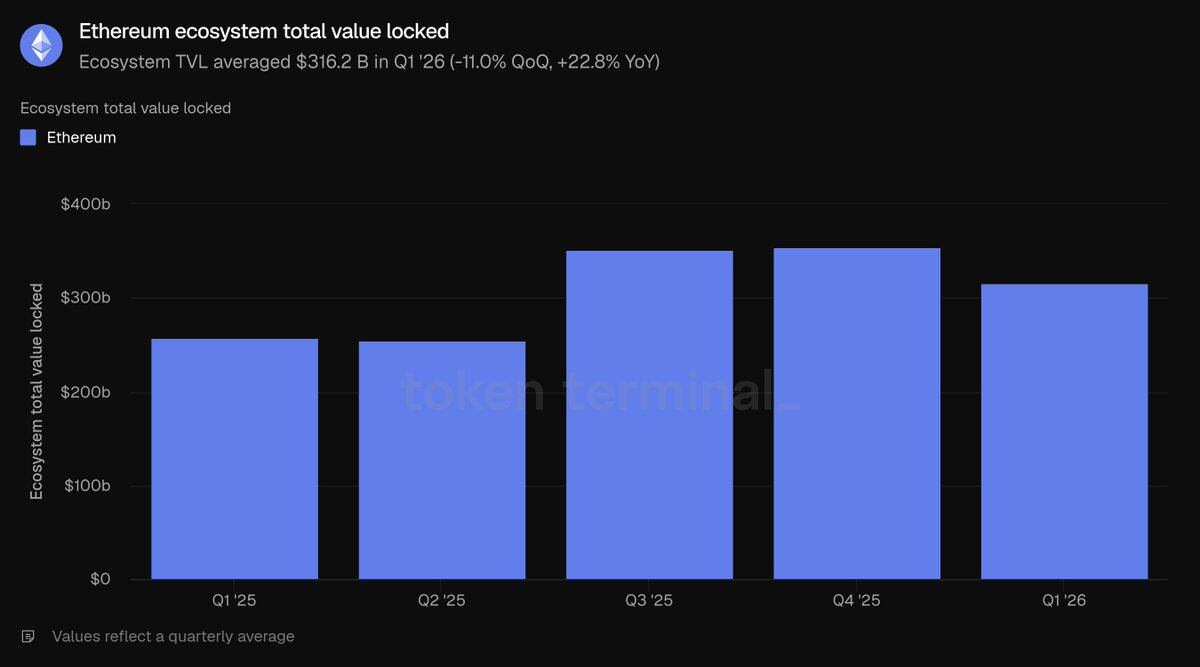
Ecosystem Total Value Locked (TVL): $316.2 billion (QoQ -11.0%, YoY +22.8%)
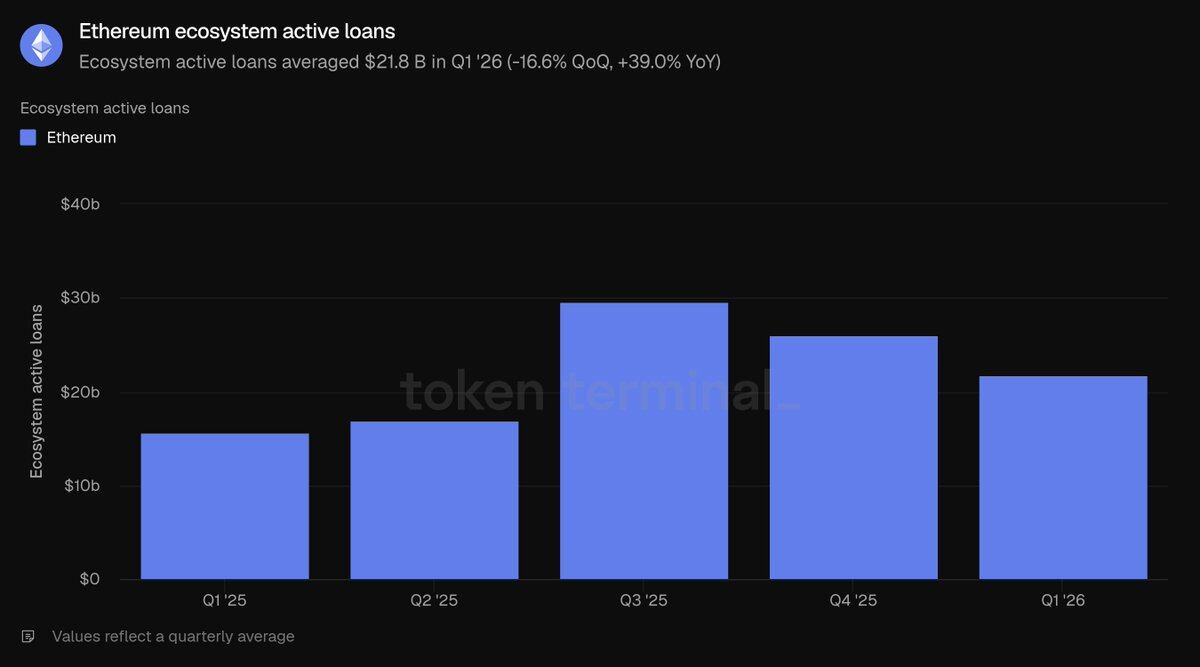
Ecosystem Outstanding Active Loans: $21.8 billion (QoQ -16.6%, YoY +39.0%)
Ecosystem Decentralized Exchange (DEX) Total Trading Volume: $134.5 billion (QoQ -24.0%, YoY -31.2%)
Ecosystem Total Application Fee Revenue: $2 billion (QoQ -16.9%, YoY -7.8%)
On-Chain Tokenized Asset Total Market Cap: $203.4 billion (QoQ -0.7%, YoY +42.9%)
Stablecoins: $178.9 billion (QoQ -2.3%, YoY +37.6%)
Tokenized Funds: $19.4 billion (QoQ +4.9%, YoY +73.1%)
Tokenized Commodities: $4.7 billion (QoQ +60.0%, YoY +325.9%)
Tokenized Stocks: $365.1 million (QoQ +16.5%)
Monthly Active User Addresses: 13.2 million (QoQ +53.5%, YoY +85.9%)
Layer 1 Total Transaction Count: 200.4 million (QoQ +38.0%, YoY +81.5%)
Average Transactions Per Second (TPS): 25.78 (QoQ +41.2%, YoY +81.7%)
Layer 1 Mainnet Total Transaction Fee Revenue: $39.9 million (QoQ -47.9%, YoY -81.9%)
ETH Fully Diluted Market Cap: $290 billion (QoQ -30.3%, YoY -9.9%)
ETH Staking Ratio: 0.31 (QoQ and YoY increase of 0.03)
Total ETH Holding Addresses: 292.8 million (QoQ +8.1%, YoY +24.9%)
Note: This report only covers the Ethereum Layer 1 mainnet. Layer 2 networks are treated as independent blockchains, and their data is not included in Ethereum's statistical scope.
Overall Ecosystem Development
Total Value Locked (TVL) refers to the total USD value of assets deposited into various on-chain applications and serves as a leading indicator for revenue-generating activities like lending, trading, and staking. Here, it measures the on-chain capital deposited by users across the entire Ethereum ecosystem that can be withdrawn at any time. In Q1 2026, the average TVL of the Ethereum ecosystem reached $316.2 billion, down 11.0% QoQ but up 22.8% YoY. The QoQ contraction is attributed to the overall price correction in crypto assets, while the significant YoY growth demonstrates substantial ecosystem expansion compared to the same period last year.
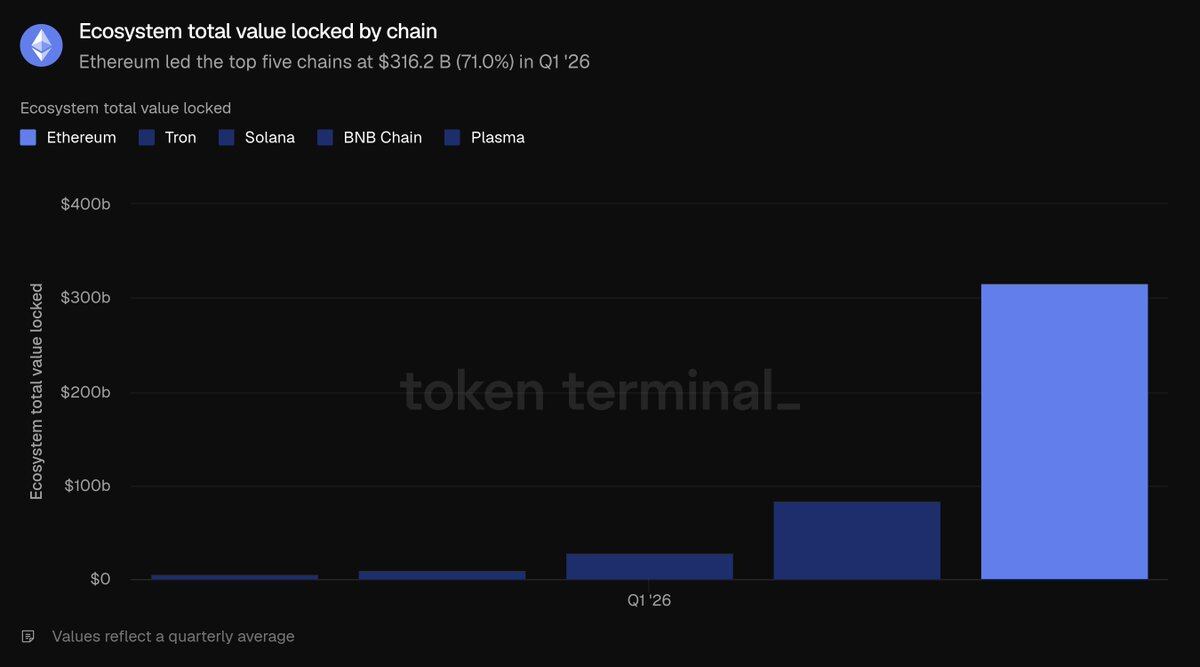
Among the top five major public chains, Ethereum's TVL holds a dominant lead: its $316.2 billion far surpasses the combined total of TRON ($84.5B), Solana ($28.8B), BNB Chain ($10.3B), and Plasma ($5.7B), accounting for 71% of the total TVL across these five chains. Capital is primarily concentrated in two major sectors: the liquid staking sector led by Lido and the lending sector centered on Aave. Restaking protocols like EigenLayer and ether.fi, along with synthetic dollar stablecoin platforms like Ethena and Sky, also hold significant capital. This high concentration of capital is Ethereum's most prominent structural advantage.
The active loans indicator represents the size of deposits lent out by users to generate interest income, directly reflecting lending business revenue. Here, it measures the total outstanding loan amount across all Ethereum lending applications. The average active loan size in Q1 was $21.8 billion, down 16.6% QoQ but up 39.0% YoY. The contraction in loan balance alongside TVL reflects a cooling of overall market risk appetite, though the scale remains significantly higher than last year.
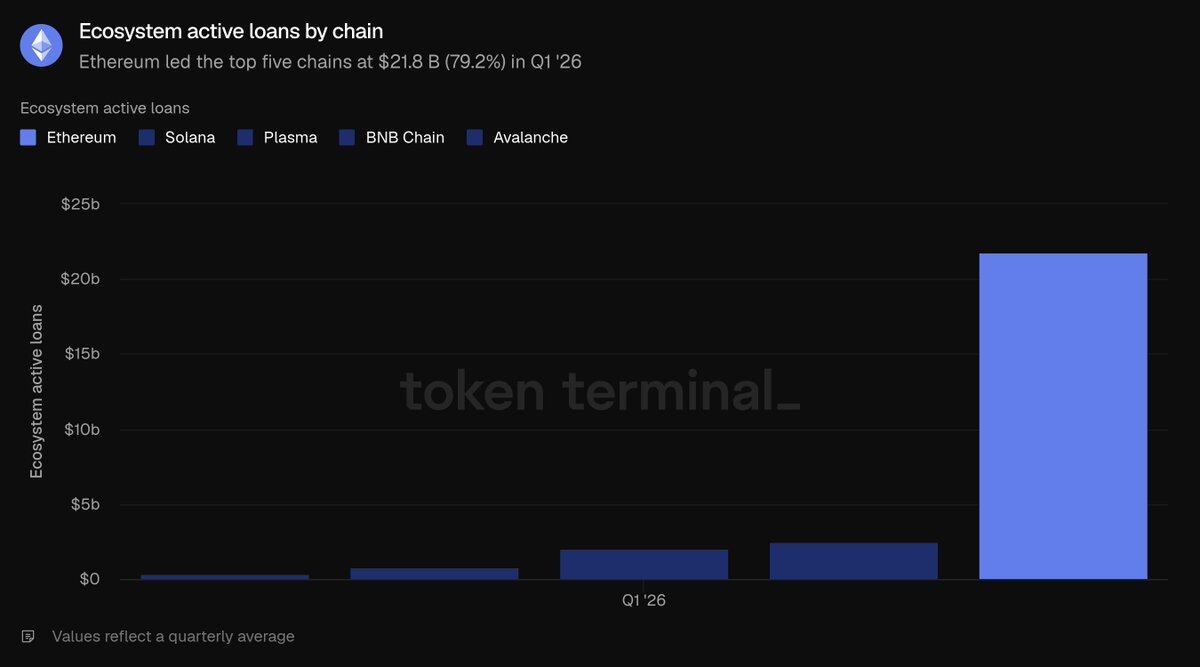
Ethereum's lending market is concentrated in a few major pools, with Aave dominating overwhelmingly: its active loan size at the end of the quarter was approximately $13.5 billion, accounting for the vast majority of the ecosystem. It is followed by Morpho (~$1.9B), Spark under Sky (~$1B), and Maple (~$0.84B). The QoQ contraction in lending was primarily driven by Aave, as the decline in crypto asset prices led to reduced lending demand, resulting in an approximate 24% drop in its total loan volume. Comparing across the top five public chains, Ethereum's $21.8 billion in active loans significantly leads Solana ($2.5B), Plasma ($2.1B), BNB Chain ($0.7608B), and Avalanche ($0.3924B), capturing 79.2% of the total lending volume among these five chains. This is the category where Ethereum holds its highest market share.
Decentralized Exchange (DEX) trading volume refers to the total value of transactions completed on-chain spot exchanges. Traders pay fees when trading, making volume highly correlated with platform revenue. This data aggregates DEX trading across the entire Ethereum ecosystem. Total ecosystem trading volume in Q1 was $134.5 billion, down 24% QoQ and 31.2% YoY. The decline in volume, exceeding the contraction in TVL, confirms a significant reduction in market risk appetite during this quarter's asset price downturn.
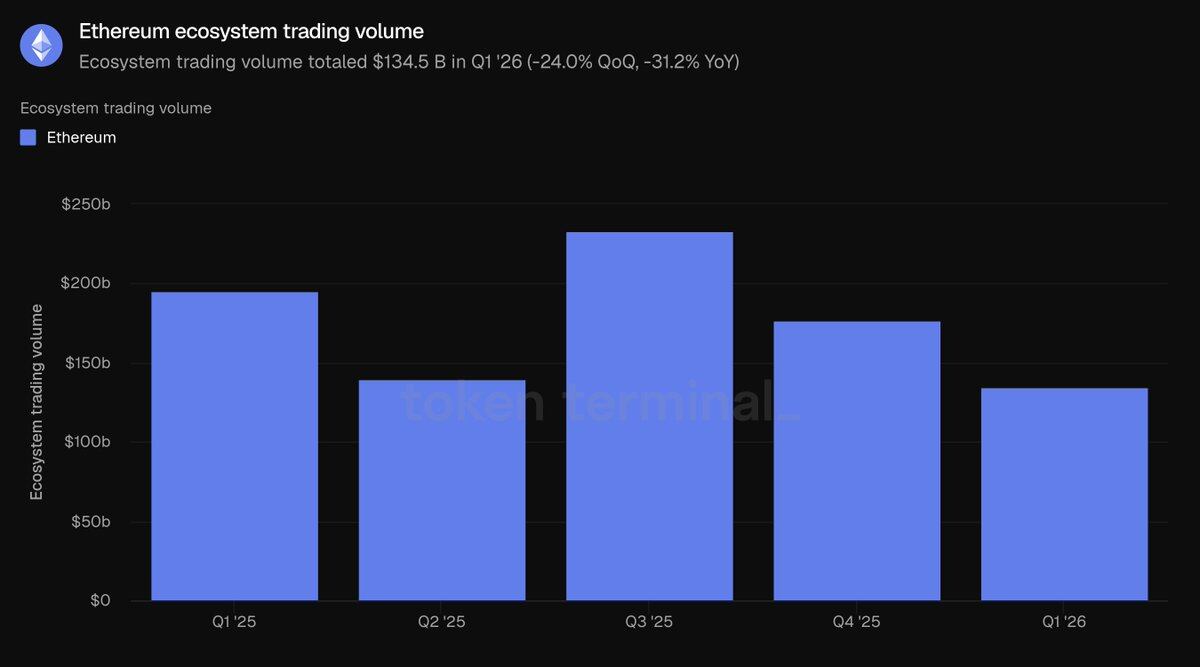
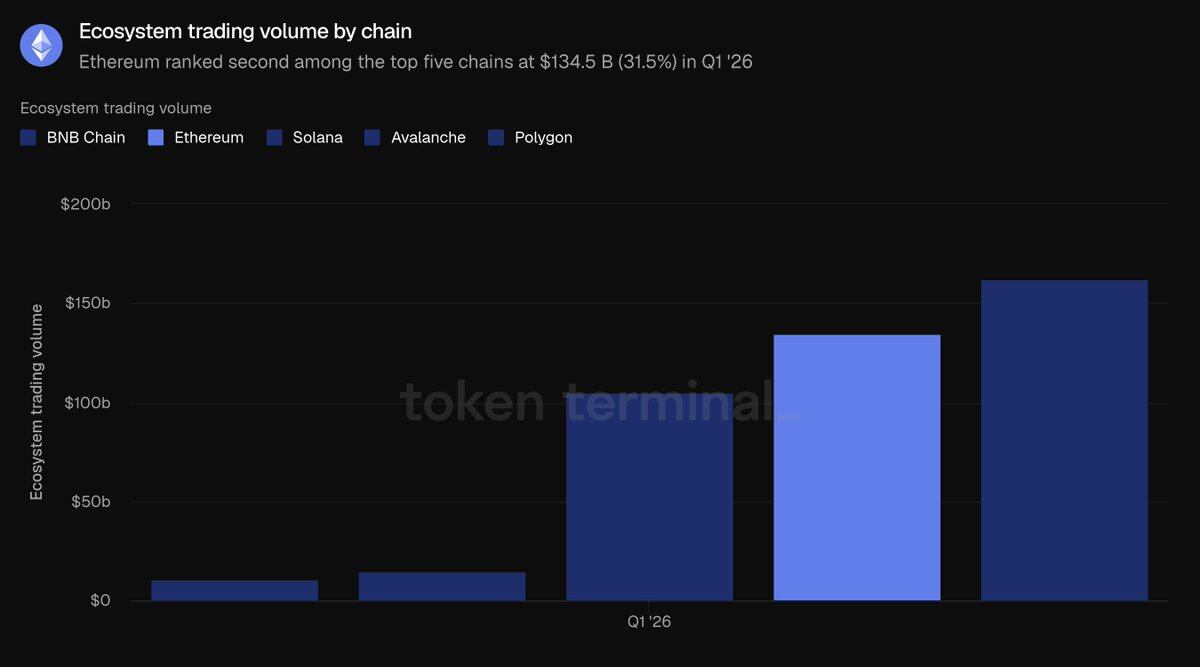
Ethereum DEX trading flow is highly concentrated on top platforms: Uniswap's Q1 trading volume was approximately $85.5 billion, accounting for two-thirds of the ecosystem total. It is followed by Curve (~$22.1B) and CoW Swap (~$12.4B). DEX trading volume is the only metric where Ethereum did not rank first among the top five public chains: BNB Chain's total volume of $162.5 billion exceeded Ethereum's $134.5 billion, with Solana close behind ($104.9B), while Avalanche ($14.5B) and Polygon ($10.7B) lagged. Ethereum's trading volume accounts for 31.5% of the total for the five chains, behind BNB Chain's 38%.
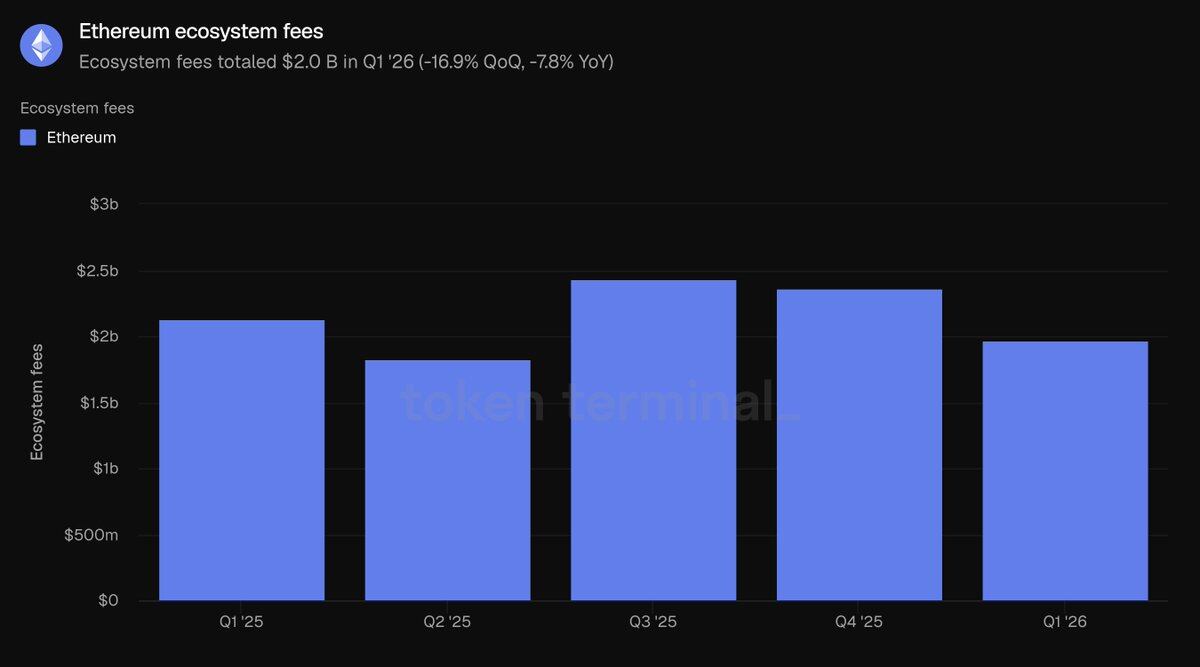
Ecosystem fees refer to all costs incurred by users when using various applications, including borrower interest and trader transaction fees. They directly represent the economic value generated by the ecosystem. Here, it sums the fees across all Ethereum applications. Total ecosystem fees in Q1 amounted to $2 billion, down 16.9% QoQ and 7.8% YoY, reflecting the concurrent decline in trading and lending activity.
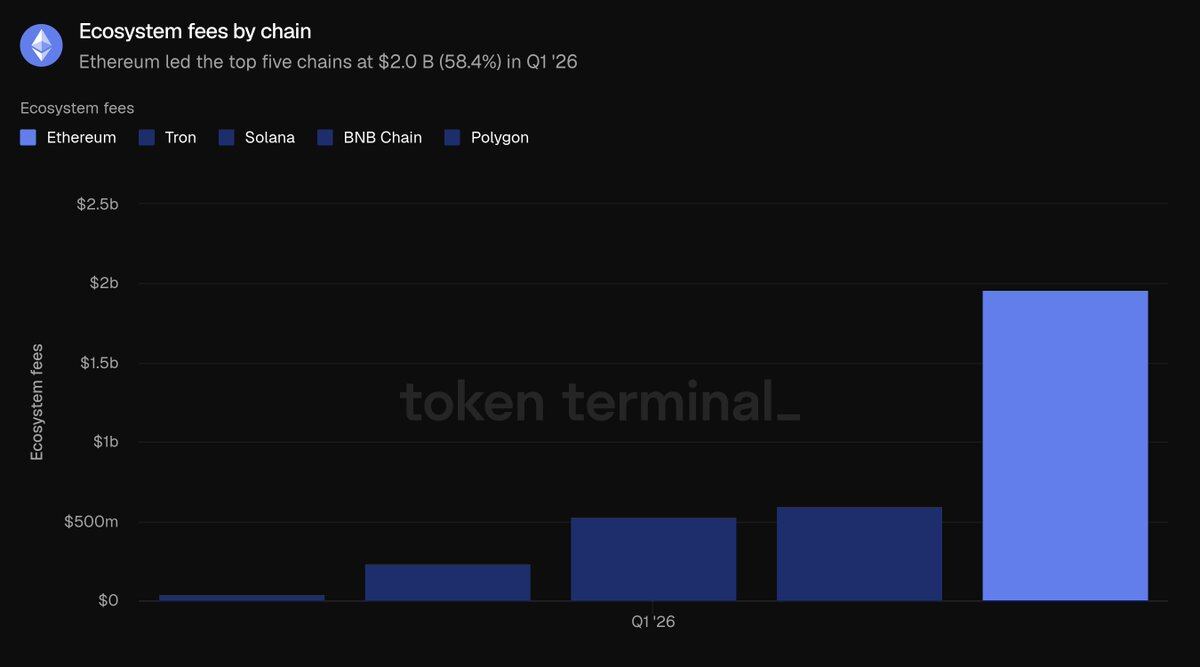
Ethereum's $2 billion in ecosystem fees significantly outpaces TRON ($599.3M), Solana ($532.5M), BNB Chain ($231.9M), and Polygon ($38.8M), capturing 58.4% of the total fees among the top five public chains. Even with this quarter's decline, Ethereum remains the primary source of application fees in the industry. Summarizing all metrics in this section: Ethereum leads the industry in TVL, lending scale, and ecosystem fees, falling short only to BNB Chain in DEX trading volume.
Tokenized Assets Section
Circulating Asset Market Cap refers to the total value of on-chain tokenized assets, calculated as the circulating supply multiplied by the closing price of the day. For stablecoins, it's the total circulating supply; for tokenized funds, it's the assets under management on-chain; for tokenized stocks, it's the total value of shares issued on-chain. This section only covers assets issued on Ethereum.
The average total market cap of tokenized assets on Ethereum in Q1 was $203.4 billion, roughly flat QoQ (down only 0.7%) but up significantly by 42.9% YoY. Stablecoins account for 87.9% of the total, with the remainder split between tokenized funds, commodities, and stocks.
Stablecoins
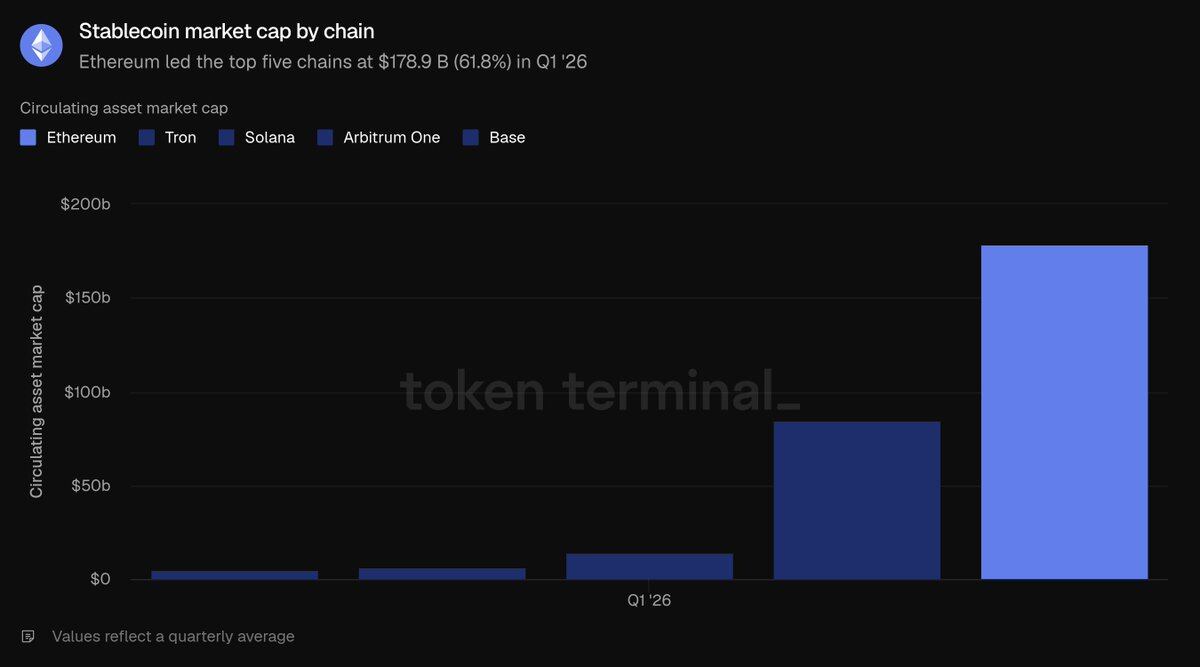
The average stablecoin market cap on Ethereum in Q1 was $178.9 billion, down slightly by 2.3% QoQ but up 37.6% YoY, making it the only tokenized sub-sector to contract QoQ. The market is dominated by two major issuers: at the end of the quarter, Tether's USDT ($94.1B) and Circle's USDC ($54.5B) together accounted for the vast majority of Ethereum's stablecoin market cap. Other notable products include Sky's USDS ($12.4B), Ethena's USDe ($5.9B), PayPal's PYUSD ($2.9B), and newly launched compliant stablecoins like Ripple's RLUSD ($1.1B). Comparing across the top five public chains, Ethereum's $178.9 billion stablecoin market cap leads TRON ($84.5B), Solana ($14.5B), Arbitrum One ($6.8B), and Base ($4.7B), capturing 61.8% of the total stablecoin market cap among these five chains.
Tokenized Funds
The average market cap of tokenized funds on Ethereum in Q1 was $19.4 billion, up 4.9% QoQ and surging 73.1% YoY. This sector is divided into two main types:
Yield-bearing on-chain dollar products (largest segment): Sky's sUSDS (~$6.4B), Ethena's sUSDe (~$3.5B).
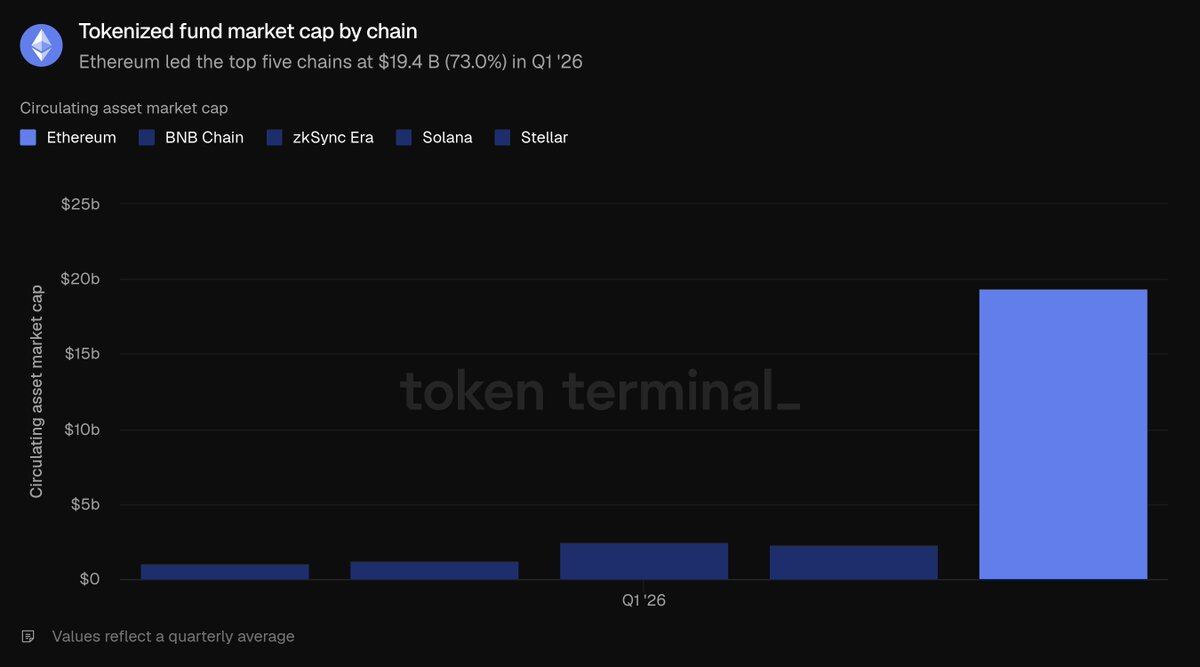
Traditional finance compliant funds (core narrative vehicle for institutional adoption): BlackRock's BUIDL (issued via Securitize, ~$1B), WisdomTree Government Money Market Fund (~$0.815B), Superstate's USTB (~$0.62B), followed by Ondo's OUSG (~$0.32B). Comparing across the five major public chains, Ethereum's $19.4 billion in tokenized funds significantly leads ZKsync Era ($2.5B), BNB Chain ($2.3B), Solana ($1.3B), and Stellar ($1.1B), capturing 73% of the total. This is the tokenized asset category where Ethereum holds its second-strongest advantage.
Tokenized Commodities
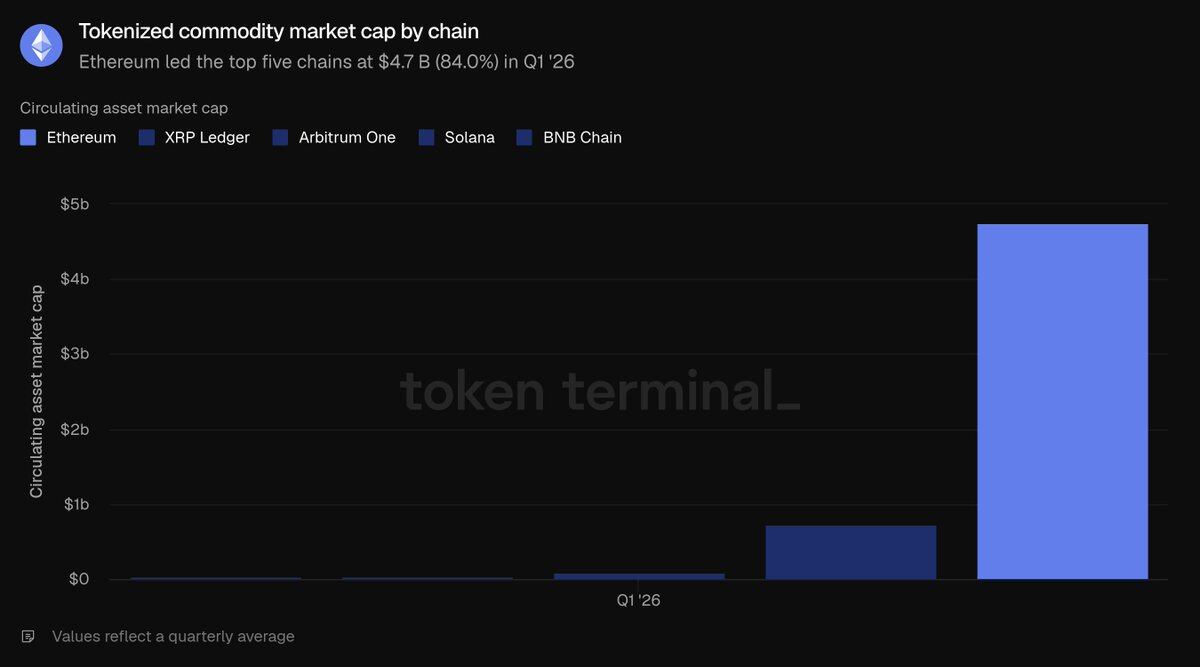
The average market cap of tokenized commodities on Ethereum in Q1 was $4.7 billion, up 60% QoQ and surging 325.9% YoY, making it the fastest-growing tokenized category. This sector consists almost entirely of on-chain gold: Tether Gold (XAUT, ~$2.6B) and Paxos Gold (PAXG, ~$2.4B) together account for the entire segment. Comparing across five related public chains, Ethereum's $4.7 billion scale vastly exceeds Ripple ($736.6M), Arbitrum One ($95.9M), BNB Chain ($38.4M), and Solana ($29.8M), capturing 84% of the total. This is the most dominant sub-sector for Ethereum.
Tokenized Stocks
Tokenized stocks are the smallest sub-category. In Q1, the average market cap on Ethereum was $365.1 million, with the scale being nearly negligible in the same period last year, representing a 16.5% QoQ increase. This sector is almost exclusively dominated by Ondo Finance, which issues on-chain assets tracking the S&P 500, Nasdaq 100 broad-based indices, and dozens of individual stocks, constituting the vast majority of Ethereum's tokenized stock market cap. Comparing across the five major public chains, Ethereum's $365.1 million slightly leads Solana ($249M), BNB Chain ($150.5M), Arbitrum One ($29M), and Stellar ($4.2M), but only accounts for 45.8% of the total tokenized stock market cap among these five chains. This is the only tokenized asset category where Ethereum does not hold an absolute majority share.
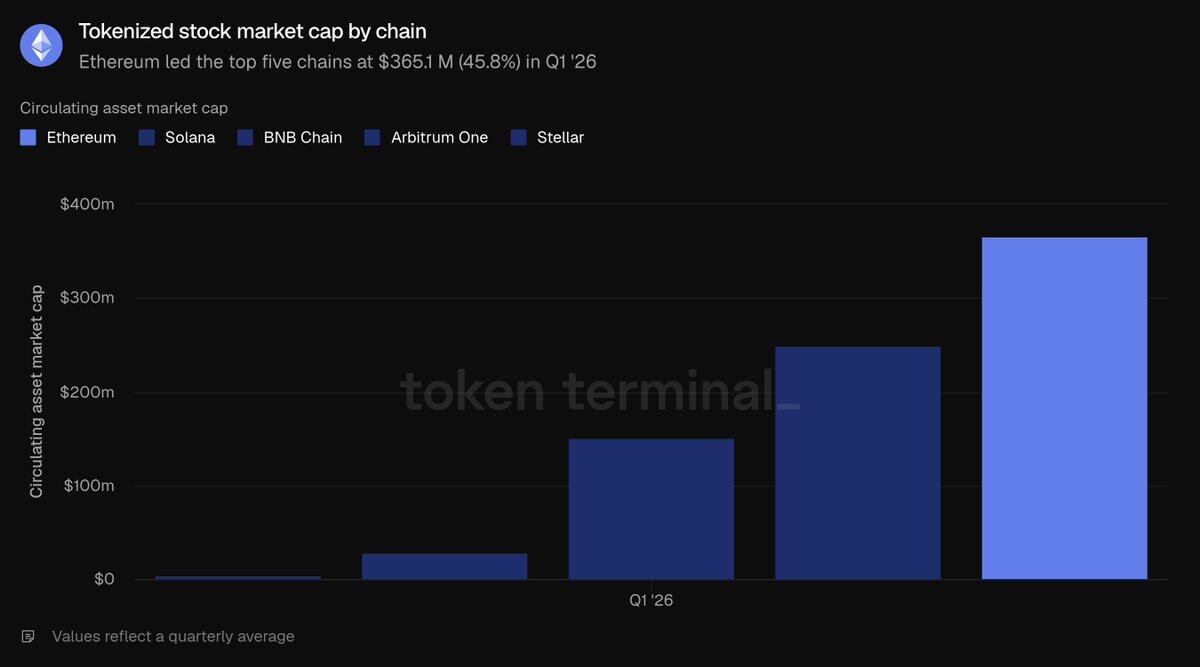
Summarizing the tokenized assets section: Stablecoin inventory slightly declined in Q1, but Ethereum's dominant positions in the tokenized fund and commodity sectors continued to consolidate.
On-Chain Usage Activity
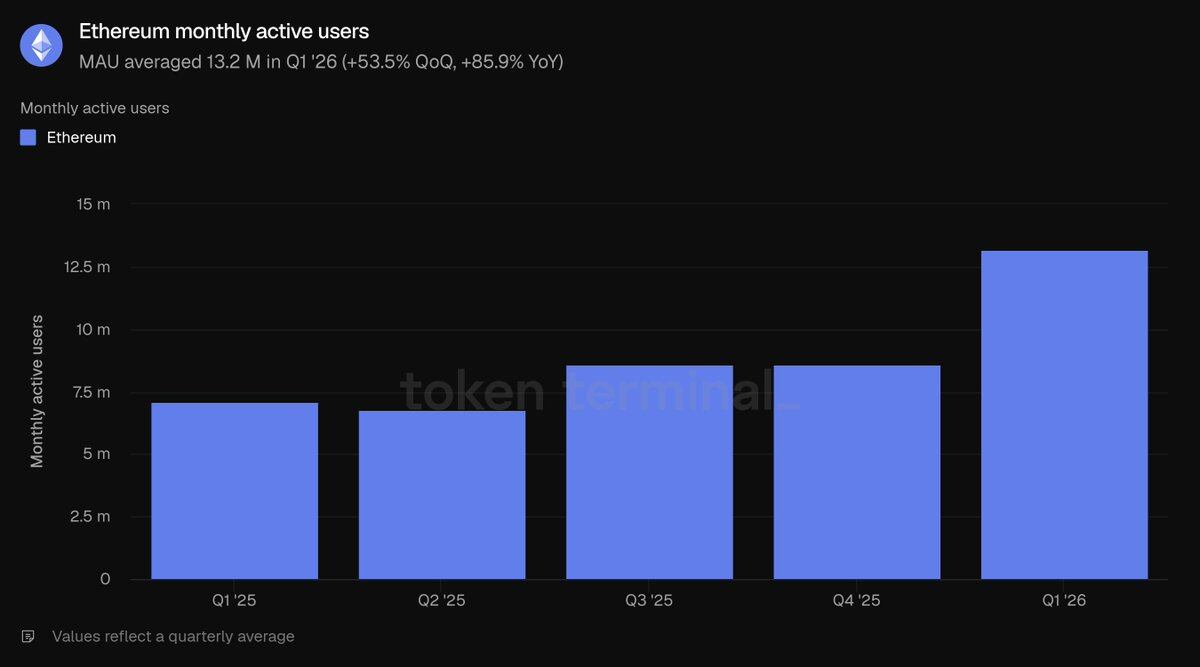
Monthly Active Users are defined as unique addresses that engage in revenue-generating on-chain transactions each month. This indicator only statistics addresses interacting with the Ethereum Layer 1 mainnet. The average monthly active users in Q1 reached 13.2 million, skyrocketing 53.5% QoQ and 85.9% YoY, setting a new all-time high. This breaks the trend of slow growth seen in previous quarters, with user growth rates accelerating significantly.
Total Transactions refer to the number of transactions written and confirmed on the blockchain, reflecting the intensity of user on-chain interaction. Transactions Per Second (TPS) is the average confirmation rate over the period, measuring the network's real-time carrying capacity. Both metrics only statistics the Ethereum Layer 1 mainnet. In Q1, Layer 1 total transactions were 200.4 million, up 38% QoQ and 81.5% YoY. The average TPS increased to