






The second front of the World Cup is in the prediction market.


- Key Takeaway: The first week of the 2026 World Cup drove prediction market sports trading volume to a historic high of $7.18 billion. Leading platforms Polymarket, Kalshi, and predict.fun benefited through different pathways (user mindshare, compliance dividends, ecosystem gateway), validating the immense potential of sports as a high-frequency trading scenario.
- Key Elements:
- Sports notional trading volume in prediction markets reached $7.18 billion in the first week of the World Cup, hitting an all-time high, with a weekly breakthrough of $10 billion within reach.
- Polymarket, leveraging its user mindshare and liquidity advantages, generated $1.18 million in 24-hour revenue, overtaking Hyperliquid; cumulative trading volume for World Cup events exceeded $1.7 billion.
- Kalshi benefited from the CFTC's positive regulatory signals regarding sports event contracts. Riding the compliance dividend, its sports trading volume surpassed $1 billion for two consecutive days, far exceeding Polymarket's $350 million during the same period.
- predict.fun, leveraging the Binance wallet entrance and a $2 million prize pool (the largest in scale) for superimposed incentives, reached 20,000 daily active users and over 180,000 daily trading transactions within three days of the World Cup kickoff.
- The three platforms pursued different paths but jointly proved one thing: the World Cup generates genuine trading demand, and the sports prediction market is entering a new phase of value validation.
Original: Odaily Planet Daily (@OdailyChina)
Author: Asher (@Asher_0210)

Since the start of the 2026 World Cup, prediction markets have quickly become the hottest topic in the crypto industry.
On one hand, the World Cup itself commands the largest global sports audience; on the other hand, prediction markets, which have developed rapidly over the past two years, have finally found their perfect stage. Match results, progression scenarios, championship winners, and Golden Boot contenders – almost every topic can be transformed into a tradable market.
This surge in interest is reflected in the data. During the first week of the World Cup, the notional trading volume for sports in prediction markets reached $7.18 billion, setting a new all-time high. It may only be a matter of time before weekly sports trading volume exceeds $10 billion. Among the platforms benefiting from this World Cup frenzy, Polymarket, Kalshi, and predict.fun have emerged as the three most closely watched prediction platforms.
Polymarket's Moat is Higher Than Imagined
The impact of the World Cup on Polymarket is most directly visible in its revenue. According to DefiLlama data, Polymarket's 24-hour revenue yesterday reached $1.18 million, surpassing Hyperliquid's $814,900.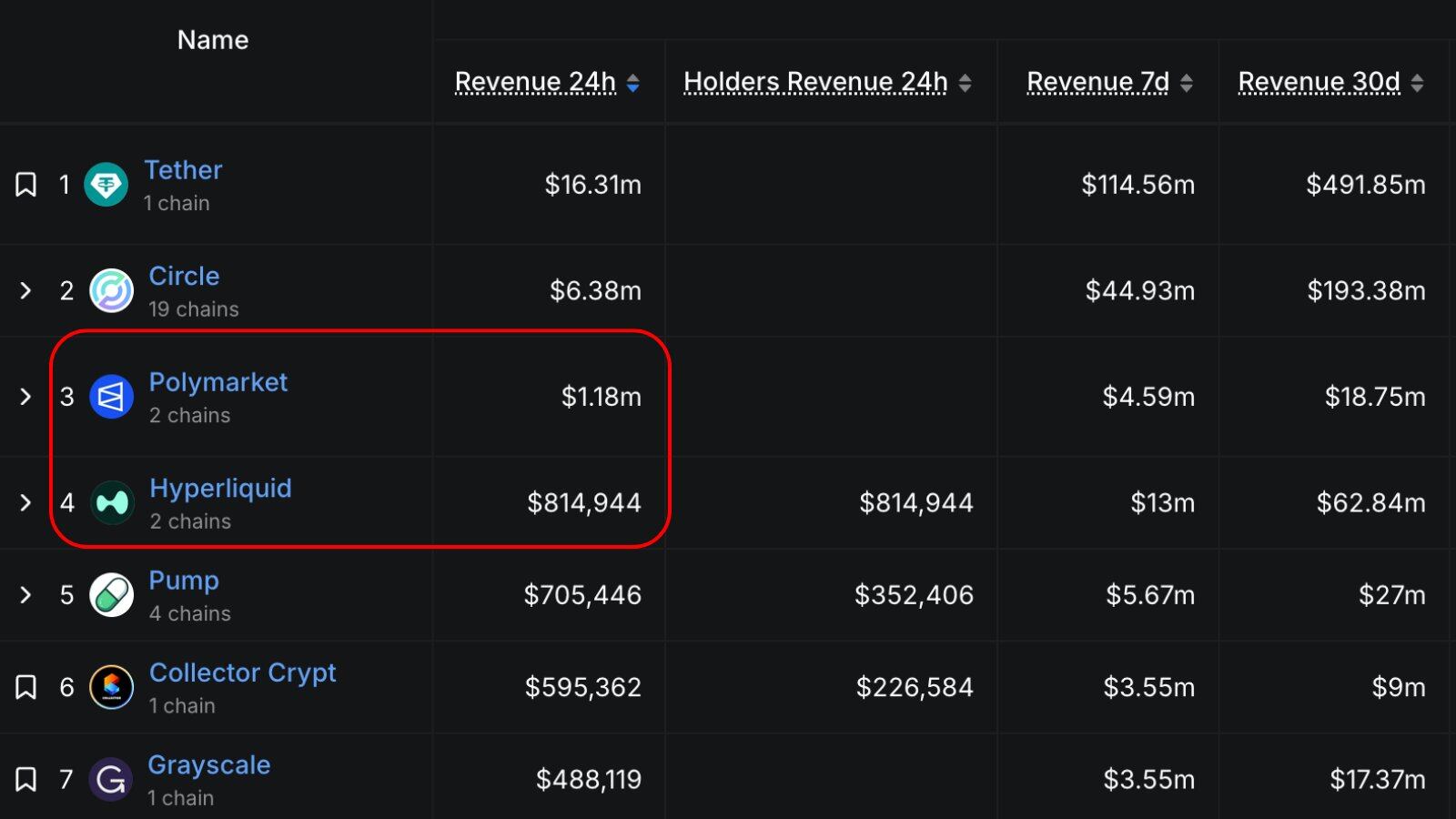
Polymarket's 24-hour revenue overtakes Hyperliquid
Polymarket hasn't relied on "throwing money" to attract users to participate in World Cup predictions. During the World Cup, the platform only launched a $1 million liquidity reward program, focusing on improving market depth rather than directly stimulating user trading with massive prize pools.
In terms of market depth, since the World Cup kicked off, the cumulative trading volume for World Cup-related events on Polymarket has exceeded $1.7 billion, with over $63 million traded in the past 24 hours. Additionally, Polymarket has been expanding its sports partnerships around the World Cup, connecting with football-related channels and events like OneFootball and Liga MX, further embedding prediction markets into fan content scenarios.
This also shows that Polymarket's moat may be higher than external estimates. When a global event like the World Cup arrives, the first reaction of on-chain users looking to participate in related predictions is to go to Polymarket. Polymarket's advantage isn't just "having the odds"; it's that it has become the default choice for on-chain users participating in predictions for all types of events.
Kalshi Benefits from Both Compliance and Sports Momentum
If Polymarket is more like the first stop for on-chain users to participate in World Cup predictions, then Kalshi's advantage comes from the expansion of sports trading within the US regulatory framework.
Just before the World Cup, the CFTC issued clearer regulatory signals regarding event contracts. Based on the proposal content, the CFTC's signals leaned positive – most prediction events centered on the overall outcomes of sports matches are still likely to have a clear compliance path. The CFTC preliminarily believes that markets focused on overall match results, such as win/loss, score, point spread, progression outcomes, overall team or player statistics, and season performance, are still likely to be considered event contracts with price discovery functions and information value. What is more likely to draw regulatory attention are markets concerning player injuries, referee decisions, or single actions, which are more susceptible to manipulation, insider trading, or incentive distortions.
This is very critical for Kalshi. Kalshi is itself a platform under CFTC regulation, and sports are one of its most important sources of trading volume. An analysis by Pew Research shows that since July 2024, sports trading has accounted for approximately 80% of Kalshi's total volume. This means that as long as sports prediction markets gain clearer space within the regulatory framework, Kalshi will be one of the most direct beneficiaries.
The data from this World Cup confirms this. As the tournament began, Kalshi's sports trading volume increased significantly, reaching a single-day notional sports trading volume of $1.09 billion, exceeding $1 billion for two consecutive days. In comparison, Polymarket's single-day notional sports trading volume during the same period was $350 million. This means that during the World Cup, the peak window for sports trading, Kalshi's daily volume has already shown a significant gap.
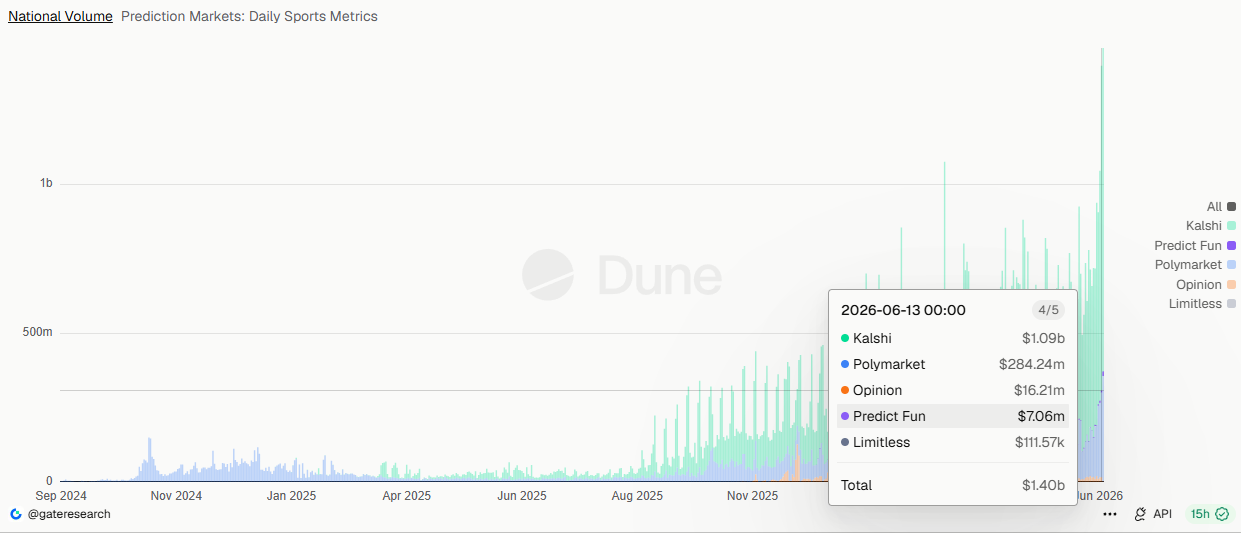
Kalshi's sports trading volume exceeds $1 billion for two consecutive days
So, Kalshi is not just benefiting from the World Cup; it's also benefiting from the compliance dividend. The World Cup thrust sports prediction markets into the spotlight, while the CFTC's regulatory discussions provide Kalshi with a clearer narrative space. While Polymarket represents the mindset of on-chain prediction markets, Kalshi is proving that compliant sports prediction markets can also achieve very high trading intensity.
predict.fun's Variable: The Binance Gateway
Different from Polymarket and Kalshi, predict.fun's main highlights this World Cup are two-fold: first, its frequent integration with the Binance ecosystem; second, its use of the highest World Cup cash prize pool among current prediction market platforms to amplify event excitement.
During the World Cup, predict.fun launched the "Predict Cup" 2026 World Cup prediction campaign, with a total prize pool of $2 million, the highest dedicated World Cup reward among leading prediction market platforms. Compared to Polymarket and Kalshi, each with $1 million campaigns, predict.fun has clearly increased the incentive intensity this time.
Looking at the campaign design, predict.fun isn't just offering a single championship prediction; instead, it has turned the World Cup into a 39-day points competition. The campaign covers 48 teams and 104 matches. Users can select up to 5 supported teams and earn Fan Points by participating in markets like match results, scores, and goals, then compete for rewards based on periodic leaderboards.
Rewards are spread throughout the tournament. Each group stage group has a $70,000 prize pool, and various stages of the knockout round also offer their own rewards, with the final match prize pool reaching $260,000. This means users aren't just betting on one outcome; they can continuously participate around their supported teams.
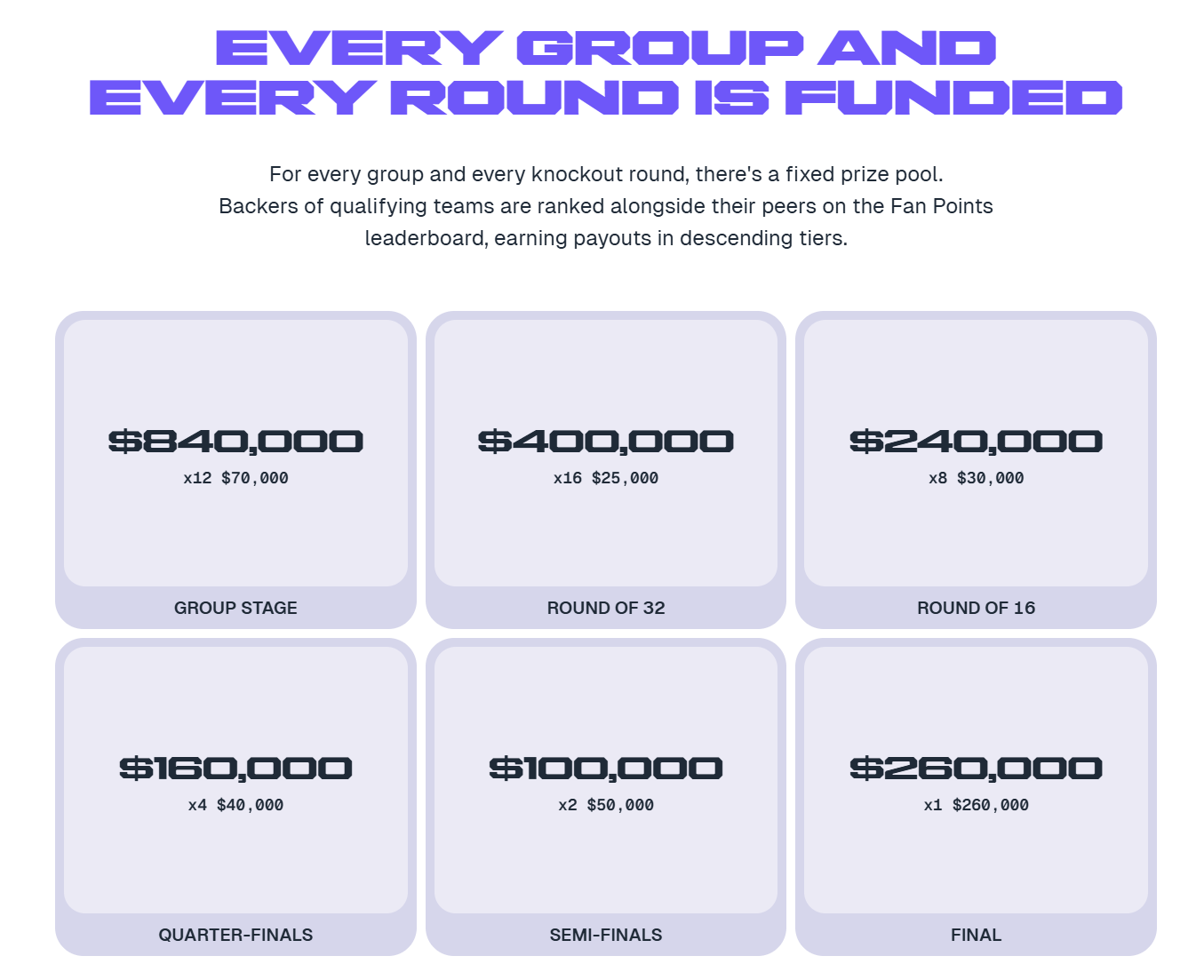
predict.fun launches the 2026 World Cup prediction campaign with a total prize pool of $2 million
More importantly, this campaign has been placed within the Binance gateway.
According to an official announcement, Binance Wallet now supports users participating in the $2 million PREDICT CUP campaign, provided and operated by predict.fun, through the Binance app interface. Users can select supported teams within the Binance app, participate in related prediction markets, earn Fan Points by following the rules, and improve their team's ranking. Additionally, eligible users who participate in relevant markets through the Binance Prediction Market during the campaign period and complete effective locks have the chance to share an extra 3 million Predict Points rewards.
The World Cup provides the event excitement, Binance provides the gateway traffic, and the $2 million prize pool plus 3 million points rewards lower the barrier for new users to try (Binance Wallet also has a separate $300,000 trading competition). The combination of these three factors gave predict.fun an exposure gateway closer to an exchange level within just a few days of the World Cup. Just three days into the World Cup, predict.fun had 20,000 daily active users and over 180,000 daily transactions.
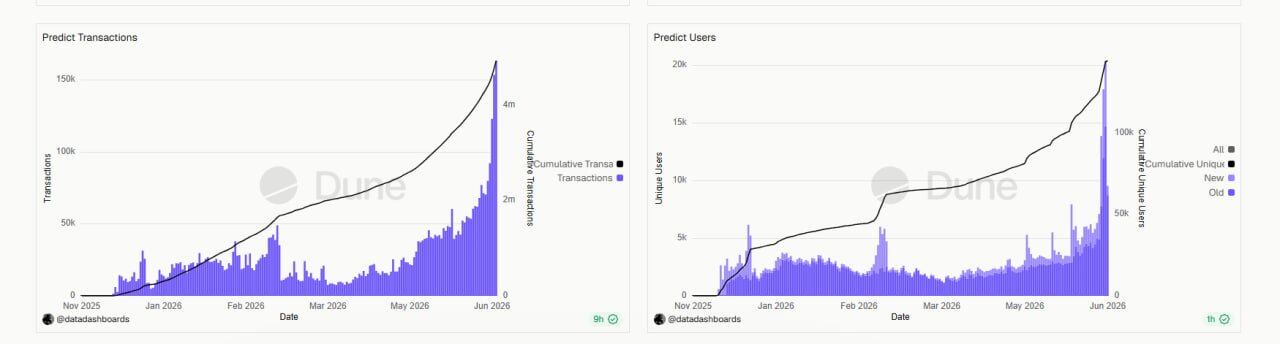
predict.fun Daily Active Users and Daily Transactions
As World Cup Traffic Floods In, Prediction Markets Enter a New Phase
In less than a week since the World Cup kicked off, prediction markets have already delivered results exceeding expectations. Whether it's trading volume, platform revenue, or user engagement, all metrics are constantly breaking records.
Polymarket has proven the user mindshare and liquidity advantages of a top-tier platform through the World Cup; Kalshi has leveraged clearer regulatory expectations to push compliant sports prediction markets to a new scale; and predict.fun has achieved far greater exposure and user growth than usual through the Binance ecosystem gateway and high incentives.
Although their paths differ, all three platforms are illustrating the same point – the World Cup brings not just traffic, but real trading demand. For prediction markets, sports have always been the most understandable, accessible, and easily high-frequency trading scenarios. The World Cup, as one of the highest-attention global sports events, is amplifying this demand to an unprecedented scale.
As of now, most teams have only completed one group stage match. As the qualification scenarios become clearer and the knockout rounds approach, the importance of matches, market sentiment, and capital attention will all continue to increase. Whether it's trading volume, user numbers, or market heat, prediction markets have the potential to keep breaking records in the coming weeks.
For prediction markets, the World Cup brings not just a traffic surge, but an opportunity to prove their own value. And based on the current data, this validation is just beginning.


