







Khi Nvidia trên Bitget bắt đầu chia cổ tức, thị trường chứng khoán Mỹ bước vào thời khắc 'Reality'


- Quan điểm cốt lõi: Mảng chứng khoán Mỹ dạng token hóa đang phát triển từ 'token bóng tối không có tài sản thực hỗ trợ' thành các sản phẩm tài chính có lưu ký thực, quyền lợi đầy đủ và khả năng kết hợp đa tài sản. Bằng cách tự xây dựng nền tảng Reality, Bitget đã hiện thực hóa các chức năng như lưu ký cổ phiếu thực 1:1, chi trả cổ tức và sử dụng làm tài sản ký quỹ, với tham vọng xây dựng một 'sàn giao dịch toàn diện' bao gồm tiền mã hóa, cổ phiếu Mỹ, vàng, ngoại hối, v.v.
- Các yếu tố then chốt:
- Thị phần hợp đồng vĩnh viễn cổ phiếu của Bitget đạt 22,61% (đứng thứ hai toàn cầu), khối lượng giao dịch chứng khoán token hóa của họ chiếm khoảng 89% nền tảng Ondo, tổng khối lượng giao dịch hợp đồng tương lai cổ phiếu đã vượt quá 10 tỷ USD.
- Nền tảng Reality tự xây dựng của họ, thông qua công ty môi giới được cấp phép Alpaca, thực hiện lưu ký cổ phiếu thực 1:1, được kiểm toán độc lập bởi The Network Firm, và công bố minh bạch dự trữ theo thời gian thực qua bảng điều khiển trên chuỗi, đảm bảo tính xác thực của tài sản.
- rToken (ví dụ: rNVDA) đã có quyền hưởng cổ tức, cổ tức được chi trả bằng USDT hoặc token; đồng thời có thể được kết nối vào tài khoản hợp nhất của Bitget, sử dụng làm tài sản ký quỹ cho giao dịch đa tài sản (ví dụ: dùng cổ phiếu Nvidia để mở hợp đồng BTC).
- Bitget ra mắt sản phẩm IPO Prime, cho phép người dùng mua cổ phần của các công ty chưa niêm yết (như SpaceX, OpenAI) thông qua cấu trúc SPV, hai đợt đã thu hút gần 300 triệu USD đăng ký mua, với gần 20.000 người tham gia.
- Nền tảng đã niêm yết các sản phẩm CFD bao gồm 79 loại (ngoại hối, vàng, v.v.), khối lượng giao dịch hàng ngày đạt đỉnh vượt 8 tỷ USD, chủng loại tài sản vượt xa phạm vi của các sàn giao dịch tiền mã hóa truyền thống.
Tác giả: David, Triều Hướng Nghiên Cứu
Tokenized stocks are one of the fastest-growing sectors in the crypto industry over the past two years, and also one of the most criticized.
What's the criticism? That they are empty shells.
For example, you spend 100 USDT to buy a token called NVDA, thinking you own a small piece of Nvidia stock. In reality, you likely only get a shadow that tracks the stock price. With no real stock underlying, no dividends, and none of the rights that come with owning actual stock.
But this very criticized sector has become an inevitable trend for the crypto industry in this current cycle.
And among it, one exchange has produced a set of numbers that are hard to ignore.
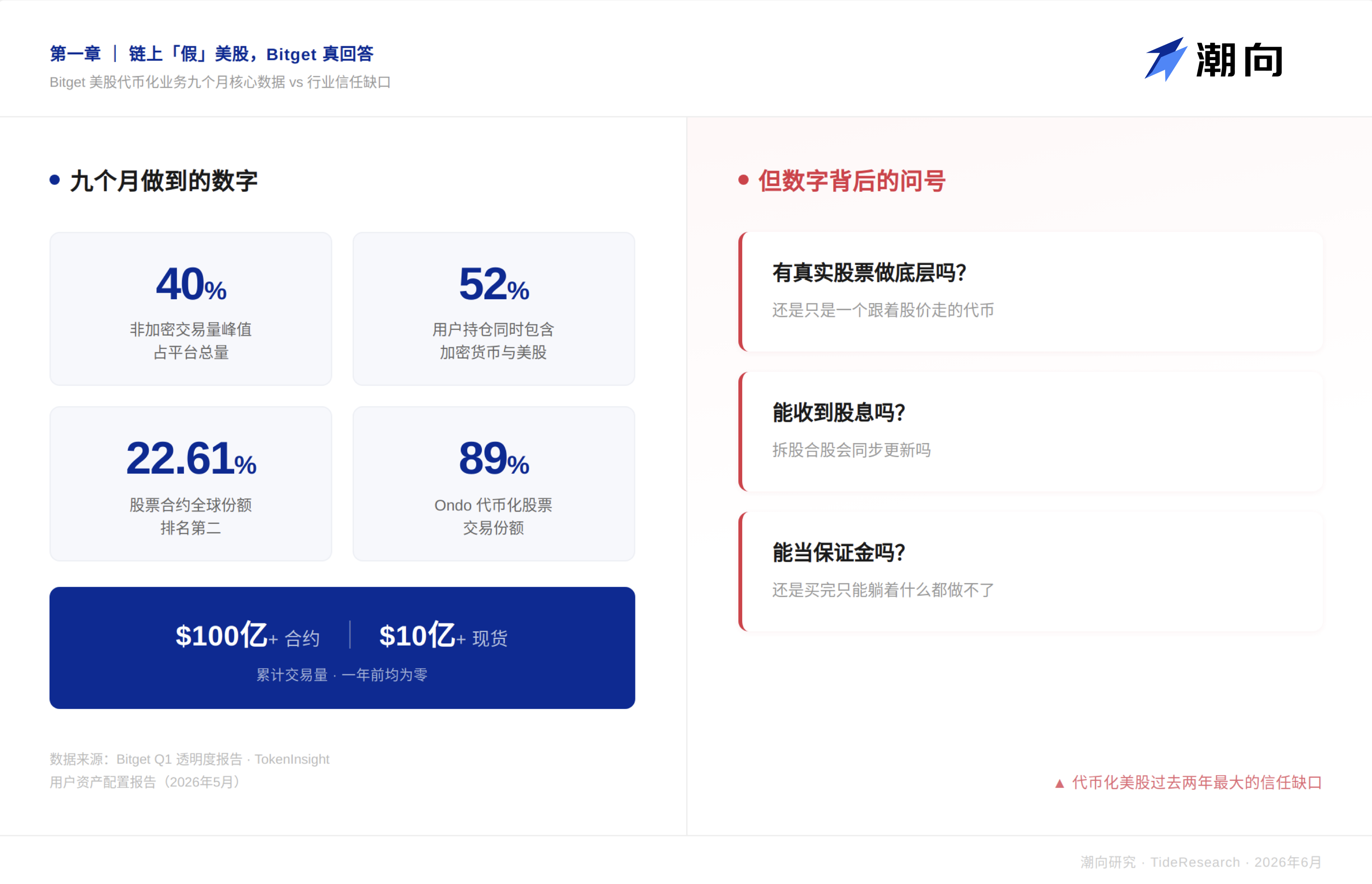
According to Bitget's 2026 Q1 Transparency Report, the peak trading volume of non-crypto assets now accounts for 40% of the platform's total. Stocks, gold, forex – things that should be found in a brokerage app – a significant portion of their trading now occurs on a crypto exchange.
TokenInsight's Q1 derivatives market report provides another data point: Bitget's stock perpetual swaps rank second globally, with a market share of 22.61%.
Furthermore, among the tokenized stocks issued by Ondo, Bitget alone consumes approximately 89% of the trading volume. The cumulative trading volume of stock futures has exceeded 10 billion USD, and spot trading has surpassed 1 billion USD.
Let's look at the user side.
According to a user asset allocation report released by Bitget in May this year, 52% of users already hold both cryptocurrencies and US stocks in their portfolios. Half of the users no longer just buy coins; their accounts now house assets from two different worlds.
And all these numbers were zero just a year ago.
The numbers are certainly impressive, and the demand is real. But from our perspective, a sharper question lies behind the numbers:
These on-chain US stocks – what exactly are you buying? Or are you spending real money only to buy a sophisticated price shadow?
It took Bitget nine months to answer this question.
Stones from Other Hills, to Polish the Jade of US Stocks
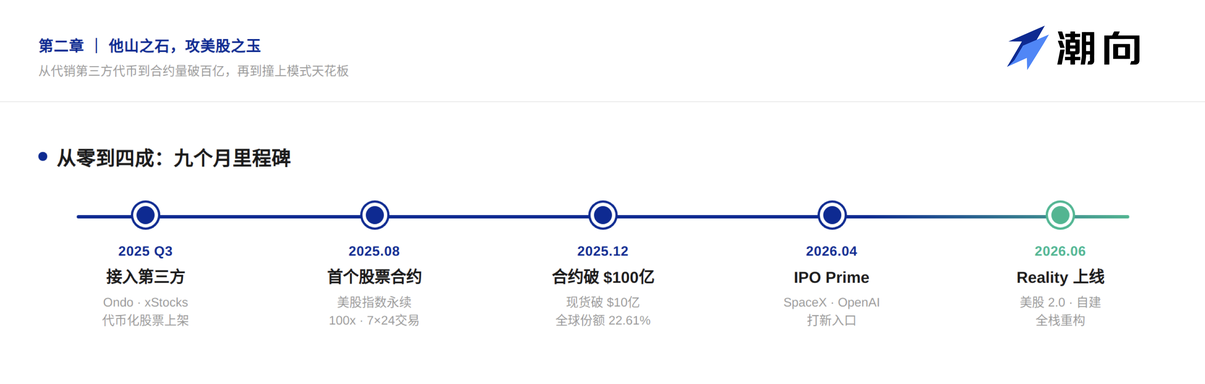
In Q3 of last year, Bitget began listing US stocks, adopting a "stones from other hills" approach.
Ondo, xStocks – tokenized stocks issued by third parties – Bitget handled the listing and trading matching. During the same period, they also launched the industry's first US stock index perpetual swap, offering up to 100x leverage and 24/7 trading.
This model ran for a few months. By the end of December last year, the contract volume had reached 10 billion USD, a quite substantial scale. The demand was undisputed; users indeed wanted to trade US stocks on a crypto exchange. However, the product itself had problems.
"Stones from other hills can polish jade," but if the stone itself is too coarse, you still cannot create a smooth experience. As volume grew, problems emerged.
For instance, you search for Nvidia, buy 100 USDT of the on-chain NVDA token, and the price does follow the Nasdaq. Then what?
First, the user experience: the liquidity is at a DEX level; even moderately sized orders have noticeable slippage. Second, regarding shareholder rights: if Nvidia pays dividends each quarter, you won't receive a cent. When a stock split occurs, your holdings might take days to update.
Essentially, for on-chain US stocks, you mostly buy a price and get nothing else.
These three problems aren't exclusive to Bitget; they are common issues across the entire tokenized stock sector. Third-party issuers control the underlying assets and product logic. The exchange is merely a shelf displaying goods; it has no control over liquidity, dividends, or asset usability.
The ceiling of the distribution model is the ceiling of the third-party products.
Faced with this, Bitget and other exchanges had two paths. One was to keep patching up the existing infrastructure of others. The other was to build their own ship. It chose the heavier path.
Self-Refinement: When Stocks on Bitget Start Paying Dividends
Recently, Nvidia announced it would raise its quarterly dividend from $0.01 to $0.25 per share, with the next payment date on June 26. If you hold rNVDA on Bitget, your account might see an additional cash dividend converted into USDT, and your cost basis will be automatically updated.
In the on-chain stock sector, this is arguably the first instance of "real equity." This corresponding right exists because the underlying layer of on-chain stocks has undergone a new evolution on Bitget.
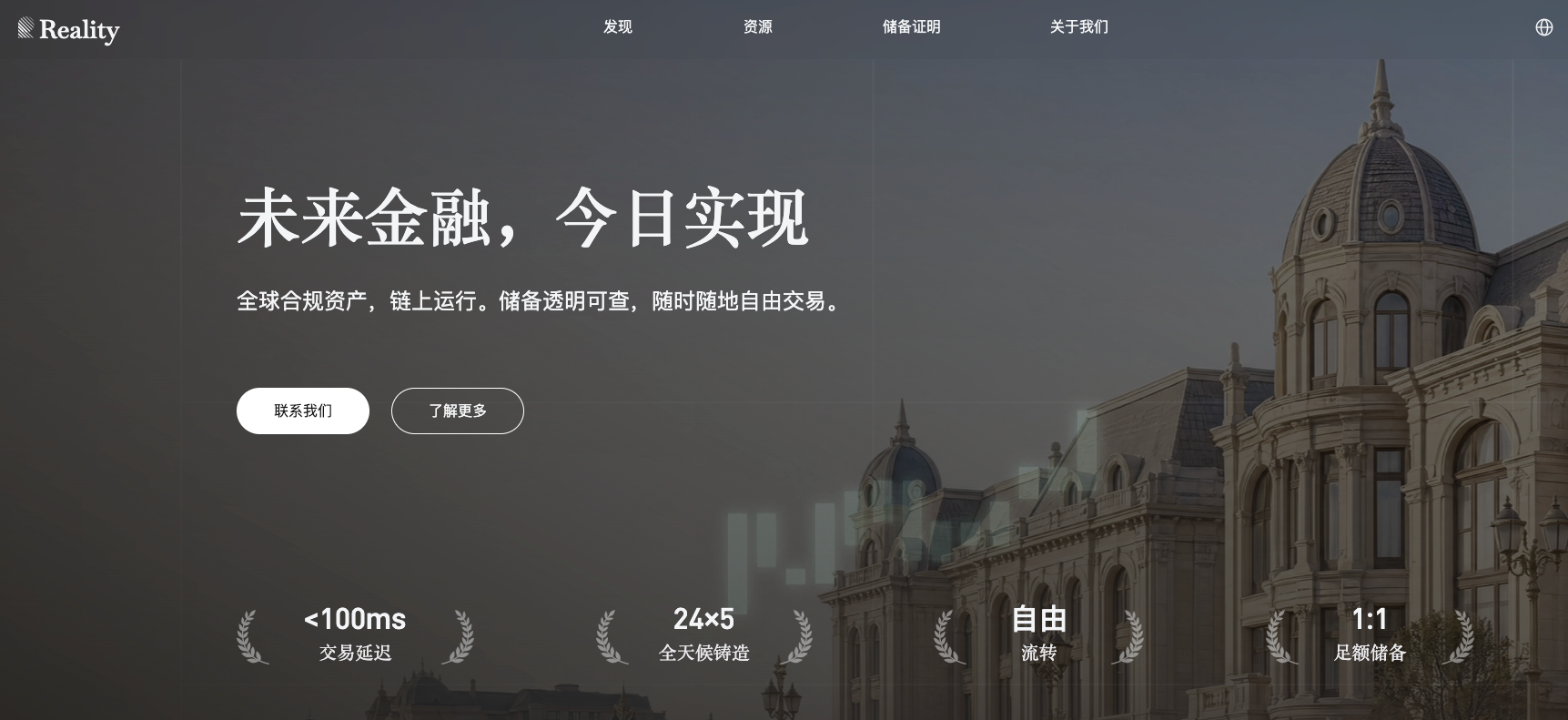
This June, Bitget launched a platform called Reality. The name literally translates to reality. In a crypto-stock sector flooded with shadow stock assets, the name itself reads like a manifesto:
When tokenized stocks become the mainstream of the future, they will shed the prefix "tokenized" and become the default "stocks" people refer to, while the stocks traded today might be retroactively prefixed as "traditional stocks."
This might sound sci-fi, but Reality's goal is to make it a reality.
What the platform does is not overly complex to explain. Instead of sourcing from Ondo or xStocks, Reality issues tokenized US stocks itself. Reality handles the issuance, custody is entrusted to licensed broker Alpaca, and auditing is independently conducted by The Network Firm, with each link performing its specific role.
The stock tokens issued by the platform are called rTokens. The US stock tickers you buy on Bitget now will be presented with an "r" prefix.

How does the experience of rTokens differ from the third-party tokens of six months ago?
The most direct difference is that you can finally be clear about whether there's a real asset behind it. In the 1.0 era of tokenized stocks, the underlying custody chain was essentially a black box for users. You didn't know if the NVDA you bought was backed by an actual Nvidia share.
Reality has made this chain transparent. rToken, this type of tokenized stock, has underlying real-world assets mapped to it.
For example, when you buy $100 worth of rNVDA on Bitget, Reality, through Alpaca, purchases the corresponding amount of real Nvidia stock on the US stock market and deposits it into Alpaca's custody account. You buy however much, it buys exactly that much – a 1:1 correspondence.
Public documents show that Alpaca is a US-licensed self-clearing broker, registered with the Financial Industry Regulatory Authority (FINRA), and protected by the Securities Investor Protection Corporation (SIPC).
SIPC is a federal-level investor insurance mechanism in the US. This means that even if the broker itself fails, the securities assets in the custody account have a safety net, up to $500,000. Alpaca is currently one of the most widely used custodians in the tokenized securities field; Binance, Ondo, and xStocks are also Alpaca clients.
The independent audit is handled by The Network Firm, which produces CPA-level reports periodically, confirming a reserve ratio of over 100%. Bitget has also created an on-chain proof-of-reserves dashboard, updated in real-time and open for anyone to view.
You've bought an asset, and you know it's real. This is the perceived change at the user level.
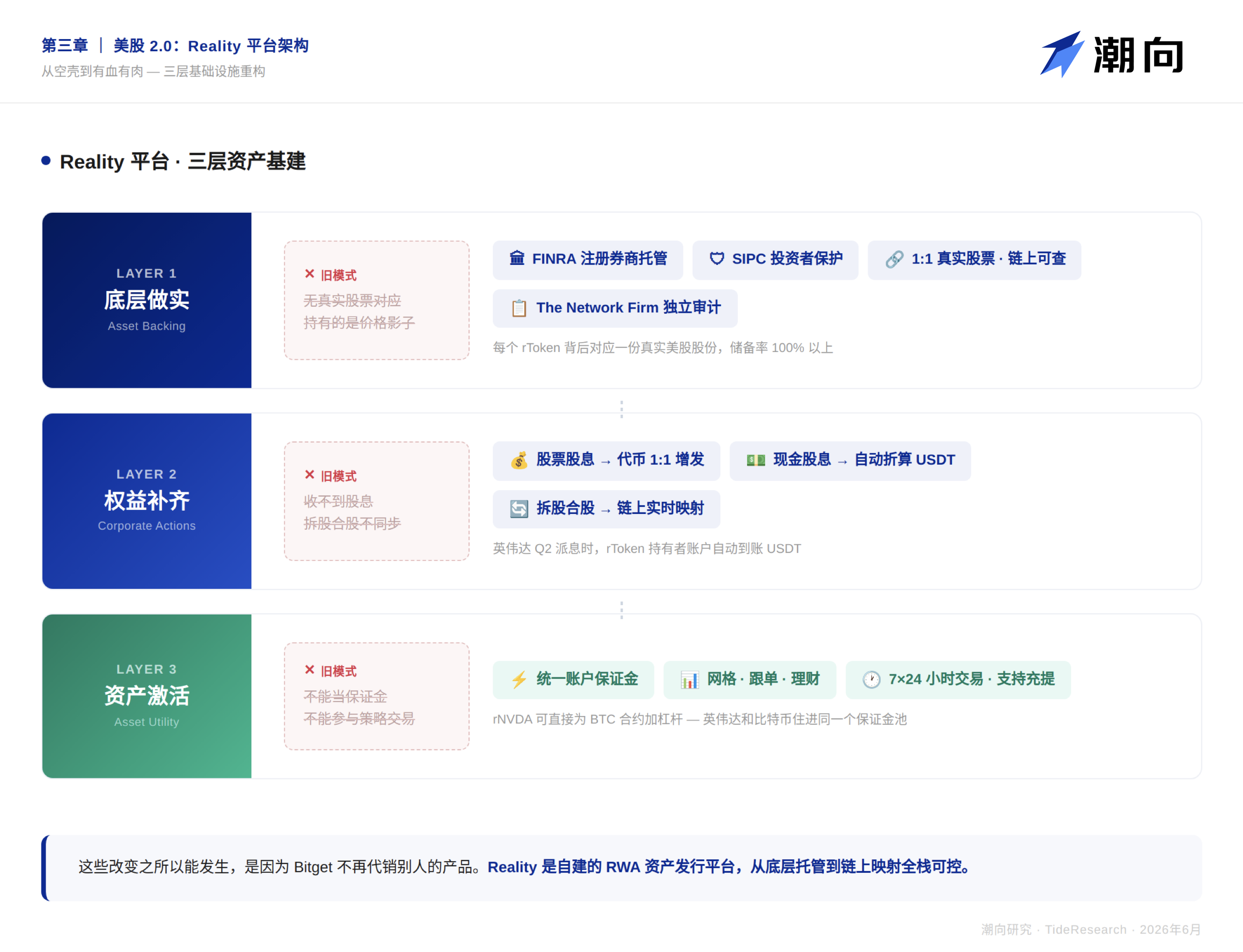
Following this user experience, you can see the design philosophy behind Reality's entire architecture. Bitget rebuilt tokenized stocks by breaking them down into three layers:
The first layer is securing the foundation. The aforementioned Alpaca custody, 1:1 purchasing, and on-chain proof-of-reserves address the most fundamental trust issue: "Is there really something behind what I bought?"
The second layer is completing the rights. Stock dividends are issued 1:1 as tokens into your account; cash dividends are converted into USDT and credited directly; stock splits and reverse splits are mapped onto the chain in real-time. Over the past two years, if you bought tokenized Nvidia elsewhere, you watched real shareholders collect dividends quarter after quarter while your account remained unchanged. Now, it's the rToken holders' turn.
The third layer is asset activation.
rTokens are integrated into Bitget's unified account system. Your rNVDA holdings can be used directly as margin. You can use a Nvidia position to open a BTC contract, leveraging a US stock to trade a crypto derivative. In traditional brokerages, cross-asset margining is a privilege reserved for institutions, something unthinkable with previous on-chain stocks. Now, a regular user can achieve a similar effect on Bitget.
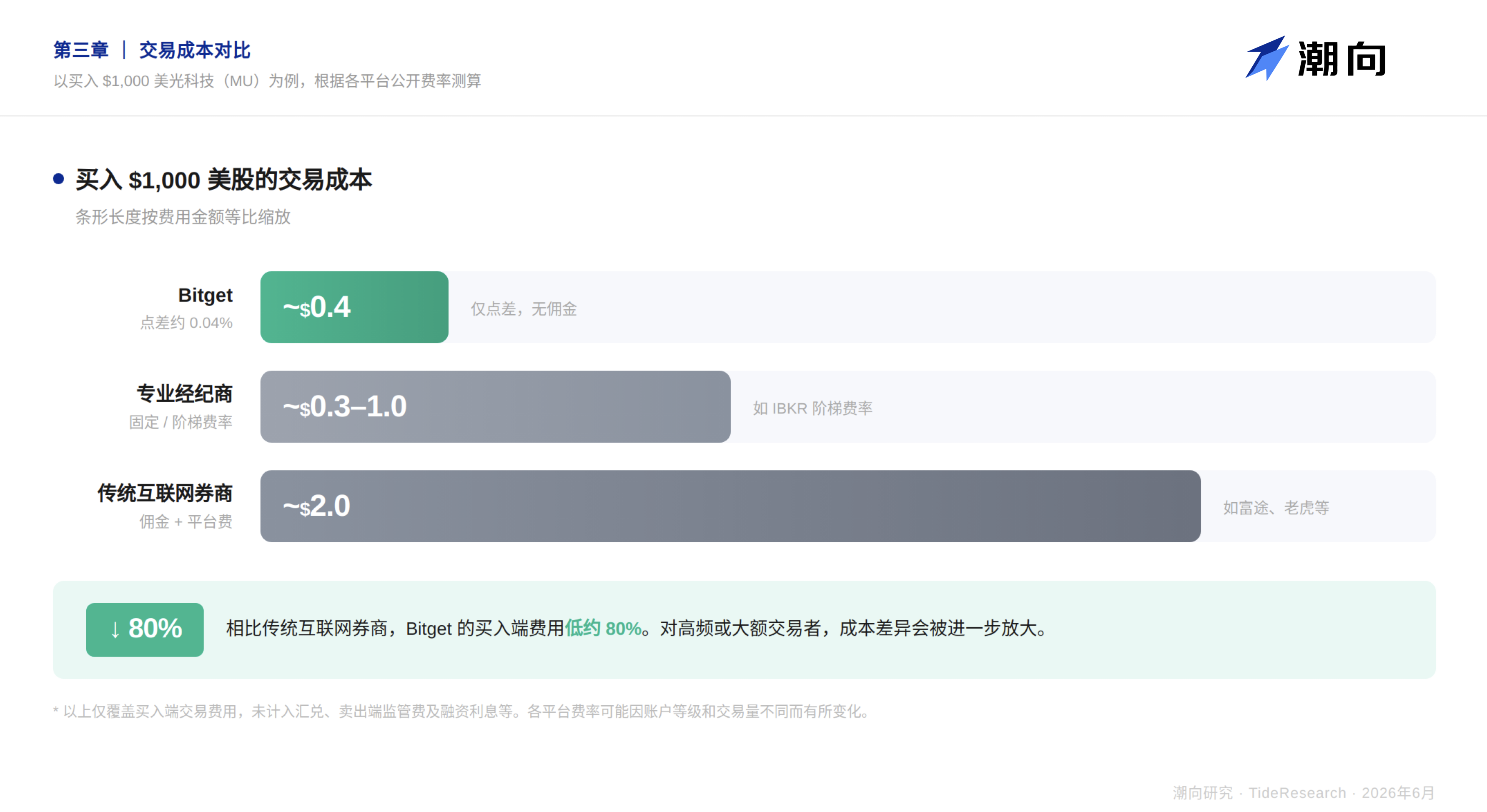
So, after this round of building in-house, what is the cost of buying stocks?
According to publicly disclosed fee schedules from various platforms, for a $1,000 US stock purchase, Bitget charges approximately $0.4, while traditional online brokerages typically charge around $2.
Looking at these three layers together, the category of tokenized stocks has undergone a qualitative change in Bitget's hands: from a shadow token that merely follows the price, it has become a financial product with real custody, complete rights, and the ability to be mixed and used with crypto assets.
Two years ago, brokerages wouldn't do this, and exchanges couldn't.
Some might ask, since the goal is to offer US stocks, why not take a simpler route, like directly connecting to a brokerage's API and just building a front-end?
Bitget's choice is the opposite. It doesn't want to be an appendage to traditional finance; it wants to rebuild the entire chain using crypto and on-chain methods. Reality has full-stack self-control, from custody to distribution to on-chain mapping. rTokens are inherently on-chain assets that can be deposited, withdrawn, and combined – things a direct brokerage connection cannot achieve.
Writing this, the author recalls a famous line from the Chinese drama "The Knockout": The bigger the waves, the more valuable the fish.
But to navigate the changing market environment and catch more fish, you need a reliable boat. Borrowing someone else's boat might work, but with a self-built boat, you control the water level.
This is probably the unspoken but evident ambition behind Bitget's Reality platform, rarely stated directly in various announcements.
And clearly, Bitget doesn't plan to use this boat only for US stocks.
Beyond US Stocks: The Blueprint of a Panoramic Exchange
The first batch of cargo loaded onto the newly built ship isn't just publicly listed company stocks.
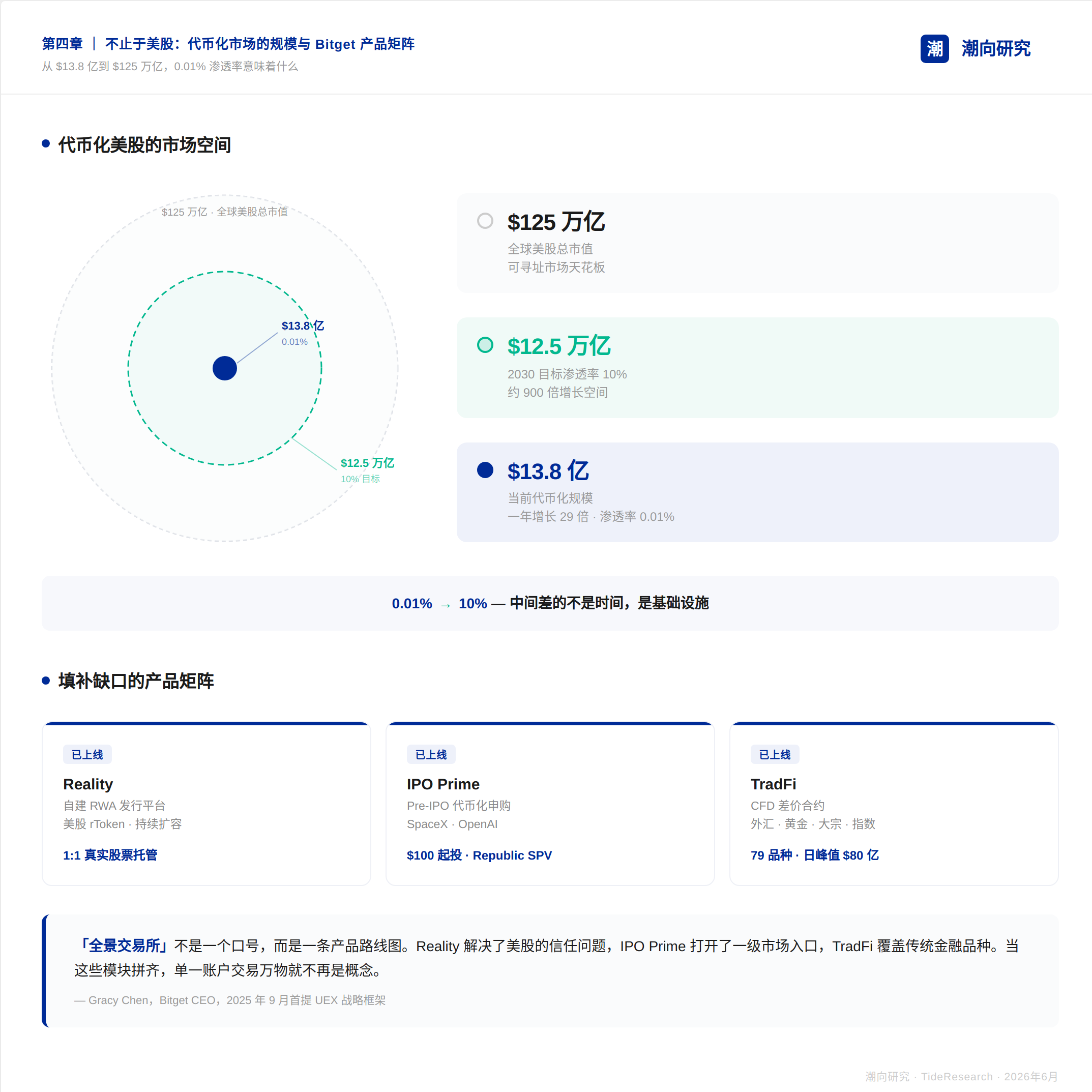
In April this year, Bitget launched a product called IPO Prime, allowing regular users to subscribe to companies before they go public. The first issue was SpaceX, with a subscription price of $650 per unit and a total pool of approximately $61 million. The result: $177 million poured in, contested by 14,435 people.
The second issue was OpenAI, with a subscription price of $725 per unit, a pool of about $21 million. Actual subscriptions reached $120 million, with 5,448 participants, an oversubscription of nearly six times.
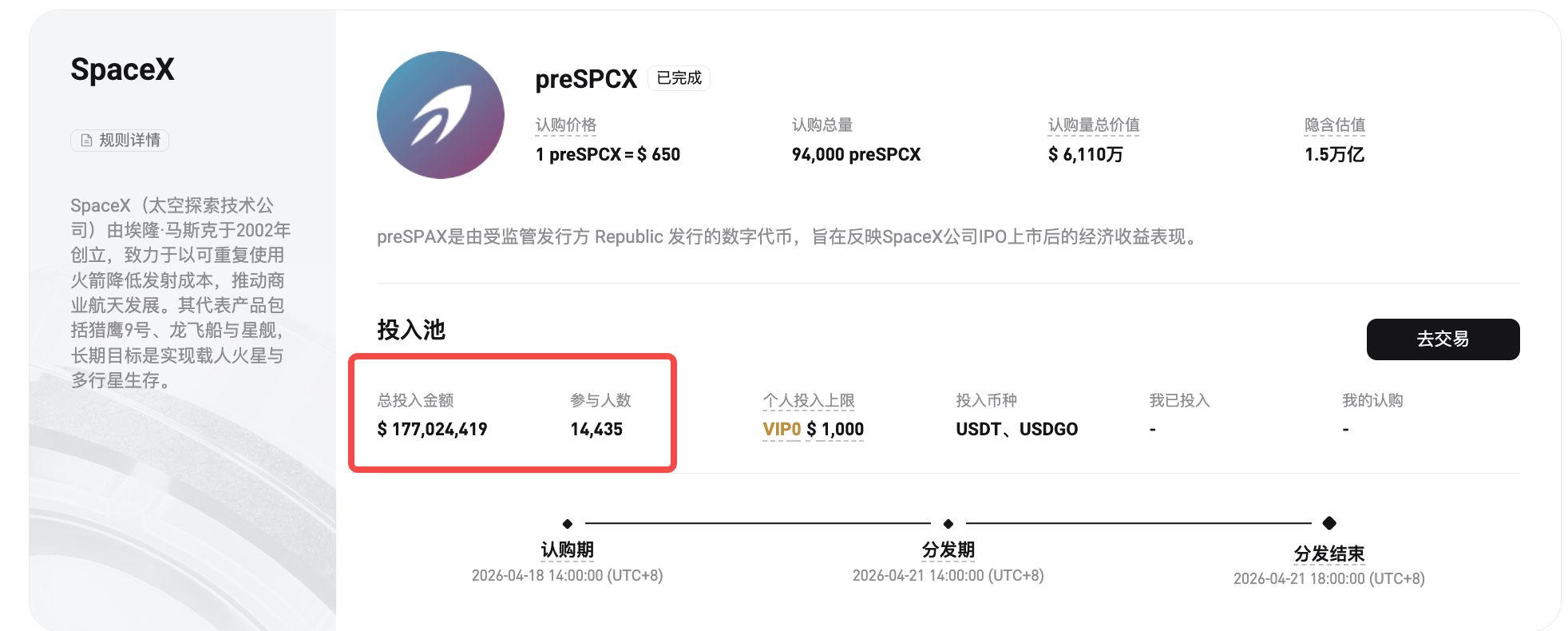
Combined, the two rounds attracted nearly $300 million in subscriptions from almost 20,000 participants.
The common characteristic of these two companies is that, in the traditional financial world, ordinary people have no channel to gain equity exposure before they go public. Behind IPO Prime is an SPV structure in partnership with Republic, anchored to real equity.
Beyond Pre-IPO, Bitget also launched TradFi late last year, a CFD product denominated in USDT covering 79 instruments including forex, gold, commodities, and stock indices. Its daily trading volume peaked at over $8 billion.
Combined with Reality's continuously expanding list of US stock rTokens, the range of assets accessible from a single Bitget account now far exceeds the traditional definition of the five words "crypto exchange."
Internally at Bitget, this direction is called UEX, the Universal Exchange.
When CEO Gracy Chen first publicly mentioned this concept in September last year, she stated the goal directly: to cover crypto, US stocks, gold, ETFs, and forex through a single account, enabling one-stop trading of global high-quality assets.
To support this framework, the team is also expanding.
Public information shows that Bitget has intensively recruited a batch of multi-talented professionals with backgrounds in both traditional finance and internet growth over the past six months. Hired candidates come from companies like Futu, LongBridge, Robinhood, and eToro, possessing cross-market experience covering the US, Hong Kong, Singapore, and Australia, and have collaborative ties with traditional financial institutions like Nasdaq.
Judging by the direction of these hires, this isn't a crypto exchange catching up on lessons; it looks more like a new species building its skeleton.
What the author finds interesting is Bitget's attitude toward this endeavor. There was a lighter path to offering US stock trading: connect to a brokerage's API, put a shell over the front-end, and let users buy and sell.
Many platforms take this route. Bitget specifically chose the heaviest path, building its own issuance platform, its own custody chain, with rTokens being deposit-able, withdraw-able, and composable on-chain.
Why?
From the product choices, Bitget's attitude is already clear. A direct brokerage connection essentially means building a front-end for traditional finance


