






Odaily phỏng vấn SharpLink: "Nhà tư bản sản xuất" của Ethereum


- Quan điểm cốt lõi: Công ty niêm yết trên Nasdaq SharpLink đã cấu hình gần như toàn bộ bảng cân đối kế toán của mình vào Ethereum, thông qua chiến lược staking gốc và hợp tác tuân thủ sáng tạo trên chuỗi, nhằm mục tiêu trở thành "cách thức nắm giữ Ethereum tốt nhất". KPI cốt lõi của họ là tối đa hóa số lượng ETH trên mỗi cổ phiếu, và tin rằng Ethereum đang bị định giá thấp một cách nghiêm trọng do các xu hướng như RWA (tài sản thế giới thực).
- Yếu tố then chốt:
- Chiến lược và định vị cốt lõi: SharpLink là một kho bạc tài sản kỹ thuật số, chiến lược cốt lõi là "bản vị ETH", phân bổ gần như toàn bộ vốn khoảng 3 tỷ USD vào ETH. KPI cốt lõi là tối đa hóa số lượng ETH trên mỗi cổ phiếu, thay vì chỉ đơn thuần theo đuổi lợi nhuận bằng đô la Mỹ.
- Nguồn thu nhập: Kiếm được khoảng 1 triệu USD mỗi ngày thông qua staking gốc, và hợp tác với Linea, ether.fi để triển khai trên chuỗi trong hai năm, nhằm kiếm được lợi nhuận ETH vượt trội so với tỷ lệ staking gốc.
- Đổi mới về tuân thủ và an ninh: Thông qua hợp tác với Anchorage Digital - một tổ chức lưu ký được OCC cấp phép, lần đầu tiên thực hiện các hoạt động tài chính trên chuỗi mà không cần rời khỏi môi trường lưu ký tuân thủ, nhằm thiết lập một "khuôn mẫu tuân thủ an toàn hàng đầu" cho sự tham gia của các tổ chức vào DeFi.
- Quan điểm thị trường và cơ hội: Cho rằng Ethereum đang bị định giá thấp một cách nghiêm trọng, cơ hội cốt lõi nằm ở thị trường sơ khai khổng lồ của việc mã hóa RWA (tài sản thế giới thực), và Ethereum sẽ đứng ở trung tâm của sự biến đổi này.
- Rủi ro và truyền thông với nhà đầu tư: Công ty không có rủi ro nợ và thanh lý, nhưng tồn tại khoản lỗ trên sổ sách. Thông qua giáo dục thị trường liên tục, tỷ lệ nắm giữ của các tổ chức đã tăng mạnh từ khoảng 6% lên 46%.
Original|Odaily (@OdailyChina)
Author|Hao Fangzhou
On-site Interview|Cody
"E Guards", are you still there?
In the current atmosphere of widespread pessimism, I heard a statement – "ETH that is not staked has no productivity" – hold on, let's first understand the person who said this:
Matt Sheffield (X@sheffieldreport), CIO (Chief Investment Officer) of SharpLink.
Recently, SharpLink, which positions itself as a "next-generation digital asset treasury," publicly announced that it has directly placed $200 million worth of ETH on-chain through the qualified custodian Anchorage Digital, entering into a two-year yield enhancement collaboration with Linea, ether.fi, and EigenCloud. This move not only aims to earn ETH yields exceeding native staking but also intends to establish a compliant model for institutional-grade DeFi operations. Its core logic is very clear: while firmly believing that Ethereum is severely undervalued at present, the company is maximizing the amount of ETH per share at its own pace.
Why does this publicly listed company dare to stake almost its entire balance sheet on ETH? Is the bullish rhetoric entirely due to its own position, or does it see a different vista from its high vantage point? How do large institutions and regulators trust on-chain excess returns? Facing paper losses amounting to billions of dollars, how do they convince traditional investors?
In New York, Odaily had the privilege of meeting Matt for an in-depth conversation, seeking answers to the above questions.
He clearly explained to us SharpLink's "ETH-centric" philosophy, the steady strategy with "maximizing ETH per share" as the core KPI, and how they aim to become the "best way to hold Ethereum" through native staking, on-chain collaborations, and pioneering compliance practices, while also pioneering a secure path for the entire industry from compliant custody to DeFi yields.
Below is the fully edited interview transcript, enjoy~
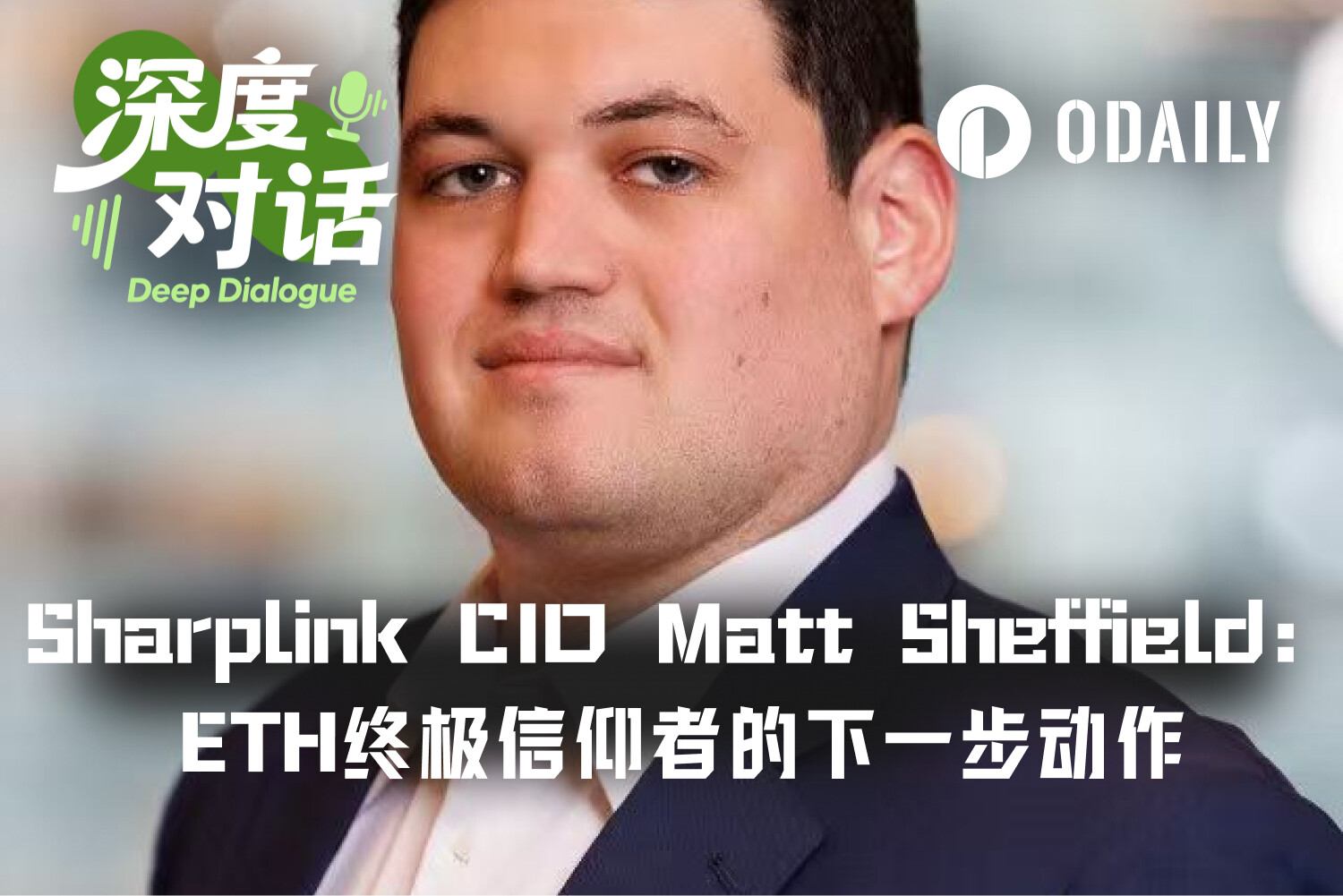
Odaily: Hello, Matt. I'm Cody from Odaily. It's a great honor to visit the SharpLink team in Midtown Manhattan today. Could Matt please briefly introduce himself?
Matt: I am the Chief Investment Officer of SharpLink, which is a digital asset treasury listed on Nasdaq with approximately $3 billion in equity capital. Our goal is to deploy this capital on our balance sheet in the most efficient way to hold Ethereum and demonstrate a "safety-first" philosophy to the world.
Odaily: What previous experience and resource advantages can you leverage since joining SharpLink?
Matt: I come from a traditional finance background, initially working at Bridgewater Associates trading rates and credit products, then in 2022, I went independent and co-founded a crypto hedge fund with several former colleagues.
More recently, I led the spot trading team at FalconX, one of the world's largest digital asset prime brokers and dealers. My interest in the digital asset treasury space grew at FalconX, and I connected with the SharpLink team. My career has consistently focused on native yield and the "productivity" of assets.
Odaily: After joining SharpLink, what is the core KPI for you as CIO?
Matt: It's to maximize ETH per share. My work in this role is to build what we consider to be the efficient frontier portfolio for SharpLink, denominated in ETH, aiming to generate higher risk-adjusted ETH returns.
For example: We started by natively staking all our ETH to demonstrate to the market that Ethereum is a fundamentally different asset. It is "productive," and in the right hands, it can become even more productive. An ETF that does not stake has no productivity and fails to utilize the full value Ethereum can create.
Odaily: Does the company prioritize maximizing USD profits or maximizing ETH per share?
Matt: Actually, we believe these two are essentially the same thing. Because our core belief is: Ethereum is an undervalued opportunity with tremendous upside potential, stemming from the growth curves we see in areas like tokenization, smart payments, and more. Therefore, SharpLink made a strategic decision starting last June – to allocate almost our entire treasury to Ethereum. We believe this is the best decision we can make for our shareholders.
Since Ethereum is undervalued, and we want to accumulate as much ETH per share as possible as a driver of shareholder growth, that ultimately equates to creating the highest USD value over time.
Odaily: This question also touches on SharpLink's positioning. Publicly listed company, Digital Asset Treasury Company, active fund in the Ethereum ecosystem – which description is more accurate?
Matt: We are a digital asset treasury – that's the industry term – but I'd say we are a completely different treasury because we focus more on Ethereum's native productivity rather than financialized yield.
Odaily: Please elaborate on the part about focusing on native productivity that differs from other treasuries?
Matt: People's understanding of digital asset treasuries originally came only from Michael Saylor's Strategy. Buying digital gold (BTC) is a fundamentally different asset choice, belonging to the structural type of financialized yield – adding leverage in common stock, introducing variable Gamma (option price acceleration) – using financialization methods to generate equity returns that don't exist in Bitcoin-denominated trading.
But we are trying to cater to a completely different set of participants interested in linear accumulation of yield. We currently earn about $1 million per day just from staking, and we currently have no debt.
Odaily: Does this mean the external concern that "during high volatility or price declines, the treasury needs to sell assets to alleviate cash flow pressure" is unlikely to happen at SharpLink? More specifically, at what ETH price point would trigger a "liquidation" for you?
Matt: We indeed don't have a liquidation price like those treasuries with convertible bonds, preferred shares, etc., which constantly face erosion, or if they engage in some kind of over-collateralized borrowing, liquidation might occur.
This also goes back to why we believe "Ethereum on the balance sheet can be so powerful": you have recurring income from staking, which helps protect the network, and you can generate excess income through more productive activities on-chain.
Odaily: Besides staking, which on-chain operations generate excess income?
Matt: SharpLink will engage in multi-year deployments with DeFi partners to earn additional ETH beyond the native staking rate. The ETH we earn now already exceeds the native staking rate. We've taken on slightly more risk and pushed the business boundary outward a bit.
Our goal is, if the Ethereum native staking rate is considered the risk-free rate in crypto, then it should be our benchmark, and we should strive to outperform it on a risk-adjusted basis. That's my focus.
Not only establishing partnerships on-chain, SharpLink is also seeking external partners, exploring ways to achieve this goal both on-chain and off-chain. Ultimately, holding a large amount of Ethereum will have parallel dual benefits – creating excess value for shareholders and being beneficial to the Ethereum ecosystem.
Odaily: Besides continuing to accumulate ETH, does SharpLink have plans for more active participation in RWA, the Ethereum ecosystem, etc., this year? Or will it maintain a relatively passive treasury management role?
Matt: I don't consider this passive; we are actively managing the Ethereum treasury. It's just that currently, we have no interest in diluting the value proposition.
While we are very interested in helping with RWA liquidity, yield-generating strategies, smart payments, etc., such as providing liquidity to protocols to generate more ETH per share. These are not core businesses; SharpLink's goal is very focused.
Odaily: In January this year, SharpLink announced it had deployed $170 million worth of ETH on Linea to enhance staking yields. How do you assess liquidity risk and on-chain risk? What is the acceptance level among institutional investors?
Matt: The news you mentioned is a very interesting transaction not only for us but for the entire industry. Because historically, institutions have not been on-chain. I think this time they are compromising on crucial risk values to achieve a greater trade-off. Behind this is partly a market structure issue and partly an incentive issue. Previously, institutions participating in DeFi were not large enough to invest the time and resources to reduce transaction risks.
To this end, we collaborated with Linea, ether.fi, and EigenCloud on a two-year deployment. By the way, updating the number, it's now $200 million; we added another $30 million after the initial announcement.
We not only earn on-chain liquidity and interest rates, but our partners also provide a long-term nature that is basically non-existent in crypto currently and give us Ethereum-denominated incentives.
We want to establish institutional-grade partnerships and maintain institutional-grade durations, which is important.
Another partner, Anchorage Digital, is an OCC-chartered compliant custodian. We wanted to achieve, for the first time, a financial operation without leaving a qualified custodian. We didn't want to use hot wallets, so we minted assets from within the custodian and then bridged across chains via LayerZero. No publicly listed company should have done this before.
This is setting a "safety-first" example, both raising standards and paving the way for later entrants to access DeFi more easily and trustingly.
Odaily: As a Nasdaq-listed company, the SEC has very strict accounting treatment for crypto assets (like fair value measurement). How do you ensure complex DeFi yield strategies (like LST, LRT) comply with the compliance requirements of a listed company?
Matt: Interestingly, we are always "eating the crab." When SharpLink started native staking, we saw this – native staking flows into revenue, while liquid staking tokens are currently treated as intangible assets and subject to impairment – the market must understand our financial statements.
Whenever we do something, we communicate extensively with large internal and external teams to ensure compliance. We pioneer compliant precedents so others can follow, giving Wall Street and investors confidence, and the entire industry can develop accordingly. This is a very time-consuming process, which is why we proceed methodically.
We have been employing a digital asset strategy for less than a year, with assets under management of about $30 billion. The accumulation speed of this number may not sound astonishing, but it's already an appropriate balance point.
Odaily: What frustrates ETH holders is that compared to BTC and other mainstream coins, ETH's current performance is poor. What's your take?
Matt: The major bullish factors for ETH are just beginning to be noticed. I think the most important one is RWA. When looking at market size and data charts, you need to look at "how much of the digital assets have been tokenized, compared to the scale of the entire financial world." For example, BlackRock intends to tokenize everything. Just one of their ETF series has $4.5 trillion. That's several times the total current RWA market cap.
So we are still in the super early stages of a massive transformation of assets moving on-chain. Ethereum will be at the center of this transformation. This is the opportunity we see for Ethereum – substantial network growth, harboring price appreciation potential.
Over the past month or so, the market foundation has become more solid and healthy, especially during US trading hours, with trading behavior becoming more rational. Tailwinds like US regulatory clarity, ETFs, etc., are blowing.
We try to avoid predicting prices because, ultimately, everyone must assess for themselves whether the Ethereum opportunity is right for them. But we absolutely hope SharpLink is the best way to hold Ethereum.
Odaily: ETH's price weakness has also brought huge paper net losses to SharpLink. How do you explain this financial performance of "high growth accompanied by large losses" to traditional shareholders?
Matt: That's a good question. We do a lot of investor communication and education, trying to accurately explain to the market what SharpLink's strategy is. So you know exactly what you're investing in, not putting money into a black box.
The result of market education is: when we filed the 13F last June, our institutional ownership was 5-6%, the rest retail; the recently released 13F shows our institutional ownership is now 46%, and the list includes many large institutions that previously had little exposure to digital assets.
This is also why I keep attending meetings, giving interviews, explaining the strategy, conveying the idea – if you are interested in going long on Ethereum, we want to be the best way to achieve that in a public, regulated vehicle. If you are not interested in going long on Ethereum, I also hope people understand SharpLink is not the right stock for them.
Odaily: Have you had any cooperation with the Asian market before?
Matt: Yes, I have traded in and spent time in Asian markets myself. The growth space in Asia is huge, especially for digital assets. When attending the Consensus conference in Hong Kong in February, I was pleasantly surprised by the surge in attention. We also went to South Korea, Japan, and recently to the Gulf region, meeting with large institutions and sovereign funds, discussing the opportunities in Ethereum, SharpLink's opportunities, and what kind of ecosystem they are trying to build locally.
I saw tremendous interest in RWA in Hong Kong and the Gulf region. The regulators are incredibly cooperative and visionary; they are trying to figure out how we can do this safely, how to advance so they can be seen as innovation hubs; local builders also see it as home.
We want to be where early protocols are, acting as a bridge between traditional finance and cryptocurrency.
Odaily: Besides Ethereum, where are SharpLink's interests?
Matt: In the entire on-chain ecosystem surrounding it. RWA, smart payments... are all within the scope we are willing to participate in. However, venture capital and liquidity funds seek high-risk, high-return investment opportunities; ETFs are buy-and-hold, not necessarily making assets productive; while SharpLink's goal is to have this nearly permanent, Ethereum-denominated capital.
We want to go out and collaborate with partners pushing the Ethereum ecosystem forward


