Strategy Q1 Báo cáo tài chính: Lỗ sổ sách 14,4 tỷ USD, không loại trừ khả năng bán coin để trả lãi


- Quan điểm chính: Báo cáo tài chính quý 1 năm 2026 của Strategy cho thấy khoản lỗ ròng 12,54 tỷ USD, chủ yếu do giá BTC giảm dẫn đến khoản lỗ chưa thực hiện, nhưng công ty vẫn tăng lượng nắm giữ BTC và phụ thuộc vào nguồn tài trợ từ cổ phiếu ưu đãi STRC, đồng thời lần đầu tiên ngụ ý có thể bán BTC để trả cổ tức, thu hút sự chú ý của thị trường.
- Các yếu tố chính:
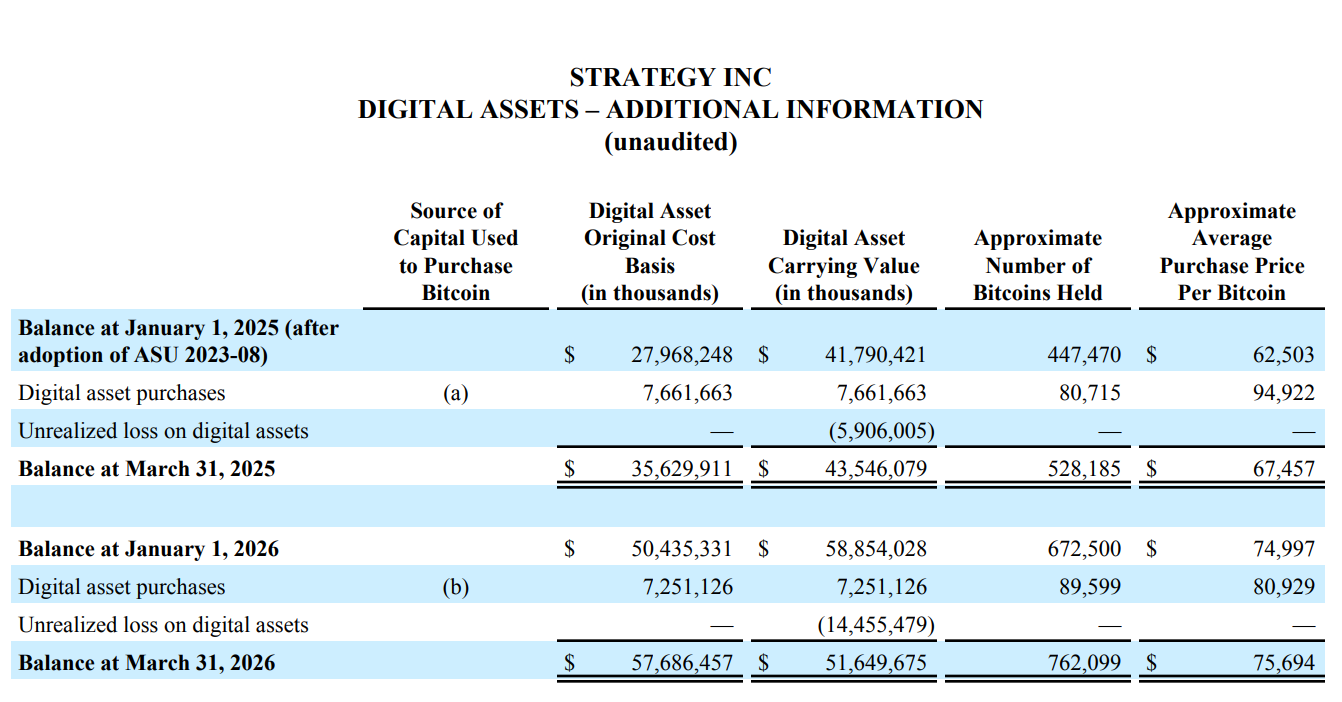
- Lỗ ròng quý 1 là 12,54 tỷ USD, chủ yếu đến từ khoản lỗ chưa thực hiện 14,46 tỷ USD; nắm giữ 818.300 BTC, giá trung bình khoảng 75.537 USD.
- Công ty lần đầu tiên nêu rõ "khả năng bán BTC để trả cổ tức", nợ ròng hiện tại là 8,17 tỷ USD, tiền mặt chỉ còn 2,21 tỷ USD.
- Cổ phiếu ưu đãi STRC đạt giá trị thị trường 8,5 tỷ USD trong 9 tháng, trở thành cổ phiếu ưu đãi lớn nhất toàn cầu, cơ cấu tài trợ quý 2 chuyển đổi, STRC chiếm hơn 80%.
- Quý 1 mua vào 89.599 BTC (giá trung bình 80.929 USD), nhưng khoản lỗ ròng 12,54 tỷ USD phản ánh tác động của việc giảm giá BTC.
- Doanh thu phần mềm chỉ 124,3 triệu USD, hoàn toàn bị gạt ra ngoài lề; lợi nhuận giữ lại lịch sử lần đầu tiên chuyển từ dương sang âm, thâm hụt tích lũy 6,47 tỷ USD.
- Trong quá trình xây dựng hệ sinh thái DeFi, STRC được các giao thức như Apyx hấp thụ 270 triệu USD, làm tài sản thế chấp trên chuỗi.
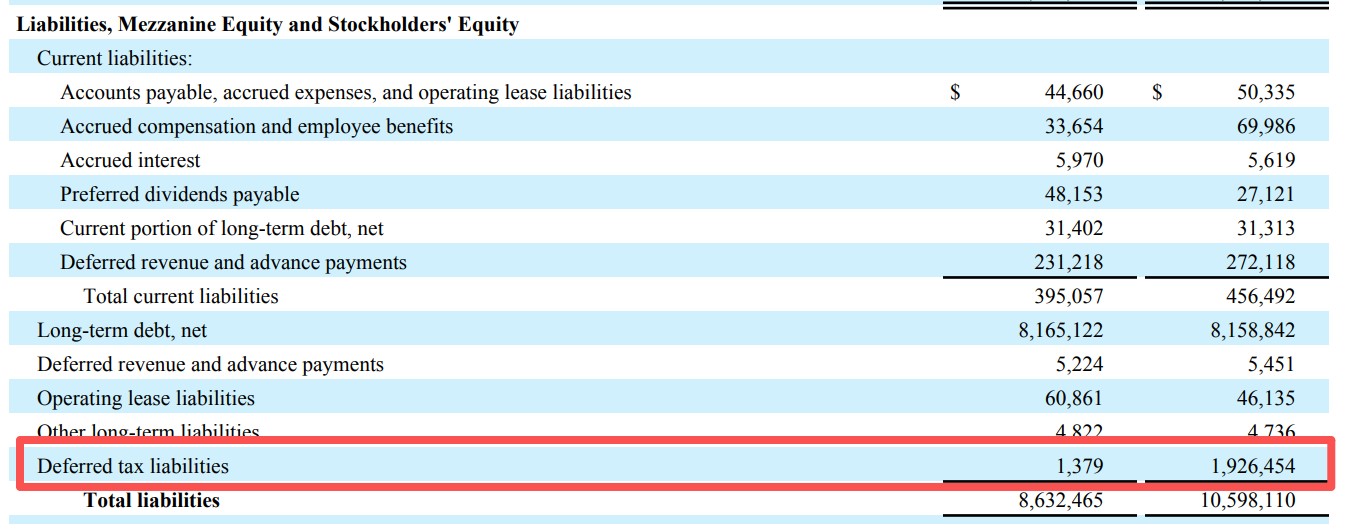
- Nợ thuế hoãn lại giảm từ 1,93 tỷ USD xuống còn 1,38 triệu USD, dự kiến không có lợi nhuận chịu thuế trong 10 năm tới, việc khấu trừ thuế thực tế không hiệu quả.
Original|Odaily Planet Daily (@OdailyChina)
Author|Wenser (@wenser 2010 )
Early this morning, the Strategy 2026 Q1 Earnings Call officially concluded, and the Q1 financial results were formally released. Once again, the true operational status of this "industry heartbeat," holding 818,300 BTC, was laid bare before the market. Behind the net loss of $12.54 billion lies the BTC price briefly dipping to around $62,000, the continuous accumulation of 63,400 BTC, and the STRC market cap growing to $8.5 billion.
Of course, the most thought-provoking part of the earnings report and Michael Saylor's public statements concerns the indication that "Strategy may sell some BTC to pay dividends." Perhaps influenced by this news, despite Q1 performance falling short of market expectations, the capital market instead showed optimism, with Strategy's stock price edging up 3%.
Odaily Planet Daily has summarized the key points and future potential from the Q1 earnings report as follows.
Q1 Book Net Loss of $12.5 Billion; Selling BTC for Dividends Not Ruled Out
Key Point One: Selling BTC Is No Longer Impossible, but an Option
Scrutinizing the Q1 earnings report and conference call content, Strategy repeatedly mentions in its forward-looking statements and KPI explanations — "If convertible notes mature or are redeemed without conversion into common stock, the company may need to sell common stock or Bitcoin to generate sufficient cash to meet these obligations."
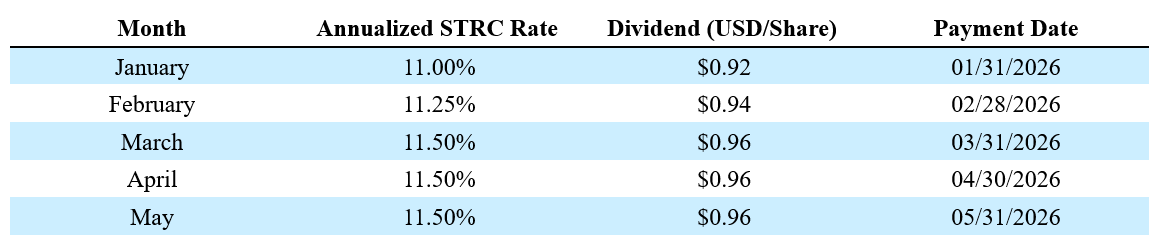
As of the end of Q1, Strategy had net long-term debt of $8.17 billion, preferred stock redemption value of $10 billion, and cash of only $2.21 billion. Meanwhile, the company must continuously pay preferred stock dividends (current STRC annualized rate of 11.5%) and has already begun financing dividends through issuing common stock. If BTC prices continue to face pressure, thereby limiting financing windows, selling coins to service debt could transition from a theoretical assumption to a realistic possibility, inevitably sending ripple effects through the market.
Strategy founder Michael Saylor stated, "This move is merely to convey a message to the market that this model (referring to verifying that Bitcoin assets can support shareholder returns within a corporate financial framework) has been realized."
Notably, unlike traditional companies' "KPI metrics," Strategy has created its own KPI system, including: BPS (Bitcoin Per Share), BTC Yield (9.4%), BTC Gain (63,410 BTC), and BTC$ Gain (BTC Dollar Gain $4.97 billion) (Odaily Planet Daily note: Data as of May 3rd). However, in the disclaimer, it also points out that these metrics do not consider debt, do not consider the preferential claims of preferred stock, do not represent return on investment, do not represent fair value gains, and "BTC Dollar Gain may be positive while the company is recording significant fair value losses." In fact, Strategy's Q1 business performance supports this mechanism: KPIs showed a $4.97 billion BTC Dollar Gain, but under GAAP, it recorded a $14.46 billion unrealized loss. The core function of this KPI system is to maintain the capital market narrative, not to reflect the true financial condition. To put it bluntly, "spinning bad news as good" or "presenting a rosy picture while hiding the thorns" is a common tactic for Strategy in the capital markets.
As of May 3, 2026, Strategy held 818,334 Bitcoin, a 22% increase year-to-date. However, the Q1 earnings report recorded a net loss of $12.54 billion, almost entirely from unrealized losses on digital assets ($14.46 billion); the total cost basis for the 818,334 BTC was $61.81 billion, corresponding to an average purchase price of approximately $75,537 per BTC. Notably, thanks to the recent market rebound, the Q2 floating profit amounts to $8.3 billion.
Key Point Two: Spent $7.25 Billion Buying BTC in Q1, but Book Value Shrunk by $7.2 Billion at Quarter End
Purely from a buying and selling numbers perspective, Strategy's Q1 statement could barely be described as "a wash."
Earnings data shows that Strategy purchased 89,599 BTC in Q1, spending $7.25 billion at an average price of approximately $80,929. However, due to the decline in BTC, the book value of digital assets fell from $58.85 billion at the beginning of the year to $51.65 billion, a net decrease of about $7.2 billion.
One must admit that persistently leveraging (financing + dividends) to bottom-fish BTC during a bear market and achieving this result is quite commendable.
Key Point Three: AI's Impact on Strategy is Objectively Real; Software Business Revenue Completely Marginalized
Nominally, Strategy still publicly insists it is an "AI-driven enterprise analytics software company," evident from its revenue structure including software subscription service revenue, license revenue, and product support revenue.
However, comparing the structure shows that Strategy's Q1 total software revenue was merely $124.3 million, with a gross profit of only $83.35 million; compared to its BTC holdings market value of $64.1 billion, over 500 times the quarterly revenue gap clearly tells the market: In the era of rapid AI development, the software business, marginally related to AI, has been thoroughly marginalized.
Key Point Four: STRC Becomes the Shining Star Business, Reaching $8.5 Billion Market Cap in 9 Months
As Strategy's "financing weapon," STRC's market performance during the relentless bear market can be described as a "lifeline."
Currently, STRC (Variable Rate Series A Perpetual Preferred Stock) has grown to $8.5 billion in just 9 months, becoming the world's largest preferred stock by market cap. Year-to-date, Strategy has raised $5.58 billion through STRC, a growth rate of 189%.
Additionally, Strategy stated that STRC's Sharpe ratio reached 2.53, with volatility of only 3% and an average daily trading volume of $375 million. This means that, through STRC—a low-volatility, high-yield, high-liquidity fixed-income product—a new asset backed by BTC reserves has emerged in the traditional financial market.
Key Point Five: Major Q1, Q2 Financing Structure Transformation; STRC Becomes the Main Financing Engine
In the earnings report, of the $7.37 billion financing completed by Strategy in Q1, MSTR common stock ATM contributed $5.3 billion, and STRC contributed $2.07 billion, a ratio of approximately 72% to 28%. However, after entering Q2 (April 1 to May 3), this structure reversed—STRC contributed $3.51 billion in financing, while MSTR only contributed $0.81 billion.
This means the financing gap for common stock is narrowing, and Strategy is increasingly relying on preferred stocks offering fixed income to maintain capital reserves, thereby continuing to drive BTC accumulation.
Furthermore, perhaps considering STRC's stellar performance and strong capital attraction, Strategy is actively promoting this "wealth management fixed-income product" in traditional financial markets. The company has initiated a proposal for semi-monthly STRC dividend payments, aiming to shorten the dividend payment cycle and attract more capital.
Key Point Six: Strategy Records First Historical Accumulated Earnings Deficit
In traditional financial markets, retained earnings are a crucial indicator of a company's financial health—the cumulative result of all net profits minus all dividends since the company's inception. In other words, it's the company's "money bag."
From its founding in 1989 to the end of 2025, after over thirty years of operations, Strategy had accumulated profits of $6.32 billion. However, by the end of the first quarter of this year, this figure turned negative, resulting in an accumulated deficit of $6.47 billion.
This is a direct consequence of the ASU 2023-08 standard (Odaily Planet Daily note: This standard requires listed companies to measure BTC at fair value starting in 2025, with price changes directly reflected in the income statement). But from the perspective of the commonly used GAAP in traditional financial markets, Strategy's historical accumulated profits over three decades have been completely erased by a single quarter's BTC decline.
Of course, what goes down can come up. If BTC prices recover later, this figure can turn positive again. This indicator once again highlights the high risk and high volatility of crypto assets compared to traditional financial assets.
Key Point Seven: DeFi Ecosystem Centered on STRC is Under Construction
Strategy's Q1 report mentioned that DeFi protocols like Apyx and Saturn have absorbed over $270 million in STRC assets; $150 million in STRC assets have been incorporated into the corporate asset reserves of listed companies like Prevalon, Strive, and Anchorage.
In other words, STRC is evolving from a single preferred stock financing tool into a foundational collateral asset for the on-chain ecosystem of the cryptocurrency market. If STRC's appeal to capital markets and the crypto ecosystem continues to grow (Odaily Planet Daily note: Fixed income is quite attractive in the wealth management track, both in traditional financial markets and crypto markets), STRC will gradually surpass MSTR (traditional preferred stock).
Of course, there are trade-offs. As the proportion of STRC increases, the requirements for Strategy's dividend payment capacity become higher, and the scope of risk transmission to the market broadens.
Key Point Eight: Tax Deduction Potential Exists, but Unusable for the Next Decade
Apart from business data, Strategy's Q1 report also mentioned a drastic change in deferred tax liabilities.
According to the table data, Strategy's deferred tax liabilities plummeted from nearly $1.93 billion at the start of the year to just $1.38 million at the end of Q1, nearly zeroed out.
In other words, Strategy previously had a "deferred tax bill" of nearly $1.93 billion due to realized business profits. However, due to business losses driven by the BTC decline, the company's income statement recorded this unpaid tax as an "income tax benefit." Additionally, Strategy's Q1 unrealized loss of $14.46 billion could theoretically offset some taxes, meaning the business losses reduce the taxes payable, creating a "tax shield."
But the problem is that this tax shield is only effective if Strategy actually has taxable profits in the future. Yet the company also stated it does not expect to have taxable profits for over ten years. In other words, Strategy gained a "$1.9 billion tax deduction benefit" from the BTC decline, but because future taxable profits are unlikely, this benefit will probably not be realized.
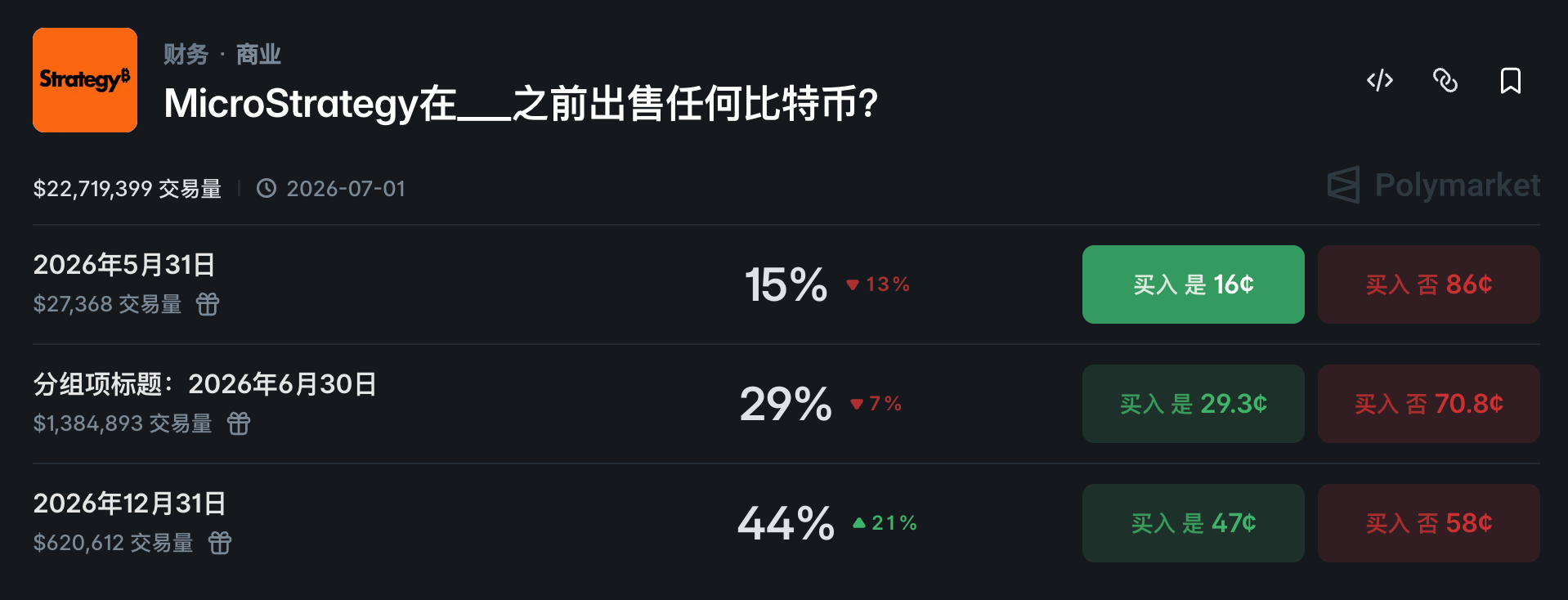
Finally, beyond buying Strategy-related stocks, prediction markets have listed an event for betting on "whether Strategy will sell Bitcoin before the end of the year", with the current probability of "Yes" standing at 44%.