






BTC最大治理冲突升级,BIP-110从软分叉走向硬分叉


- 核心观点:BIP-110提案因矿工支持率仅2%而未能激活,其支持者在强制窗口期后发起少数链软分叉失败,现计划更换PoW算法转向硬分叉,但面临节点支持率低和社区共识不足的双重困境,实质已宣告失败。
- 关键要素:
- BIP-110于8月9日进入强制窗口期后,少数链仅挖出2个区块,落后主链超200块,因未达最长链共识而失败。
- 全网矿工投票支持率约2%,远低于55%激活阈值;节点支持率仅15.07%(17913/118850个节点),剔除僵尸节点后更低。
- 支持BIP-110的唯一矿池Ocean仅占全网算力1.6%,继承主链127.48万亿难度后每日最多出块2-3个。
- Luke Dashjr计划更换PoW算法(候选包括RandomX、Scrypt等),并提议通过确定性随机过程选定算法以防矿工预挖,但尚未落地。
- BIP-110支持者将失败归咎于大型矿池勾结,称其执行“秘密硬分叉”;反对者Michael Saylor和Adam Back指出分叉无安全性和共识支撑则毫无意义。
Original | Odaily Planet Daily (@OdailyChina)
Author | Golem (@web3_golem)
On August 9, Bitcoin block height reached 961632, and BIP-110 officially entered its enforced window period (961632-963647). During this phase, nodes running BIP-110 began rejecting blocks that did not comply with the new rules (including non-monetary data transactions), and Bitcoin was effectively soft-forked into two competing chains (the main chain and a minority chain supporting BIP-110).
One day after the soft fork, the BIP-110 chain had only mined two blocks—961632 and 961633—and was already over 200 blocks behind the main chain. According to Bitcoin’s longest-chain principle, the BIP-110 chain failed to become the longest-chain consensus, and the network did not unify under BIP-110’s new rules.Therefore, it is safe to declare that the BIP-100 soft fork led by Bitcoin core developer Luke Dashjr has failed.

Length comparison between the main chain and the minority chain supporting BIP-110
The failure of BIP-110 was expected. Before entering the enforced window period, miner voting support across the network was only about 2%, far below the 55% activation threshold.However, BIP-110 supporters led by Luke Dashjr still refuse to accept defeat and are already planning to change the PoW algorithm, which means the BIP-110 chain will no longer use the SHA-256d algorithm, evolving from a Bitcoin soft fork into a Bitcoin hard fork.
It is worth noting that in June, Luke Dashjr himself said he would not carry out a BIP-110 hard fork or any change/removal of proof-of-work, yet now he has come to this point. F2Pool co-founder Wang Chun even directly criticized,stating: “Luke Dashjr is not only financially bankrupt, but his personal credibility is also bankrupt. Attempting to change the PoW algorithm will not end well either.”
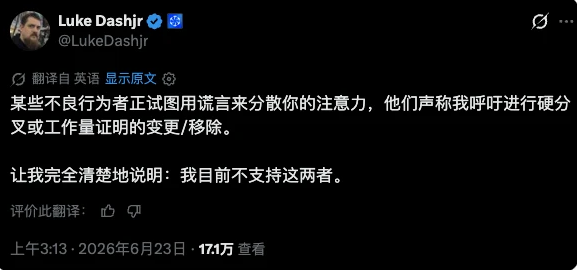
BIP-110 Moves Toward a Hard Fork
In mid-July, Odaily Planet Daily published an analysis of the pros and cons of BIP-110 and hypothesized three scenarios for what might happen after its activation.(Recommended reading: “With Less Than 1% Support, Will BIP-110 Still Push Bitcoin Toward a Soft Fork?”)
Reality has entered the third scenario, which is also the worst-case one:the BIP-110 chain cannot surpass the main chain, and Luke Dashjr is calling on BIP-110 supporters to permanently fork the BIP-110 chain into an independent chain, “manually” adjust block difficulty, and launch a new network token.
The reason the BIP-110 chain cannot produce blocks is simple: it inherited approximately 127.48 trillion in mining difficulty from the Bitcoin main chain but only attracted a tiny fraction of the main chain’s SHA-256d hash power. The only mining pool supporting BIP-110, Ocean, accounts for just 1.6% of total network hash power, and it can generate at most 2-3 blocks per day. Each block production can be described as a stroke of luck.
To change this situation, Luke Dashjr and BIP-110 supporters have chosen the solution of “firing the miners,” i.e., changing the proof-of-work algorithm of the BIP-110 chain so that main-chain miners can no longer work on the BIP-110 chain. The hash power supporting BIP-110 then becomes “total network hash power,” dominating block production on BIP-110—but the block rewards mined will no longer be Bitcoins worth over $60,000.
In the Discord channel of Bitcoin Knots (a Bitcoin full-node software version created by Luke Dashjr), Luke Dashjr and BIP-110 supporters have been focusing on discussions about what proof-of-work mechanism can keep the BIP-110 chain running while avoiding dependence on current Bitcoin miners. Participants discussed specific cryptographic algorithms including RandomX, KT256, various variants of BLAKE3 and BLAKE2, Scrypt, Autolykos v2, and CPU and GPU mining.
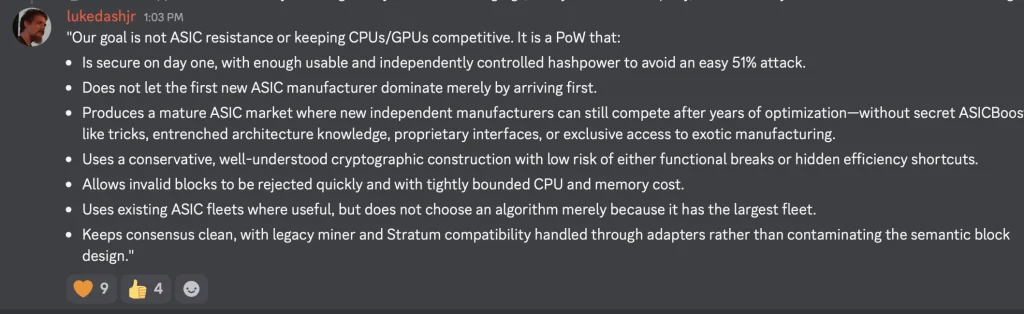
Luke Dashjr discusses changing BIP-110’s algorithm on the Bitcoin Knots Discord server, source: BitcoinNews
Ultimately, Luke Dashjr proposed selecting the final algorithm from the list of candidates through a deterministic random process, reasoning that “this way, no one will know in advance before everyone knows,” reducing the risk of some miners preparing BIP-110-chain-specific mining machines ahead of time.
As of press time, the BIP-110 chain has not yet enabled or approved any PoW change, and Luke Dashjr has not yet announced the chosen algorithm or the activation block height. Relevant experimental code has been ported to the recent Bitcoin Knots codebase. In short, the BIP-110 hard fork has not yet truly materialized, but the probability of it happening has never been higher.
Who Really Caused the Centralization Problem?
Meanwhile, the conflict between BIP-110 supporters and opponents is escalating.
BIP-110 proposal author Dathon Ohm believes that BIP-110 was “forced” into a hard fork by the collusion of large mining pools. In a post on X, hestated: “Large mining pools have colluded to secretly hard-fork the Bitcoin node network, turning Bitcoin from a monetary network into a toxic data dumping ground.” In other words,the ones truly conducting a hard fork are not BIP-110 but the large mining pools that defy the community’s will, and the community is designing a new proof-of-work mechanism to escape their centralization control.
Luke Dashjr is even more outspoken, still believing that BIP-110 has community support and viewing the actions of large mining pools that do not support BIP-110 (such as Antpool and F2Pool) in seizing block production rights as an attack by an extremely small number of malicious actors. Therefore, changing the PoW mechanism is aimed at eliminating their centralization threat.
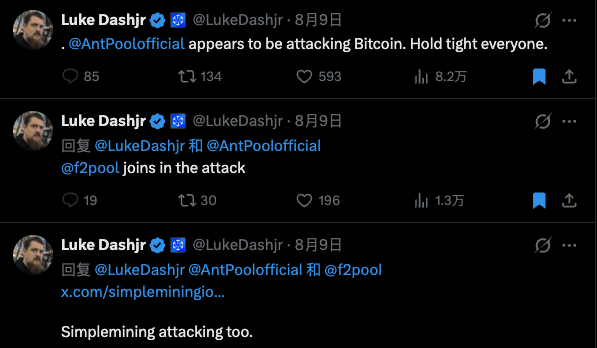
Antpool and F2Pool competing with BIP-110 miners for the right to produce block 961632, viewed by Luke Dashjr as an attack on the Bitcoin network
Currently, BIP-110 supporters argue that nodes and the community, not miners and hash power, determine Bitcoin network governance. They subjectively believe that the main chain operated by large mining pools through “hash power dominance” is no longer the true Bitcoin chain, and what they mine is just “Core altcoin.” The true Bitcoin chain is the new BIP-110 chain.
But the biggest flaw in the BIP-110 narrative is that, aside from miners, the so-called nodes and community supporting BIP-110 are also a minority within the broader Bitcoin community. Real community support is difficult to measure, but node support is crystal clear: among the 118,850 Bitcoin nodes worldwide, only 17,913 are willing to run BIP-110, accounting for 15.07% of the network. If “zombie nodes” are excluded, the support rate would be even lower.
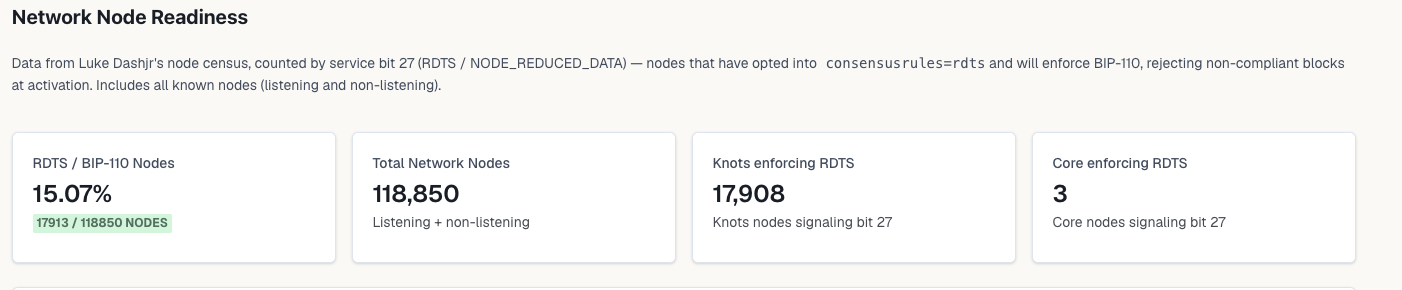
BIP-110 node support rate
Such data makes it hard to argue that the majority of Bitcoin nodes and the community support BIP-110 and that only large mining pools are united in opposition. In the end, Luke Dashjr and BIP-110 supporters have simply been deceiving themselves. When protesting the “centralized tyranny” of large mining pools, perhaps they should look back and ask whether they are imposing their so-called Bitcoin maximalist will on everyone else. Isn’t that also a form of governance centralization?
Michael Saylor, an opponent of BIP-110 and founder of Strategy, believes BIP-110’s failure was inevitable. Hestated that BIP-110 is free to fork, but other network members can also choose not to follow. BIP-110’s current hash power is only 0.15% of the Bitcoin main chain. “Anyone can fork Bitcoin, but without security, utility, capital, and users, a fork is meaningless. Consensus is achieved through effort, not through artificial declarations.”
Cypherpunk pioneer Adam Back also criticized the “persecution complex” of BIP-110 supporters regarding large mining pools. He pointed out that the belief that “Bitcoin whales,” governments, or miner groups are conspiring against Bitcoin to cause its losses is wrong, and the idea that nodes control Bitcoin protocol changes while miners will submit is even more misguided. “BIP-110 has not reached consensus, so economic nodes and the market have ignored it, which is why miners did not mine on it.”
No one can control Bitcoin. Consensus comes from the network, and the network has already made its choice.


