






MSX美股每日观察:FMS 2026存储峰会:HBF标准首发,三星、SK海力士、美光集体押注产能


- 核心观点:在2026年FMS峰会上,三大存储巨头针对“AI内存墙”提出互不兼容的解决方案,表明存储已成为制约AI算力发挥的关键约束条件,行业标准尚未收敛但产能已同步扩张。
- 关键要素:
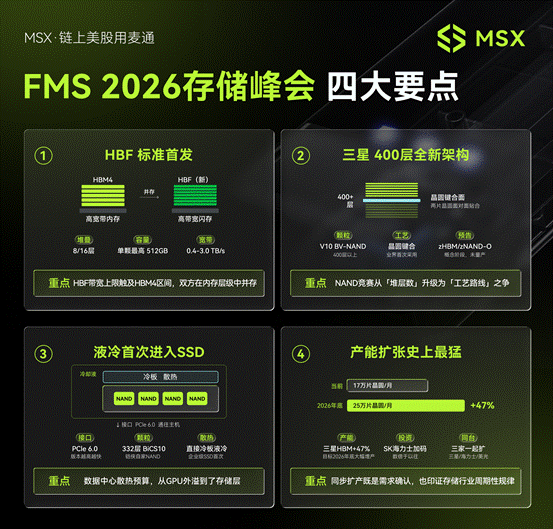
- SK海力士与闪迪联合发布高带宽闪存(HBF)首个标准规格,支持8层与16层堆叠,单颗容量最高512GB,定位为HBM之下的新增层级。
- HBF读带宽区间为0.4–3.0 TB/s,上限触及HBM4区间,但基于闪存介质,延迟与写入寿命与DRAM不同,官方定位为增量层而非替代品。
- 三星发布V10 BV-NAND,堆叠400层以上,首次采用晶圆键合工艺,同时预览zHBM与zNAND-O概念产品,尚未量产。
- SK海力士发布第10代375层4D NAND,能效比较上一代提升2.5倍;铠侠CM10为首款结合PCIe 6.0、332层BiCS10与直接冷板液冷的企业级SSD。
- 据报道,三星计划将HBM月产能从约17万片晶圆提升至约25万片,增幅约47%,目标2026年底达成,扩产先于需求兑现。
【MSX Research Institute · US Stock RWA Daily Observation】 is a flagship daily report produced by MSX, a leading RWA trading platform. Leveraging our strong macroeconomic research capabilities, we capture the core pulse of global traditional US stocks, liquidity changes, and the RWA tokenization market, helping you strategically position for high-quality assets.
Today's Observation
FMS 2026 was held on August 4–6 in Santa Clara, USA, marking the 21st edition of the world's largest independent storage industry summit. At the same event, three industry giants delivered three mutually incompatible answers to the "AI memory wall": SK Hynix and SanDisk jointly released the first standard specification for High Bandwidth Flash (HBF), adding a new tier below HBM; Samsung unveiled BV-NAND with over 400 layers, using wafer bonding technology for the first time to stack vertically; Kioxia, meanwhile, integrated direct cold-plate liquid cooling into enterprise SSDs for the first time, addressing constraints from the thermal management side.
Data in a Minute
• The first HBF standard specification was released by SK Hynix and SanDisk through OCP, supporting 8-layer and 16-layer stacking with a maximum single-device capacity of 512GB
• HBF read bandwidth ranges from 0.4 to 3.0 TB/s, with the upper limit entering the bandwidth territory of HBM4, but it is officially positioned as an additional tier below HBM, not a replacement
• Samsung unveiled V10 BV-NAND with over 400 layers, marking the industry's first use of wafer bonding technology
• Samsung also previewed zHBM and zNAND-O, both of which are still in the concept stage and not yet in mass production
• SK Hynix released its 10th-generation 375-layer 4D NAND, delivering a 2.5x improvement in energy efficiency compared to the previous generation
• Kioxia's CM10 is the first enterprise SSD to combine PCIe 6.0, 332-layer BiCS10, and direct cold-plate liquid cooling
• According to reports, Samsung's monthly HBM production capacity is set to increase from approximately 170,000 wafers to approximately 250,000 wafers, a rise of about 47%, with a target of achieving this by the end of 2026
MSX View
The most noteworthy signal at this summit was not any specific product, but rather the changing position of storage within AI systems. Thermal budgets have spilled over from GPUs all the way to SSDs, and the need for an additional tier below HBM all points to the same thing: storage has become a constraint determining whether compute can run at full capacity. It is worth noting that while HBF's bandwidth ceiling has already touched the HBM4 range, its underlying medium is still flash memory, with latency and write endurance on a different scale from DRAM. Its official positioning is always as an incremental layer rather than a replacement—something most likely to be amplified and misinterpreted in media coverage. What deserves closer observation is that although the three routes are mutually incompatible and industry standards are far from converging, all three companies have simultaneously committed production capacity. Capacity decisions are made far earlier than demand materializes, which is precisely the root cause of the storage cycle. In the short term, the simultaneous capacity expansion is a signal that AI demand has been jointly confirmed by all three players; in the medium term, whether supply pacing can align with demand is the real variable in this cycle.
About MSX
MSX is a leading RWA trading platform dedicated to providing secure, efficient, and transparent access to global financial markets. As one of the earliest on-chain US stock trading platforms in the world, MSX has always been at the forefront of the industry, leading market transformation through continuous innovation.
The platform deeply integrates blockchain technology with a compliance framework, offering comprehensive spot and derivatives trading of nearly 400 tokenized stocks and Pre-IPO assets, perfectly bridging the gap between traditional finance and the digital asset industry.
Centered on the core mission of "enabling the free circulation of high-quality assets," MSX has built a diversified digital financial services ecosystem covering US stock spot and perpetual contracts, crypto-to-crypto trading, Pre-IPO, and the MSX Research Institute, designed to provide global investors with round-the-clock, high-performance access to premium assets.
Official Website: https://msx.com/
Now available on the global App Store and Google Play.
Risk Disclaimer: Macroeconomic conditions and US stock market volatility are significant. This content is provided for academic and research observation purposes by the MSX Research Institute only and does not constitute any investment advice.


