Real Vision Founder: Reconsidering the Long-Term Value of Cryptocurrency After 13 Years of Bull and Bear Markets


- Core Thesis: The article argues that the current pessimistic market sentiment is a normal phenomenon of cyclical fluctuations, and the long-term bullish logic remains unchanged. Bitcoin is the "digital vault" for global savings, while smart contract public chains (such as Ethereum, Solana, and Sui) are the infrastructure for the future machine economy. The potential market value of the latter far exceeds that of the former, and investing in such public chains is betting on the infrastructure of the next generation economy.
- Key Elements:
- Bitcoin is a hard asset with a fixed total supply, targeting the global savings pool of approximately $35 trillion. In contrast, smart contract public chains target global debt, equities, and real estate, collectively valued at over $850 trillion—an order of magnitude larger.
- As the underlying settlement layer for the machine economy, smart contract public chains provide a programmable, instant, 24/7 transaction environment for AI agents. Their value derives from the sum of all ecosystem applications built upon them, rather than traditional valuation models.
- The author's personal experience shows that frequent trading destroys the power of long-term compounding; had they held Bitcoin long-term from an early stage, a $200,000 principal would have grown to over $100 million.
- The current market downturn stems from the macroeconomic business cycle (e.g., the US PMI index consistently below the boom-bust line) and delayed adjustments to liquidity expectations. However, the business cycle has already bottomed out and is recovering, and historical patterns indicate the crypto market will rebound.
- Long-term winners are investors who understand the true nature of assets, can withstand short-term high volatility (e.g., a 50% drawdown), and maintain their positions, rather than short-term traders.
Original Author: Raoul Pal, Founder of Real Vision
Original Compiled by: Chopper, Foresight News
If you open your news feed right now, you'll find market sentiment overwhelmingly pessimistic. The cycle is over, the crypto industry is dead, the four-year bull-bear cycle pattern is broken, and everyone who told you to buy was wrong. Coin prices have deviated from popular expectations. Once price movements fall outside common understanding, pessimism spreads. History keeps repeating itself.
I have witnessed this cycle countless times and know exactly how the story ends. Having been in the crypto industry for thirteen years, I've made nearly every mistake possible. Before I explain my logic for staying bullish, let me first share the pitfalls I've encountered. True experience always comes from failure.
In 2013, I entered the market when Bitcoin was priced at $200. However, the timing of the buy was not the main point. Before purchasing my first Bitcoin, I wrote the first-ever macro valuation analysis for Bitcoin.
By today's standards, this valuation model was very crude. I drew on commodity valuation approaches, calculated the total above-ground and below-ground gold reserves, and then applied this framework to Bitcoin. The conclusion was: if Bitcoin could become digital gold, and if gold prices remained at current levels, the value of a single Bitcoin could potentially reach $1 million.
This article quickly spread through Silicon Valley and financial circles. At that time, no one had yet built a valuation framework for Bitcoin from a macro perspective. I didn't just publish an opinion; I recommended Bitcoin to all GMI subscribers, including multiple hedge funds and family offices. In 2013, recommending a $200 Bitcoin to such investors required immense courage.
My core conclusion at the time was: "Bitcoin is currently priced at $200, with a long-term target potentially reaching a million dollars. Considering the high probability of my own miscalculation, I'll voluntarily give a 10% discount and set a ten-year target price of $100,000."
The final result roughly aligned with the prediction; Bitcoin did indeed reach that price level.
However, correctly predicting the destination and understanding the fluctuations along the way are entirely different matters.
Looking back on this journey, I entered at an excellent price. The value doubled, tripled, and then crashed 84%. I comforted myself, thinking it was a long-term bet that required no action. Then, the market surged again at the end of 2017. One day, staring at the screen, the price climbed to an unimaginable number, and I chose to sell.
Why? Fear, Uncertainty, and Doubt (FUD) played their part. Fork controversies were endless, "bubble theories" were everywhere, and a voice inside kept telling me: Take the 10x profit and secure it; don't let all the gains slip away.
I exited the market. But after I sold, Bitcoin went on to rise another tenfold.
I tried to pretend I wasn't regretful, but I knew I had made a huge mistake. Even worse, during the pandemic, prices plummeted again. I re-entered the market, thinking I was brilliantly buying the dip. That wasn't the case: I had sold at $2,000, only to buy back in at around $8,000 or $9,000. Frequent trading, taking profits at highs, short-term trading around my positions... all these actions hindered the only correct long-term strategy from working.
I once roughly calculated that if I had simply held onto my initial $200,000 principal, its value today would be around a hundred million dollars. That's the power of compounding interest, and it also proves how easily people make foolish decisions. The asset itself continues to appreciate, but I kept artificially interrupting this process.
Losing out on massive paper gains was an expensive lesson that taught me one thing: Extend your time horizon, ignore the noise, and hold for the long term. For any brokerage, "dormant accounts" often have the best returns because their holders don't actively trade the assets.
That was my reflection. Now, let me talk about the logic I understand today but couldn't fully grasp back then.
Bitcoin is a Vault for Storing Value
Over the past few weeks, I've been consistently writing about currency debasement. All analysis ultimately points here. Demographics create debt, debt drives continuous currency devaluation, and cash loses about 8% of its purchasing power annually compared to long-term assets. To fully understand this chain of logic, you can read my previous article. In short: Holding cash is like holding a melting ice cube. The rational choice is to hold assets whose total supply cannot be artificially increased.
Bitcoin is the purest form of such assets. Its total supply is permanently capped at 21 million; no committee can vote to increase it. It is the hardest currency ever created by humans, serving as a store of value layer—a digital vault.
But a vault has a growth ceiling, and understanding this is crucial. Bitcoin's target market is the global pool of savings seeking a safe haven. This is roughly equivalent to the ~$35 trillion gold market, plus a portion of other assets held for wealth preservation. My judgment is that Bitcoin will continue to capture allocation from this pool. Its only real competitor is Zcash, a privacy-focused cryptocurrency that might capture 10% of the market in the future, leaving the rest for Bitcoin.
So, the digital vault logic holds; Bitcoin is a quality asset. But the vault is only half the story, perhaps even less than half.
The Economic System Built on Top of the Vault
Bitcoin lacks programmability. By design, it excels at one thing and doesn't take on other functions. Smart contract public chains are an entirely different track. There are many public chains on the market, but I consistently favor three: Ethereum, Solana, and Sui. The most common mistake people make is lumping them together with Bitcoin as "cryptocurrency" and debating which one will ultimately win.
People overlook a key fact: their purposes are fundamentally different. Bitcoin solves value storage; smart contract platforms solve multi-party coordination and collaboration.
The Exponential Age framework I proposed posits that AI, robotics, energy, and crypto technology are simultaneously entering an explosive growth phase. The future economy won't be driven by human labor but by machines. Billions of AI agents will conduct transactions non-stop, buying compute power, settling with each other, at speeds far exceeding humans.
This raises an obvious question: What will they use to transact? The traditional banking system isn't suitable. The machine economy cannot tolerate three-day settlement cycles, reliance on correspondent banks, or clearing houses that close on weekends. Smart agents need programmable, instant, 24/7 underlying rails – this is the value of smart contract public chains. They will become the settlement layer for the machine economy of the Exponential Age.
Therefore, investing in these public chains is not betting on a specific token, but betting on the infrastructure upon which the next generation of the economy will run. The tokens themselves are not just currency; they are the holders' equity in the network, the collaborative foundation of the digital age.
This also means you cannot apply a Bitcoin valuation model to public chains, nor can you measure them using traditional corporate valuation methods. A public chain is not a company; it's an economy. To assess the value of an economy, you look at the total economic activity occurring on it.
When we compare the target markets of these two tracks side-by-side, the core argument becomes clear. Bitcoin targets global savings capital, corresponding to a ~$35 trillion market, similar in size to gold, making it a worthwhile allocation. Smart contract platforms, in the future, could potentially handle the settlement needs of global real estate (~$400 trillion), global debt (~$325 trillion), and global stock markets (~$125 trillion). This isn't just a larger scale; it's an order of magnitude larger.
The conclusion is self-evident: in the long term, the total market capitalization of high-quality smart contract public chains will be multiple times that of Bitcoin. This doesn't mean Bitcoin will fail; it will perfectly fulfill its mission as a store of value. The reason: the economy built on top of the vault will naturally be larger than the vault itself. The vault stores savings capital; the underlying rails carry the flow of the entire economy.
Counterargument: Are They Just Utility Tokens?
I can foresee the mainstream bearish argument, and it's worth dissecting seriously rather than simply refuting. The narrative goes like this: Bitcoin is fundamentally designed for capital preservation, continuously accumulating value as money. Ethereum, Solana, and Sui are merely utility assets, financial infrastructure; infrastructure doesn't appreciate like a pure monetary asset. Regardless of how good the technology is, they aren't considered good investment targets.
But this logic reveals its flaw when reversed. The growth ceiling for a pure store of value asset is determined by the total savings seeking preservation. This is a massive but finite ceiling. The ceiling for infrastructure assets is determined by all the applications that can be built on top of them. Every time a new project is born, the ceiling is raised. Low fees don't equate to low value. The underlying network achieves widespread adoption precisely because of low costs, and the network's value continues to rise along with it.
There is a clear dividing line here. Lending protocols and exchanges built on Ethereum are commercial projects. They have revenue, competitive moats, and can be valued based on cash flows. Ethereum itself is not a commercial project. Ethereum's value derives from the sum of the entire ecosystem built on top of it. If Ethereum were to stop, what would disappear isn't just one enterprise; all Layer 2 networks, most of the stablecoin market, and the entire DeFi ecosystem would instantly collapse. That is its core value. It is the foundational layer upon which all projects rely for existence, not just one project among many.
Similarly, this explains why Layer 2 networks struggle to replicate the value of a Layer 1 blockchain. Layer 2 networks rent security from the underlying main chain, with significant revenues flowing back to the base layer. Even if a thriving Layer 2 network emerges on Ethereum, it essentially continues to push Ethereum's value higher. Ultimately, all value settles on the underlying Layer 1 chain.
Why is the Market Generally Pessimistic Now?
Let's return to the market sentiment from the beginning of the article. If the long-term logic is so solid, why is the current market situation so painful? The macro environment of continuously easing liquidity and softening financial conditions has been in place for a while. What disrupted the market rhythm was the unexpected event that the price increase didn't arrive as scheduled. The market crash in October 2025, government shutdowns, and subsequent disturbances wrecked the original market rhythm, delaying the start of the rally. Many investors directly interpreted "delayed" as "the logic has completely failed."
The underlying logic never collapsed. The gap between crypto asset prices and liquidity expectations has lasted longer than I anticipated, but gaps are meant to be closed, not permanently sealed.
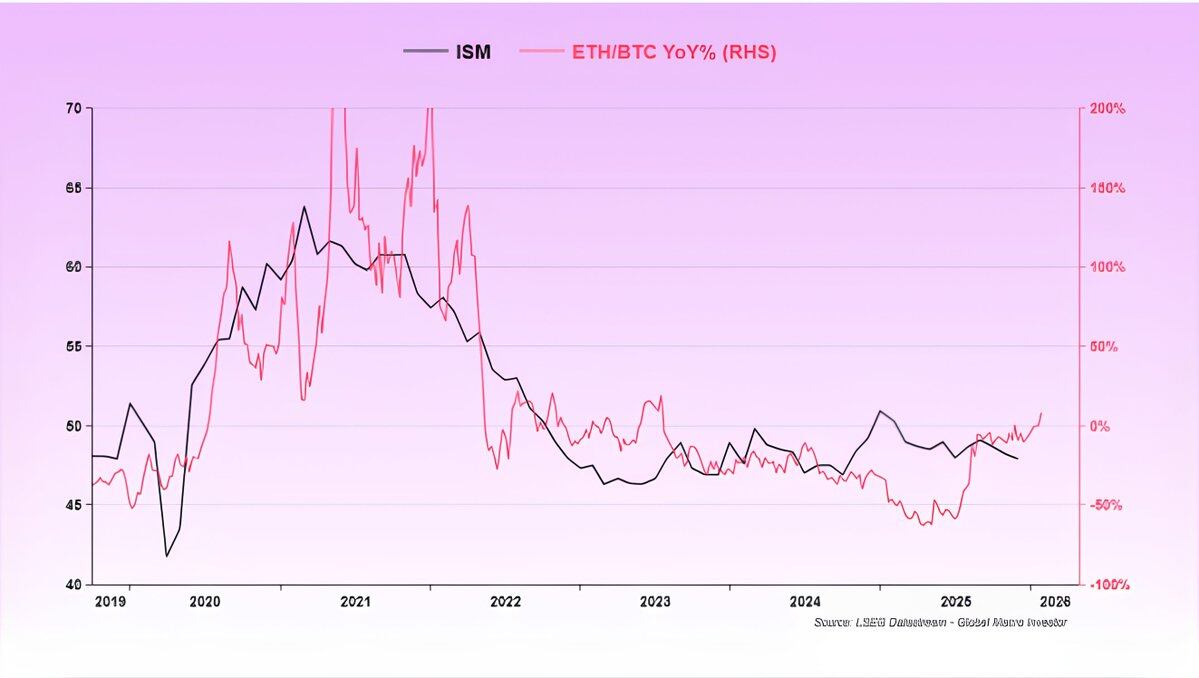
Earlier, the US Manufacturing PMI was below the expansion/contraction threshold for a long time, with the business cycle in a downturn. The crypto industry is highly dependent on market activity and investment appetite, naturally requiring the macro cycle to recover. For a long time, the macro environment was under continuous pressure. In addition, Bitcoin periodically shows a liquidity discount, decoupling from the overall liquidity trend. This phenomenon occurs cyclically. Crypto asset volatility is higher than liquidity indicators; when the market overheats, gains exceed expectations; when the market cools, losses also exceed expectations. Over an extended time frame, their correlation coefficient remains around 87%.
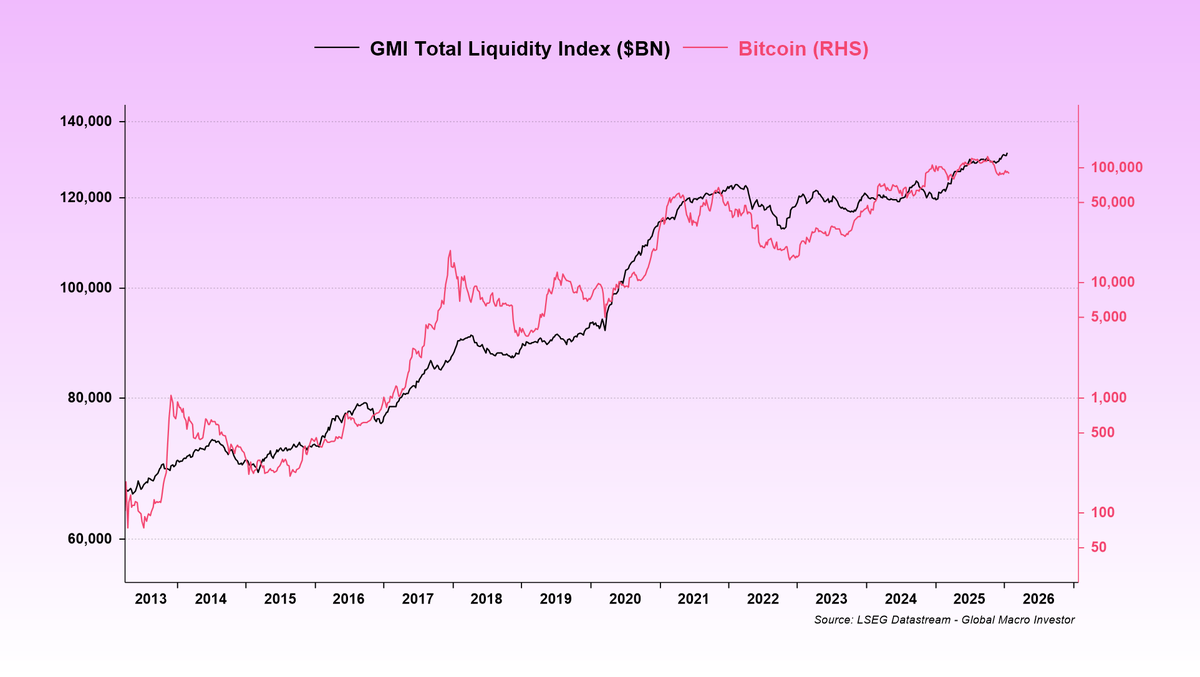
We are currently in a cool phase, leading many to conclude the long-term logic is invalid. That's not the case. The business cycle has already bottomed out and is recovering. The Manufacturing PMI has been in expansion territory for six consecutive months, with the latest July figure at 53.3. Historical patterns suggest that in such macro environments, the crypto market often sees a recovery. During the upward phase of the cycle, investor risk appetite increases, and a divergence occurs within the crypto market: junk bonds outperform treasuries, small-cap assets outperform large-cap leaders; Ethereum and other smart contract chains outperform Bitcoin. The reason is that economic activity boosts demand for block space, while savings demand drives Bitcoin's price.
How to Act
I won't give a fixed portfolio, nor will I predict the bottom. Thirteen years in this industry have taught me that no one can perfectly time the market. Forcing predictions will likely lead to repeating the tragedy of selling Bitcoin at $2,000.
The reflection at the beginning of this article is the most important takeaway. The crypto space is a long-term game that heavily tests one's mentality. Many people have their income and net worth deeply tied to the industry. The ultimate winner is not the one with the best short-term trading skills. It's the investor who can clearly understand the essence of the assets they hold, is confident in the network's continued adoption trend, and can withstand the deep 50% drawdowns that occur every few years.
Extend your horizon. Strip away the market noise. Simultaneously allocate to the digital vault (Bitcoin) and the underlying infrastructure of the economy (high-quality smart contract chains). Align yourself with the industry's growth curve instead of wasting energy trying to beat the cycle.