






เมื่อ ETH 8 ล้าน枚 เริ่ม «ย้ายบ้าน»: หลังยุค Pectra Staking กำลังเผชิญกับการเปลี่ยนแปลงเชิงโครงสร้างครั้งใหญ่?


- มุมมองหลัก: บทความวิเคราะห์ว่า Lido กำลังย้ายผู้ตรวจสอบที่จัดการ ETH กว่า 8 ล้าน枚 (มูลค่าประมาณ 16,000 ล้านดอลลาร์) ไปยัง "ผู้ตรวจสอบแบบทบต้น" (0x02 credentials) ที่นำมาใช้หลังการอัปเกรด Pectra ของ Ethereum การดำเนินการนี้มีจุดประสงค์เพื่อรวมผู้ตรวจสอบและลดต้นทุนการดำเนินงาน แทนที่จะเพิ่มผลตอบแทนอย่างมีนัยสำคัญ ซึ่งเป็นสัญญาณของการเปลี่ยนแปลงเชิงโครงสร้างของระบบนิเวศการ Stake บน Ethereum จากผลิตภัณฑ์มาตรฐานไปสู่การแข่งขันด้านโครงสร้างพื้นฐานที่ละเอียดยิ่งขึ้น
- องค์ประกอบสำคัญ:
- Lido วางแผนที่จะรวมผู้ตรวจสอบรุ่นเก่า 0x01 จำนวนกว่า 265,000 ราย เข้าเป็นผู้ตรวจสอบ 0x02 ซึ่งจะทำให้จำนวนผู้ตรวจสอบทั้งหมดบนเครือข่าย Ethereum ลดลงจากประมาณ 880,000 ราย เหลือประมาณ 628,000 ราย หรือลดลงเกือบหนึ่งในสาม
- EIP-7251 ในการอัปเกรด Pectra จะเพิ่มยอดคงเหลือสูงสุดที่มีประสิทธิภาพต่อผู้ตรวจสอบหนึ่งราย จาก 32 ETH เป็น 2048 ETH ซึ่งอนุญาตให้ผลตอบแทนถูกนำไปทบต้นโดยอัตโนมัติ ลดความจำเป็นในการสร้างผู้ตรวจสอบใหม่เพื่อจัดการ ETH ที่มากขึ้นอย่างต่อเนื่อง
- การจำลองในเอกสารแสดงให้เห็นว่า APR ของชั้น Consensus สำหรับผู้ตรวจสอบ 0x02 เพิ่มขึ้นเล็กน้อยเมื่อเทียบกับ 0x01 (เพิ่มขึ้นสัมพัทธ์ประมาณ 4.7%) และมีผลชัดเจนกว่าสำหรับผู้ Stake รายเล็ก ซึ่งเดิมทีมีปัญหาในการรวบรวมผลตอบแทนที่กระจัดกระจายเพื่อนำไปทบต้น
- สำหรับสถาบันขนาดใหญ่เช่น Lido คุณค่าหลักของการย้ายครั้งนี้คือการลดต้นทุนการจัดการโหนด คีย์ และข้อความในชั้น Consensus ผ่านการรวมผู้ตรวจสอบ แทนที่จะไล่ตามการเติบโตเพียงเล็กน้อยของ APR
- หลังจากย้ายไปยัง Curated Module v2 ผู้ให้บริการโหนดของ Lido จะต้องล็อก ETH เป็นหลักประกันเป็นครั้งแรก ซึ่งเป็นการเพิ่มข้อจำกัดด้านเงินทุนจริง และเป็นสัญญาณว่ามาตรฐานการแข่งขันได้เปลี่ยนไปสู่การจัดการเงินทุนและการควบคุมความเสี่ยง
There has been a significant piece of news overlooked by the market recently: Lido is in the process of "moving" over 8 million ETH (approximately $16 billion).
Of course, this is not about transferring funds from Lido to another new protocol, but about gradually migrating the hundreds of thousands of legacy validators that back stETH to a new validator architecture introduced after the Pectra upgrade.
According to Lido's plan, over 265,000 validators using the old 0x01 withdrawal credentials will be consolidated into fewer, higher-balance 0x02 validators. Upon completion of the migration, the total number of validators on the Ethereum network is expected to decrease from approximately 880,000 to around 628,000, a reduction of nearly one-third. The number of attestation messages that need to be propagated per epoch could also be reduced by about 29%.
This won't directly lower the gas fees paid by regular users, nor will it suddenly speed up transaction confirmation times. In fact, to complete the migration, Lido estimates the temporary loss of rewards will be equivalent to roughly 0.28% of the protocol's annual staking rewards.
So, given that the yield improvement is limited and the migration itself incurs costs, why is Lido still pushing for this multi-billion dollar "relocation"?
The answer lies in a crucial change brought by the Pectra upgrade in May 2025: Compound Validators.

1. What Exactly is Involved in Lido's "Move" of 8 Million ETH?
On May 7, 2025, the Pectra upgrade officially went live on the Ethereum mainnet.
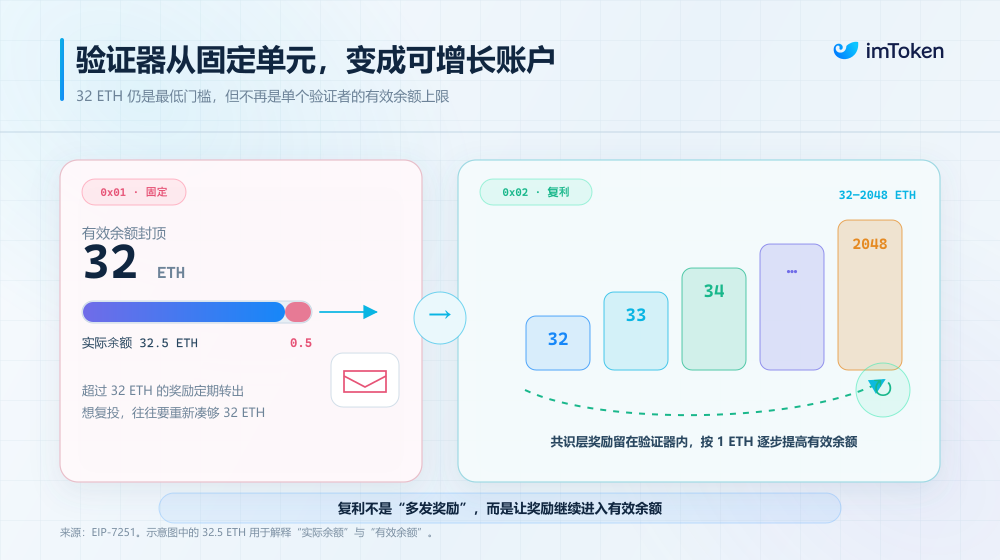
Key among its changes, EIP-7251, increased the maximum effective balance of a single validator from 32 ETH to 2048 ETH and introduced withdrawal credentials starting with "0x02". Validators using the new credentials can keep their consensus layer rewards within the beacon chain balance, gradually increasing their effective balance and generating new returns. Hence, they are also called "Compound Validators".
On the surface, this simply codifies "automatic reward compounding" into the protocol. However, the deeper change is that it breaks Ethereum's long-standing fixed 32 ETH validator structure.
As is well known, the effective balance cap for an Ethereum validator has always been fixed at 32 ETH. Regardless of whether the balance grows to 33 ETH or higher, the effective balance used for calculating consensus rewards is always capped at 32 ETH. The excess does not increase staking weight and is periodically transferred to the execution layer withdrawal address.
For individual stakers running only one or a few validators, to get their rewards to continue participating in native staking, they must gather enough rewards, scattered across different validators, to reach another 32 ETH. The barrier to compounding is high, and small leftover balances, having been sent to the withdrawal address, remain outside the staking system.
Simultaneously, for Lido, large exchanges, and professional staking service providers, while they can aggregate the small, scattered rewards from many users to create new 32 ETH stakes faster, they face a different kind of cost: every time an additional 32 ETH is accumulated, it typically requires creating and maintaining a new validator.
As Ethereum's staking scale has grown continuously, the number of validators has ballooned, leading to increased overhead for indexing, managing keys, signatures, and attestation messages, with operational and maintenance costs rising accordingly.
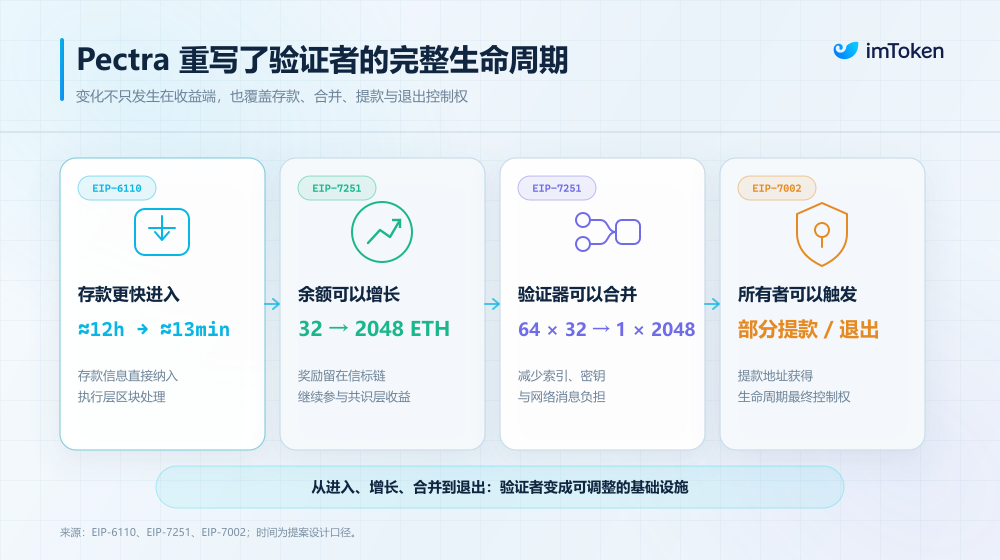
EIP-7251, introduced by Pectra, aims to change this structure.
In the new 0x02 mode, the minimum threshold to launch a validator remains 32 ETH, but the maximum effective balance for a single validator has been raised to 2048 ETH. This means rewards no longer have to be automatically withdrawn; instead, they can stay within the validator, continuously increasing the effective balance and generating new returns.
Furthermore, multiple existing validators can be merged. For example, 2048 ETH spread across 64 separate validators can be consolidated into a single high-balance validator. The total staking weight remains unchanged, but the number of validators, keys, and network messages that need to be maintained is drastically reduced (see extended reading: "Lean Ethereum" Revisits: What Answers Does Ethereum Aim to Provide?).
Ultimately, no funds leave Ethereum, and the economic security provided remains the same, but the operational burden drops significantly.
This is exactly the type of consolidation Lido is currently driving.
Strictly speaking, the term "compound" in compound validators only explains half of their value. The other half lies in the fact that validators can finally be reorganized from numerous standardized 32 ETH units into a simpler, more streamlined infrastructure suitable for large-scale operations.
2. What Kind of Yield Improvement Can Be Expected?
Interestingly, from a yield perspective, the improvement from compounding is not evenly distributed.
Theoretically, both individual stakers and large institutions can use 0x02 to reduce idle balances, allowing rewards to participate more directly in subsequent staking. However, because different participants start with different capital management capabilities, the marginal benefit from the upgrade varies.
A paper published in June 2026, "When Staking Rewards Compound: Measuring the Impact of Ethereum's Pectra Upgrade," compared the yields of 0x01 and 0x02 validators.
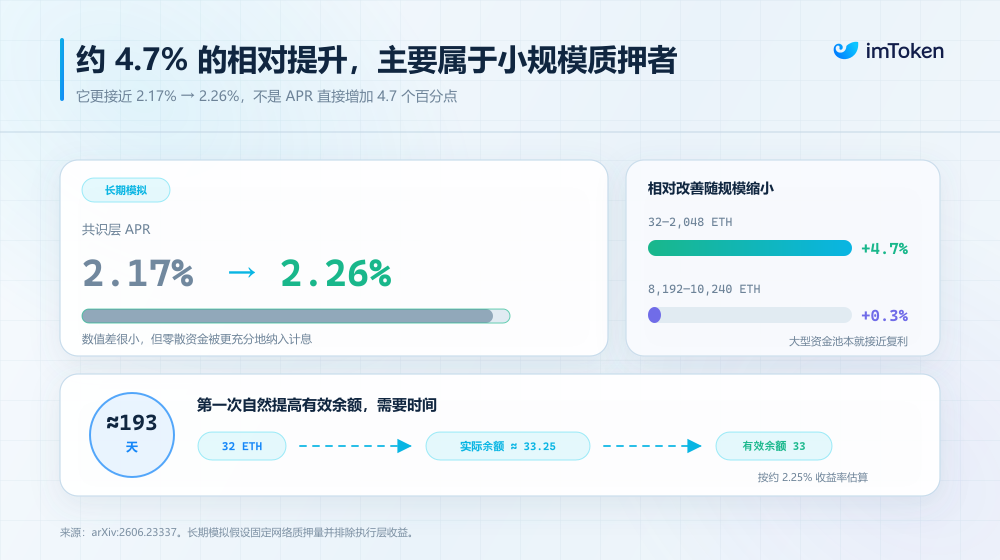
Simulation results show that for balances ranging from 32 ETH to 2048 ETH, the average consensus layer APR for 0x01 validators was approximately 2.17%, while for 0x02 validators it was about 2.26%. This represents a relative improvement of roughly 4.7% for the latter. However, when the staking scale reached 8192 ETH to 10240 ETH, the relative difference between the two narrowed to approximately 0.3%.
It's particularly important to note that the "approximately 4.7%" mentioned in the paper does not mean a direct 4.7 percentage point increase in APR. It refers to a relative improvement of about 4.7% on the base consensus layer APR of roughly 2% to 3%.
The primary reason smaller stakers see a more significant improvement is not because they have access to special yields, but because they previously faced greater difficulty in compounding their rewards.
For instance, a user with a single 32 ETH validator sees their rewards automatically transferred to a withdrawal address. They would need to accumulate for a long time or combine with other funds to reach another 32 ETH and launch another validator. Amounts less than 32 ETH remain scattered across different addresses, making consolidation less appealing.
However, a 0x02 validator allows these funds to continue increasing the effective balance within the same validator, thus reducing idle capital formed by amounts "under 32 ETH." In essence, what smaller stakers lacked in the past wasn't just the willingness to compound, but the ability to reinvest their scattered ETH back into native staking.
Large staking service providers can also benefit from native compounding, but they already possess stronger capital aggregation capabilities. They can quickly gather new 32 ETH batches and launch new validators. From the perspective of the entire capital pool, they could achieve capital allocation effects close to compounding.
Therefore, the larger the staking scale, the lower the proportion of idle balances relative to total capital, and consequently, the smaller the marginal benefit from adopting 0x02.
However, this does not mean 0x02 is unimportant for large institutions.
Quite the contrary, the core challenge for large institutions is shifting from "how to make rewards continue generating returns" to "how to manage more ETH with fewer validators."
For them, the value of 0x02 is mainly reflected in two aspects: first, rewards can stay within the validator to compound, reducing the need for frequent collection, redepositing, and validator creation; second, a large number of existing 32 ETH validators can be merged, significantly lowering the management overhead for nodes, keys, and consensus layer messages.
Of course, this change also brings new trade-offs.
Traditional 0x01 validators automatically transfer rewards exceeding 32 ETH to the withdrawal address without needing active on-chain operations. In contrast, 0x02 validators default to keeping rewards within them. For large service providers needing to meet user redemptions or schedule liquidity, they must actively initiate partial withdrawals and redesign their accounting, reward distribution, and capital buffer mechanisms.
Therefore, for small stakers, the most direct value of 0x02 is lowering the barrier to compounding and reducing idle capital. For large institutions, while the yield improvement is smaller, the efficiency gains from validator consolidation and infrastructure optimization are more critical.
Both benefit from the same mechanism, but their sources and priorities of benefit are different.
3. Changes and Constants in the Ethereum Staking Ecosystem
So, if you only look at APR, Lido's migration might not seem like an exceptionally attractive endeavor.
After all, the yield improvement for large service providers from compounding might be less than 1%, and the migration process involves temporary reward losses. Their existing accounting, withdrawal, and liquidity management systems also need adjustments.
Yet, Lido has decided to push forward with its most significant core architecture upgrade since V2 in 2023. This is because when a protocol manages over 8 million ETH, the sheer number of validators itself becomes a cost.
Especially after the Pectra upgrade, a single 2048 ETH validator can carry the staking weight equivalent to 64 traditional validators. This means being able to manage more capital more efficiently with fewer validators.
In reality, Lido's upgrade isn't just about merging validators.
With the migration to the Curated Module v2 (CMv2), its professional node operators are, for the first time, required to lock ETH as a security deposit. If operational interruptions, slashing, reward mismatches, or other attributable issues occur, this deposit can be used to cover losses.
Previously, Lido's curated node operators relied primarily on historical performance and reputation for trust. While reputation still matters, a layer of real capital commitment has been added. All 34 existing curated node operators are expected to migrate to CMv2, with none opting out due to the collateral requirement.
This change might be more noteworthy than the compounding aspect itself. It suggests that the competitive standards for post-Pectra staking are undergoing a structural transformation. Future differences between staking services will likely manifest more in how effectively they utilize funds, manage withdrawals and liquidity, allocate validator risk, and balance asset control, operational complexity, and returns.

For user-facing platforms like wallets, the value no longer lies solely in displaying a yield figure. They must help users understand the capital flows and risk structures behind different staking methods. Take imToken Stake as an example:
- Users can currently enter the staking function directly from the ETH asset page, choosing services based on their capital size and needs. Users wishing to participate with smaller amounts can do so via the integrated staking service within the wallet.
- For users holding over 32 ETH who wish to retain control of their assets, non-custodial validator solutions are available. These allow participation in Ethereum native staking without needing to maintain a node themselves.
As compound validators become more common, the information these entry points need to present will grow. This includes whether yields are auto-compounded, when rewards can be withdrawn, what withdrawal credentials the validator uses, who controls the funds, and the technical and liquidity risks associated with different options.
This also means wallets are no longer just connecting to single staking yield page, but to a set of increasingly differentiated validator services.
Final Thoughts
Overall, from The Merge to the Shanghai upgrade, and now to the Pectra upgrade, Ethereum is progressively completing the lifecycle of staking.
The Merge made validators the core of network security. The Shanghai upgrade addressed the issue of how staked funds can be withdrawn. The Pectra upgrade begins to optimize how funds enter, accumulate, and are reorganized within the system.
Of course, compound validators won't lead to equal yield improvements for all participants:
- For small stakers, it can reduce idle balances, allowing long-held ETH to participate more fully in consensus.
- For large institutions, its more important value might not be raising APR, but reducing the number of validators and lowering operational burdens.
Therefore, the migration to 0x02 validators is destined to be gradual. Different participants, based on their capital size, liquidity needs, and operational structure, will choose whether to keep their existing validators or gradually transition to the compounding model.
Nevertheless, the way Ethereum organizes its staking capital is already undergoing a profound structural shift. Especially now that validators are no longer fixed at 32 ETH, the staking ecosystem is evolving from standardized yield products towards more granular capital management and infrastructure competition.
This evolving paradigm shift in Ethereum staking is well worth tracking over the long term.





