好的,这是根据您的要求翻译后的内容: Tiger Research: AI Agent Wallet Infrastructure, the Underlying Engine for a 7-Fold Revenue Leap


- Core Thesis: To support the large-scale, high-frequency micro-payment needs of future AI agents, the crypto wallet industry is racing to build out its capabilities. The ultimate goal is to seize the infrastructure of the agent economy era and the related potential financial services, despite the absence of short-term revenue.
- Key Elements:
- Existing payment systems (e.g., bank cards), with their high fixed fees and chargeback mechanisms, cannot handle the thousands of sub-cent or smaller payment requests an AI agent might make per second.
- Companies like Coinbase are proactively building agent wallets that support programmability and automatic splitting. The core logic is to lock in the future user base, rather than competing for current fee income.
- Calculations based on Coinbase data indicate that in an aggressive scenario of widespread AI agent adoption, its annual revenue could reach up to approximately 7 times its current total revenue, with revenue increments growing geometrically.
- The payment history accumulated by wallets can serve as a credit standard for evaluating AI agent income, laying the groundwork for new financial services like loans based on future revenue (e.g., RBF).
- Currently, the market still faces significant obstacles, including erroneous payments by AI agents, fragmentation of payment protocols, and unclear legal status for agents. The sector is still in its validation phase.
This article is written by Tiger Research. Headlines often report on AI agents trading autonomously and handling payments by themselves. In reality, the crypto wallet industry has been quietly laying the groundwork for some time. Currently, more than ten companies are specifically building wallets for agents. What do they truly want? And how big is the potential return?
Key Takeaways
- When AI agents browse the web, purchase goods, or access information on behalf of humans, they initiate hundreds or thousands of micro-payments, each worth only a few cents or even less. The existing credit card payment infrastructure simply cannot handle this volume, requiring wallets capable of automatically splitting and sending funds based on predefined conditions.
- Despite generating almost no revenue in the short term, companies like Coinbase and Binance are still doubling down on AI wallet infrastructure. The reason is simple: to secure the future user base before agents engage in large-scale transactions. This current phase is about gaining an early-mover advantage before actual demand explodes.
- Based on Coinbase's data, after the increase in AI agent usage, its revenue could potentially reach up to approximately 7 times its current level.
- The payment history accumulated in wallets can intuitively show whether a specific AI agent is generating income. This opens the door for providing loans based on future earnings – similar to extending credit to a small business based on its credit card transaction history.
- However, all of this remains at the stage of possibility, not established fact. AI agents can still make errors and execute incorrect payments; regulations vary across countries and companies; and the legal status of agents is still unclear. Therefore, the current focus of competition is not on making money today, but on securing a strategic position years in advance for a market expected to take shape.
AI Agents Are Becoming Fully Active
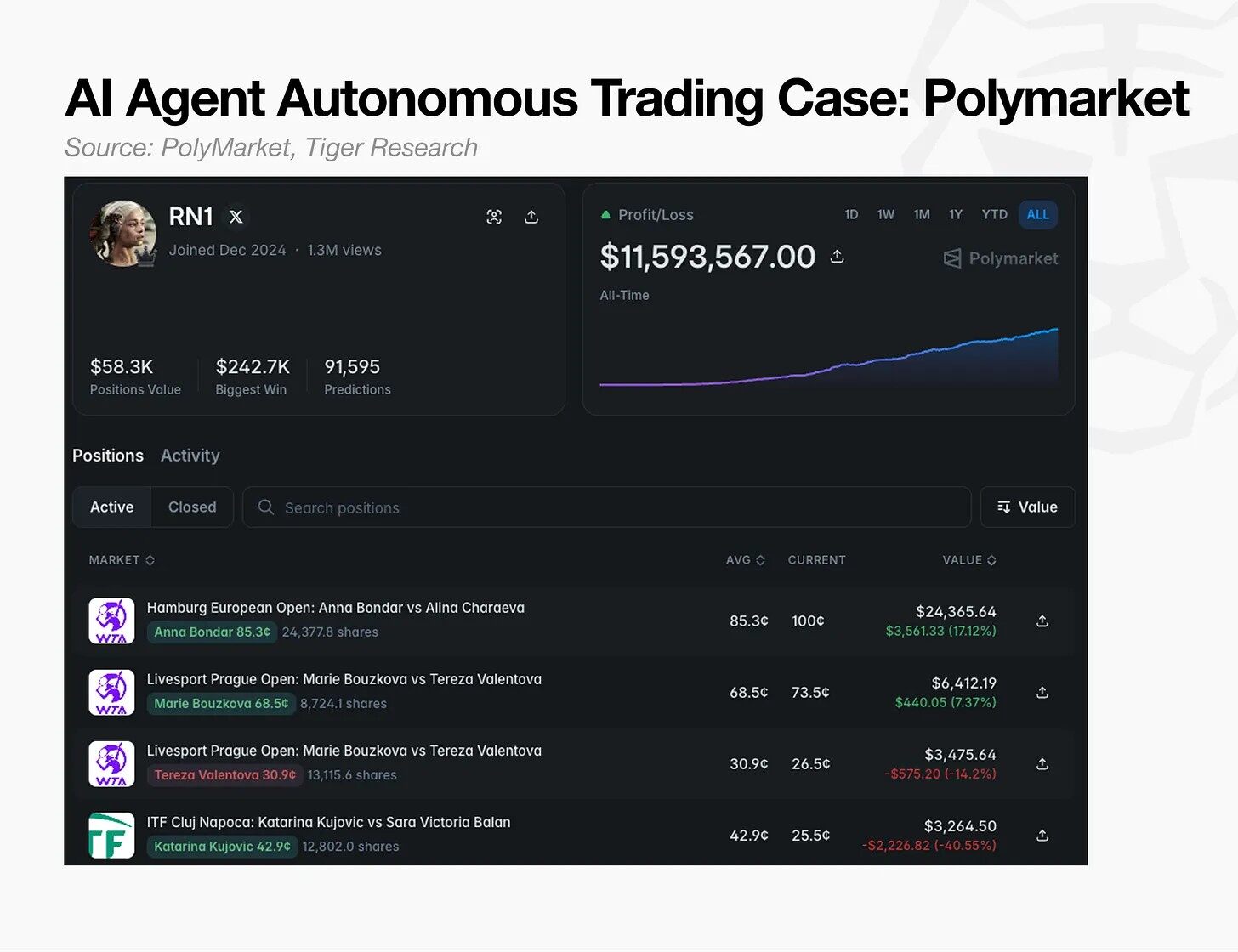
Earlier this year, a widely-followed experiment took place on the prediction market Polymarket: an AI agent was given $50 in seed capital to trade autonomously, with the condition that it would "disappear" if it failed to earn enough to cover API and server costs. The result was that the agent successfully traded. Since then, a series of similar agents have started trading in the same manner.
AI agents have not yet entered everyday life, but it is already clear that they will be used on a large scale in the near future.
Every Agent Transaction Begins with a Wallet
Currently, AI agents have not yet entered everyday payment scenarios. Their most active application remains as trading bots within the crypto ecosystem – operating independently of traditional payment rails, focused on cryptocurrency trading.
In the future, payments will extend into areas that are difficult to imagine today. As noted in our previous report, AI is changing the very nature of payments. Once agents, rather than humans, act directly on the network, the value of individual payments will drop dramatically. The cost of a single API call or a data query could be as low as $0.001, or in extreme cases, even $0.00001.
To move beyond current wallet usage and achieve payments of such small amounts, automatically split based on preset conditions, and executed without human intervention, a programmable payment system is essential. This is the context in which the x402 payment rail emerged, and the wallet serves as the foundation for this rail to operate.
However, existing payment rails are designed around "humans" as the transacting entities.
Bank cards are issued to specific cardholders and utilize a chargeback mechanism – when a problem occurs, humans dispute and reverse the transaction – and each transaction incurs a fixed fee of tens of cents. These are not issues when a person occasionally spends $20. But once an agent starts issuing thousands of payments per second, at $0.001 per API call and $0.00001 per data record, this payment model becomes economically unviable.
The core issue is: Is money itself programmable?
Bank cards can automate the input of payment information, but they cannot be programmed to split payments based on conditions, stream payments, or settle funds flows instantly. Conversely, the rails on which wallets operate inherently possess these capabilities by default. Storing payment information on a card can, at best, execute a "human-scale" transaction on behalf of a person. Once the economy shifts towards machine-to-machine transactions, the wallet becomes the only possible starting point.
Agents Could Represent a $50 Billion Business

As can be seen from the relevant table, wallet providers have a broad coverage, ranging from exchanges to stablecoin issuers. Why are so many different types of players entering the agent wallet infrastructure space, which shows almost no profitability in the short term?
The answer is: They are positioning for future revenue and business, not today's. Adding agent functionality to wallets now is not about making immediate money, but about building capacity in advance to absorb massive transaction volumes when agents become highly active.
The key point is that AI agents will ultimately operate 24/7 in a browserless environment, requiring no human intervention. Imagine a user asking an agent to complete a research report. While the agent gathers information, it executes a small payment each time it pulls paid data from different platforms. One user command could instantly trigger 20, 30, or even more payments.
A request that seems like a simple operation for a human, once processed by an AI agent, transforms into a massive number of payment transactions.

How would this change in the payment environment affect a company's revenue? An estimation can be made using disclosed data from Coinbase. The calculation is based on Coinbase's 9.2 million monthly transacting users (MTU), not its total of approximately 120 million registered users.
Combining three variables – adoption rate, number of agents per user, and daily call frequency – leads to the following scenarios:
- Conservative scenario (10% adoption rate, 1 agent per user, 50 calls per day): ~$84 million in additional annual revenue, representing a 1.2% increase.
- Base scenario (50% adoption rate, 2 agents per user, 200 calls per day): Additional revenue rises significantly to ~$3.36 billion, representing a 46.8% increase.
- Aggressive scenario (100% adoption rate, 3 agents per user, 1000 calls per day): Annual revenue reaches ~$50.37 billion, roughly 7 times Coinbase's current total revenue.
The most striking aspect of this comparison is that the gap between the scenarios amplifies geometrically, not additively. While the adoption rate increases only 10x (from 10% to 100%), the revenue gap expands by about 600 times – from $84 million to $50.37 billion.
This is because the three variables – adoption rate, agents per user, and daily calls – are multiplicative. Any small increase in one can lead to exponential growth in the total. Therefore, once agents achieve mass adoption and the user base surges, the resulting revenue stream could reach up to approximately 7 times current total revenue.
This is precisely why Coinbase is aggressively promoting agent wallet infrastructure even though it generates almost no related revenue today – it wants to lock in its share of the revenue expected to emerge from the agent era well in advance.
Towards a New Bank for Agents

The transaction data accumulated through wallet infrastructure is far more than simple records. It provides the foundation for new business models: the payment history stored in wallets can serve as a credit standard for evaluating the financial health and performance of AI agents.
Once this data-driven credit assessment system is established, wallet providers can naturally extend into next-generation financial services, such as Revenue-Based Financing (RBF) specifically tailored for agents.
Stripe Capital is a prime example. It successfully built a new financial business on top of existing payment data. When Stripe launched its lending service, Stripe Capital, in September 2019, it did not rely on external credit bureaus or require cumbersome loan documentation. Instead, it directly used real-time sales data for each merchant within its own payment network to assess loan eligibility and amounts.
The Stripe case demonstrates that a company can build a high-value financial business on top of its existing operational data pipeline, without needing an additional sales network or marketing investment.
Agent wallet providers are likely to follow a similar expansion path. By continuously accumulating agents' income data through the wallet, they gain the foundation to provide operational capital via RBF and earn returns as a financial platform focused on agents.
However, for this new business line to truly materialize, there is a prerequisite: AI agents must evolve from being mere payment executors into asset-holding entities capable of generating their own income, earning enough real revenue to repay loans.
This Growth Remains Unvalidated
The descriptions above – of Coinbase's revenue potentially growing 7x and expanding into RBF – are optimistic scenarios assuming the widespread adoption of agent payments. Significant obstacles remain to bring this to life within the real economy.
First, there are major questions regarding the actual purchase conversion rate and payment reliability of AI agents. When placing orders autonomously, agents can still make "hallucination" errors, leading to incorrect payments; they are also sometimes blocked by issuers' anti-fraud systems (FDS). Consequently, the actual payment completion rate remains low.
Furthermore, payment protocols like x402, AP2, and MPP remain fragmented and have not yet converged to a single standard. Additionally, AI agents are not legal entities, and the lack of clear KYC and financial regulations further hinders market expansion.
Therefore, the current objective for wallet providers is not short-term fee income. Apple's App Store took 15 years to build a $10 billion annual fee market. WeChat Pay took 7 years to establish its vast mini-program ecosystem. Agent wallets are on a similarly long timeline – they are building an ecosystem, not chasing immediate returns.
The competition today is not about today's marginal revenue, but about which company can be the first to control the data flow of agent-driven economic activity five to ten years into the future.