






Tokenized stock market grows 56% in three months: How can crypto solve the liquidity fragmentation puzzle?


- Core Thesis: Tokenized stocks represent the fastest-growing category in the current RWA sector, with market size surging 56% to $1.88 billion in three months. However, this expansion is accompanied by significant liquidity fragmentation, which divides the market along both vertical and horizontal dimensions.
- Key Elements:
- The tokenized stock market is expanding through three main channels: synthetic securities (e.g., Ondo), issuer-sponsored tokenized securities (e.g., Securitize), and perpetual contract exchanges (e.g., Hyperliquid).
- Liquidity fragmentation manifests in two dimensions: vertically, different tokenization structures (e.g., custodial, synthetic securities, derivatives) are non-interoperable; horizontally, fragmentation exists among different providers of the same structure (e.g., Robinhood vs. xStocks).
- Taking TSLA as an example, it can theoretically be traded in various forms including original shares, DRS, custodial tokens, synthetic securities, swaps, funds, and perpetual contracts. Liquidity for each form is independent and non-fungible.
- From an accessibility perspective, fragmentation may be a byproduct of attracting new investors rather than simply disrupting existing liquidity; the stablecoin sector addressed similar issues through orchestration platforms.
- Potential solutions include: the emergence of intermediary entities like clearing houses or orchestration platforms, or the market naturally consolidating into an oligopoly or monopoly structure driven by economies of scale and network effects.
Original Author: @100y_eth
Original Compilation: AididiaoJP, Foresight News
Key Takeaways
Although the overall growth of the RWA sector has slowed in recent months, tokenized stocks continue to expand at an exceptionally rapid pace. Currently, the tokenized stock sector is expanding through three main channels:
- Linked Security tokenized stocks offered by Ondo, xStocks, Robinhood, etc.;
- Issuer-Sponsored tokenized securities offered by Securitize, Figure, Superstate, etc.;
- The growth of perpetual futures exchanges (strictly speaking, this is not tokenization).
While the tokenized stock sector is growing overall, liquidity fragmentation has begun to emerge as a side effect. Even when the underlying stocks are the same, liquidity is fragmented across two dimensions:
- Vertically, between different tokenization structures;
- Horizontally, between different tokenization providers using the same structure.
From a more positive perspective, particularly in terms of improving accessibility, this phenomenon does not necessarily represent the fragmentation of existing liquidity. Instead, tokenized stocks may have attracted investors who previously had no access to US stock market liquidity, with fragmentation being a mere byproduct.
Regardless, the fragmentation of liquidity in tokenized stocks is a real problem. Potential solutions might include:
- The emergence of an orchestration or clearing platform similar to those in the stablecoin sector;
- Consolidation into an oligopoly or monopoly structure driven by economies of scale.
Tokenized Treasuries Stall, Tokenized Stocks Surge Ahead
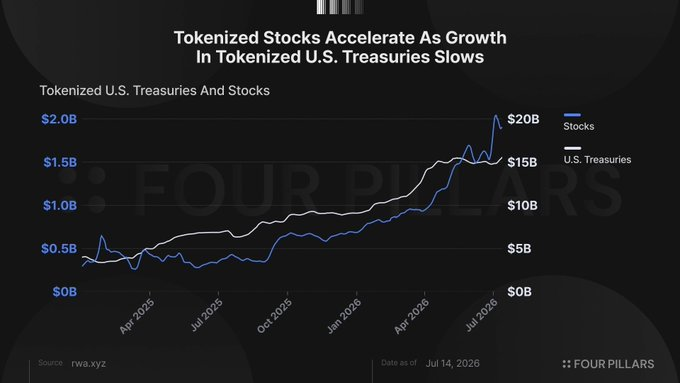
Market interest in RWA remains strong. It's no exaggeration to say that tokenized US Treasuries have been the main engine of RWA growth to date. From January 1, 2024, to the present, total crypto market cap has only grown from $1.65 trillion to $2.19 trillion, an increase of about 1.33 times. In contrast, the tokenized US Treasury market has expanded from $695 million to $16.1 billion over the same period, a growth of 23 times.
However, the previously explosive growth of tokenized US Treasuries has recently begun to slow. This trend is not limited to Treasuries. Other RWA categories like stablecoins, private credit, and commodities have recently shown signs of stagnation or even contraction. Within the RWA sector, however, one asset class has recently exhibited rapid growth: tokenized stocks.
Over the past three months, the tokenized stock market has grown from $1.2 billion to $1.88 billion, a 56% increase. During the same period, tokenized US Treasuries grew only 7.3%, private credit grew 16%, and commodities decreased by 13%. These figures clearly illustrate the steepness of the recent growth in tokenized stocks.
Several factors explain the rapid growth of tokenized stocks. Fundamentally, due to the recent rally in AI and semiconductor-related stocks, equities as an asset class have attracted more attention. Furthermore, as the RWA market matures, the pathways and structures for stock tokenization have become quite clear. Consequently, numerous tokenization platforms have begun offering tokenized stock services, and the market is starting to see scale growth.
The current growth of tokenized stocks is primarily achieved through three main channels:
The first is the growth of platforms using offshore structures to tokenize debt instruments as Linked Securities, including Ondo Global Markets, Backed Finance xStocks, and Robinhood Stock Tokens. These stock tokens do not represent direct rights to the underlying shares. However, because they face fewer compliance restrictions in secondary distribution, they can be actively used in on-chain DeFi protocols, enabling rapid growth.
The second is the growth of platforms like Securitize, Superstate, and Figure. They directly tokenize existing shares via transfer agents. As these platforms tokenize the shares themselves while fully complying with securities laws, they face strict compliance restrictions in both issuance and secondary trading. This leads to a smaller number of available stocks and more limited utility. However, when these platforms partner with companies to tokenize their shares, the number of stocks may be limited, but the size of tokenization for each individual stock can be very large. Therefore, they have recently made significant contributions to the growth of the tokenized stock market.
The final channel is perpetual futures exchanges like Hyperliquid, Variational Omni, and QFEX. Strictly speaking, the stock products traded on perpetual futures exchanges are not tokenized stocks. Nevertheless, a large number of users are already trading products that track stock prices through these exchanges, and on a massive scale.
However, from the perspective of financial market development, the emergence and growth of tokenized stocks cannot be viewed entirely positively. Just as growth always has a dark side, the expansion of tokenized stocks has also brought several problems. This report focuses on one of these issues: liquidity fragmentation.
Liquidity Fragmentation of Tokenized Stocks
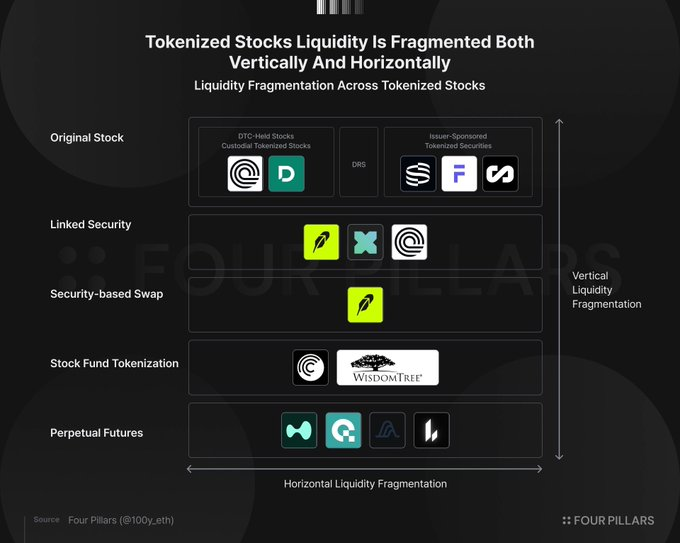
Even when the underlying stocks are the same, liquidity can be fragmented both vertically and horizontally depending on the tokenization structure and platform.
Vertical Liquidity Fragmentation Between Different Tokenization Methods
There are various ways to tokenize stocks:
- Custodial Tokenized Stocks: A third party tokenizes the rights to shares held within the DTC custody system. Representative examples include DTCC, Ondo, Dinari.
- Issuer-Sponsored Tokenized Stocks: The issuer or transfer agent directly tokenizes share ownership. Representative examples include Securitize, Figure, Superstate.
- Linked Security: A third party issues and tokenizes a separate security that provides economic exposure to the underlying stock. Representative examples include Robinhood Stock Tokens, Backed Finance xStocks, Ondo Global Markets.
- Security-Based Swap: A third party tokenizes a derivative contract providing economic exposure to the underlying stock. A representative example is Robinhood Classic Stock Tokens.
- Stock Fund Tokenization: Tokenizing shares of a fund composed of stocks. Representative examples include Centrifuge, WisdomTree.
- Perpetual Futures: These platforms do not tokenize stocks but operate exchanges offering perpetual futures markets that track stocks. Representative examples include Hyperliquid, QFEX, Variational Omni, Lighter.
Even if the underlying stock is the same, liquidity fragmentation exists between different tokenization methods. Custodial tokenized stocks and issuer-sponsored tokenized stocks are based on original shares; Linked Securities tokenize debt securities; security-based swaps tokenize derivatives; stock fund tokenization involves fund shares. These instruments are therefore non-interoperable. Perpetual futures, fundamentally, do not tokenize stocks and thus trade in separate markets with their own liquidity.
Horizontal Liquidity Fragmentation Within the Same Tokenization Method
Even when the tokenization method is the same, liquidity can be fragmented depending on the entity performing the tokenization.
- Original Stocks: Even if tokens are based on original shares, they may not be interoperable. Shares held within the DTC custody system and tokenized as custodial tokenized stocks are different from shares whose ownership is directly registered with the transfer agent and tokenized as issuer-sponsored tokenized stocks. Thus, liquidity is fragmented among: 1) shares in DTC custody vs. custodial tokenized stocks; 2) shares directly registered via DRS; 3) issuer-sponsored tokenized stocks – because these three categories are non-interoperable.
- Linked Securities: Under this tokenization method, liquidity is fragmented between different tokenization platforms. Even if the underlying stock and tokenization structure are the same, the resulting tokens differ based on the tokenizing entity, e.g., Robinhood, xStocks, or Ondo Global Markets.
- Stock Fund Tokenization: Under this method, liquidity is also highly fragmented, depending on the type of fund and the management entity. However, it's hard to say tokenization itself creates this fragmentation. Funds and ETFs composed of stocks have existed in various forms in traditional financial markets for a long time, and their liquidity was already fragmented.
- Perpetual Futures: Following Hyperliquid's success, numerous perpetual futures exchanges have emerged. Even if they list the same stock, that stock trades separately on each exchange, each with its own fragmented liquidity.
A Hypothetical Scenario
Imagine a hypothetical scenario where TSLA shares are tokenized through every method and platform mentioned above. TSLA could then trade in the following forms:
- Original TSLA: TSLA shares traded on NASDAQ. Even in traditional stock markets, TSLA trades not only on NASDAQ but also on various public electronic exchanges, alternative trading systems (ATS), and OTC markets. It also trades on various overseas exchanges and as depositary receipts. Its liquidity is therefore already fragmented to some extent.
- Multiple Custodial Tokenized TSLA Products: These are products that tokenize rights to TSLA shares already held within existing DTC and brokerage account systems. DTCC could tokenize TSLA, and different securities firms could tokenize their own rights to TSLA shares. However, since these tokens merely represent rights within the traditional stock market system as tokenized receipts, it's hard to view their liquidity as entirely separate from the original shares.
- DRS TSLA: TSLA shares held via DRS, with ownership directly registered with Tesla or Tesla's transfer agent. This asset is already fragmented from the original TSLA shares.
- Issuer-Sponsored Tokenized TSLA: Tokenized TSLA shares where ownership is directly registered with Tesla or Tesla's transfer agent in token form. To trade in the same liquidity pool as original TSLA shares, ownership would need to be moved back from direct registration to the DTC custody system.
- Multiple Linked Security TSLA Products: Under this structure, tokenization platforms tokenize debt securities backed 1:1 by TSLA shares. Since platforms like Robinhood, Ondo, and xStocks can each tokenize TSLA into different tokens, liquidity fragmentation occurs.
- Multiple Security-Based Swap TSLA Products: Under this structure, tokenization platforms tokenize derivative contracts where TSLA stock is the underlying asset.
- Multiple Tokenized Stock Fund Shares Containing TSLA: Under this structure, shares of funds whose portfolio includes TSLA are tokenized.
- TSLA Traded on Multiple Perpetual Futures Exchanges: TSLA trades separately on each perpetual futures exchange, each with its own independent liquidity.
In summary, while TSLA liquidity within the traditional securities system was already fragmented, this fragmentation has historically been limited to ATS, DRS, and overseas exchanges. However, in the tokenized stock ecosystem, there could be numerous tokenized forms of TSLA under different legal structures, including derivative contracts, debt securities, and fund shares. These products might also target completely different investor groups, such as US vs. non-US investors, or retail vs. institutional investors.
None of these products are interoperable; each trades in a market with its own liquidity. Consequently, tokenization could potentially fragment TSLA's liquidity far more than it is today.
The Paradox of Tokenized Stocks: How Can Liquidity Fragmentation Be Solved?
The value proposition of tokenized stocks is clear. They offer benefits like higher accessibility, 24/7 trading, faster settlement, and integration with smart contracts. Tokenization aims to provide better financial services for people around the world. However, in the case of tokenized stocks, it seems to produce the paradoxical side effect of liquidity fragmentation.
Personally, I think this view is partly correct and partly incorrect. How one interprets this issue depends on how one views the tokenized stock ecosystem.
Looking at the current state, the tokenized stock ecosystem undoubtedly suffers from liquidity fragmentation. A single stock can experience both vertical liquidity fragmentation between different tokenization structures and horizontal liquidity fragmentation between different platforms using the same tokenization structure.
However, from the perspective of improving accessibility, the situation looks different. Rather than tokenization fragmenting the liquidity of existing stock markets, the newly created platforms have improved access to these markets for some investors, ultimately resulting in liquidity fragmentation. Linked Security tokenization, security-based swap tokenization, and perpetual futures have opened accessibility paths for investors who previously had difficulty accessing US stocks, thus bringing new liquidity into the market.
Regardless of whether liquidity fragmentation is an inherent problem of tokenized stocks or an eventual byproduct of their growth, this issue will become more severe if the tokenized stock market grows to be much larger than its current size. Therefore, solving it will become important.
In the stablecoin sector, companies have attempted to solve liquidity fragmentation through stablecoin orchestration platforms and services resembling clearinghouses. So, how can the liquidity fragmentation of tokenized stocks be solved? Two potential scenarios can be considered.
The first scenario is the emergence of a platform that plays a role similar to stablecoin orchestration or clearing in the tokenized stock sector. However, unlike stablecoins, which typically use a consistent tokenization method and have relatively simple rights structures, tokenized stocks utilize diverse tokenization structures involving complex rights and cover a number of individual securities far exceeding stablecoins. Therefore, it's hard to imagine a single entity handling all of this at scale.
The second scenario is market consolidation into an oligopoly. In the early stages of any industry, numerous participants often emerge. However, factors like liquidity and network effects make it highly likely that the industry will eventually reorganize around a few dominant or monopoly platforms. Tokenized stocks are unlikely to be an exception. As regulatory conditions become clearer and restrictions ease, a specific stock tokenization structure or platform could see significant growth, leading to the concentration of liquidity.
Tokenized stocks are still in their infancy. Following stablecoins and tokenized Treasuries, it remains to be seen how the tokenized stock market will evolve and whether it can deliver value to investors consistent with the fundamental purpose of tokenized equity.


