






จาก "กลัวพลาด" สู่ "กลัวถือ": การเหยียบกันของโมเมนตัมจะคงอยู่นานเท่าไร? นี่คือปริศนาที่ใหญ่ที่สุดของตลาดในขณะนี้


- มุมมองหลัก: โกลด์แมน แซคส์เตือนว่า ตำแหน่งกลยุทธ์โมเมนตัมของกลุ่ม AI และเทคโนโลยีห่างไกลจากการเคลียร์สัญญา ความผันผวนในไตรมาสที่สามจะยังคงดำเนินต่อไป ปัจจัยโมเมนตัมลดลงติดต่อกันเป็นสัปดาห์ที่ห้า กองทุน ETF แบบเลเวอเรจประสบกับการล่มสลายครั้งประวัติศาสตร์ ความสนใจของตลาดเปลี่ยนจากการใช้จ่ายด้านทุนไปสู่อัตรากำไรและผลตอบแทนจากการลงทุน แรงกดดันหลายด้านกำลังปะทุขึ้นพร้อมกัน
- ปัจจัยสำคัญ:
- ปัจจัยโมเมนตัมลดลงติดต่อกันเป็นสัปดาห์ที่ห้า ขนาดของกองทุน ETF แบบเลเวอเรจลดลงครึ่งหนึ่งจากจุดสูงสุด อารมณ์ตลาดเปลี่ยนจาก "กลัวพลาด" เป็น "กลัวถือ"
- วาทกรรม AI เปลี่ยนไปสู่ความขัดแย้งหลัก: ความสนใจเปลี่ยนจากการใช้จ่ายด้านทุนไปสู่อัตรากำไร ผลตอบแทนจากการลงทุน และขนาดการออกพันธบัตร Spread เครดิตของผู้ให้บริการคลาวด์รายใหญ่ขยายตัวอย่างรวดเร็ว
- ตั้งแต่ต้นปีถึงปัจจุบัน อุปทานพันธบัตรที่เกี่ยวข้องกับ AI สูงถึง 489 พันล้านดอลลาร์ คิดเป็น 1.5 เท่าของปริมาณที่คาดการณ์ทั้งปี ต้นทุนการจัดหาเงินทุนผ่านหนี้สูงขึ้น
- ความสัมพันธ์โดยนัยของหุ้นใน S&P 500 อยู่ในระดับต่ำมาก แต่ความผันผวนของหุ้นรายตัวพุ่งสูงขึ้น ซึ่งเป็นโครงสร้างที่สนับสนุนการทำ Long ความผันผวนของดัชนี
- ตลาดเอเชียมีการเคลื่อนย้ายเงินทุนจากกลุ่มโมเมนตัมสูงไปยังสินทรัพย์ป้องกันความเสี่ยง การถือครองฟิวเจอร์สทองคำเพิ่มขึ้น ความต้องการหลบภัยเพิ่มสูงขึ้น
- แรงกดดันหลายด้านปะทุขึ้นพร้อมกัน: ความขัดแย้งทางภูมิรัฐศาสตร์ ความผันผวนของราคาน้ำมัน แนวโน้มอัตราดอกเบี้ย และความเสี่ยงจากภาษี การแย่งชิงอำนาจการกำหนดราคาในตลาดทวีความรุนแรงขึ้น
Original Author: Dong Jing
Original Source: Wall Street Sights
Beneath the deceptive calm of global stock markets, a historic collapse of momentum strategies is accelerating. Goldman Sachs trader Benny Quek warns that positions in AI and tech sectors are far from cleared, and volatility will persist into the third quarter.
The momentum factor has fallen for five consecutive weeks, with leveraged ETFs experiencing a historic crash. Market sentiment has rapidly shifted from "fear of missing out" (FOMO) to "fear of holding." Meanwhile, the core narrative of AI is pivoting from capital expenditure to profit margins and returns on investment, and credit spreads for hyperscale cloud vendors are widening sharply, putting pressure on the market.
Multiple pressures are brewing synchronously — geopolitical conflicts, oil price fluctuations, interest rate trends, and re-emerging tariff risks are all vying to dominate market pricing. Goldman Sachs' risk appetite indicators remain high, while implied correlation among S&P 500 constituents is extremely low. This combination provides structural support for long positions in equity index volatility.
Momentum Collapse Enters Fifth Week, Leveraged ETFs Bear the Brunt
The rout in the momentum factor is the most prominent structural feature of the current market.
According to Goldman Sachs trader Benny Quek's latest "Weekend Thoughts" report, the unwinding of momentum strategies has been ongoing for five consecutive weeks, accompanied by a historic collapse in leveraged ETFs.
Taking the Korean market as an example, the size of leveraged ETFs has halved from a peak of $53 billion to approximately half, and the proportion of leveraged exposure relative to the market's free-float market capitalization has fallen from a peak of 3.3% to 2.1%.
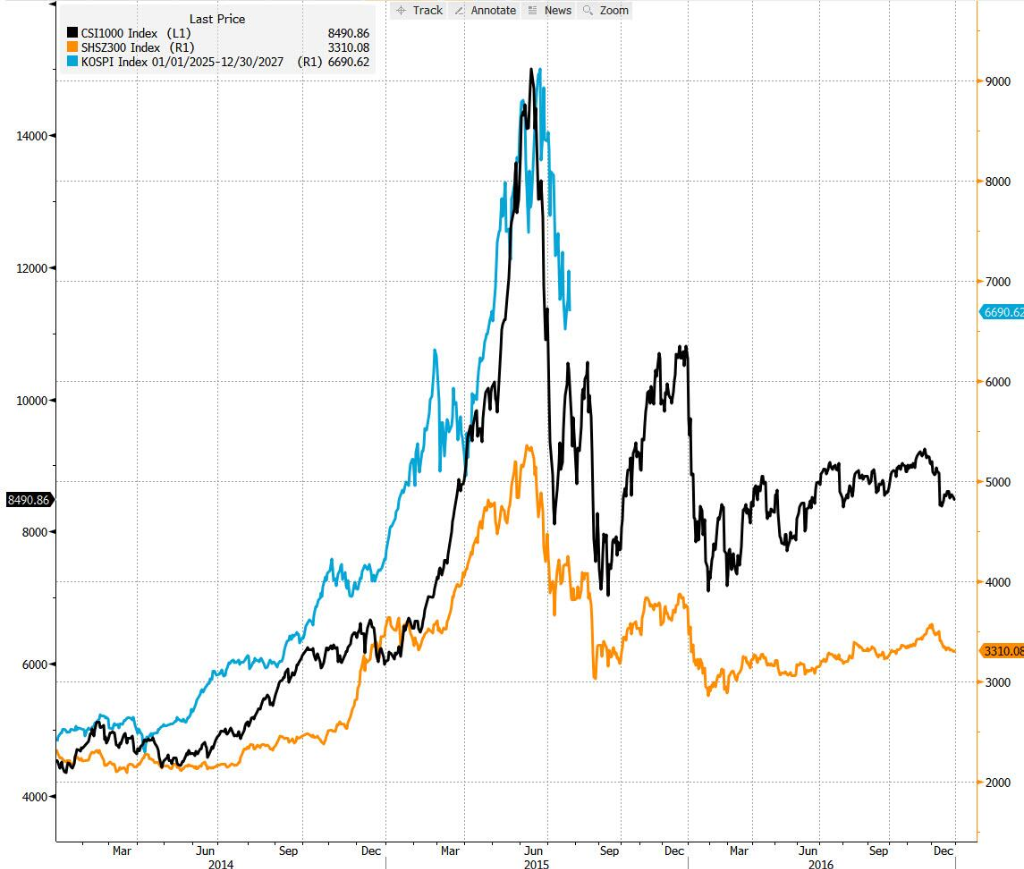
The daily rebalancing flows for Samsung and SK Hynix as a percentage of the average daily trading volume over the past month have also significantly decreased, from 40% and 26% respectively to 15% and 14%. The KOSPI has fallen for five consecutive weeks, creating an unsettling parallel with the trajectory of China's CSI1000 from 2014 to 2015.
The U.S. market is also under pressure. The High vs Low Momentum Pair hedge portfolio fell 8% in a single day last Friday. Although it still recorded a 4% gain for the week, the sheer volatility fully reveals the fragility of the positions.
AI Narrative Shifts, Credit Spreads of Hyperscale Cloud Vendors Flash Warning
The logic of the AI trade is undergoing a fundamental change.
Quek points out that market focus has shifted from headline capital expenditure figures of hyperscale cloud vendors to more pressing core issues: profit margins, return on investment, and the continuously rising volume of debt issuance.
Goldman Sachs estimates that year-to-date, AI-related bond supply has reached $489 billion, with 40% coming from hyperscale cloud vendors, equivalent to 1.5 times the total forecast for 2025. Meanwhile, the credit spreads of hyperscale cloud vendors are widening sharply, making the pressure of rising debt financing costs unavoidable.
From a market capitalization perspective, the S&P 500's market cap has increased by $31 trillion since December 2022. Goldman Sachs' estimations of AI's potential value under base, bull, and blue sky scenarios are $9 trillion, $8 trillion, and $28 trillion, respectively. This comparison implies that the current market cap expansion has significantly preempted AI's potential upside.
Positions Far from Cleared, Volatility Remains the Key Theme for Q3
Quek explicitly states that he believes positions in AI, tech, and momentum strategies are far from the "clean" state the market anticipates and remains highly vigilant regarding sustained high volatility in the third quarter.
He leans towards adopting a "barbell" strategy to navigate the current environment, i.e., simultaneously allocating to defensive assets and select offensive positions to cope with directionless, oscillating markets.
From a technical perspective, despite the substantial surge in volatility at the individual stock and factor level, implied correlation among S&P 500 constituents remains extremely low. Quek notes that this divergence provides an additional structural rationale for going long on equity index volatility — low correlation implies that index-level volatility is undervalued. Once correlation rebounds, index volatility will be amplified.
Goldman Sachs' risk appetite indicator remains elevated, suggesting that overall market sentiment has yet to adequately price in the aforementioned risks, further supporting a cautious outlook on volatility.
Rotation and Divergence: Structural Opportunities Emerge in Asian Markets
Despite the overall pressured environment, signs of capital rotation are quite evident in Asian markets. The Jakarta Composite Index (JCI) in Indonesia has rebounded 16% from its low, and India recorded the strongest monthly foreign inflow in the region. Capital is shifting from high-momentum, high-valuation sectors towards more defensive and value-oriented assets.
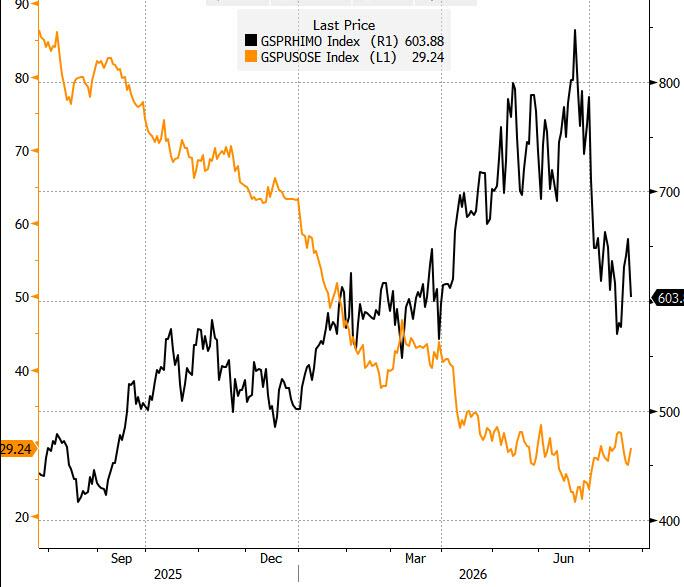
From a sector perspective, the rotation trend is even clearer. The price ratio of the software sector relative to semiconductors has broken above its 50-day moving average, indicating that structural rebalancing within the market is still underway.
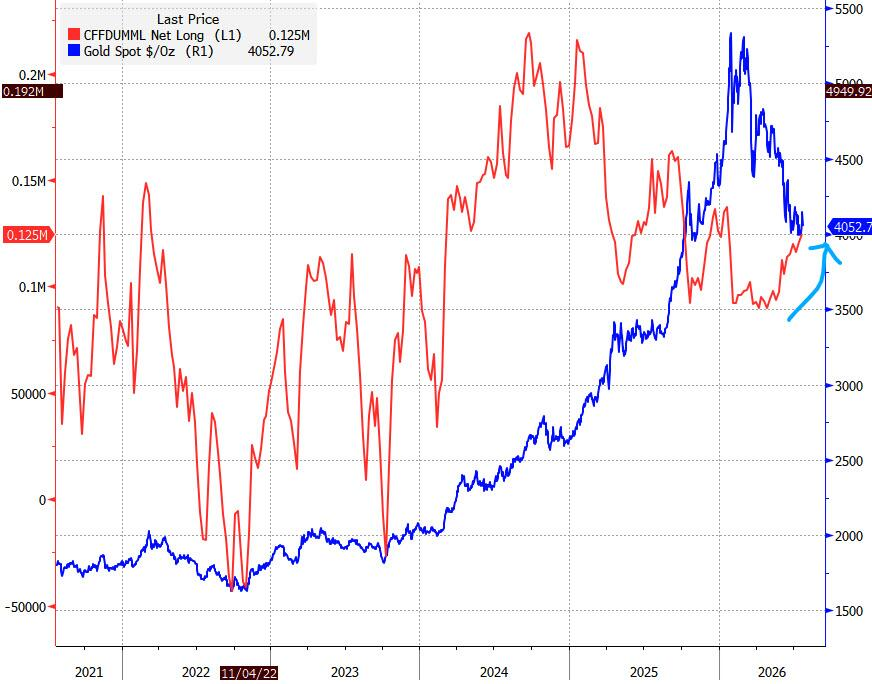
Furthermore, the gold market is flashing noteworthy signals: CFTC gold futures positioning is increasing, an indicator historically leading spot gold prices; meanwhile, China's gold imports in June rose to a two-year high, underscoring the non-negligible underlying support from safe-haven demand.
Quek also anticipates that as the U.S. midterm elections approach, the market will face more headline-driven volatility.
Historical data shows that U.S. stocks typically trade sideways before midterm elections and tend to strengthen afterwards. This pattern could provide a temporary temporal anchor for the currently pressured market, but the biggest mystery remains: how much longer will the momentum stampede continue?
Global stocks ended last week essentially flat, but this figure masks the intense internal turmoil. The market had largely ignored the persistent geopolitical conflicts, oil price trends, and interest rate changes, but these three forces have now simultaneously burst onto the market's radar, vying for pricing power.
At the same time, tariff issues are heating up again, adding new uncertainty to an already fragile market sentiment. Quek notes that the volatility this year has been extremely exhausting for investors, and the market is in a complex phase where multiple narratives are intertwined and the direction is difficult to discern.


