






จาก HBM สู่การจัดเก็บข้อมูลแบบ Cold Storage: ผู้เล่นรายใหญ่ในอุตสาหกรรมจัดเก็บข้อมูล 6 รายมาถึงจุดเปลี่ยนผ่าน อะไรจะขับเคลื่อนรอบตลาดหน้า?


- ประเด็นสำคัญ: รอบการลงทุนในตลาดจัดเก็บข้อมูล AI ครั้งนี้ได้ขยายวงจากการจัดเก็บข้อมูลความเร็วสูงที่ขับเคลื่อนด้วย HBM ไปสู่พื้นที่การจัดเก็บข้อมูลความจุสูงและต้นทุนต่ำในระยะยาว อาทิ DRAM สำหรับเซิร์ฟเวอร์, SSD ระดับองค์กร และ HDD อย่างไรก็ตาม ราคาหุ้นโดยรวมได้ปรับตัวลดลง 20%-30% ทำให้ช่วงเวลาของตลาดเปลี่ยนจาก "การระเบิดของอุปสงค์" ไปสู่ "การตระหนักถึงคำสั่งซื้อและผลกำไร" โดยแกนหลักของรอบตลาดหน้าคือคำสั่งซื้อระยะยาว การส่งต่อราคา และกระแสเงินสดอิสระ
- ปัจจัยหลัก:
- ความต้องการจัดเก็บข้อมูล AI กำลังขยายจาก HBM ใกล้ชิป GPU (เพื่อแก้ปัญหาแบนด์วิดท์) ไปสู่ทั้งระบบข้อมูล ซึ่งรวมถึง SSD สำหรับการเข้าถึงความถี่สูง และ HDD สำหรับการจัดเก็บข้อมูลถาวร โดยตรรกะการลงทุนเปลี่ยนจาก "การจัดเก็บข้อมูลที่เร็วขึ้น" เป็น "การจัดเก็บข้อมูลที่มากขึ้นและถูกกว่า"
- ทั้ง 6 บริษัทเป็นตัวแทนของตรรกะที่แตกต่างกัน: SK Hynix ซื้อขายด้วยความเป็นผู้นำด้าน HBM; Samsung ซื้อขายด้วยการไล่ตามเทคโนโลยีและการฟื้นฟูส่วนแบ่ง; Micron เป็นตัวแทนโดยตรงที่สุดของ HBM/DRAM ในตลาดหุ้นสหรัฐฯ; SanDisk มีความอ่อนไหวต่อการขึ้นราคา NAND มากที่สุด; Seagate และ Western Digital ได้ประโยชน์จากความต้องการ HDD ความจุสูงและ Data Lake
- ตลาดเข้าสู่ช่วงที่มีความผันผวนสูง: ราคาหุ้นของทั้ง 6 บริษัทปรับตัวลดลง 20%-30% หลังจากแตะจุดสูงสุดในเดือนมิถุนายน แม้ว่าบริษัทอย่าง Micron จะรายงานผลประกอบการที่แข็งแกร่ง แต่ตลาดเริ่มตั้งคำถามถึงความยั่งยืนของราคาผลิตภัณฑ์และผลกระทบของกำลังการผลิตใหม่ในปี 2027-2028 ต่ออุปสงค์และอุปทาน
- ตัวเร่งปฏิกิริยาหลักของรอบตลาดหน้าได้ยกระดับขึ้นแล้ว: ไม่ใช่แค่การเปิดตัวผลิตภัณฑ์หรือการส่งมอบตัวอย่างอีกต่อไป แต่เป็นการเปลี่ยนแปลงไปสู่คำสั่งซื้อระยะยาว การปรับเพิ่มแนวโน้มผลกำไร และการเติบโตของกระแสเงินสดอิสระอย่างยั่งยืน
Core Overview:
- The current storage market cycle is not an ordinary price cycle, but a scenario where AI infrastructure demand is gradually spreading from HBM to server DRAM, enterprise SSDs, NAND, and HDD. The market's trading focus has also shifted from "faster storage" to "more, cheaper storage that needs to be retained long-term."
- Six companies correspond to different investment logics: SK Hynix (SKHY.M) trades on its HBM leadership and order visibility; Samsung trades on technology catch-up and market share recovery; Micron is the most direct HBM and DRAM proxy in the US stock market; SanDisk is most sensitive to NAND and enterprise SSD price increases; Seagate and Western Digital benefit from high-capacity HDD, data lake, and cold storage demand.
- Since 2025, all six companies have experienced significant revaluation, but as of mid-July 2026, they have generally retraced about 20%-30% from their cycle highs. The sector is transitioning from a phase of "demand explosion and profit recovery" to one of high expectations, high valuations, and high volatility.
- Historical performance shows that catalysts capable of creating a sustained rally are usually not product launches or sampling, but rather earnings beats, key customer qualifications, volume deliveries, lock-in of orders for the following year, and upward revisions to revenue, pricing, and margin guidance.
- The core of the next market phase lies in which companies can convert demand into long-term contracts, higher product prices, controllable capacity expansion, and sustained growth in profits and free cash flow.
In June 2026, Micron (MU.M) reported earnings with almost no discernible weaknesses.
The company's quarterly revenue reached $41.456 billion, non-GAAP gross margin rose to 84.9%, adjusted free cash flow exceeded $18.3 billion, and revenue guidance for the next quarter was further raised to around $50 billion. In other words, product prices, profit margins, and order visibility all pointed to the same conclusion: AI storage demand remains robust.
However, the market's reaction was not as straightforward as before.
Micron's stock initially surged after the earnings release but quickly gave back its gains. SanDisk, SK Hynix, Samsung Electronics, Western Digital, and Seagate also subsequently retreated from their June highs. Based on a unified adjusted price calculation, as of July 22, these six companies generally retraced about 20%-30% from their cycle highs, with some individual stocks exceeding 30%.
Paradoxically, there has been no sudden weakening in fundamentals, nor has AI data center construction halted. Instead, investors, no longer doubting whether AI will drive greater storage demand, are now questioning how long product prices can continue to rise and whether new production capacity will alter the supply-demand dynamics in 2027-2028.
Consequently, the storage sector has reached a new inflection point.
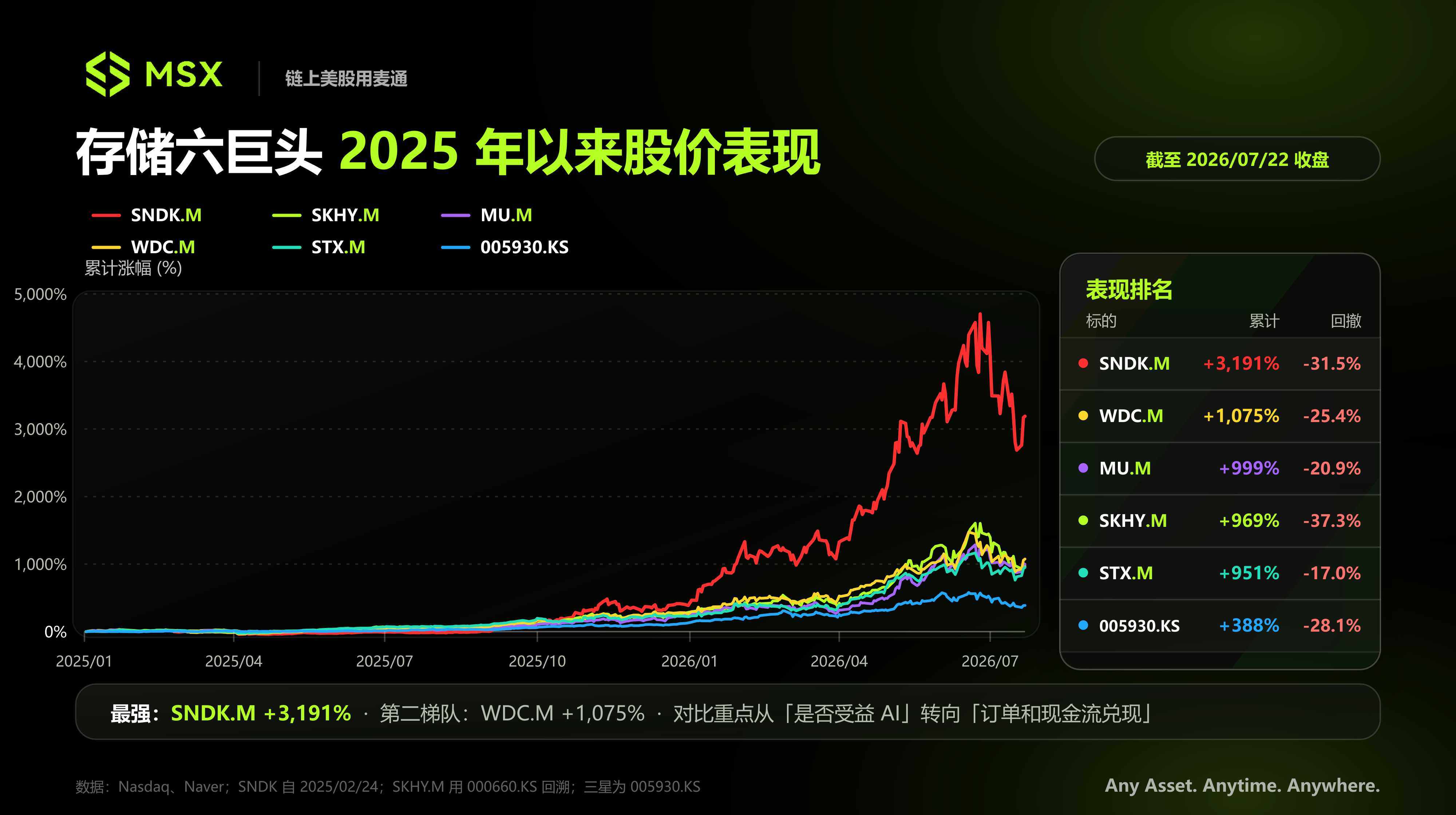
1. Expansion of the AI Storage Cycle Since 2025
The storage market cycle since 2025 was initially ignited by HBM.
Large model training requires GPUs, and large-scale GPU clusters need a high-bandwidth, lower-latency memory system. By vertically stacking multiple layers of DRAM, HBM significantly boosts data throughput, quickly becoming one of the most critical, highest-margin, and most supply-constrained components in AI accelerators.
SK Hynix (SKHY.M), leveraging its leadership in HBM3E products, key customer relationships, and mass production advantages, was the first to undergo a revaluation of its earnings power.
In the third quarter of 2025, the company indicated that discussions for the following year's HBM supply were largely complete, HBM4 would ship in Q4, and customer demand already covered its DRAM and NAND production for the next year. By Q1 2026, the company's revenue, operating profit, and net profit continued to set new records.
Micron (MU.M) became the most convenient core U.S. market proxy for trading HBM and server DRAM supply-demand dynamics. This was especially driven by the volume shipment of HBM4, rising server memory prices, and multiple long-term customer agreements, which collectively boosted revenue, gross margins, and cash flow.
Therefore, for U.S. equity investors, Micron's earnings significance extends beyond the company itself. When Micron raises its revenue, pricing, and margin guidance, the market typically reassesses the profitability potential of the entire storage industry.
Samsung Electronics followed a different path.
In 2025, the market primarily priced in its lag behind SK Hynix in HBM product progress, customer qualifications, and yield. Entering 2026, with HBM4 beginning commercial deliveries, HBM4E entering the sampling stage, and a significant improvement in memory business margins, Samsung's valuation logic began shifting from "lagging behind" to "catching up."
The company's preliminary Q2 2026 results showed quarterly sales of approximately 171 trillion KRW and operating profit of about 89.4 trillion KRW. However, this data includes businesses like smartphones, foundry, displays, and consumer electronics, so it does not directly represent the standalone performance of the memory division.
In reality, the driving force behind the sustained expansion of this cycle wasn't solely HBM itself.
As manufacturers allocated more wafers, capital expenditure, and advanced packaging resources to high-value AI products while maintaining relatively strict supply discipline, the supply-demand dynamics for server DDR5, general DRAM, and NAND also improved.
Concurrently, as AI moved from training towards large-scale inference, storage demand began to spread from the GPU periphery to the entire data system.
Model weights, vector databases, key-value caches, inference contexts, and frequently accessed data drove demand for enterprise SSD capacity and performance. Training data, videos, multimodal materials, inference logs, historical model versions, and compliance archives required more cost-effective, scalable, high-capacity storage.
SanDisk (SNDK.M) became the highest-beta stock in the sector during this phase.
After completing its spin-off from Western Digital (WDC.M) in February 2025, SanDisk transformed from part of a mixed HDD and flash company into a purer NAND and SSD proxy in the U.S. stock market. In its latest fiscal quarter, data center revenue grew 233% sequentially. It signed multiple new business model agreements with financial safeguards and announced a stock buyback program of up to $6 billion after repaying debt.
As AI data continues to accumulate, demand further expanded from high-speed storage toward high-capacity storage.
Not all model training data, videos, multimodal data, inference logs, historical versions, and compliance archives need to reside permanently on expensive SSDs. A large volume of infrequently accessed but long-term retention data ultimately requires nearline HDDs and tiered storage systems.
Western Digital's non-GAAP gross margin in its latest fiscal quarter reached 50.5%, with free cash flow of $978 million. It expects nearline HDD exabyte shipments to maintain mid-to-high single-digit growth or higher over the next three to five years.
Seagate (STX.M) commanded a more apparent technology premium via its HAMR commercialization. In its latest quarter, the company's non-GAAP gross margin reached 47%, free cash flow was $953 million, and its highest-capacity Mozaic 4+ product, reaching 44TB, began volume shipments to two top-tier hyperscale customers.
Therefore, this storage cycle cannot be simply summarized as a price upswing. It is more akin to a progressive expansion of the storage demand radius as AI infrastructure construction deepens. HBM solves the bandwidth bottleneck around GPUs, server DRAM handles workloads during computation, enterprise SSDs support high-frequency data access, and HDDs accommodate the ever-expanding data lakes and long-term archives.
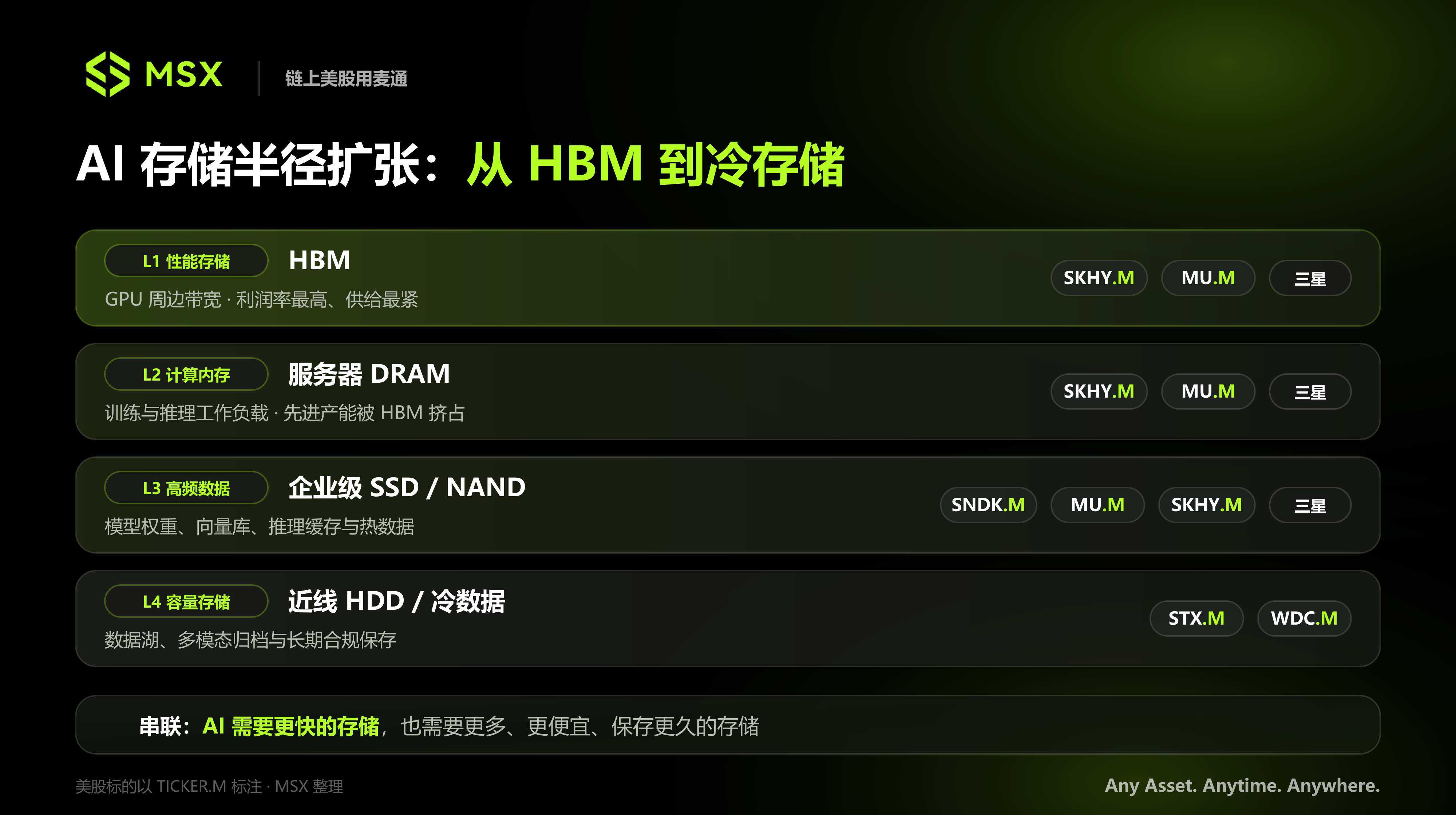
To some extent, the market initially traded on "AI needs faster storage" and then began trading on "AI also needs more storage." This industrial logic, diffusing from HBM to server DRAM, NAND, enterprise SSDs, and HDDs, is fully reflected in the stock performance of these six companies.
Based on a unified adjusted price calculation from the start of 2025 or their first trading day post-spin-off to July 22, 2026, all six companies have undergone significant revaluation, but with varying magnitudes and initiation timings:
- SK Hynix and Micron were the earliest beneficiaries of the HBM and server DRAM upcycle.
- Samsung subsequently began trading on its HBM technology catch-up and market share recovery. After its spin-off, SanDisk, with its purer exposure to NAND and enterprise SSDs, became the highest-beta stock in this cycle.
- Western Digital and Seagate took over the rally in the first half of 2026, as the market began incorporating nearline HDD, high-capacity products, and cold data demand into the AI infrastructure valuation framework.
Breaking down the past year and a half, the cycle can be roughly divided into four phases:
- First Half of 2025: Market Initially Trades HBM. SK Hynix and Micron were the most direct beneficiaries. Investors confirmed HBM was not a short-term inventory restocking event but a long-term, high-margin product tied to the expansion of AI accelerators.
- Second Half of 2025: Cycle Spreads to General DRAM and NAND. HBM's consumption of advanced wafers, packaging, and test resources tightened supply for server DRAM and other memory products. The market began raising earnings expectations for companies like Samsung and SanDisk.
- First Half of 2026: Enterprise SSDs and HDDs Take Over. As AI transitioned from training to inference, storage demand was no longer limited to high-speed memory near GPUs. Training data, inference logs, and long-term archive needs drove a re-pricing of HDDs and cold storage.
- June-July 2026: Cycle Transitions to High Expectations and High Volatility. The stock prices of all six companies peaked almost simultaneously in June. Subsequently, even strong earnings reports from companies like Micron failed to sustain the previous unilateral upward trend.
This pullback suggests a shift in the market's pricing logic. Previous stock price increases relied on the continuous reinforcement of three consensus views: expanding AI storage demand, tight industry supply, and further upside potential for product prices and margins.
However, after significant revaluation, investors began simultaneously considering other questions, such as whether current valuations have already discounted future growth, if trading has become overly crowded, whether new capacity in 2027-2028 will gradually come online, and how much of the robust demand can ultimately translate into long-term orders and free cash flow.
Therefore, this collective retracement is more likely a marker of the storage cycle transitioning from its first phase to its second. Subsequent performance will depend more on which companies can provide longer order visibility, stronger pricing power, and more sustainable profit growth.
2. Belonging to Storage, Yet the Six Companies Trade Different Narratives
Looking only at stock prices, the six companies appear to belong to the same AI storage cycle.
But from the perspectives of industry positioning, earnings elasticity, and catalysts for the next phase, they actually represent six distinct pricing logics.
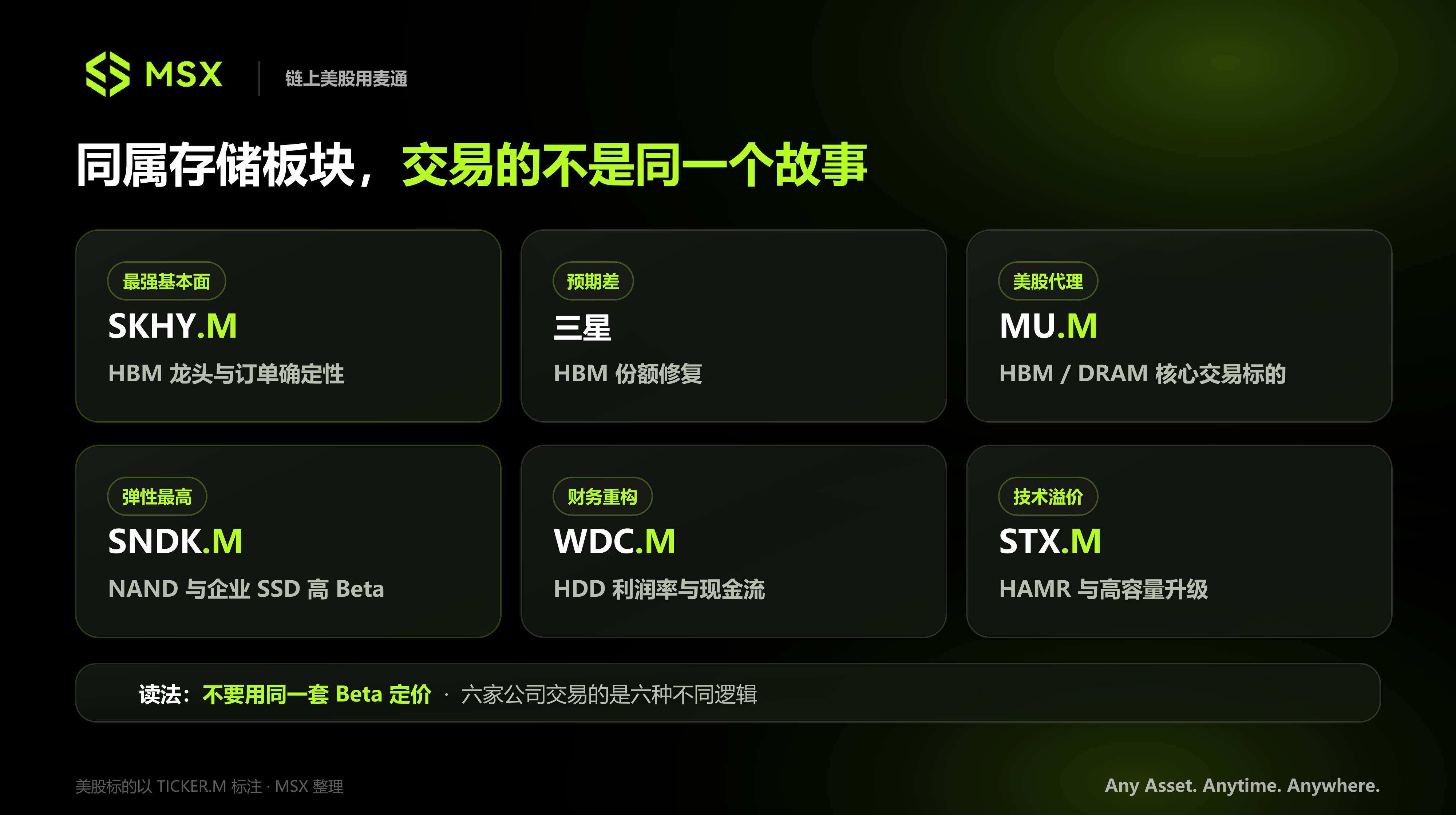
SK Hynix remains the strongest company of the six in terms of industry position and order visibility.
Its core advantage is not just leading HBM market share, but also its ability to lock in customers, pricing, and capacity for the next year earlier. Compared to regular product launches, having orders covered in advance more easily improves the visibility of future revenue and margins, and more readily forms a sustained rally.
However, with SKHY listing on Nasdaq in July 2026, a new layer of trading variables was added. SKHY was issued at $149 and closed its first day around $168. With limited circulating shares initially available in the U.S. market, the ADR traded at a significant premium relative to the common stock in Korea. This premium may converge as conversion and arbitrage mechanisms gradually open.
Therefore, it is necessary to analyze the company's fundamentals separately from SKHY ADR supply-demand dynamics.
The Korean common stock more reflects HBM orders, pricing, and margins, while SKHY is simultaneously influenced by U.S. capital access, float size, ETF allocations, and arbitrage mechanisms. This means that even if the company's operations remain strong, the ADR could experience volatility independent of fundamentals due to increased supply.
Micron is the most direct U.S. stock proxy and the easiest name for pre-trading on sector news.
Its advantage lies in covering HBM, server DRAM, NAND, and enterprise SSDs simultaneously, while also benefiting from U.S. domestic manufacturing and supply chain policy support. When Micron raises product prices, gross margins, and guidance, the market often upgrades earnings expectations for the entire storage sector. Its earnings reports serve not only as the company's own catalyst but also as a crucial price signal for the global storage industry.
However, its problem is equally apparent: the market adjusts expectations for it extremely quickly.
Simply put, when valuations are low and industry expectations are weak, a strong earnings beat can lead to sustained revaluation. Once in the high-expectation phase, merely performing well is insufficient. The stock price requires prices higher than the most optimistic market forecasts, longer order visibility, and more substantial upward revisions to profit margins.
This explains why Micron's single-day volatility post-earnings remains significant, but the sustainability of its price momentum has started to decline.
Samsung Electronics has shown relatively lagging upside, yet has the clearest potential for share recovery-driven elasticity.
It is not the purest fundamental play in this cycle. Its foundry, smartphone, consumer electronics, and display businesses dilute the impact of memory profit improvement on overall group earnings. Furthermore, its earlier lag in HBM customer qualifications resulted in weaker stock performance compared to SK Hynix and Micron.
Conversely, Samsung possesses the most apparent "expectation gap" among the six companies. While the market knows SK Hynix is the HBM leader, it still cannot determine how many high-end HBM orders Samsung will ultimately secure.
Therefore, the truly meaningful catalysts for Samsung in the next phase are: whether core customer qualifications are completed, whether products enter volume procurement, whether the HBM revenue share increases, and whether market share and memory business margins improve simultaneously. Once these metrics begin to materialize, Samsung's logic will upgrade from "technology catch-up" to "share recovery."
SanDisk is gradually transitioning from a NAND price-up Beta play to a contract visibility trade.
It is the highest-beta stock in this cycle and also the highest-risk name when expectations decline. On one hand, its high purity in NAND and enterprise SSD businesses makes it extremely sensitive to product pricing and industry inventory changes. On the other hand, its standalone valuation post-spin-off, growing data center revenue, and long-term business agreements have further amplified the potential for earnings upgrades.
However, a noteworthy change is occurring at SanDisk. Previously, the market primarily viewed it as a high-beta proxy for NAND price increases. Recently, with an increase in agreements involving minimum purchase commitments, financial safeguards, or long-term cooperation mechanisms, investors are beginning to assign higher valuations to its revenue and cash flow visibility.
The sampling of BiCS10 is an important product milestone but may not directly create a sustained rally. What truly needs observation is whether the product passes enterprise customer qualification, enters volume procurement, and is ultimately reflected in average selling prices, data center revenue, and gross margins.
Ultimately, for high-valuation cyclical stocks, advanced technology is just the starting point; order fulfillment is the finish line.
Western Digital and Seagate both benefit from HDDs, but their revaluation paths and core logics differ.
Western Digital's revaluation leans more towards financial structure. After the flash business spin-off, WDC became a purer HDD company. The higher mix of high-capacity products, improved per-TB pricing, industry supply discipline, and operating leverage collectively drove gross margins and free cash flow higher.
Therefore, WDC's stock price sometimes doesn't fully react on the day following an earnings release. The market needs time to confirm that margin improvements aren't due to inventory, currency, or one-time factors, but stem from sustained changes in long-term orders, product mix, and industry supply discipline.
Seagate's revaluation leans more towards technology and capacity value. HAMR allows increasing per-drive capacity without significantly increasing the physical number of hard drives, lowering cost-per-TB and increasing the sales value per drive. With products over 40TB entering volume delivery, the market is no longer just trading on HDD shipment growth, but on the penetration rate of next-generation products, scarce capacity, and long-term profit margins.
This is why Seagate's earnings catalysts often have stronger sustainability. Investors don't just upgrade current EPS; they also upgrade capacity and earnings power for several years into the future.
3. What to Watch for in the Next Market Phase?
Overall, over the past year and a half, the valuation restructuring of storage companies primarily accomplished two things: the market confirmed that AI storage demand is not a one-time inventory restocking event, and it began to acknowledge that the earnings power of


