






2026年下半年,สินค้าโภคภัณฑ์เข้าสู่ยุค «เหตุการณ์หงส์ดำความถี่สูง»


- มุมมองหลัก: ซิตี้ รีเสิร์ช ชี้ให้เห็นว่า เหตุการณ์ “หงส์ดำ” ที่รุนแรงในตลาดสินค้าโภคภัณฑ์ ซึ่งเคยเกิดขึ้นในอัตราหนึ่งครั้งต่อทศวรรษ กำลังกลายเป็นเรื่องปกติ อันเนื่องมาจากผลกระทบทางภูมิรัฐศาสตร์ สภาพภูมิอากาศ และเทคโนโลยี รายงานได้สรุปสถานการณ์ความเสี่ยงส่วนปลาย (tail risk) ที่อาจเกิดขึ้นตั้งแต่ช่วงครึ่งปีหลังของปี 2026 เป็นต้นไป ซึ่งขนาดของผลกระทบด้านราคานั้นมากพอที่จะพลิกกรอบการวิเคราะห์อุปสงค์และอุปทานแบบดั้งเดิมได้
- ปัจจัยสำคัญ:
- สถานการณ์ที่มีความเสี่ยงสูงสุดคือความขัดแย้งระหว่างสหรัฐฯ และอิหร่านที่ทวีความรุนแรงขึ้น หากช่องแคบฮอร์มุซถูกปิดเป็นเวลานาน โลกจะเผชิญกับปัญหาการขาดแคลนอุปทานน้ำมัน 5-10 ล้านบาร์เรลต่อวัน ซึ่งอาจผลักดันให้ราคาน้ำมันพุ่งสูงเกิน 200 ดอลลาร์สหรัฐต่อบาร์เรล
- ความน่าจะเป็นของการแข่งขันกักตุนแร่ธาตุสำคัญได้รับการประเมินว่า “สูง” หากปริมาณสินค้าคงคลังทองแดงกลั่นทั่วโลกเพิ่มขึ้นเป็นปริมาณการบริโภค 3 เดือน ราคาทองแดงอาจทะลุ 20,000 ดอลลาร์สหรัฐต่อตัน ซึ่งสูงกว่าราคาในสถานการณ์ฐานที่ 13,500 ดอลลาร์สหรัฐต่อตันอย่างมาก
- ทองคำมีความเสี่ยงที่จะปรับตัวลงในระยะสั้น โดยอาจร่วงลงอีก 15%-20% จากระดับ 4,000 ดอลลาร์สหรัฐต่อออนซ์ ภายใน 4-6 สัปดาห์ข้างหน้า แต่อย่างไรก็ตาม แนวโน้มระยะกลางถึงยาวยังคงได้รับการสนับสนุนจากการซื้อสะสมของธนาคารกลางและกระแสการลดบทบาทของดอลลาร์สหรัฐฯ (de-dollarization) โดยคาดว่าราคาจะเพิ่มขึ้นเป็นสองเท่าแตะ 6,000 ดอลลาร์สหรัฐต่อออนซ์ในอีกไม่กี่ปีข้างหน้า
- ความน่าจะเป็นของเหตุการณ์เอลนีโญที่รุนแรงสูงถึง 81% ซึ่งอาจส่งผลให้อุปทานโกโก้ในแอฟริกาตะวันตกเสียหายอย่างหนัก และราคากลับขึ้นไปถึง 10,000 ดอลลาร์สหรัฐต่อตัน ขณะที่ราคาน้ำตาลในอินเดียและไทยก็มีความเสี่ยงที่จะปรับตัวสูงขึ้นเช่นกัน
- การแตกของฟองสบู่ AI จะทำให้การก่อสร้างศูนย์ข้อมูลลดลงอย่างรวดเร็ว ซึ่งเป็นปัจจัยลบต่อทองแดง ก๊าซธรรมชาติ และยูเรเนียม ในทางกลับกัน หากผลตอบแทนด้านผลิตภาพจาก AI เป็นจริง การใช้พลังงานจะเร่งตัวขึ้น ซึ่งจะยิ่งตอกย้ำแนวคิดเรื่องการขาดแคลนโครงสร้างของทองแดงและอะลูมิเนียม โดยราคาทองแดงอาจเพิ่มขึ้นเป็น 17,000 ดอลลาร์สหรัฐต่อตัน
Original Author: Bao Yilong
Original Source: Wall Street Sights
Amidst the intertwining impact of geopolitics, climate change, and technological disruptions, Citi believes that "black swan" events in the commodity market have shifted from occurring once a decade to becoming almost the norm.
According to the trading desk, on July 23rd, the Citi Research team led by Eric G Lee published a report, outlining potential extreme risk scenarios for the second half of 2026 and beyond, with price shocks large enough to render traditional supply-demand analysis frameworks ineffective.
The tail risk scenarios covered by Citi Research include: the US-Iran conflict evolving from a temporary shock into a multi-year persistent disruption, a critical mineral stockpiling race, gold falling 15% to 20% before doubling, extreme El Niño weather impacting agricultural products, and the AI bubble's burst or sustained boom causing two-way volatility, among others.
Since 2020, the commodity market has already traversed the COVID-19 pandemic, the Russia-Ukraine conflict, trade wars, a central bank gold buying spree, and recurring Middle East conflicts. The density of extreme events is unprecedented.

The report notes that these risk scenarios are not baseline forecasts but rather tail scenarios that "could happen and would have a significant impact if they did," aimed at supplementing Citi's existing baseline forecasting framework.
Highest Risk: US-Iran Conflict Evolves into a Multi-Year Supply Crisis
Citi ranks an escalation of the US-Iran conflict as the tail scenario with the highest impact, although its probability of occurrence is assessed as "low."
The report points out that from the US-Israel joint strike on Iranian nuclear facilities in June 2025 (the "12-Day War"), to the resumption of conflict in February 2026, the signing of a fragile ceasefire agreement in June, and then renewed military escalation in July 2026, oil and refined product prices have already experienced multiple rounds of violent fluctuations.
If the conflict expands further, Iran could potentially strike the energy infrastructure of Gulf oil-producing nations. Combined with a prolonged closure of the Strait of Hormuz and disruption of the Bab el-Mandeb strait, the world could face a sustained supply shortfall of 5 to 10 million barrels per day.
Citi calculates that, assuming a demand elasticity of approximately -0.05, a supply loss of this magnitude would drive oil prices up by 100% to 200%, meaning full-price crude oil exceeds $200 per barrel, and US retail gasoline prices remain persistently above $6 per gallon.
Citing historical data, the report states that if global oil inventories excluding China fell below the 70-day consumption cover level, the corresponding Brent crude oil price had previously exceeded $150 per barrel.
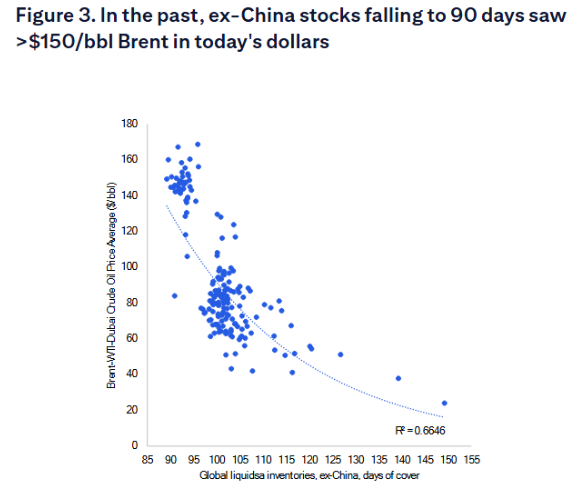 (Historically, when crude oil inventories outside China fell to a 90-day low, Brent crude surpassed $150 per barrel)
If measured by the ratio of oil and gas spending to GDP, replicating the 8% peak from the second oil crisis in the 1970s, the required oil price level would exceed $200 per barrel.
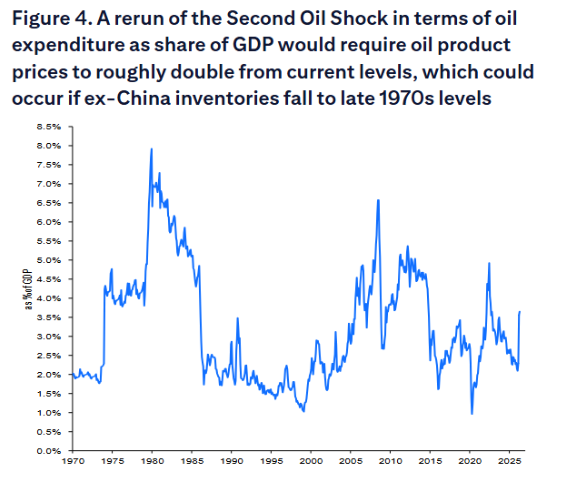 (If inventories outside China fall to late 1970s levels, petroleum product prices would roughly double from current levels)
As of July 2026, total global oil inventories outside China still stand at approximately 94 days of consumption, but Citi predicts that if a global deficit of 7 to 8 million barrels per day persists, this metric could fall below 70 days by early 2027.
Russia-Ukraine Escalation: Natural Gas Market Expected to Be Hit Harder than Crude Oil
Citi rates the possibility of stricter restrictions on Russian energy exports as "medium probability" and emphasizes that the impact on the natural gas market will be greater than on crude oil.
Regarding LNG, Russia exported approximately 44 billion cubic meters (bcm) in 2025, accounting for about 7% of global LNG supply, mainly from the Yamal LNG and Sakhalin-2 projects.
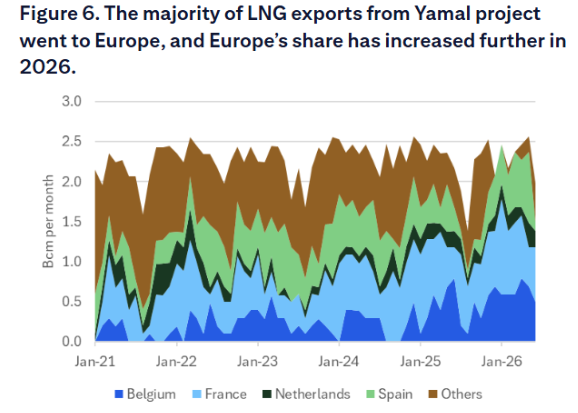 (The majority of Yamal LNG exports go to Europe, and Europe's share is expected to rise further in 2026)
Over 70% of exports from Sakhalin-2 flow to Japan and South Korea; approximately 90% of Yamal LNG's exports in mid-2026 went to Europe.
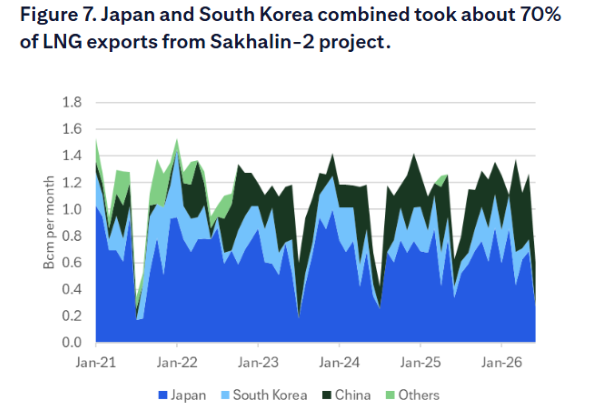 (Japan and South Korea together account for about 70% of LNG exports from the Sakhalin-2 project)
If a global ban on purchasing Russian LNG is imposed, over 30 bcm of annual supply would need to be redirected, but constrained by shipping and contract limitations, the global LNG market would face a significant supply gap.
In terms of pipeline gas, the destructive power of a ban on Russian pipeline gas is even greater due to the physical constraints of pipelines, making it difficult to flexibly adjust the direction of gas flows.
Russia exports over 70 bcm of pipeline gas annually to markets outside China, with imports by Europe and Turkey alone totaling approximately 37 bcm.
Critical Mineral Stockpiling: Copper Prices Could Break $20,000/Ton
Citi rates the probability of a critical mineral stockpiling race as "high," with the impact varying by commodity and the extent of stockpiling. If governments massively accumulate strategic mineral inventories, copper prices could be pushed above $20,000 per ton.
The report notes that major global economies like the US and the EU have already shown policy signals.
The US "Project Vault" proposal plans to spend $12 billion to stockpile critical industrial commodities. The EU has announced €3 billion in funding for critical mineral security.
Using the copper market as an example, Citi calculates: if global refined copper inventories are increased from the current level of about 1.3 months of consumption to 3 months, it would require accumulating approximately 4 million tons of copper over two years.
Based on historical scrap copper supply elasticity, this would require copper prices to rise to around $23,000 per ton. Currently, under Citi's baseline scenario, the copper price is approximately $13,500 per ton.
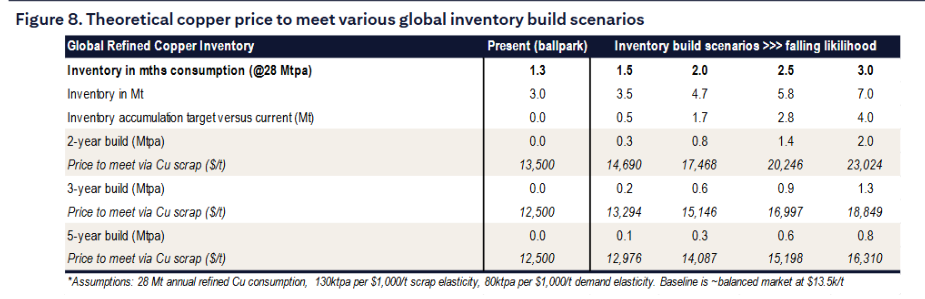 (Theoretical copper prices under various global inventory increase scenarios)
Gold: Short-term Decline of 15% to 20% Possible Before Doubling Later
Citi rates gold's tail risk as low probability and low direct immediate impact, but significant within the scenario analysis framework.
After surging from $2,500 per ounce in January 2025 to a peak of $5,500 per ounce in February 2026, the gold price has now retreated to around $4,000 per ounce.
The report believes the risk of a downside overshoot is most concentrated in the next 4 to 6 weeks. If the price falls below $3,800 per ounce, liquidation pressures on ETFs and leveraged positions could be triggered on a large scale.
Potential triggers include: a deterioration of the Middle East situation pushing up real interest rates and the US dollar, and a liquidity crunch triggered by adjustments in the stock and bond markets.
However, the report remains highly optimistic about gold's medium-to-long-term trajectory.
China's trade surplus exceeding $1.3 trillion, continued central bank buying, concerns over global fiscal sustainability, and the de-dollarization trend constitute multiple supports for long-term gold demand.
Citi expects that, driven by major inflation declines and a new wave of investor buying, gold could rise to $6,000 per ounce over the next few years, nearly doubling from current levels.
Extreme El Niño: Cocoa Prices Could Return to $10,000/Ton
The latest forecast from the U.S. National Oceanic and Atmospheric Administration (NOAA) updated in July raised the probability of a very strong El Niño event to 81%, with a 97% likelihood of persisting until spring 2027. Citi lists this as a "medium probability, high impact" tail scenario.
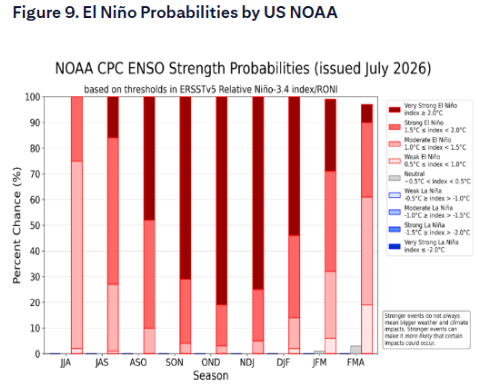 (US NOAA El Niño probability forecast)
The report points out that the impact of an extreme El Niño varies significantly among different agricultural products. Cocoa, sugar, and Robusta coffee are the most affected; soybeans are next; corn and wheat are relatively less impacted.
If West Africa experiences a Harmattan wind similar to the 2023-2024 season, cocoa supply will be severely impacted, and cocoa prices could return to $10,000 per ton or even higher, after reaching all-time highs in 2024-2025.
Regarding sugar, below-average rainfall in India in June, combined with potential monsoon deficits and flooding risks in Thailand and Brazil,could push global sugar prices above 20 cents per pound.
Corn and soybean prices may receive some support as El Niño typically favors increased yields in US growing regions, while European heatwaves and a weakening Indian monsoon remain key downside risk sources.
AI Boom and Bust: Two-Way Shock Creates Divergence in Commodity Landscape
Citi characterizes the impact of AI scenarios on commodities as "low-to-medium probability, highly divergent shock."
The expansion of AI infrastructure is becoming a significant driver of demand for electricity, natural gas, uranium, and grid metals like copper and aluminum. The report expects US data center electricity consumption to roughly double by 2030.
If the AI bubble bursts, data center construction would contract sharply, harming both actual and anticipated demand for copper, natural gas, and uranium. A decline in global risk appetite would further trigger a contraction in commodity demand.
However, a weaker US dollar could provide passive support for commodity prices, and significant Fed rate cuts would also provide a cushion for the market to some extent.
If the AI productivity dividend materializes, accelerating energy consumption and advancing grid investments would reinforce the narrative of a structural deficit for copper and aluminum. Citi sees this as one of the paths in the bull case scenario for copper prices reaching $17,000 per ton.
Gold is viewed as the most asymmetric hedge tool under AI scenarios. Whether in boom or bust, gold has its own logic for benefiting.
Power of Siberia 2 and LNG Glut: Prices Could Fall Below $6/MMBtu in the 2030s
Citi lists the signing of a final agreement for the Power of Siberia 2 pipeline between Russia and China as a "medium probability, high impact" scenario.
With an annual capacity of 50 bcm, if the pipeline becomes operational around 2030, it would significantly reduce China's LNG import needs, adding further pressure to a global LNG market already expected to loosen starting in 2028.
The report predicts that under this scenario, the JKM Asian LNG benchmark price could fall to $5 to $6 per million British thermal units (MMBtu), well below the current futures prices for 2029-2030 above $8/MMBtu, and also far below the breakeven range of $7 to $10/MMBtu for most new LNG supply terminals.
Citi points out that the potential new supply of 50 bcm/year between China and Russia is almost equivalent to Russia's current pipeline exports to Europe of approximately 53 bcm/year. Its impact on the global LNG glut will far outweigh the debate over whether Russian pipeline gas will return to Europe.
Extreme Monroe Doctrine: Blockade of Americas Oil Could Trigger Repeat of 1973
If the US pushes the "Monroe Doctrine" to its extreme, blocking oil exports from Latin America or even the entire Americas, the global oil price landscape would undergo a drastic distortion.
The Monroe Doctrine is a core US foreign policy articulated in 1823, whose central tenet is "America for the Americans." It aimed to oppose European colonial intervention in the Americas while declaring US non-interference in European internal affairs.
Citi lists a "US blockade of all oil exports from the Americas" as a low-probability, high-impact scenario.
Under this assumption, approximately 9.8 million barrels per day of crude oil production from Latin America (including Mexico), representing about 10% of global total output, would be cut off from the global market. The magnitude of the shock could rival or even surpass the 1973 Arab oil embargo.
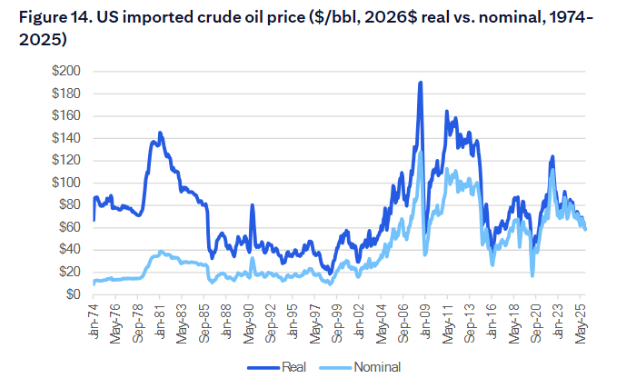 (US Import Crude Oil Price, 2026 Real Value vs. Nominal Value, 1974-2025)
At that time, 7 OPEC member countries cut production by about 3.6 million barrels per day (about 6% of global output), causing oil prices to surge from around $3 per barrel to about $12 per barrel by January 1974, an increase of approximately 300%.
Under this scenario, global benchmark crude prices (e.g., Brent, Dubai) could skyrocket to over $100 per barrel, while intra-Americas crude benchmarks (e.g., WTI, WCS) could see significant discounts exceeding $30 per barrel due to lack of export outlets, creating a dramatic cross-regional price divergence pattern.


