






เมื่อ AI เริ่มมีร่างกาย: AI ทางกายภาพจะกลายเป็นแนวทางหลักทางเทคโนโลยีรอบต่อไปหรือไม่?


- มุมมองหลัก: อุตสาหกรรม AI กำลังก้าวจากยุค "สมอง" ของ Generative AI ไปสู่ยุค "ร่างกาย" ของ Physical AI แนวโน้มหลักคือการทำให้ AI ก้าวออกจากหน้าจอ เพื่อรับรู้ ตัดสินใจ และลงมือปฏิบัติในโลกแห่งความเป็นจริง เช่น ในรถยนต์และโรงงาน ซึ่งจะก่อให้เกิดห่วงโซ่อุตสาหกรรมใหม่ทั้งหมดตั้งแต่พลังคำนวณไปจนถึงการประยุกต์ใช้
- ปัจจัยสำคัญ:
- Physical AI ครอบคลุมถึงหุ่นยนต์ฮิวแมนนอยด์ การขับขี่อัตโนมัติ และหุ่นยนต์อุตสาหกรรม โดยแกนหลักคือการทำให้เครื่องจักรเข้าใจกฎทางฟิสิกส์และมีปฏิสัมพันธ์ในสภาพแวดล้อมจริง การพัฒนาต้องอาศัยความร่วมมือของห่วงโซ่อุตสาหกรรม 5 ชั้น ได้แก่ พลังคำนวณ โมเดล การจำลอง การรับรู้ และการประยุกต์ใช้
- แพลตฟอร์มพื้นฐานระดับล่างในห่วงโซ่อุปทาน (เช่น พลังคำนวณ ซอฟต์แวร์จำลอง) ที่ "ขายพลั่ว" มีความแน่นอนสูงที่สุด โดย NVIDIA กลายเป็นผู้ให้บริการโครงสร้างพื้นฐานสำคัญผ่านการบูรณาการชิป โมเดล และระบบนิเวศการจำลอง
- สถานการณ์แบบปิด เช่น โรงงานและคลังสินค้า อาจเป็นที่แรกที่สร้างโมเดลธุรกิจที่ยั่งยืนได้ เนื่องจากสภาพแวดล้อมมีมาตรฐานและสามารถวัดผลตอบแทนจากการลงทุน (ROI) ได้ เช่น การใช้งานจริงของ Amazon และ Teradyne
- หุ่นยนต์ฮิวแมนนอยด์ (เช่น Tesla Optimus) มีจินตนาการทางการตลาดมากที่สุด แต่มีรอบระยะเวลาการนำไปใช้ในเชิงพาณิชย์ที่ยาวนาน โดยต้องจับตาดูว่า ต้นทุนต่อเครื่องและมูลค่าที่สร้างขึ้นจริงจะสามารถคุ้มกับต้นทุนหรือไม่
- การขับขี่อัตโนมัติ (Robotaxi) มีความก้าวหน้าในการพิสูจน์เชิงพาณิชย์มากกว่าหุ่นยนต์ฮิวแมนนอยด์ โดย Waymo ให้บริการเดินทางแบบไร้คนขับโดยสมบูรณ์แล้วกว่า 20 ล้านเที่ยว ในขณะที่โดรนและหุ่นยนต์ป้องกันประเทศเนื่องจากมีความต้องการที่ชัดเจน การยืนยันคำสั่งซื้อจึงตรงไปตรงมามากกว่า
Over the past two years, the AI traded in capital markets has primarily been the "brain" of AI.
From ChatGPT and large models to GPUs, HBM, data centers, optical communications, and power infrastructure, almost all core themes have revolved around how to make models larger, training faster, and inference cheaper.
However, while these AIs can generate text, images, code, and videos, most still operate within screens and the digital world.
Therefore, as large model capabilities and computing infrastructure gradually mature, the market naturally begins to ask the next question: Will these increasingly intelligent models eventually step out of the screen and enter cars, factories, warehouses, hospitals, and the real world?
This is precisely why Physical AI has begun to take center stage in the industry.
1. From 'Thinking' to 'Acting': Why is Physical AI Important?
According to NVIDIA's definition, Physical AI is about bringing AI out of the screen, enabling autonomous systems like robots, cameras, and self-driving cars to perceive and understand their surroundings, perform reasoning, make decisions, and execute complex actions.
In other words, if Generative AI solves the problem of "how machines think," then Physical AI attempts to solve the problem of how machines, after thinking, can act correctly, safely, and cost-effectively, thereby granting machines the true ability to interact with the real world.
Judging by Jensen Huang's recent public speeches, NVIDIA is continuously strengthening its product lines such as Isaac, GR00T, Cosmos, Omniverse, and Jetson. The goal is not simply to bet on a single type of robot, but to build a comprehensive underlying platform covering training, simulation, reasoning, and deployment for machines entering the physical world.
True Physical AI is not as simple as plugging a large model into a robot. It also requires understanding spatial relationships and physical laws, necessitating world models, training data, simulation environments, edge computing power, machine vision, sensors, motion control, and extensive safety testing before deployment.
In the market context, Physical AI overlaps significantly with "Embodied Intelligence," but its scope is broader. It includes not only humanoid robots but also autonomous driving, industrial robots, drones, smart factories, warehousing systems, and smart spaces driven by cameras and sensors.
Of course, Physical AI is not a suddenly emerging new concept.
Autonomous driving, industrial robots, machine vision, and warehouse automation have been developing for years. What has truly changed is that large models, world models, simulation technology, and edge computing power are connecting these previously fragmented technological paths.
Many traditional industrial robots rely on pre-programmed code to repeatedly execute standard actions in relatively fixed environments. The goal of Physical AI, however, is to enable machines to adjust their judgments and actions based on real-time information when facing different objects, unfamiliar environments, and unexpected situations.
This means the AI industry chain is extending from the "brain" to the "body."
Over the past two years, the market first revalued the GPUs, storage, servers, networks, and power needed to train and run AI. Next, capital may flow towards carriers that can utilize this computing power and translate model capabilities into real-world productivity: robots, autonomous vehicles, drones, industrial automation equipment, and the vision and sensor systems deployed across factories, warehouses, and cities.
Therefore, Physical AI is not a single-point concept that can be simply equated with 'humanoid robots.' What it truly opens up is a complete industry chain extending from computing power to action.
2. From Computing Power to Robots: The Five-Layer Physical AI Industry Chain
For ease of understanding, the MSX Research Institute has roughly broken down the Physical AI industry chain into five key segments.
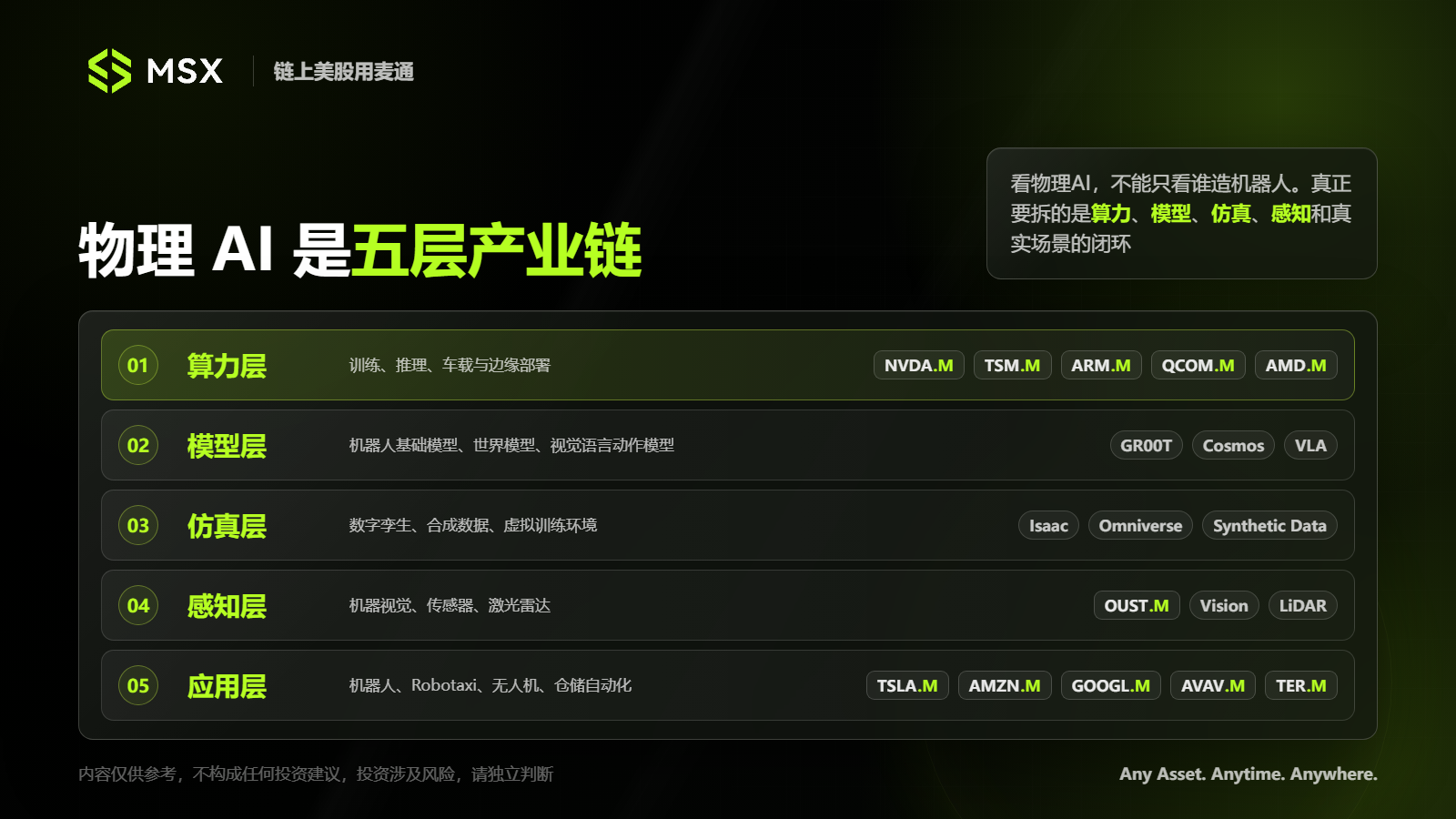
1. Layer 1: The Computing Power Layer
Whether it's training robot models, building virtual environments, or performing real-time inference in cars and robots, computing power is indispensable.
This layer encompasses data center GPUs, edge AI chips, in-vehicle computing platforms, and low-power processors. Key corresponding targets include:
- NVIDIA (NVDA.M): Covers training computing power, the Jetson edge computing platform, and the robot development ecosystem;
- TSMC (TSM.M): Manufacturing foundation for AI chips, automotive chips, and edge computing chips;
- Arm (ARM.M): Low-power computing architecture widely used in cars, robots, and smart devices;
- Qualcomm (QCOM.M): Presence in automotive AI, edge inference, and smart terminals;
- AMD (AMD.M): Potential beneficiary of AI computing power and embedded computing;
The logic for this layer is similar to the Generative AI trends of the past two years, continuing the "picks-and-shovels" logic: Regardless of which robot company ultimately wins, the underlying layers require chips, computing power, and computing architecture.
2. Layer 2: The Model Layer
This is also straightforward. Physical AI requires not just language models, but also robot foundation models, world models, and vision-language-action models.
Language models understand human commands, vision models help machines recognize environments, action models translate decisions into specific movements, and world models go further by attempting to let AI understand relationships between objects, predict what might happen next, and simulate scenarios before acting.
This layer is currently primarily driven by large tech companies and platform-type enterprises, including NVIDIA, Tesla, Google, and some robot startups.
Compared to large language models, the biggest challenge for robot models is data. While there is vast text, image, and video data on the internet, high-quality robot operation data is scarce. How to generate enough training data will be a critical hurdle in the development of Physical AI.
3. Layer 3: The Simulation Layer
Because real-world training is expensive, slow, and risky, robots need to learn first in virtual worlds. Thus, digital twins, synthetic data, and virtual training environments form a very important layer of Physical AI.
NVIDIA has built a relatively complete toolchain in this layer: Omniverse for building digital twins and simulation environments, Isaac Sim and Isaac Lab for robot training, testing, and validation, and Cosmos for world models and data generation capabilities.
The value of this layer lies in moving the expensive, dangerous, and slow trial-and-error of the real world to a virtual environment. Developers can run numerous scenarios simultaneously, testing different lighting, weather, terrain, and unexpected events, and then deploy the validated models to real devices.
Ultimately, training a robot once in the real world might take minutes, while in a simulation environment, it can be run thousands of times in parallel.
4. Layer 4: The Perception Layer
For robots entering the real world, the first step is often not having dexterous hands, but being able to stably "see" and understand the surrounding environment.
They must recognize objects, judge distances, understand environmental changes, and localize themselves in complex spaces. After making judgments, they need to translate decisions into real actions via controllers, motors, robotic arms, and joint modules.
This layer includes machine vision, cameras, LiDAR, sensors, control chips, motion control, and various execution components:
- Cognex (CGNX.M): Industrial machine vision and identification systems;
- Ouster (OUST.M): LiDAR and perception platforms;
- Qualcomm, NVIDIA: Provide in-vehicle and edge vision computing platforms;
Ouster has integrated its new digital LiDAR into the NVIDIA Jetson and Isaac ecosystem, advancing applications in industrial robots, inspection, and autonomous systems. Cognex continues to deploy AI vision systems in manufacturing inspection and automation scenarios.
While the imaginative potential of machine vision and sensors might be less than that of humanoid robots, they are closer to actual orders and existing customers.
As for execution components like motors, reducers, and joint modules, pure-play targets in the US stock market are relatively limited. Related opportunities are more dispersed among industrial automation, analog chip, and specialized component companies.
5. Layer 5: The Application Layer
As the topmost layer of the industry chain, these are the most familiar robots, autonomous vehicles, drones, and industrial automation equipment. Corresponding targets include:
- Tesla (TSLA.M): Optimus, FSD, and Robotaxi;
- Alphabet (GOOGL.M): Autonomous driving via Waymo;
- Amazon (AMZN.M): Warehouse robots, logistics automation, and Zoox;
- Teradyne (TER.M): Collaborative robots and mobile robots;
- AeroVironment (AVAV.M), Kratos (KTOS.M), Ondas (ONDS.M): Drones and unmanned systems;
- Palantir (PLTR.M): Software platform connecting data, decisions, and unmanned devices;
Among these, Palantir is not a robot manufacturer but leans more towards being a software platform connecting data, decisions, and unmanned devices. Uber could potentially serve as a traffic gateway for different Robotaxi fleets to acquire users, dispatch orders, and complete transactions. Both represent indirectly benefiting directions.
This is also the segment of Physical AI most prone to generating high elasticity. Once a particular robot, Robotaxi, or drone enters mass production, the market will quickly revise its revenue and valuation estimates upwards.
However, simultaneously, the application layer is also the most competitive and the most difficult part to deliver on its promises.
3. Who Will Profit First: The Picks-and-Shovels Sellers or the Robot Builders?
Judging by the typical sequence of industrial returns, the incremental revenue and profit from Physical AI may not appear first on the most sci-fi humanoid robots.
Instead, a more likely path is: first sell the underlying platform, then target controlled environments; first solve standardized tasks, then challenge open worlds. In a nutshell, the certainty for the 'picks-and-shovels' sellers remains highest.
So, if NVIDIA was the biggest beneficiary of the first phase of Generative AI, the early development of Physical AI will still be hard to bypass. Regardless of whether Tesla, Amazon, or some robot startup ultimately wins, they will all need model training, simulation testing, real-time inference, and edge deployment.
NVIDIA's advantage isn't just its GPUs; it's that it's integrating chips, models, simulation software, and edge computing platforms into a complete development ecosystem. This means it doesn't need to manufacture every robot itself; it just needs more and more robots to use its computing power and software ecosystem.
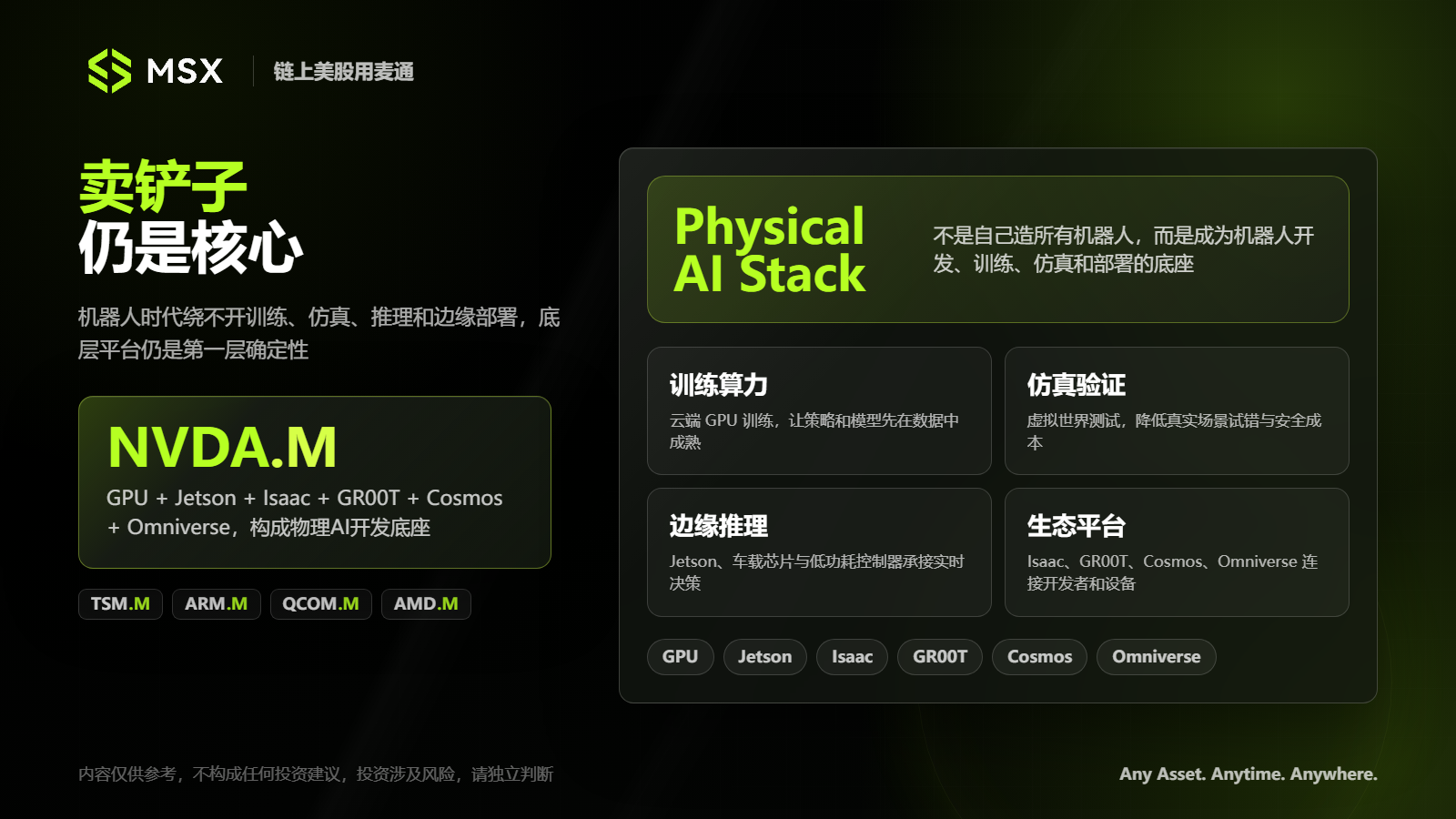
From this perspective, the clearer beneficiaries in the first phase of Physical AI are likely still the 'picks-and-shovels' providers of computing power, simulation, chips, and development tools. However, a 'clear path to benefit' doesn't equal risk-free stock prices. Whether the market has already priced in growth expectations, whether the software ecosystem can generate sustainable revenue, and whether competitors can offer alternatives, remain to be seen.
Next, factories and warehouses might achieve a commercial closed loop earlier. That is, the earliest financial reports reflecting Physical AI's impact are likely to come from manufacturing, warehousing, and logistics.
These environments are relatively controlled, routes, and tasks are more standardized, and companies find it easier to calculate ROI – the reduction in labor, increase in efficiency, and decrease in wastage from deploying a robot can be directly quantified.
Amazon already uses robots on a large scale in its warehousing network and optimizes equipment scheduling and routing with AI models. Teradyne's subsidiaries, Universal Robots and MiR, cover collaborative robotic arms and autonomous mobile robots respectively, already deployed in actual production environments like manufacturing, logistics, and semiconductors.
The common characteristic of these companies is that they don't just showcase what a robot can do; they have started placing robots in factories and warehouses to solve real production problems. In contrast, getting robots into homes to cook, clean, and care for the elderly involves much more complex environments and liability issues, making the commercialization timeline likely significantly longer.
Finally, humanoid robots undoubtedly hold the largest market imagination. Theoretically, they can enter human-designed factories, warehouses, hospitals, and homes, directly using existing roads, tools, and workstations.
Tesla's Optimus has thus become one of the most watched directions in the Physical AI theme. However, this does not mean mass commercialization is imminent. For humanoid robots, what truly needs monitoring is not the fluidity of movements at a product launch, but the cost per unit, continuous operating time, and whether the value created can cover procurement and maintenance costs.
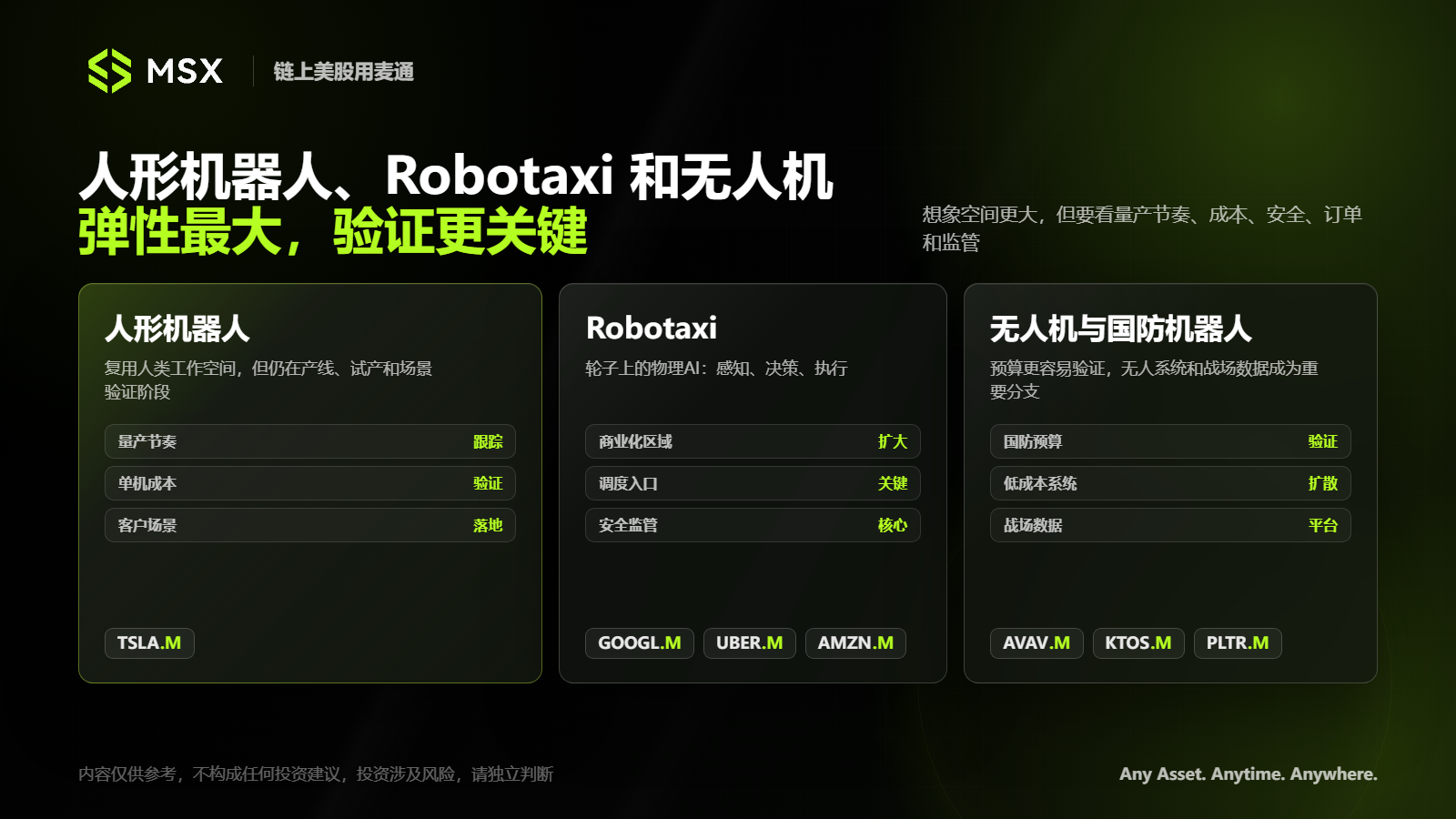
By comparison, Robotaxis are already significantly further along. An autonomous vehicle is essentially "Physical AI on wheels" – the vehicle perceives its environment via cameras, radar, and LiDAR; a model makes decisions; and the car executes the physical actions.
Tesla, Waymo, and Zoox represent the hardware-software integration, autonomous driving system, and dedicated Robotaxi approaches respectively. Uber aims to be the platform connecting different autonomous vehicle fleets with passengers. Waymo has already begun fully driverless operations for its 6th generation autonomous driving system. When equipped in its latest vehicles, the company disclosed completing over 20 million fully driverless trips, demonstrating that Robotaxis are significantly ahead of general-purpose humanoid robots in commercial validation.
Additionally, drones and defense robots are more likely to secure order validation. Defense customers have well-defined needs for autonomous, low-cost unmanned systems and counter-drone equipment. Companies like AeroVironment and Kratos have shown revenue and order growth in their autonomous and unmanned systems businesses. Ondas has also consistently secured orders for counter-drone systems, loitering munitions, and autonomous defense systems.
However, these smaller companies typically come with higher project concentration, financing, and execution risks.
Therefore, evaluating whether a Physical AI company is worth tracking ultimately comes down to three questions:
- Is it an irreplaceable core component of the industry chain?
- Does it have real customers, orders, and application scenarios?
- Can its technological progress ultimately translate into revenue, profit, and cash flow?
Concluding Thoughts
Physical AI will not be fulfilled overnight.
Based on industry patterns, it is more likely to progress along a path from certainty to high elasticity: first, computing power, simulation, and edge platforms; then, warehouses, factories, and specialized robots; followed by Robotaxis, drones, and general-purpose humanoid robots.
What truly determines how far this theme can go is not how many actions a robot performs at a product launch, but whether, after stepping off the stage, it can enter factories, warehouses, roads, and real business operations, creating value that can be verified in financial reports.
When that happens, AI will have truly stepped out of the screen and into reality.


