






从 AI Beta 到盈利兑现:Q3 美股,如何寻找新的赚钱姿势?


- 核心观点:Q3 美股市场核心逻辑从“估值扩张”转向“盈利兑现”,通胀限制估值上限,盈利决定指数下限。AI 主线未变,但交易重心将从宽泛的 AI Beta 下沉至能被订单和财报验证的具体环节,如存储、网络与光互连、电力及数据中心基础设施。
- 关键要素:
- Q3 宏观环境:通胀仍高于美联储目标,高估值成长股容错率下降,资金偏好盈利确定性高或具通胀对冲能力的资产。
- 指数驱动因素:标普 500 指数上涨更依赖 EPS 上修而非市盈率扩张,Goldman Sachs 已将 2026 年 EPS 预测上调至 340 美元。
- AI CapEx2.0:市场从交易“算力稀缺”转向验证“交付兑现”,供应链瓶颈从 GPU 扩展至电力、冷却和光互连等环节。
- 存储产业升级:AI 对 HBM、DRAM 和 NAND 需求已转化为收入与现金流,存储逻辑从单点稀缺走向全产业链扩散。
- 数据中心独立成组:电力、热管理和系统交付等基础设施环节,因 AI 资本开支进入建设阶段而成为核心交易子板块。
- 市场宽度重要性:健康的行情需 AI 主线外,工业、金融和平台广告等板块接力上涨,以降低市场集中度风险。
- 三种情景:基准情景为中性偏积极,指数震荡上行;乐观情景需盈利上修与通胀回落共振;悲观情景由二次通胀和AI兑现不及预期触发。
Let's get straight to the point: US stocks still have support in Q3, but if you want to continue making money in the market, your approach may need to change.
In the just-concluded Q2, the market's pricing of geopolitical shocks became temporarily insensitive. Coupled with the recovery of AI infrastructure investment and a rebound in risk appetite, US stocks strengthened again. Driven especially by large-cap tech stocks and core AI assets, the market once again returned to a familiar trading pattern: as long as capital expenditures continue to increase, and as long as demand for computing power remains strong, valuations can continue to rise.
But as we enter Q3, this logic is facing a higher verification threshold.
On one hand, inflation remains above the Fed's target, and long-term interest rates and the policy path continue to limit the expansion space for high-valuation assets. On the other hand, stock prices of AI-related companies have already priced in quite optimistic growth expectations. What the market needs to see next is no longer just larger CapEx numbers, but orders, deliveries, gross margins, cash flow, and return on capital.
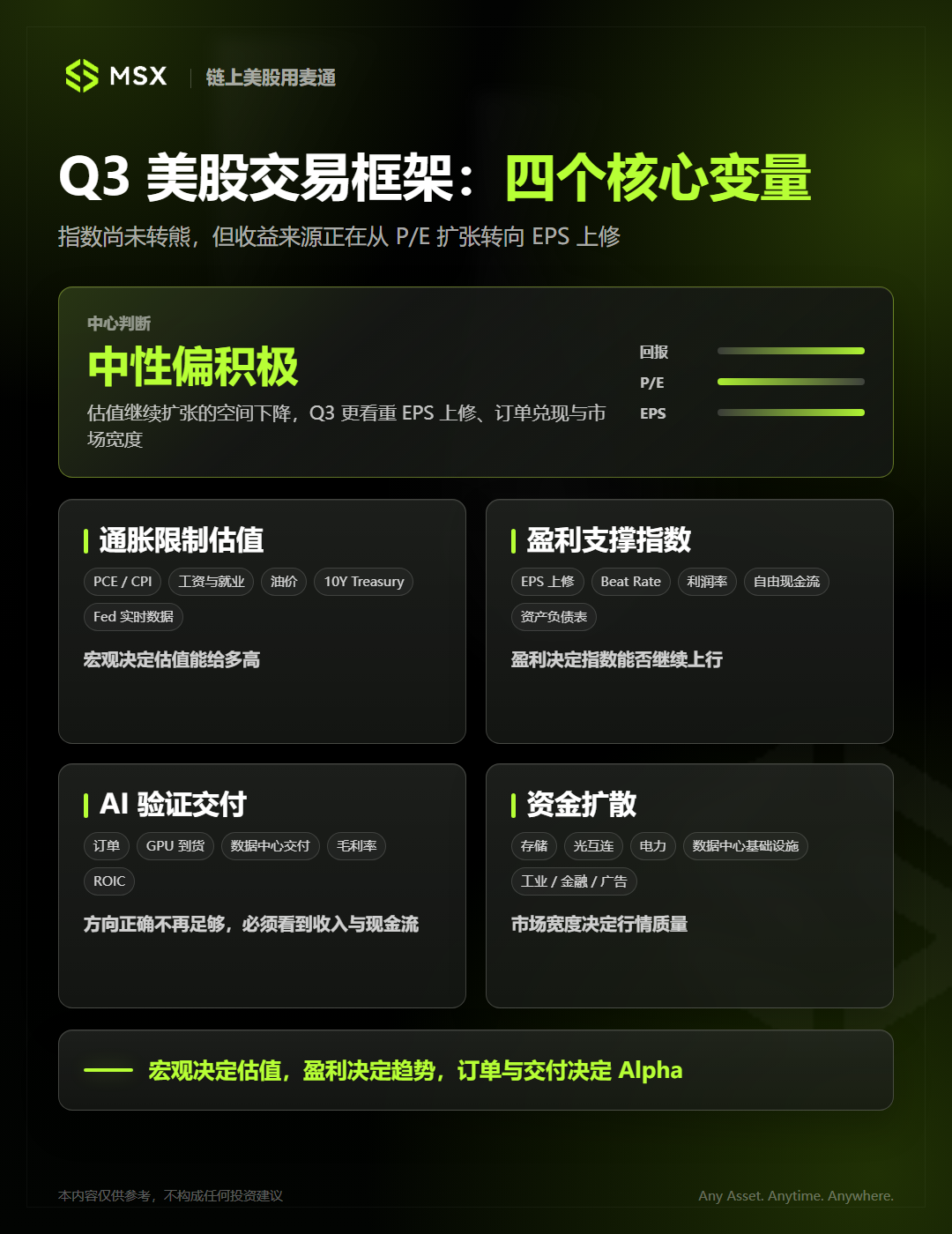
Therefore, MSX Maitong Research Institute maintains a neutral-to-positive judgment on US stocks for Q3.
The indices have not yet entered a systemic bear cycle, but the source of returns is shifting from "valuation expansion" to "earnings realization." AI remains the most important industrial theme, but the trading focus will move from broad AI Beta down to links more easily verifiable by financial reports—storage, networking & optical interconnects, power, cooling, data center delivery, as well as edge computing and Physical AI centered around real-world applications.
If one sentence could summarize the Q3 market environment, it would be: inflation limits the valuation ceiling, earnings determine the index floor, AI realization dictates structural Alpha, and market breadth determines the quality of the rally.
1. As Valuation Expansion Recedes, Earnings Must Support the Indices
From Q2 to Q3, the dominant contradictions in the market have clearly shifted.
The trading chain in Q2 was relatively clear: geopolitical conflicts impacted oil prices and inflation expectations, leading to adjustments in the interest rate path. After risk appetite recovered, funds flowed back into AI and large-cap tech stocks. The core of the entire market's trading was valuation repair following a marginal easing of macro pressures.
In Q3, the contradiction has further cascaded. Inflation constrains valuations, the Fed provides less forward guidance, earnings need to support the indices, and AI must move from capital expenditure to real-world realization.
This does not mean the market is about to turn bearish. A more accurate description is that the barrier to returns is rising.
1. Inflation Remains the Ceiling for High-Valuation Assets
The first constraint in Q3 still comes from inflation and the Fed.
US inflation remains significantly above the 2% long-term policy target, meaning the foundation for "rapid rate cuts to prop up valuations" is not solid. At the same time, the communication style of the Fed under Warsh places more emphasis on real-time data, price stability, and policy discipline, weakening the market's long-standing reliance on forward guidance.
This will have three main impacts:
- The market's familiar "Fed put" is thinning: Investors can no longer simply assume that if market volatility increases, policymakers will quickly signal easing;
- The market's sensitivity to individual data points will increase further: CPI, PCE, wages, employment, oil prices, consumer data, and even corporate earnings could trigger repricing of the interest rate path and valuations;
- The margin for error for high-valuation growth stocks will decrease significantly: While the AI industry trend remains intact, "being in the right direction" is no longer sufficient to sustain stock price expansion. The market needs more proof from orders, revenue, profit margins, and cash flow to confirm that current valuations are not based on distant imagination alone;
Therefore, the macro backdrop of Q3 is not a typical recession trade, but a high-valuation market that still has growth support but is perpetually constrained by interest rates.
In this environment, capital will favor two types of assets: one is companies with strong earnings certainty, high cash flow quality, and robust balance sheets; the other includes directions with low duration, resource attributes, or inflation-hedging capabilities, such as gold, resources, power, and some high-cash-flow financial assets.
2. Indices Can Still Rise, But Not Solely on Higher P/E
The most important support for US stocks in Q3 still comes from corporate earnings.
Many Wall Street institutions have raised their US stock targets in their mid-year outlooks. The core basis is not that valuations can expand indefinitely, but that there is still room for further upward revision of corporate EPS.
This distinction is very important.
When market valuations are already at historically high levels, the key to whether the indices can continue to rise is no longer whether investors are willing to pay higher multiples, but whether corporate earnings can continue to grow beyond expectations. Goldman Sachs has raised its year-end 2026 S&P 500 target to 8,000 points and raised its 2026 and 2027 EPS forecasts to $340 and $385, respectively.
At the same time, it expects the forward valuation of US stocks to roughly maintain around 21 times – a level already in the historically high range of the past 40 years.
In other words, future index upside depends more on EPS, not on further expansion of valuation multiples. If the earnings season drives continuous upward EPS revisions, US stocks still have the foundation for a volatile uptrend. However, if earnings revisions begin to slow, coupled with a resurgence in inflation or long-term interest rates, the market could quickly switch from "earnings-driven" to "valuation compression."
So, the most critical question for Q3 is not whether the indices can still rise, but under current valuations, can earnings continue to support the indices?
This also means that the allocation mindset should not remain passively chasing the indices, but should shift more towards directions verifiable by orders and financial reports, including AI infrastructure, storage, power, data center infrastructure, industrials, finance, platform advertising, and consumer leaders with stable cash flows.
3. Market Breadth Will Determine the Health of the Rally
Beyond index levels, market breadth is another key focus for Q3.
If US stocks continue to rise, but the gains remain highly dependent on a few AI giants, market concentration will increase further. Any single earnings miss could then trigger more severe volatility.
A healthier market structure would be: AI continues as the main theme, while sectors like industrials, finance, platform advertising, and certain consumer segments begin to take the baton.
In other words, Q3 shouldn't just focus on whether Nvidia, the semiconductor index, or the Nasdaq hits new highs. One must also observe the equal-weight index, the number of advancing stocks, and whether earnings expectations for non-AI sectors are improving simultaneously.
AI determines the market's height, but market breadth determines how far this rally can go.
2. AI CapEx 2.0: From Computing Scarcity to Delivery Realization
AI remains the most important industrial theme for Q3, but the trading logic has shifted from "expectation" to "verification."
In Q2, the market primarily traded on computing scarcity, upward capital expenditure revisions, and supply chain expansion. As long as tech giants kept raising CapEx, and as long as GPUs remained in short supply, the supply chain could be revalued around higher demand.
But in Q3, the market will more directly ask a few questions:
- Can financing truly be transformed into GPUs and data centers?
- Can GPUs be converted into computing power delivered on schedule?
- Can this computing power generate long-term, stable revenue?
- Can the revenue cover depreciation, financing costs, and equity dilution?
- Can it eventually generate positive free cash flow and reasonable ROIC?
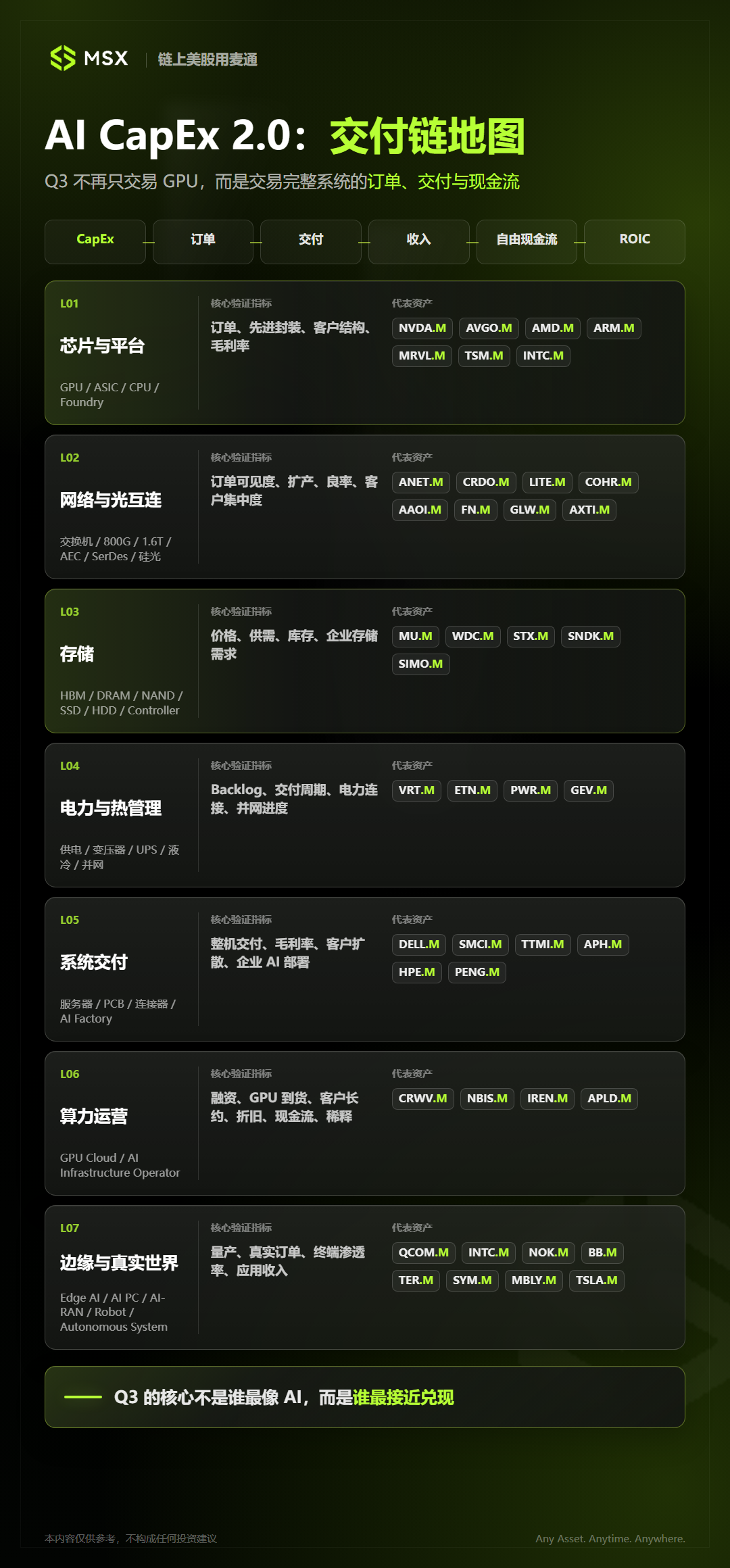
This is the so-called AI CapEx 2.0. It is no longer about betting on a single chip or simply chasing a single optical module. Instead, it follows the complete data center construction chain to find links that can truly deliver on orders and profits – chips & platforms → networking & optical interconnects → storage → power & cooling → server & system delivery → computing operations → edge & real-world applications.
1. Chips are Still the Gateway, But No Longer the Only Answer
Among them, chips remain the most crucial gateway to the AI industry.
NVDA is still the pricing anchor for global AI assets. AVGO corresponds to custom ASICs and networking platforms. MRVL benefits from both custom chips and optical interconnects. TSM represents advanced process nodes, advanced packaging, and the entire AI semiconductor manufacturing ecosystem.
However, the judgment on the chip layer in Q3 will be stricter than before.
The market will not just care about chip performance; it will continue to ask whether orders can sustainably beat expectations, whether advanced packaging and capacity bottlenecks can be alleviated, whether the customer base is healthy enough, whether gross margins can remain high, and whether inference, AI PCs, enterprise AI, and Edge AI can form new growth curves.
INTC needs to be understood within a different framework. It is not a direct replacement for NVDA but is closer to a comprehensive option covering US semiconductor security, server CPUs, AI PCs, Edge AI, and foundry business. Its logic lies in whether a low-base asset can see a confluence of positive catalysts from policy, industry, and fundamental improvements.
2. The Bigger the Cluster, the More Important Networking & Optical Interconnects
The larger the GPU cluster scale, the higher the importance of interconnects.
The Q2 market already fully priced in optical modules, switches, and high-speed interconnects. The focus in Q3 will shift from pure industry prosperity to more granular delivery quality. For example, are 800G and 1.6T demands continuing to be revised upward? Is order visibility sufficiently high? Is customer concentration controllable? Can capacity expansion and yield rates keep up with demand? Are silicon photonics, upstream materials, and specialty processes becoming new bottlenecks?
This layer is also one of the directions where capital can most easily spread from core AI leaders to second-tier assets.
When order visibility improves, optical communication, silicon photonics, and specialty materials companies often possess both earnings elasticity and room for valuation repair. Compared to companies relying solely on grand narratives, these firms are undoubtedly easier to verify through orders, capacity utilization rates, and earnings guidance.
ANET.M, CRDO.M, LITE.M, COHR.M, AAOI.M, FN.M, AXTI.M, and TSEM.M are important observable assets in this direction.
GLW.M is also worth including. It is not the purest optical module play, but its fiber optics, glass, and data center basic materials businesses allow it to benefit from increased data center connection density and infrastructure investment.
3. Storage is Transforming from an AI Sideline to a Core Bottleneck
Storage remains an area where weight needs to be increased in Q3.
In the past, when the market talked about AI, it first thought of GPUs and networking. However, as model parameters, inference calls, and data scale continue to grow, AI's consumption of HBM, DRAM, NAND, enterprise SSDs, and HDDs is also rising.
Storage is no longer a sideline to the AI industry; it is becoming an increasingly unavoidable core link in data center construction.
Micron's recent earnings and guidance strengthened the judgment that "AI storage has entered a realization phase." In its fiscal Q3 2026, the company reported revenue of $41.456 billion, Non-GAAP gross margin of 84.9%, and adjusted free cash flow of approximately $18.3 billion. For the fourth fiscal quarter, it guided revenue around $50 billion, plus or minus $1 billion, with a gross margin guidance of about 86%.
These figures indicate that AI's boost to storage is no longer just an order expectation but is beginning to manifest as a simultaneous realization of revenue, profit margins, and cash flow.
However, storage trading in Q3 should not be simplistically understood as "a single-point trade on MU." A more reasonable structure is to split storage into three tiers:
- Tier 1 is the NAND, SSD, and HDD diffusion, including WDC.M, STX.M, and SNDK.M. They benefit from AI data volume growth, improved enterprise storage demand, and the repair of the traditional storage cycle, with relatively limited direct competition with HBM leaders;
- Tier 2 is MU.M. Micron remains one of the core storage assets in the US market, benefiting from improvements in HBM, DRAM, and NAND simultaneously. However, with the progress of the SK hynix ADR plan, MU's premium as a "scarce HBM proxy in US stocks" may face some diversion (see also: "Watching SK Hynix by Day, Trading US Stocks by Night: A New 'Asian Session Bellwether' for Global AI Markets?");
- Tier 3 includes SIMO.M and other controller and second-order elasticity assets. They benefit from the diffusion of enterprise SSDs, AI PCs, and Edge AI storage, but their certainty and priority are currently lower than the main storage manufacturers and HDD/NAND theme;
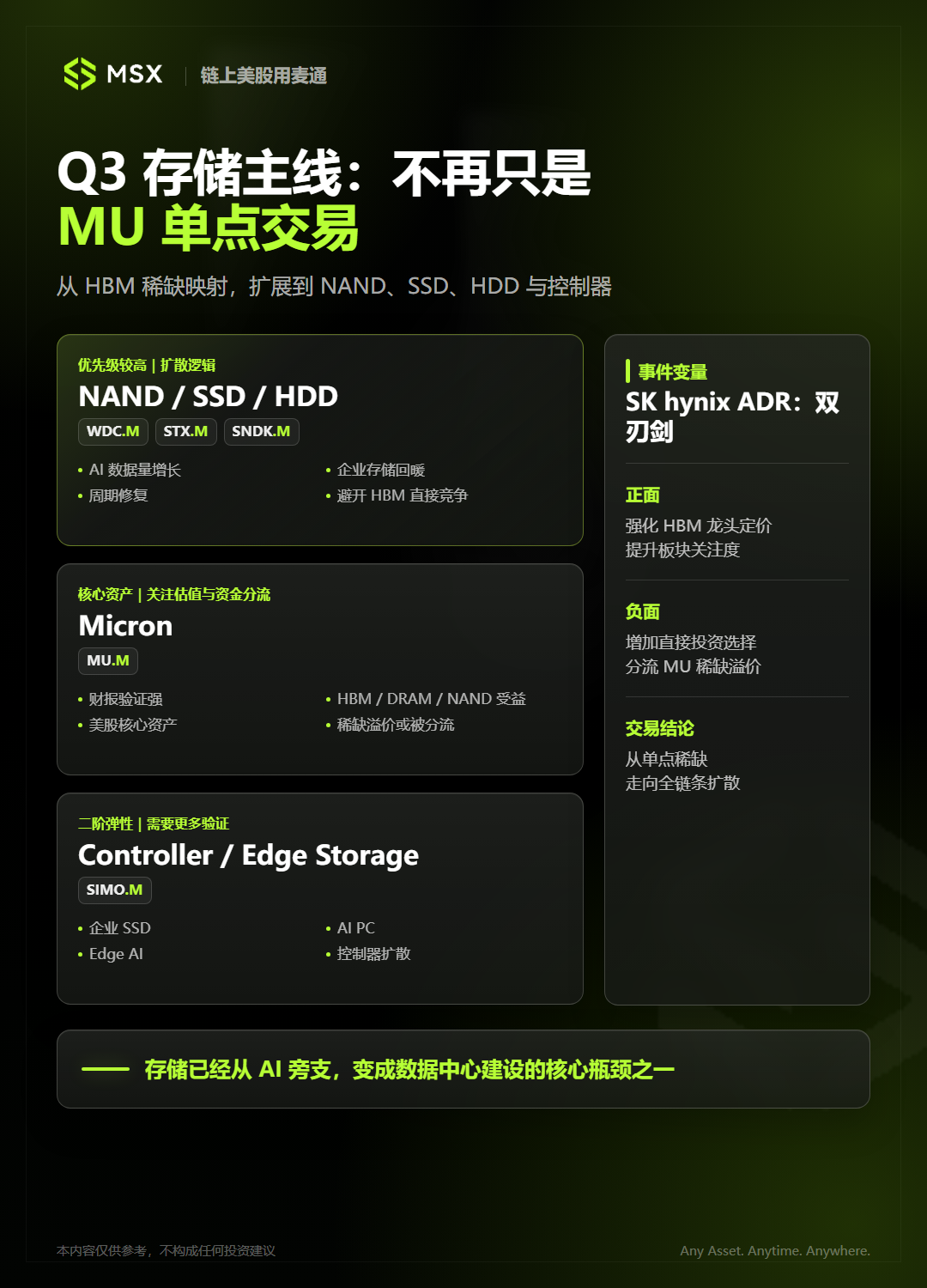
The SK hynix ADR is a classic double-edged sword for the entire storage sector.
Positively, it will strengthen the public market pricing for the global HBM leader and increase investor attention on the entire storage industry. Negatively, once US stock investors have a more direct investment channel for the HBM leader, MU's original premium for being a scarce proxy may be partially diluted.
Therefore, the storage logic in Q3 will gradually shift from "single-point scarcity" to "diffusion across the entire supply chain."
4. Data Center Infrastructure Must Be Grouped Separately
The bottleneck for AI is expanding from "whether there are enough GPUs" to "whether there is enough power, enough space, enough cooling, and the ability to connect to the grid."
This layer should no longer be simply classified as industrials or utilities. As AI capital expenditure gradually enters the real construction phase, power, thermal management, electrical equipment, construction delivery, and high-reliability components have become part of the AI CapEx trade.
Data center infrastructure can be broken down into at least five layers:
- Power and Thermal Management: VRT.M;
- Electrical Equipment and Power Distribution: ETN.M;
- Grid Engineering and Interconnection Construction: PWR.M;
- Power Generation and Grid Equipment: GEV.M;
- System Delivery, PCB, Connectors, and Materials: DELL.M, SMCI.M, TTMI.M, APH.M, GLW.M;
The biggest advantage of this direction is that the more AI CapEx moves towards real construction, the harder it is to bypass data center infrastructure.
After all, compared to assets that rely solely on valuations and narratives, data center infrastructure companies often have clearer backlogs, order cycles, and delivery schedules, making it easier for them to verify industry trends through revenue and cash flow.
5. From Single-Point Hardware to AI Factory
As the market shifts from purchasing specific hardware to building complete AI systems, the importance of AI Factories, server delivery, high-end PCBs, and enterprise AI infrastructure will also increase.
Key judgment criteria for this layer include whether orders are sustainable, whether products can be delivered on schedule, whether gross margins are stable, whether the customer base is diversifying beyond a single large client, and whether enterprise AI deployments can generate scalable revenue.
DELL.M and SMCI.M both belong to the system delivery direction, but their characteristics differ. Comparatively, DELL's business structure leans more towards enterprise AI, servers, and complete system delivery, offering a relatively clearer revenue verification path. SMCI has higher earnings elasticity but also more prominent risks related to volatility, governance, and expectation gaps.
Other directions worth watching include PENG.M and HPE.M.
6. Computing Power Operators Have the Greatest Elasticity, But Also the Highest Verification Threshold
Computing power operators represent the layer with the greatest elasticity in the AI theme, but also the highest risk.
These companies have the most intuitive growth story: secure financing, procure GPUs, build data centers, and then generate revenue through long-term computing power contracts.
But the capital market ultimately needs to verify whether this business model can succeed. This includes whether GPUs are actually delivered, whether power and space are delivered on schedule, whether long-term customer contracts are of sufficiently high quality, whether utilization rates can continuously improve, whether depreciation, debt, and financing costs will erode profits, and whether equity financing will cause sustained dilution.
Therefore, the keywords for computing power operators are not simply "AI concept," but rather


