欧盟 MiCA 正式落地:一文读懂 CASP 授权体系与主流交易平台合规格局


- ประเด็นสำคัญ: กฎหมายว่าด้วยตลาดสินทรัพย์เข้ารหัส (MiCA) ของสหภาพยุโรปสิ้นสุดระยะเวลาเปลี่ยนผ่านในวันที่ 1 กรกฎาคม 2025 แพลตฟอร์มซื้อขายที่ไม่ได้รับอนุญาตเป็นผู้ให้บริการสินทรัพย์เข้ารหัส (CASP) จะถูกห้ามให้บริการแก่ผู้ใช้ในสหภาพยุโรป CASP ไม่ใช่ใบอนุญาตประเภทเดียว แต่เป็นระบบการอนุญาตตามรหัสบริการ (a ถึง j) และข้อกำหนดเงินทุนขั้นต่ำ (Class 1-3) ปัจจุบันมีเพียง 18 หน่วยงานเท่านั้นที่ได้รับการอนุญาต Class 3 ซึ่งรวมถึงสิทธิ์ในการดำเนินการแพลตฟอร์มซื้อขาย (ประเภท b) ในขณะที่แพลตฟอร์มหลักอย่าง Coinbase, Bybit ส่วนใหญ่อยู่ในระดับ Class 2 ส่วน Binance และแพลตฟอร์มชั้นนำอื่นๆ ยังไม่ได้รับการอนุญาตอย่างชัดเจน
- ปัจจัยสำคัญ:
- หัวใจของ MiCA คือการสร้างกฎเกณฑ์การกำกับดูแลสินทรัพย์เข้ารหัสแบบเดียวกันสำหรับประเทศสมาชิกสหภาพยุโรป 27 ประเทศ ครอบคลุมการออก Stablecoin และการให้บริการสินทรัพย์เข้ารหัส หลังจากสิ้นสุดระยะเวลาเปลี่ยนผ่าน แพลตฟอร์มที่ไม่ได้รับอนุญาต CASP โดยหลักการแล้วจะไม่สามารถดำเนินงานในสหภาพยุโรปได้
- การอนุญาต CASP แบ่งออกเป็น 10 รหัสบริการตั้งแต่ a (การ保管) ถึง j (การโอน) Class 1 (ทุน 50,000 ยูโร) ครอบคลุมบริการที่ใช้สินทรัพย์เบาเช่นนายหน้าและที่ปรึกษา Class 2 (ทุน 125,000 ยูโร) เพิ่มบริการ保管และการแลกเปลี่ยน Class 3 (ทุน 150,000 ยูโร) เป็นการอนุญาตที่สมบูรณ์ที่สุดรวมถึงการดำเนินการแพลตฟอร์มซื้อขาย (ประเภท b)
- ณ เดือนกรกฎาคม 2026 มีหน่วยงานที่ได้รับอนุญาต CASP ทั้งหมด 279 แห่ง แต่มีเพียง 18 แห่งเท่านั้นที่ได้รับอนุญาต Class 3 ซึ่งรวมถึงบริการประเภท b เช่น OKX, Kraken, Bitstamp, Bitvavo เป็นต้น โดยขอบเขตของรหัสบริการที่ได้รับอนุญาตแตกต่างกันไปในแต่ละแพลตฟอร์ม
- แพลตฟอร์มหลักอย่าง Coinbase, Bybit, Crypto.com, KuCoin, Robinhood Europe ปัจจุบันได้รับการอนุญาต Class 2 ครอบคลุมบริการ保管 การแลกเปลี่ยน การโอน เป็นต้น แต่ไม่รวมถึงบริการดำเนินการแพลตฟอร์มซื้อขาย (ประเภท b)
- แพลตฟอร์มระดับโลกหลักเช่น Binance, Bitget, MEXC, HTX ยังไม่ปรากฏในตารางการอนุญาต CASP ของ ESMA ว่าได้รับอนุญาต MiCA ซึ่งอาจต้องเผชิญกับแรงกดดันในการหดธุรกิจ ย้ายผู้ใช้ หรือถอนตัวออกจากตลาดสหภาพยุโรป
EU MiCA Officially Takes Effect: A Guide to the CASP Authorization System and Compliance Landscape of Major Trading Platforms
As of July 1 this year, the CASP transition period under the MiCA regulation has officially ended. This means that, in principle, any crypto-asset trading platform that has not obtained CASP authorization will be unable to continue providing services to users within the EU.
For the entire industry, this day marks a clear watershed moment.
It's a mixed bag: some major platforms have already secured licenses and smoothly entered the MiCA regulatory framework. However, many others have yet to make substantial progress and may now face pressure to scale back operations, witness user migration, or even gradually exit the EU market.
In fact, the MiCA regulatory framework for crypto-asset service providers had already formally applied by the end of 2024. However, over the past year or so, the market has largely been digesting the rules, applying for licenses, and adjusting business structures during the transition period. With this period now over, MiCA is truly entering its enforcement phase.
Of course, many people still lack a clear understanding of how MiCA's CASP authorization is categorized, how regulatory requirements differ across platforms, and what practical impact this will have on exchanges and EU users.
Markets in Crypto-Assets Regulation
MiCA is a unified regulatory framework established by the EU for the crypto-assets market, with its full name being Markets in Crypto-Assets Regulation.
Its core objective is to create a common set of crypto-asset rules applicable across all 27 EU member states, covering the issuance, trading, custody, exchange, order execution, transfer of crypto-assets, and provision of related services. This framework aims to unify the previously fragmented crypto regulations among member states, requiring crypto-asset issuers and service providers to operate under clear licensing, capital, governance, risk management, disclosure, and client asset protection requirements.
Looking at the MiCA framework itself, it mainly targets two types of entities:
The first category is crypto-asset issuers, particularly issuers of Asset-Referenced Tokens (ARTs) and Electronic Money Tokens (EMTs).
These entities need to obtain the relevant issuer authorization, disclose whitepapers, establish reserve fund arrangements as per regulatory requirements, and meet ongoing compliance, governance, and risk management standards.
For the market, ARTs and EMTs are the two most critical types under MiCA's issuance-focused regulation. ARTs are more akin to multi-asset-backed stablecoins, while EMTs primarily correspond to single fiat currency-backed stablecoins, such as assets like USDC.
However, issuance regulation is not the main focus of this article; we can perhaps dedicate a separate piece to discuss this part in detail later.
The second category is Crypto-Asset Service Providers, or CASPs.
This category mainly includes crypto exchanges, custodians, brokers, order execution venues, and crypto-asset transfer service providers. Unlike the issuer system, CASP regulation focuses on how platforms provide crypto-asset services to clients, including trading, custody, exchange, order execution, investment advice, portfolio management, and asset transfer.
Accordingly, MiCA's regulatory requirements for CASPs primarily revolve around capital, governance, risk control, client asset protection, disclosure, and operational compliance.
Since July 1 this year, only crypto-asset service providers that have obtained the corresponding CASP service authorization can legally offer services such as client asset custody, trade matching, asset exchange, order execution, and asset transfers within the EU.
A crucial point to note here is that, strictly speaking, CASP is not a single "universal exchange license." Under the MiCA framework, "obtaining CASP authorization" and "being able to operate a trading platform" are not synonymous.
CASP authorization itself is granted based on specific types of services. This means what business a platform can conduct depends entirely on which service codes it has applied for and been granted. This is somewhat similar to the scope of business on a business license: even within CASP-authorized entities, the permissible business scope may differ from one entity to another.
Currently, there are 279 entities with MiCA CASP authorization, of which approximately 222 are major service providers capable of offering crypto-trading-related services like trading, exchange, or order execution.
However, among these entities, only 18 are actually authorized to operate a crypto-asset trading platform, meaning they hold authorization under MiCA's Class b service code.
Therefore, understanding the MiCA CASP authorization system requires looking at which specific service types it covers.
Below, we will break this down in detail.
How is MiCA CASP Authorization Categorized?
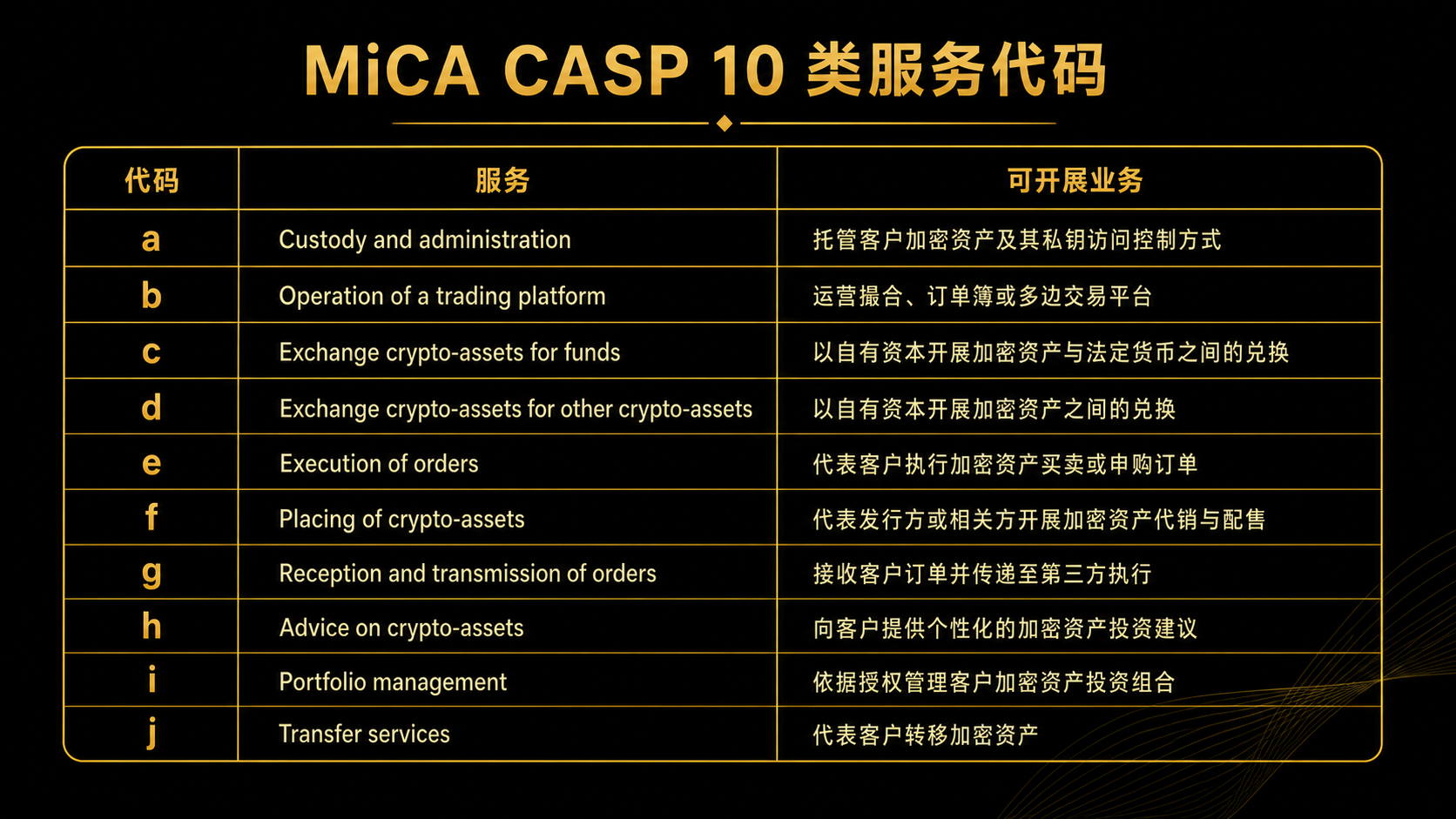
Within the MiCA CASP authorization system, crypto-asset services are subdivided into 10 major categories, represented by service codes from 'a' to 'j'. These codes determine the business a platform is permitted to conduct.
Building on these 10 service codes, MiCA's Annex IV further classifies CASP minimum capital requirements into three tiers: Class 1, Class 2, and Class 3, which dictate the minimum capital a platform must meet.
The 10 Service Codes
Class a: Custody and administration of crypto-assets on behalf of clients
Class a corresponds mainly to custody services. This involves a platform safeguarding clients' crypto-assets or controlling the means of access for clients, such as private keys, account permissions, and custodial wallets.
For a CEX, as long as users deposit their coins into platform accounts, the platform inherently assumes custodial duties. The core focus of this business is client asset security, private key management, asset segregation, and whether the platform can control client assets.
Class b: Operation of a trading platform
Class b is closest to what is commonly understood as "exchange business." It involves operating a trading system where multiple buyers and sellers can execute transactions under the platform's rules. Order books, matching engines, and multilateral trading facilities are typical examples within this category.
Therefore, if a platform only transacts with clients directly, it may not necessarily fall under Class b. However, if it facilitates transactions between numerous users via an order book, it falls under the operation of a trading platform.
Class c: Exchange of crypto-assets for funds
Class c refers to a platform using its own capital to exchange crypto-assets for funds with clients. In simple terms, this means users buying crypto with fiat currency like EUR or USD, or selling crypto to the platform for fiat, with the platform acting as the counterparty. This is somewhat similar to what is commonly known as OTC trading.
The key point here is that the platform is not just matching trades between others but is using its own asset pool to exchange crypto-assets for fiat currency directly with clients.
Class d: Exchange of crypto-assets for other crypto-assets
Class d is what is commonly referred to as crypto-to-crypto trading services. If a platform uses its own capital or asset pool to facilitate exchanges between different crypto-assets for clients, it falls under this category.
Class e: Execution of orders on behalf of clients
Class e means a platform executes buy, sell, or subscription orders for crypto-assets on behalf of clients. It is similar to a broker service: after a user places an order, the platform executes the trade on the client's behalf. The client isn't directly performing the trade on the platform themselves; the platform actively completes the transaction.
Class f: Placing of crypto-assets
Class f mainly corresponds to issuance-side business. If a platform promotes, sells, or places a crypto-asset to investors on behalf of a project team, issuer, or related party, it likely falls under this category. Services like Launchpad, IEOs, and new token issuance sales often fall here.
Class g: Reception and transmission of orders on behalf of clients
Class g refers to a platform receiving client orders and transmitting them to a third party for execution. It is easily confused with Class e. The difference is that Class e involves the platform executing the order on behalf of the client, while Class g involves the platform only receiving and transmitting the order, with ultimate execution potentially occurring on another platform or with a third party.
Aggregators, order routing platforms, and broker gateways often involve this type of service.
Class h: Advice on crypto-assets
Class h refers to providing personalized advice to clients regarding crypto-assets. For instance, recommending that a client buy, sell, or use a specific crypto-asset service based on their personal circumstances, risk tolerance, and investment objectives. It leans more towards advisory services.
Class i: Portfolio management of crypto-assets
Class i corresponds to crypto asset management. This means a client authorizes a platform or service provider to manage their crypto-asset portfolio, giving the service provider some discretionary power over asset allocation. The platform can buy, sell, and rebalance the portfolio on the client's behalf as authorized.
Class j: Transfer services for crypto-assets
Class j means a platform transfers crypto-assets from one address or account to another on behalf of a client. Examples include an exchange helping a user withdraw funds, a custodian facilitating transfers for clients, or a payment platform executing crypto-asset transfers as an agent. All these fall under this category.
Minimum Capital Classification
Beyond these 10 service codes, market discussions often mention MiCA's Class 1, Class 2, and Class 3.
In fact, Class 1/2/3 are not three different types of MiCA licenses. They are fundamentally minimum capital requirement classifications from MiCA's Annex IV.
Class 1 corresponds to services e, f, g, h, i, and j. These include order execution, placing of crypto-assets, reception and transmission of orders, investment advice, portfolio management, and transfer services. The minimum capital requirement is €50,000.
These services are more oriented towards brokerage, advisory, asset management, order transmission, and transfers. As they do not necessarily involve the platform itself holding large amounts of client assets or operating a trading platform, the minimum capital requirement is €50,000.
Class 2 builds upon Class 1 by adding services a, c, and d. This means, in addition to services covered by Class 1, it includes client asset custody, crypto-to-fiat exchange, and crypto-to-crypto exchange. The minimum capital requirement is €125,000.
Class 2 starts to involve safekeeping of client assets and the platform using its own capital for exchange transactions with clients. It covers custody and exchange services on top of basic brokerage, order, advisory, and transfer services.
Class 3 is distinguished by the inclusion of Class b, the operation of a trading platform. Class 3 can be solely for Class b or it can combine Class b with custody, exchange, order execution, transfer, and other services (building on a full or partial Class 2 foundation). Class 3 is the closest approximation to a full exchange business. The minimum capital requirement is €150,000.
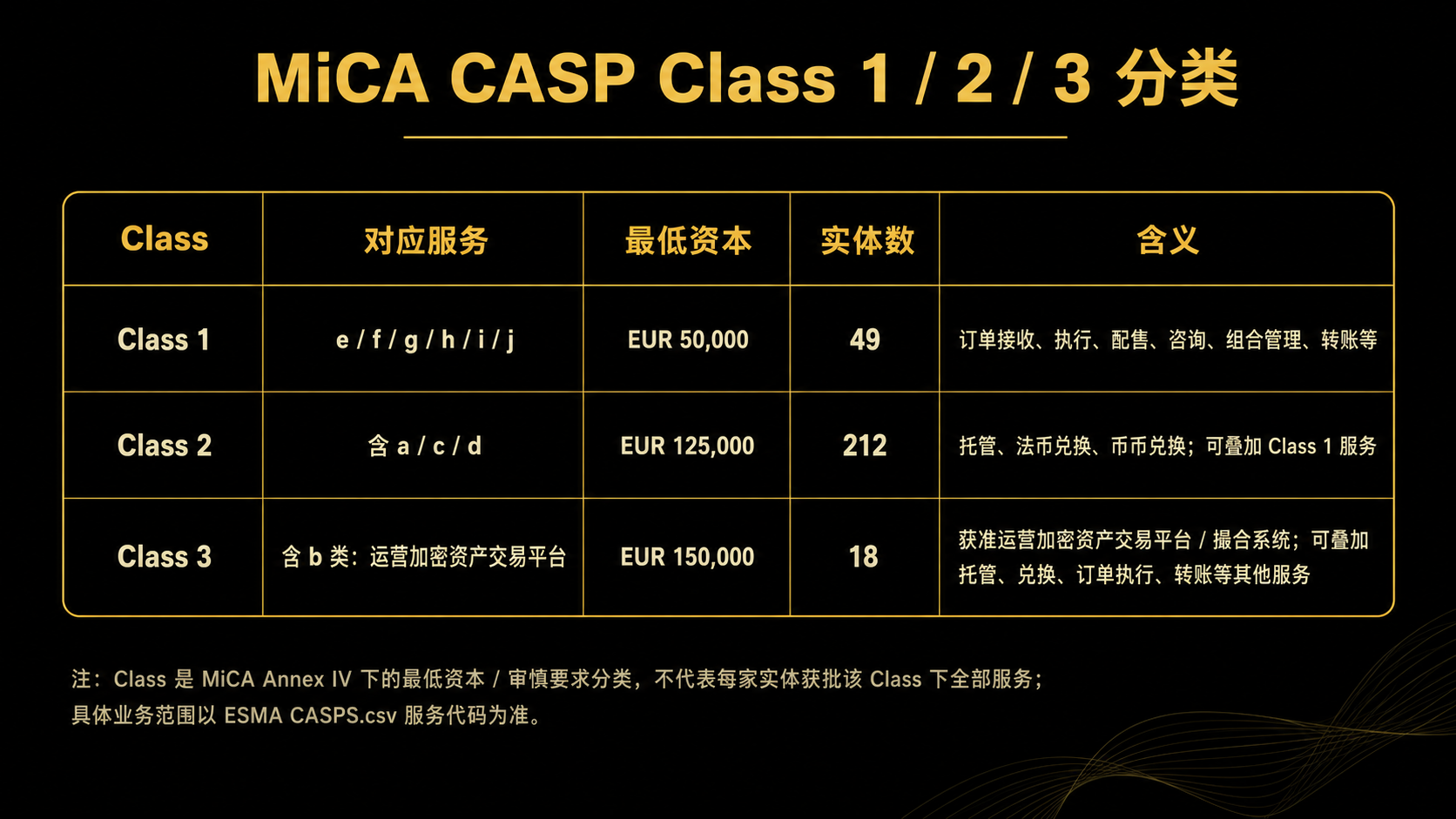
Overall, the core of MiCA CASP is authorization based on service codes. Codes 'a' through 'j' define the specific crypto-asset services a platform can offer. Classes 1/2/3 merely set different minimum capital requirements based on the risk and complexity of these services.
So, understanding these rules allows for a better assessment of which business activities a platform can legally conduct under MiCA.
Current Authorization Status of Major Crypto Trading Platforms
As of the ESMA update on July 3, 2026 (updated weekly), there are 279 entities with MiCA CASP authorization. Aside from Class 1, the vast majority are Class 2, with a small number being Class 3.
Class 3: Including Class b "Operation of a Trading Platform" Authorization
Currently, there are 18 entities that have obtained Class 3 authorization, which includes the Class b service code for operating a trading platform.
1. OKX
OKX obtained its MiCA CASP authorization through its Maltese entity, OKX Europe Limited, on January 27, 2025. Its service codes are a, b, c, d, e, f, g, i, j, covering client asset custody, trading platform operation, fiat currency exchange, crypto-to-crypto exchange, order execution, placing of crypto-assets, reception and transmission of orders, portfolio management, and transfer services. Based on this service code coverage, OKX is considered one of the Class 3 platforms with a relatively comprehensive authorization scope.
2. Gate.io EU
Gate.io EU obtained its MiCA CASP authorization through its Maltese entity, Gate Technology Limited, on September 29, 2025. Its service codes are a, b, c, d, e, j, covering client asset custody, trading platform operation, fiat currency exchange, crypto-to-crypto exchange, order execution, and transfer services.
3. Kraken
Kraken obtained its MiCA CASP authorization through its Irish entity, Payward Global Solutions Limited, on June 25, 2025. Its service code is b, meaning trading platform operation. It is important to note that Kraken also has another entity under Class 2, and the service scope of the two entities differs.
4. BSDex
BSDex obtained its MiCA CASP authorization through its German entity, Baden-Württembergische Wertpapierbörse GmbH, on July 3, 2025. Its service code is b, meaning trading platform operation.
5. flatexDEGIRO / 360T
flatexDEGIRO / 360T obtained its MiCA CASP authorization through its German entity, 360 Treasury Systems AG, on April 2, 2025. Its service code is b, meaning trading platform operation.
6. PAYMIUM
PAYMIUM obtained its MiCA CASP authorization through its French entity, PAYMIUM SAS, on June 22, 2026. Its service codes are a, b, c, d, e, j, covering client asset custody, trading platform operation, fiat currency exchange, crypto-to-crypto exchange, order execution, and transfer services.
7. Coinmate
Coinmate obtained its MiCA CASP authorization through its Czech entity, COINMATE a.s., on February 27, 2026. Its service codes are a, b, c, d, j, covering client asset custody, trading platform operation, fiat currency exchange, crypto-to-crypto exchange, and transfer services.
8. Webot
Webot obtained its MiCA CASP authorization through its Irish entity, Pionew Ireland Limited, on December 18, 2025. Its service codes are a, b, c, j, covering client asset custody, trading platform operation, fiat currency exchange, and transfer services.
9. RULEMATCH
RULEMATCH obtained its MiCA CASP authorization through its Liechtenstein entity, RULEMATCH Europe AG, on June 1, 2026. Its service codes are a, b, j, covering client asset custody, trading platform operation, and transfer services.
10. Bitstamp
Bitstamp obtained its MiCA CASP authorization through its Luxembourg entity, Bitstamp Europe S.A., on May 15, 2025. Its service codes are a, b, c, d, e, g, j, covering client asset custody, trading platform operation, fiat currency exchange, crypto-to-crypto exchange, order execution, reception and transmission of orders, and transfer services.
11. Kanga Exchange EU
Kanga Exchange EU obtained its MiCA CASP authorization through its Latvian entity, SIA AlphaRoute, on June 18, 2026. Its service codes are a, b, c, d, f, j, covering client asset custody, trading platform operation, fiat currency exchange, crypto-to-crypto exchange, placing of crypto-assets, and transfer services.
12. Anycoin
Anycoin obtained its MiCA CASP authorization through its Czech entity, MP Developers s.r.o., on February 11, 2026. Its service codes are a, b, c, d, e, covering client asset custody, trading platform operation, fiat currency exchange, crypto-to-crypto exchange, and order execution services.
13. Revolut Crypto
Revolut Crypto obtained its MiCA CASP authorization through its Cypriot entity, Revolut Digital Assets (Europe) Ltd, on October 20, 2025. Its service codes are a, b, c, d, f, j, covering client asset custody, trading platform operation, fiat currency exchange, crypto-to-crypto exchange, placing of crypto-assets, and transfer services.
14. ZBX
ZBX obtained its MiCA CASP authorization through its Maltese entity, Zillion Bits Limited, on February