






BiCS-10 Mass Production Breakthrough: Kioxia’s AI Storage Narrative Enters the Realization Window, Morgan Stanley Sees 32% Upside


- Core View: Kioxia has commenced production of BiCS-10 (332-layer) 3D NAND and begun shipping 1Tb TLC samples, demonstrating technological leadership. However, near-term profitability still relies on BiCS-8. The approximately 32% upside to the target price stems from long-term expectations of its technology translating into market share for AI data center SSDs, rather than short-term volume.
- Key Elements:
- BiCS-10 interface speed increases to 4.8Gb/s (a 33% improvement), with a 59% increase in bit density and an 18%-30% improvement in power efficiency. It is primarily targeted at enterprise-grade and data center AI SSDs.
- By March 2027, BiCS-8 is expected to still account for over 80% of Kioxia’s shipments. Near-term profit improvement will primarily come from this mature process.
- Morgan Stanley maintains an "Overweight" rating with a target price of approximately 110,000 yen, implying roughly 32% upside from the current share price. This valuation is based on an estimated free cash flow yield of around 10% for FY2028.
- Key risks include: lengthy customer qualification cycles, yield ramp-up challenges for the new process at the K2 fab, supply disruptions from NAND production expansion by Chinese manufacturers, and the FX risk associated with a JPY appreciation against the USD.
TL;DR
- Kioxia and SanDisk have started BiCS-10 production at K2 in Iwate Prefecture, with 1Tb TLC samples now shipping.
- BiCS-10 interface speed increases to 4.8Gb/s, but volume ramp-up will primarily depend on BiCS-8 until March 2027.
- Target price is approximately ¥110,000, implying roughly 32% upside; risks lie in customer qualification, K2 ramp-up, and supply disruptions.
On July 3rd, Kioxia and SanDisk announced the start of production for their 10th-generation 3D Flash memory, BiCS-10, at the Fab2/K2 facility in Iwate Prefecture, Japan. Kioxia also began shipping 1Tb TLC BiCS-10 samples on the same day, targeting enterprise and data center SSDs.
This moves Kioxia's AI data center storage roadmap into the pre-production ramp-up phase, but it is not yet a signal of immediate profit realization. The samples are for customer functional verification; mass production specifications may still be adjusted. This will need to be followed by enterprise SSD qualification, product integration, and the K2 factory ramp-up.
Morgan Stanley maintains an "Overweight" rating on Kioxia in its latest report. Based on a target price of approximately ¥110,000 and a closing share price of ¥83,300 on July 3rd, the implied upside is roughly 32%. This thesis does not hinge on short-term BiCS-10 volume ramp-up but rather on Kioxia's ability to translate faster interfaces, higher bit density, and lower power consumption into increased AI data center SSD market share and improved cash flow.
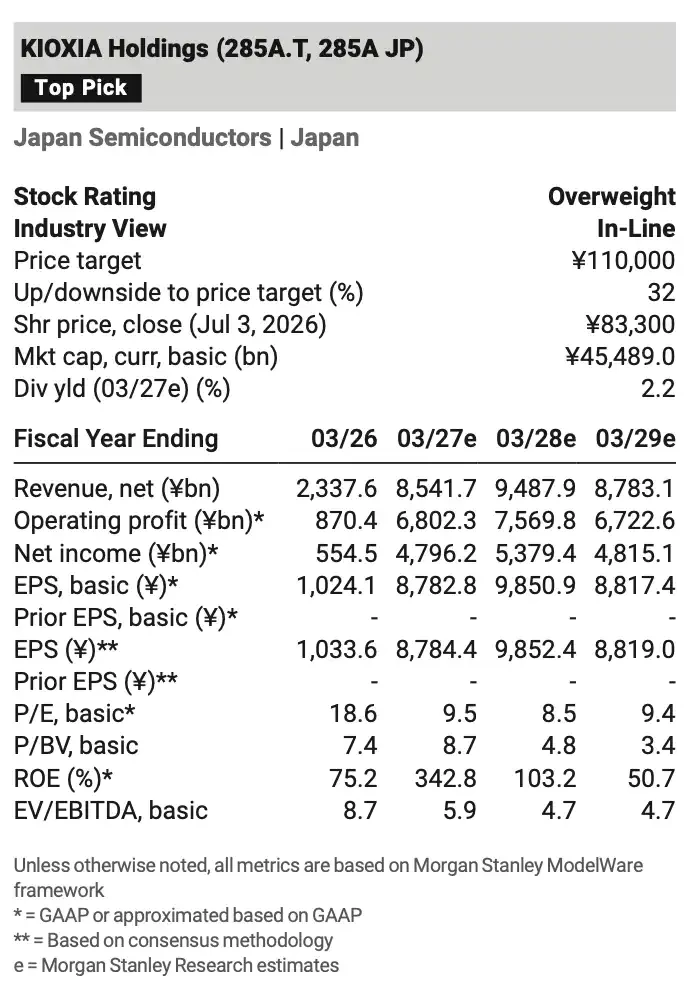
A financial forecast table shows FY2027e revenue of approximately 8.54 trillion yen and FY2028e revenue of about 9.49 trillion yen, with the earnings outlook tied to product mix upgrades.
Interface Reaches 4.8Gb/s: Kioxia Targets High-Bandwidth AI SSDs
The most direct change with BiCS-10 is increasing the NAND interface speed from 3.6Gb/s (BiCS-8) to 4.8Gb/s, a roughly 33% improvement. For consumer storage, this metric isn't always intuitive; however, for enterprise SSDs and AI servers, interface speed impacts data throughput, latency, and cache efficiency.
The 1Tb TLC samples Kioxia is shipping target enterprise and data center SSDs. In its 2026 Investor Day materials, the company positioned the CM Series as "High Bandwidth SSD with TLC Flash Memory" and mentioned suitability for NVIDIA CMX Servers and optimization for KV cache workloads. This indicates that NAND in AI servers is not just for cheap, high-capacity storage but is also expected to handle data caching and access tasks closer to the compute side.
BiCS-10 is also a 332-layer 3D Flash memory. Compared to BiCS-8, the company disclosed a 59% improvement in bit density, an 18% improvement in write power efficiency, and a 30% improvement in read power efficiency. Bit density affects the output capacity per wafer, while power consumption impacts data center operating costs. Ultimately, cloud providers will focus on the cost per TB, SSD performance, and overall system energy consumption.
However, leading technical specifications do not equate to commercial success. Enterprise SSDs typically require longer qualification cycles, especially for high-performance, low-latency, and AI workload products. BiCS-10 has started production and entered sample shipment, but becoming a primary source of revenue and profit for Kioxia requires confirmed customer orders.
Short-Term Profits Still Rely on BiCS-8, Not Immediate BiCS-10 Volume
What is often overlooked is that Kioxia's cost improvements over the next year to 18 months will still primarily come from BiCS-8.
Morgan Stanley's model expects that the company's output expansion and GB cost reduction from early 2026 to the first half of 2027 will still be driven by BiCS-8. By March 2027, BiCS Gen.8 is projected to account for over 80% of production in GB terms. BiCS-10 represents more of a starting point for long-term product structure upgrades rather than an immediate single catalyst for near-term financial results.
This cadence is not contradictory. The path from trial production and sample shipment to large-scale introduction for a new NAND generation typically involves production line transitions, yield ramp-up, customer validation, and product mix adjustments. The K2 factory has been operational since September 2025, previously producing 8th-generation 3D Flash. With the introduction of the 10th-generation product, overall capacity will continue to expand, but the income statement needs to wait for capacity utilization, yields, and customer orders to align.
Kioxia's medium to long-term goal is to increase the sales share of the data center and enterprise market to over 60%. This is where BiCS-10's significance lies: if the new NAND generation successfully enters high-end enterprise SSDs and gains share in AI server storage, Kioxia's revenue structure will become more skewed toward the enterprise market.
The 32% Upside Comes from Valuation and Product Structure Delivery
The roughly 32% upside potential is not just a bet on rising NAND prices but combines technological upgrades, increased data center SSD market share, and improved free cash flow.
In terms of valuation, the target price is based on an FY2028e free cash flow yield of approximately 10%, implying a price-to-earnings ratio of about 11x. The model forecasts FY2027e revenue of about 8.54 trillion yen and FY2028e revenue rising to approximately 9.49 trillion yen; basic EPS is estimated at roughly 8,782.8 yen and 9,850.9 yen, respectively. The premise here is that Kioxia can translate its technological upgrades into better product pricing and cost structure amidst demand growth and supply constraints.
The market's willingness to assign a higher valuation to Kioxia partly stems from AI storage demand. Compared to consumer electronics and traditional PC cycles, data center SSDs are more driven by cloud capital expenditures, AI cluster construction, and enterprise storage upgrades. If BiCS-10 successfully enters high-end enterprise SSDs, Kioxia's revenue quality and cyclical volatility could improve.
However, this chain of execution is long. Technical specifications must first become products; products must pass customer qualification; qualification leads to shipments; and finally, shipments become revenue and profit. A delay at any stage will impact market expectations for profitability beyond 2027.
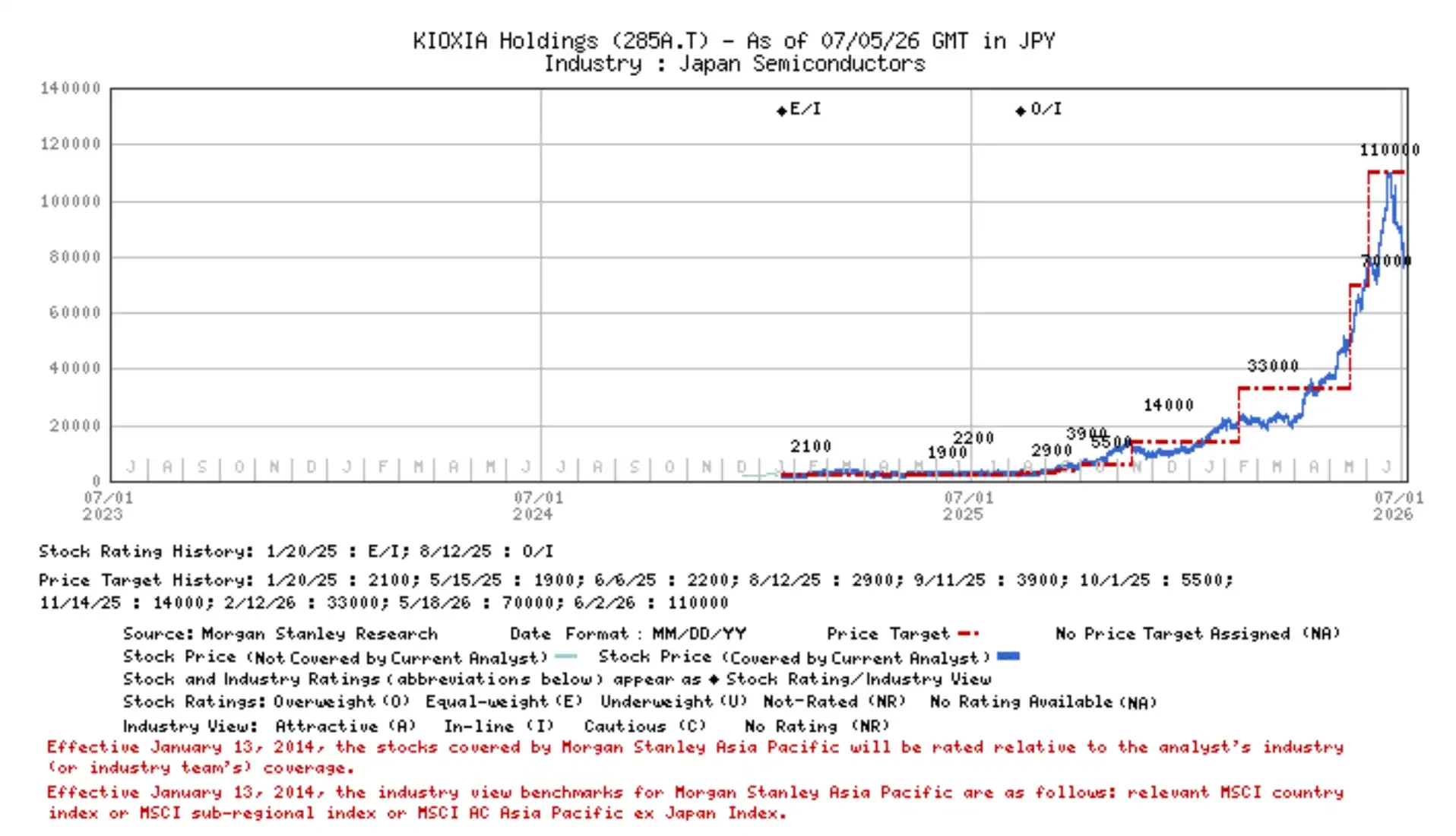
A stock price chart shows Kioxia's share price at approximately ¥83,300 as of July 3, 2026, overlaid with an "Overweight" rating marker.
The Disagreement Lies Not in Technical Specs, but in the Ramp-Up and Supply/Demand
The direction of BiCS-10 is relatively clear; the real uncertainty lies in execution.
First is customer qualification. High-end enterprise SSDs entering the ecosystem of cloud providers and data center customers must meet performance, stability, power consumption, and long-term supply requirements. Sample shipment is just the beginning; the qualification time and order size will determine when BiCS-10 makes a substantial contribution to revenue.
Second is the K2 factory ramp-up. Switching to a new process typically impacts yields and the cost curve. Even if the production line has started, improving capacity utilization takes time. If the ramp-up is slower than expected, the unit cost advantages and bit density benefits of BiCS-10 will be delayed.
Third is industry supply. NAND capacity expansion by Chinese manufacturers could disrupt the global supply-demand balance, especially if demand recovery falls short of expectations. New supply would then pressure prices and profit margins. Even if Kioxia aims for a higher revenue share from AI SSDs, it still faces the memory price cycle and changing competitive landscape.
The exchange rate is also a direct risk. Morgan Stanley's sensitivity analysis indicates that for every 1 yen appreciation against the US dollar, Kioxia's annual operating profit decreases by approximately 6 billion yen. For a memory manufacturer with global sales but reporting in yen, exchange rate fluctuations amplify the uncertainty of earnings forecasts.
BiCS-10 is more like a ticket for Kioxia to compete in the AI data center SSD market, rather than a victory already achieved. Short-term earnings will still depend on BiCS-8's share increase and cost reduction; the medium to long term hinges on BiCS-10 qualification, the K2 ramp-up, and enterprise SSD customer adoption. If these steps proceed smoothly, the roughly 32% upside potential will have stronger support. If any link is delayed, the technological lead will still need confirmation from financial results.


