






一位匿名研究者的46条暴论:AI将颠覆一切,包括核威慑与人类统治


- 核心观点:AI的智能生产可能还有4到10个数量级的增长空间,算法进步将引发远超预期的技术跳跃,并在短期内重塑社会、经济与权力结构,可能导致永久性阶级分化与国家安全格局的根本性改变。
- 关键要素:
- 算法进步将带来“大跳跃”,智能生产可能尚存4-10个数量级的提升空间,现有认知低估了其变革速度与深度。
- AI自我改进进入起飞阶段,算法研究加速,且存在“纠错逃逸速度”,长任务智能体的性能将突破误差累积的瓶颈。
- 机器人领域将经历类似ChatGPT的时刻,但全球物理机器人数量的规模化(每年1亿台)可能需到2030年代才能实现。
- 自动化将导致深刻通缩,多数商品接近零边际成本,但可能催生“永久底层阶级”,其核心是能动性受限而非收入低下。
- 相互确保摧毁(MAD)在AI与自动化军事供应链面前可能失效,军队、警察等政府执法机制将被自动化,且更聪明。
- AI实验室可能面临国有化压力,以协调国家权力与私营公司控制的危险张力,尤其在其掌握决定性暴力工具之后。
- 科技树中潜藏着真正的危险(如零日漏洞与脆弱世界假说),未来权力积累与协调的失败可能导致暴政或灾难。
Original Author: bayeslord
Original Compiled by: TechFlow
Introduction: bayeslord (@bayeslord) is an anonymous but weighty account in the AI × crypto space. He doesn’t promote products or chase trends, instead focusing on deep-diving into technical cores like scaling laws and algorithmic depth.
This blogger recently wrote a list of 46 points, projecting the future development of technology, AI, and related fields. He argues that everyone is using past efficiency curves to understand AI, but the real leap hasn’t arrived yet, and there may still be four to ten orders of magnitude left in intelligence production.
He moves from algorithmic acceleration to robotics, capital, a permanent underclass, and finally lands on the sharpest point: Mutually Assured Destruction (MAD) may fail, police and military will be automated, and AI labs could be nationalized.
The original post has nearly 1 million views. Although the views are extreme, each point is relatively self-consistent and worth a read for anyone interested in technology.
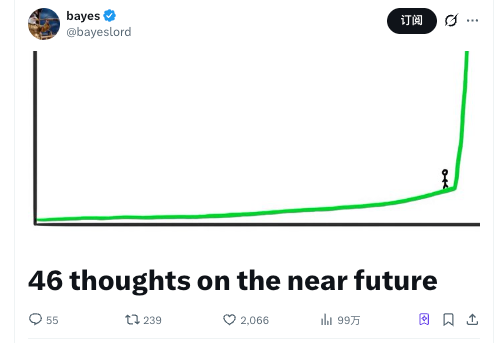
This list is based on a tweet thread I posted on June 4, with some modifications and additions. Several people said the original was too difficult to read, so I organized it into this version.
Intelligence
1. Algorithmic progress will catch everyone off guard. The entire world—markets, governments, militaries, companies, individuals—is using the production efficiencies and patterns of recent years to understand AI's impact and how things will roughly play out. Even the new labs that claim to believe in "recursive self-improvement" think it's just the same old thing with an agent running in a loop. That's not it. I suspect there are many orders of magnitude left in intelligence production, perhaps as many as ten, with four to seven being more likely. More than ten is not impossible in principle, but that would heavily bump into what I suspect is the true upper limit allowed by the laws of physics. Unlikely, but not ruled out. If this judgment holds, then the real direction of things is not what it appears to be on the surface; a big jump is approaching. Anything that happens along this direction will make the world stranger than almost everyone is pricing in.
2. We are in the early stages of takeoff. AI improving AI could ultimately become the most consequential step in history. This can't be guaranteed because we don't know how far we are from the physical and computational limits of intelligence, but I bet we're still far away (as mentioned, squeezing out another 4 to 10 orders of magnitude of intelligence output per unit of compute seems possible).
3. Since we've entered the takeoff phase, algorithmic research is accelerating. Compute remains scarce, but the opportunity cost of a researcher's time has decreased because you can just send an agent to do any task, even if it's random. It might bring something back. All new ideas carry a debt of "optimization," and now this debt can be repaid with unsupervised token consumption. Vast amounts of research scaling law curves will be traversed one by one.
4. AI models will continue to get stronger, especially frontier models. The only real wall is physics. Models are becoming more autonomous, more intelligent, and constantly improving. Math and code are being conquered by scale and reinforcement learning, with everything else falling in line. The distinction between "verifiable" and "non-verifiable" will gradually disappear as a meaningful boundary. Going forward, automated AI research and AI learning will increasingly look like the same thing. Training a model well is essentially closely related to the model learning well by itself. Sample efficiency, creativity, and all other constraints will be solved and then approach algorithmic optimality at arbitrary scale.
5. The idea that long-horizon agents need training data of equivalent length is wrong because generalization exists across time. Long tasks are not constructed by the property of "longness." This relates to LeCun's fallacy of (1-e)^n error accumulation. What actually happens is error correction. Error correction occurs at multiple scales simultaneously, from the level of individual token generation to each step within a long task. The reason METR's chart goes up is partly because agents are starting to reach escape velocity for error correction.
6. An engineering-level science of deep learning is about to emerge. It will push us toward algorithmic maturity in AI much faster than most people expect—although, as mentioned earlier, how far this path can go in principle remains unclear. For example, a science of scale invariance would drastically increase the scale and payoff of useful experiments because an experiment on one GPU could tell you how to do it with a hundred thousand.
7. Every domain of technical human activity will have its own "Move 37" moment (the move in AlphaGo's game against Lee Sedol that transcended human intuition), and then soon, "Move 37" itself will seem outdated. I mean every domain.
8. Compute will continue to improve. Today's best matrix multiplication machines are still far from the physical limits of AI accelerators. There's huge room for improvement in digital silicon. There are also many candidates for new substrates, and their algorithmic debt will be squeezed to the limit by automation, but we don't yet know what's optimal for AI in terms of space, energy, time, manufacturability, and cost. Photonics and stochastic silicon are interesting candidates, but I also expect the singularity itself to be surprising.
9. How far a lab can lead depends partly on the returns to automation and scale, including the returns to deeper algorithmic depth. If the practice (and theory) of deep learning is always shallow, then in the long run, moats probably won't be primarily algorithmic, because secrets are relatively easy to discover. Eventually, distillation plus data plus time can catch up to compute scale, albeit perhaps slower. We currently seem to be partially in this state, but even if true, there's no guarantee it will stay this way.
10. If deep learning becomes less shallow as scale increases, then each increment of automation and scale will buy you algorithmic secrets that others find increasingly harder to reach. We also seem to partially fit this state currently. Both scenarios end when marginal utility returns saturate with scale and research. We don't know where that point is. It could be 2 orders of magnitude from today, or 20. No one knows.
Intelligence Supply Chain
11. For at least the next few years, compute will be a fiercely contested resource. But during this time, it will start to commoditize, and we will look back and laugh at the poverty of the 2020s. Scale is increasing and working; capital follows, turning the flywheel over and over. More matrix multiplication machines, more fabs, more energy are on the way. The bottleneck for intelligence production is temporary. Potential economic speed bumps don't count.
12. The nature of the intelligence supply chain is changing. It is now highly concentrated in labs. But labs are automating the core things that make them strong—researchers, and the discovery of algorithmic advantages. Once this process begins, assuming open source doesn't lag too far behind, especially if labs don't lock down their AI researcher models, the labs' advantages will shift to easier financing, more compute, exclusive data, business relationships, and better products. This does depend on how the previously mentioned issue of algorithmic depth plays out, among other factors.
13. Distributed training will reduce the need for massive single data center builds, giving some advantages to non-hyper-scaler players. However, in the pure dimension of single largest training runs, it won't surpass the hyper-scalers.
14. Automated AI experimentation will lead to the widespread discovery of algorithmic secrets because these secrets are inherently easier to distribute than full-scale training. How far this path can go is unclear, but I expect quite far. As mentioned, the fundamental depth of deep learning remains unknown, and the upper bound of this judgment depends on that unknown.
15. Despite these forces seemingly favoring academia and open source, they could still shrink due to the cost and opportunity cost of compute. For instance, is it more valuable to use a GB300 to serve GLM5.2 or Fable, or to do non-frontier research in an academic lab, or to build Mythos 2 inside Anthropic? The market will figure out where demand is highest, and right now, that place is indeed the labs. This implies open-source labs might become even more compute-hungry, even if they have money, unless they have pre-locked compute capacity. Even if they have, they must calculate the opportunity cost of doing their own research versus renting out compute. Reference the Colossus and Anthropic deal.
16. In an environment where AI capabilities start getting exciting (the next 0 to 18 months), open source might also become difficult socially, especially if we are very slow at accelerating safety—which we have been so far.
17. As capital floods into labs, open source may begin to shrink. There's a coordination problem here: besides labs (and perhaps governments), nobody wants a token monopolist, but if the problem can be solved and the regulatory environment is friendly, the outcome might be okay.
Robotics
18. Robotics will have a moment similar to November 2022 (ChatGPT), and then another moment similar to November 2025 (Opus 4.5). Neither has happened yet, but they are coming, and faster than people think, as a result of rapid AI progress, including AI-accelerated physical systems engineering. The interval between these two robotic moments doesn't seem like it will be three years.
19. However, physically scaling up the number of robots worldwide to truly high levels might have to wait until 2030 or later. Although we build about 100 million cars a year, and humanoid robots are much smaller. Considering we also build 1 billion smartphones a year, if capital and algorithms run fast enough, reaching 100 million robots per year by 2030 is reasonable. 10 million per year is definitely achievable; we're already doing it with the drone market. As long as software can prove on a small scale that humanoid robots are worth the money, it can unlock infinite capital, the amount proportional to the quality of the proof.
20. Things that look like hard limits for robotics today will disappear, including poor sample efficiency, relative data scarcity, expensive and difficult hardware design for hands and motors, the fractal complexity of the physical world, and undocumented implicit knowledge about how we work in the world (like the plumber's set). World models seem useful, but which specific thing it is doesn't matter. Research scaling laws will be grinded all the way until diminishing returns.
21. Global demand for robots easily reaches tens of billions, especially counting all form factors. There's so much manual labor worth automating. The market will find a way to do this, and people probably won't stand in the way.
Progress
22. Science is being automated and virtualized. This means much of the progress the world needs will come from automated labs and simulations. We don't know the full computational limits of virtualization, but robot-driven labs in fields like biology and materials science will demolish many bottlenecks, pushing up the boundary of "validated virtualization" along the way to improve sample efficiency and the net return of "making it real." In virtually every field, we will have some combination of neural models, explicit simulation, and real-world experiments to increase the return on every dollar and hour invested in areas like biology and materials science.
23. Laws of progress are everywhere. In deep learning, they are called scaling laws. On any curve, it's hard to tell when an S-curve will saturate, and whether there's another S-curve on the horizon. What needs to be understood here is that the engine of civilizational progress itself has a law of progress. Our progress is likely saturating, like most natural processes, but we don't actually know where the saturation point is. The maturity of technology and civilization could be very near or very far. We are at a historical juncture: one, we have barely invested any resources into progress, but this is changing rapidly; two, we are automating the very machine that directly produces more progress. We live in interesting times.
24. A future of scaling up or scaling out. From zero to one or from one to n. How much progress the universe allows us in breadth and depth is an open question. Breadth is easier to estimate, as it's roughly "how many more computational steps do the laws of physics allow us from now?". And how "deep" that computation can be—in the broadest sense of the word—is unknown. In some versions of the future, the technology tree is incredibly deep, the accessible computational universe is so rich that we will keep inventing, keep discovering, until physics stops us, if it can. Other versions are flatter: we quickly max out a shallower tech tree, reach technological maturity relatively easily, and then scale it out until we are satisfied or physics gets in the way.
Capital and Production
25. More capital plus more intelligence means a more intensified capitalism, meaning we rush towards market equilibrium faster. In the long run, this should naturally lead to deflation, to most important goods competing down to near zero marginal cost, including AI, food, housing, medicine, electronics, entertainment, and travel. Provided we don't let people get in the way. In some cases, they probably will.
26. Mining will be automated. Air, land, and sea transport will be automated. Factories will be automated. Workers will be automated. Distribution centers will be automated. The maintenance, improvement, and expansion of the entire supply chain will be automated.
27. Some humans will retain jobs for a very, very long time. What percentage of humanity this represents is an open question. Those who say the number will be high are overconfident, and those who say it will be zero are equally so. However, it is indeed hard to imagine how long humans can contribute on the margin in that "knowledge" part of knowledge work. Demand for some things, like doctors, might drop dramatically—if we have a $20/month superhuman AI doctor, plus on-demand testing, plus massive health improvements from medical technology progress. But because we have cartelized doctors now, we might continue to do so, and being a doctor might remain a good career. Demand for entertainment will probably rise, but production costs will fall, and the technical human requirement for entertainment has already diminished significantly. But we care about other humans a lot, so maybe we will continue to care, and being an actor might become more lucrative. One way to think about how this evolves is: how many intermediate layers exist in the supply chain from a worker today to a consumer. For a TikTok influencer, zero. For a doctor, zero. For a factory worker, many. Whether a job can be disintermediated, competed away, or substituted will likely determine its fate to a large extent. This analysis is quite nuanced, and this paragraph doesn't nearly cover it, but it's worth mentioning: all this presupposes we don't hit a cliff on the demand side—which could happen if too many people aren't working and productivity or government efficiency can't support universal basic income or universal basic healthcare.
28. Related but not contradictory to the above: a "permanent underclass" might truly exist. In the better worlds where this comes true, it looks more like severely constrained agency rather than harmed income. This is ultimately acceptable for most people; our agency is already highly constrained by modern society, but it requires psychological adjustment, which might take time and be painful.
Culture and Psychology
29. The human mind currently grows and adapts slowly, but this will change. The key is that it changes for the better, which won't be easy for some. Abundant intelligence and automation will allow us to engineer far more enduring psychological structures than today's—which are evolutionary leftovers maladapted to our environment. Psychiatry and psychology will undergo a thousand years of innovation in no more than a few decades. Humans will fundamentally improve. The rough, degenerate "direct pleasure connection" is overrated as a risk because we will have more sophisticated and diverse mental engineering tools available.
30. In an extremely uncertain world, people will fight for power, status, and wealth more fiercely than ever


