






Neocloud Business Model: Why is Google Willing to Pay SpaceX $920 Million a Month?


- Core Thesis: The current computing power market faces a severe shortage. Building data centers and leasing out computing power (the neocloud model) is an extremely high-return business. Taking the lease Google pays to SpaceX as an example, the payback period for a 100MW data center under optimistic rental rates is less than one year, and even at conservative prices, it only takes about two years.
- Key Elements:
- Real Lease Data: Google pays SpaceX $920 million per month to lease a data center equipped with 110,000 GB200 GPUs, translating to a rental rate of $11.6 per GPU per hour.
- Construction Cost Estimate: The construction cost of a 100MW data center (configured with GB200 GPUs) is approximately $5 billion, or $50 billion per GW. If more advanced chips (such as GB300 or Rubin) are used, costs would be 20% to 100% higher.
- Profitability Calculation: A 100MW data center can accommodate approximately 83,333 GB200 GPUs. At a rental rate of $11.6/hour, the annual revenue would reach $8.467 billion. After deducting electricity, maintenance, and labor costs, the payback period is under one year.
- Market Pricing Reference: The estimated rental rate for long-term contracts is $4 per GPU per hour, while the resale price by hyperscalers (like AWS) exceeds $12 per hour, reflecting a substantial intermediary profit margin.
- Depreciation Cycle Debate: Although chips like the GB200 may lose value after 5-6 years, analysts believe that in the context of surging inference demand, the depreciation cycle for GPUs can be extended to about 10 years. Older chips like the A100 still command rental prices in the market today.
Original Author: degentrading
Original Translation: TechFlow
Summary: Everyone wants to become a neocloud, from xAI and Meta to SoftBank, all jumping into the business of selling compute power. Author degentrading reverse-engineers a real contract where Google pays SpaceX: 110,000 GB200 GPUs at $11.6 per card per hour, allowing a 100MW data center to break even in under a year. This article step-by-step deconstructs the cost structure and ledger of a neocloud, answering one core question: why building data centers and selling compute power is the best business right now.
"xAI and Google have reached a partnership."
"Meta signals its willingness to sell its surplus compute infrastructure."
"SoftBank plans to provide 10GW of AI compute power in the US."
No matter where you look, it seems like everyone wants to become a neocloud and start selling compute power. Why is that?
Let me walk you through the neocloud economics, starting with a real-world example.
On June 5, 2026, Google announced it would pay SpaceX $920 million per month to lease compute capacity from xAI's data center.
This compute capacity includes 110,000 NVIDIA GPUs, along with CPUs and other memory components, essentially a fully configured data center (Colossus 2).
The GPUs here are NVIDIA's GB200 NVL72.
Based on this amount, the unit price per GPU is 920 million / 110,000 / 720 = $11.6 per hour.
Let's create a hypothetical 100MW data center filled with GB200s.
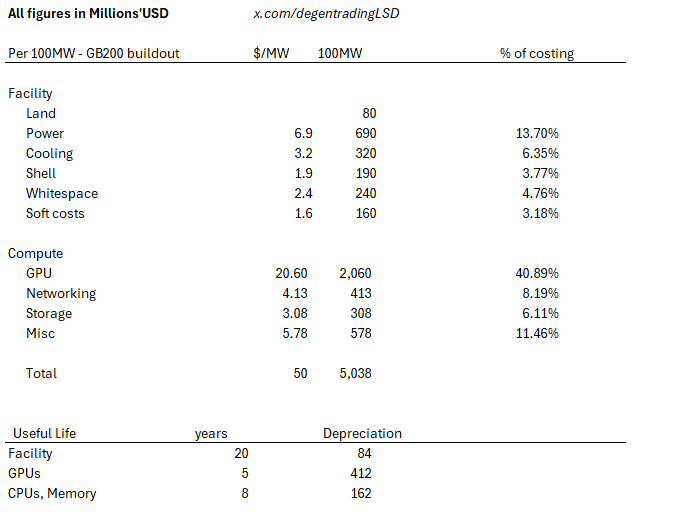
Caption: Author's cost estimate for building a 100MW data center, approximately $50 billion per GW
My estimate is about $50 billion per GW. This means the construction cost for 100MW is roughly $5 billion.
This number aligns with industry estimates. Note that this is the build cost for GB200. More advanced chips are more expensive; for example, the build plan for GB300 would increase compute costs by 20%.
Jensen Huang saying $10 billion per GW is actually realistic—if you factor in the cost of Rubin compute, which is double that of Blackwell. Costs like electricity are also rising.
We also know that each GB200 consumes about 1200 watts, so 100MW translates to roughly 83,333 GPUs.
Applying the economic model from the xAI contract, the revenue is 83,333 × 11.6 × 365 × 24 = $8.467 billion per year.
The cost structure is as follows:
Electricity cost: $740,000 per MW per year, Infrastructure maintenance: $250,000 per MW per year, Labor: $300,000 per MW per year.
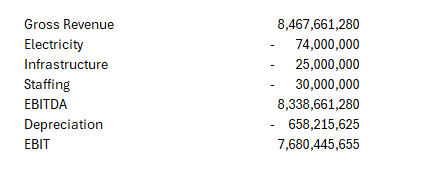
Caption: Ledger for a 100MW data center based on the xAI contract rental rate ($11.6 per card per hour), showing a break-even period of less than one year
So we see a crazy scenario: a payback period of less than one year.
Here I must say, the contract SpaceX got is ridiculously generous. Is Google facing a severe compute shortage?
If we use a less crazy, more normal assumption, like a price of $6 per hour.
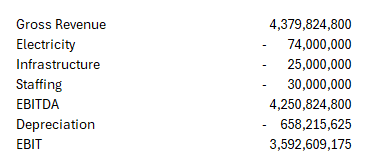
Caption: Calculation after reducing the rental rate to $6 per card per hour, extending the payback period to about two years
The payback period extends to about two years.
I estimate that long-term contracts between neoclouds and hyperscalers are priced at roughly $4 per hour. The hyperscalers then resell this compute at a higher price, e.g., AWS at over $12.
Just for fun, I've put together a projected profit and loss statement for building a single data center. It looks like this.
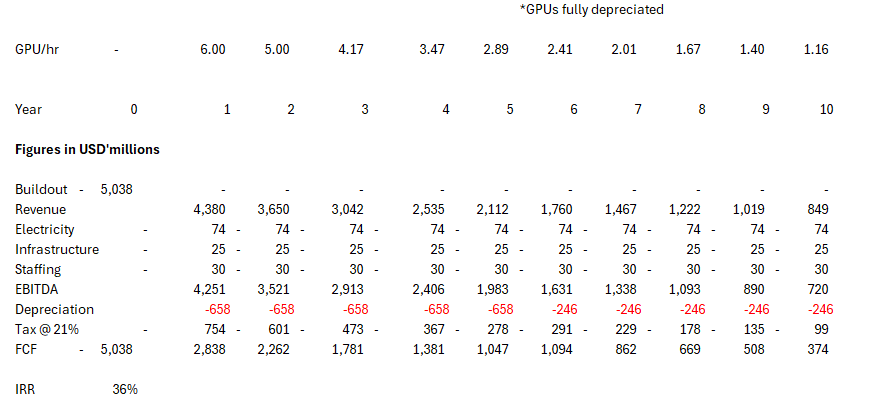
Caption: Projected profit and loss statement for a single data center build
Of course, one could argue that GB200s might lose value after five or six years. But the A100 was released in 2020 and is still being leased out at $1 to $2 per hour. This card was rented for about $3 in 2021, and hyperscalers are still leasing it for $2 to $3.5 per hour today.
Gavin Baker believes the depreciation cycle for GPUs should be stretched to about 10 years. I agree with him, especially with the rise of agentic AI and inference demand.
In the end, the current compute market is pricing in a severe shortage.
Anyone telling you otherwise is burying their head in the sand.
SpaceX is renting compute because, at the prices they're leasing it out, they are making a killing (and also because Colossus 1 and 2 face interconnect issues). Musk also retained the right to terminate the lease early when signing this contract, saying: "If compute becomes particularly tight, I've said we might need to take it back at some point."
TL;DR: Everyone wants to be a neocloud now because compute is extremely tight, and it's a money-printing machine.
Based on current facts, being able to build a data center and sell its compute power is the best business out there.
This is also why hyperscalers are willing to prepay neoclouds to lock in compute supply.
To reiterate, the valuation of a neocloud should equal the sum of the net present values of all the compute contracts it can secure. Therefore, fundraising ability, accurate depreciation schedules, and execution capability are the three most important levers affecting valuation.
For those who casually claim this is all circular financing (or whatever term you want to use), know this: Anthropic's gross margin on its current inference services already exceeds 70%. The frontier labs consuming the most compute could switch to being cash-flow positive anytime they wanted.


