






Goldman Sachs Uncharacteristically Cautious: Clearly Bullish on Two Businesses, Why Only a Neutral Rating for Intel?


- Core Thesis: Goldman Sachs initiated coverage on Intel with a neutral rating, believing that while its foundry and server CPU business growth opportunities are real, they have already been priced in. In comparison, AMD, Nvidia, and Broadcom offer more attractive growth visibility and valuations.
- Key Elements:
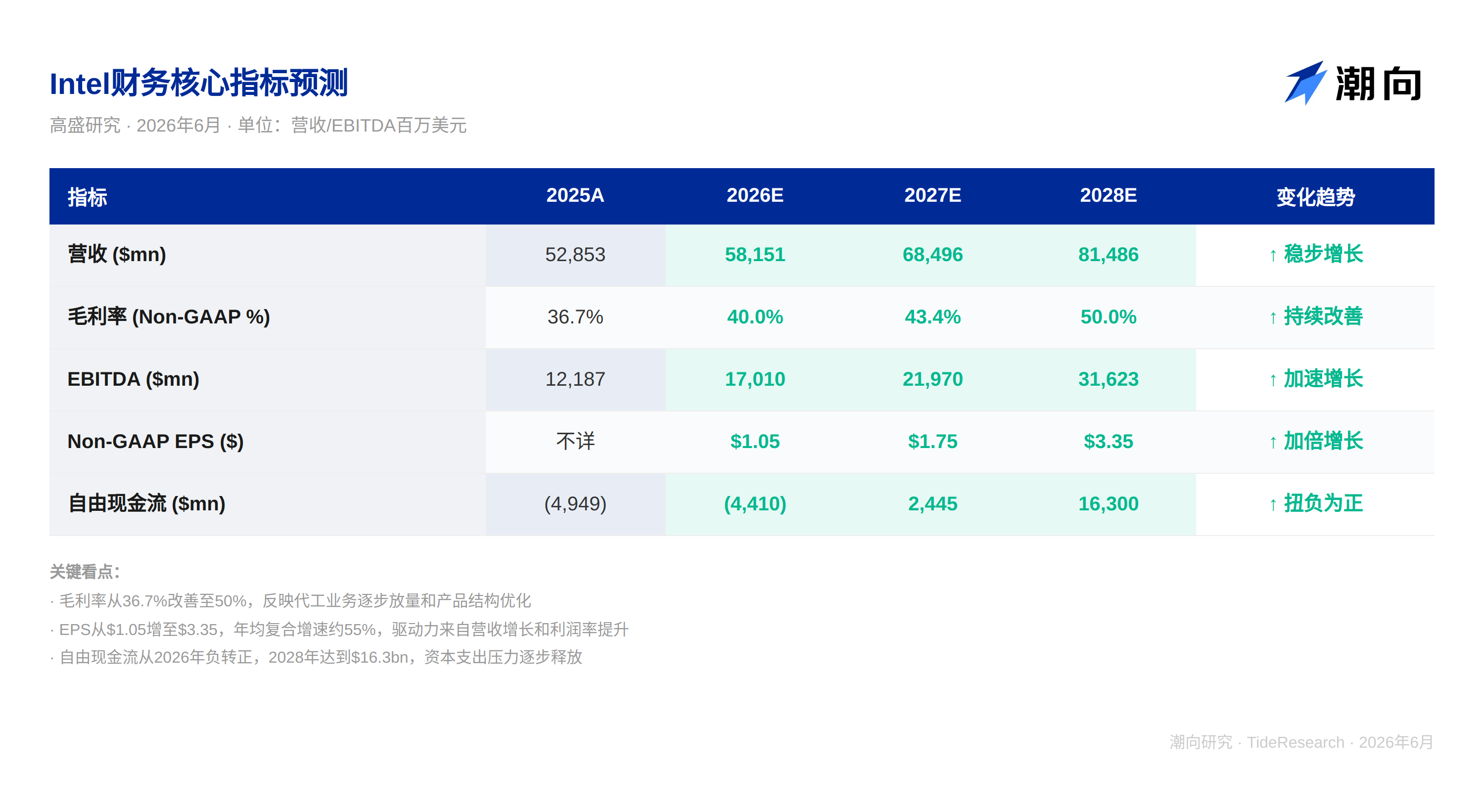
- Goldman Sachs estimates Intel's foundry business (advanced EMIB packaging technology) could generate $11 billion in revenue by 2030, with gross margins exceeding 50%, but the commercialization validation period is lengthy, with volume ramp-up not expected until after 2028.
- Driven by Agentic AI, the server CPU business is projected to maintain a 28% compound annual growth rate through 2030, yet this growth rate is lower than that of AI chip peers like Nvidia’s data center segment (which grew nearly 200% in 2024).
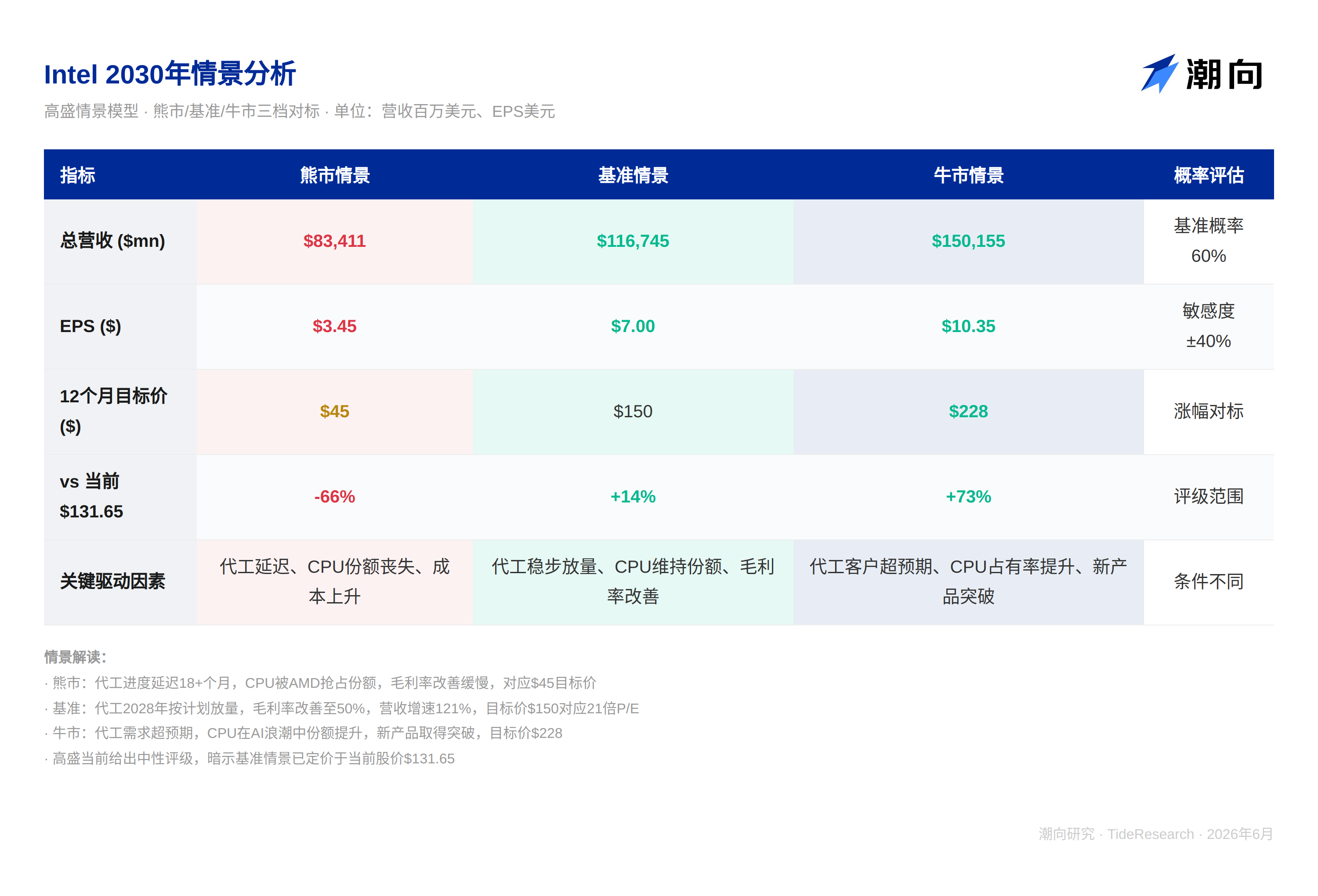
- Intel's current stock price already reflects these positives. Based on a 21x P/E ratio for its 2030 earnings power, Goldman Sachs sets a price target of $150 (representing a 13.9% upside from the reference price), implying limited upside.
- Goldman Sachs believes peers (AMD, Nvidia, Broadcom) are superior to Intel in terms of demand certainty, product roadmap aggressiveness, and valuation alignment, and has issued Buy ratings for each.
- Upside risks include stronger-than-expected foundry customer traction or better-than-expected server CPU market share gains. Downside risks include delays in advanced process node production or CPU market share being captured by AMD.
Original Author: Rita
Introduction
Goldman Sachs has published its initial coverage report on Intel, assigning a Neutral rating and a 12-month price target of $150 (representing a 13.9% upside from the benchmark price of $131.65). Behind this seemingly contradictory judgment lies a clear investment logic: foundry services and server CPUs are indeed growth highlights, but these opportunities have already been priced in by the market. In contrast, AMD, Nvidia, and Broadcom offer better options in terms of visibility and valuation.
The Contradiction Within a 'Neutral' Rating
An initial coverage report assigning a Neutral rating rather than a Buy is inherently interesting. Goldman Sachs is not saying Intel is performing poorly; instead, it explicitly points to two genuine positives.
The first is the foundry business. Intel is advancing its external wafer business, particularly in advanced packaging (notably EMIB technology). Goldman Sachs estimates that in a base case scenario, this segment could generate $11 billion in revenue by 2030, scaling from zero to a ten-billion-dollar level. This represents growth backed by confirmed customer orders, not merely a theoretical growth story.
The second is server CPUs. Driven by Agentic AI, demand from enterprises for server computing power is expected to continue growing. Leveraging the stickiness and high switching costs of the x86 architecture in the enterprise market, Goldman Sachs predicts Intel can sustain a 28% compound annual growth rate (CAGR) for its server CPUs through 2030. This implies that Intel's revenue expectations for server CPUs are on an upward trajectory, rather than being squeezed.
However, precisely because both of these stories are real, they have already been priced into the market. Intel's current stock price already reflects these expectations. Based on a valuation multiple of 21 times estimated 2030 earnings, the $150 target price suggests Goldman Sachs believes there is limited upside from current levels. Furthermore, in terms of supply chain certainty and valuation attractiveness, AMD, Nvidia, and Broadcom all present stronger cases. This is the core reason Goldman Sachs gives a Neutral rating rather than a Buy.
The Foundry Business: A Ten-Billion-Dollar Wager
Intel's foundry narrative is clear, but the focus is not on scale itself, but on cost and competitiveness.
The cost of advanced packaging is significantly lower than that of wafer foundry. EMIB (Embedded Multi-die Interconnect Bridge) technology allows Intel to perform chip integration for clients without building new fabrication plants. This is good news for clients (lower cost, faster time-to-market) and for Intel (lower capital expenditure, higher gross margins). Goldman Sachs estimates that the gross margin for this business could be over 50%, far exceeding the 20-30% typical of traditional wafer foundry.
The window of opportunity for the external wafer business is expected to open around 2028. Although Intel's 7nm and below process technologies lag behind TSMC's schedule, the geopolitical context in Europe and America has led many clients willing to pay a premium to diversify their supply chain risks. Goldman Sachs predicts this business could generate $11 billion in revenue by 2030, meaning Intel's gross profit contribution from this segment would be sufficient to lift its overall profit margins.
But this story comes with a time cost. Profit growth in 2027 and 2028 will primarily come from its core businesses (CPUs and GPUs). The foundry business won't contribute meaningfully until after 2028. Therefore, if you expect spectacular performance from Intel in the next 12 months, the foundry narrative won't help. This is also why Goldman Sachs is not overly optimistic about Intel's current stock price.
28% Growth in Server CPUs, But Peers are Growing Faster
Server CPUs are Intel's traditional stronghold, and the rise of Agentic AI is revitalizing this segment.
The key difference between Agentic AI and traditional large language model inference is its requirement for frequent multi-turn interactions and real-time responses, placing higher demands on both CPU and memory. This means enterprises cannot simply stack GPUs; they also need efficient CPUs. Intel has two advantages here: first, the completeness of the x86 ecosystem, and second, enterprise clients' established purchasing habits and supply chain dependence on Intel.
Goldman Sachs forecasts a 28% CAGR for Intel's server CPUs through 2030. While this sounds promising, it is actually quite modest within the current AI chip cycle. Nvidia's data center segment is growing much faster (approaching 200% year-over-year in 2024), and Broadcom and AMD are generally achieving higher growth rates in their respective niche segments.
The key issue is that Intel's growth is from a very large existing base. The CPU business is currently Intel's primary revenue source, and its growth potential is constrained by the overall expansion rate of the server market. In contrast, the growth ceiling for GPUs and other AI-related chips is much higher. Therefore, from a relative return perspective, investment in GPU and networking chip manufacturers may offer higher return expectations.
Why Peers are More Favored by Goldman Sachs
Among the other tech and chip companies covered by Goldman Sachs, AMD, Nvidia, and Broadcom have all received Buy ratings. Why is Intel excluded?
The core reason lies in the alignment of visibility and valuation. Nvidia's data center demand faces almost no downside risk and has substantial growth potential through 2030. AMD has a more aggressive product roadmap than Intel in both CPUs and GPUs. Broadcom is strategically positioned in networking chips, capturing the primary growth drivers of large data centers. These companies offer higher growth expectations with lower risk.
Simultaneously, while Intel's foundry story is attractive, its commercialization and validation period is longer. Visible orders are expected by 2027, but true scale contributions won't materialize until 2030. In contrast, the demand curve for GPU chip manufacturers is already validated; the discussion is merely about the pace of growth.
From a valuation perspective, Intel trades at a 21 times forward P/E ratio for 2028. While Nvidia and Broadcom have higher multiples, they also have higher growth rates. For investors pursuing high-certainty growth, a high-growth, high-multiple scenario is actually more attractive than a low-growth, low-multiple one.
The Judgment Behind Goldman Sachs' Neutral Rating
Goldman Sachs' Neutral rating implicitly suggests a judgment: Intel will neither decline nor skyrocket. In the medium term, Intel's performance may be overshadowed by the strong performance in the consumer chip segment and the speculative allure of the AI chip cycle. However, over the long term (3-5 years), the profit contributions from the foundry business and server CPUs will gradually become apparent, validating the valuation repair path towards the $150 target price.
Upside risks to this judgment include: client traction in the foundry business exceeding expectations, or better-than-expected market share protection for server CPUs amidst the Agentic AI wave. Downside risks include: delays in the mass production schedule for advanced process nodes, or faster-than-expected loss of CPU market share to AMD.
Potential catalysts include: quarterly confirmation of foundry orders, the launch performance of the next-generation Xeon processors, and the realization of gross margin improvements. However, none of these catalysts are 'immediate' events. Therefore, for investors seeking quick returns, Intel may not be the optimal choice.
Conclusion
Goldman Sachs' logic is clear: Intel has a story, the story holds water, but the value of that story has already been priced in. In an era where peers offer higher growth rates and greater certainty, Intel, pursuing steady growth, naturally ends up on the watchlist rather than the buy list.


