






美光的长期供应协议含金量:客户先支付220亿美元押金,合同不可撤销,还锁定了“史上最赚钱”的毛利率


- 核心观点:美光与客户签署的长期战略协议(SCA)通过客户预付220亿美元押金、锁定最低价格与数量,将美光从周期性存储供应商转变为拥有高利润下限的长期供应商,此举被三大投行视为“改变游戏规则”,并一致上调目标价。
- 关键要素:
- SCA覆盖约20%的DRAM和三分之一NAND出货量,已签署14份协议的最低承诺收入约1000亿美元,预计最终收入将“远高于”此底线。
- 客户需支付合计220亿美元押金(180亿现金+40亿信用证),合同不可撤销,押金提高了客户违约成本,为美光需求提供了保证金。
- 合同定价框架中的价格下限对应的毛利率“远高于历史峰值”(62%),当前美光毛利率已达84.9%,即使触发底价,盈利水平仍远超历史最好时期。
- 为履行合同,美光将FY26净资本开支指引提高至约270亿美元,长期协议为扩产提供了确定性依据,但产能投放仍是周期变量。
- SCA协议预计将使超过50%的公司收入来自此类合同,其中固定价格或价格区间协议将占约40%的收入,显著提升盈利稳定性。
Original Author: Long Yue
Original Source: Wall Street CN
Customers first pay a $22 billion deposit, sign a non-cancellable long-term contract, and accept a pricing framework significantly more favorable to Micron than at any point in history—these are the core terms of Micron's latest batch of Strategic Customer Agreements (SCAs).
According to the Zhui Feng Trading Desk, on June 25, Barclays, Morgan Stanley, and JPMorgan collectively viewed this as a "game-changing" agreement. In a research report, JPMorgan semiconductor analyst Harlan Sur characterized these SCAs as a "fundamental transformation" of Micron's business model—from a cyclical commodity supplier to a long-term supplier with multi-year contract protection and significant downside hedging for both revenue and profit.
The value of these contracts lies in: First, the substantial coverage: the signed agreements correspond to approximately 20% of DRAM volume and about one-third of NAND volume. Second, the binding of price and volume: the 14 agreements, based on minimum committed volume and minimum price, correspond to approximately $100 billion in cumulative minimum revenue. Third, customers must provide a total of $22 billion in deposits and financial commitments. Fourth, the gross margin corresponding to the agreement's price floor is "far above historical peaks" (with the historical peak around 62%), effectively locking in a higher profitability floor for Micron.
16 Contracts, Covering 20% of DRAM and One-Third of NAND
Micron disclosed that it has signed 16 SCAs, with customers spanning the three major markets of data centers, consumer electronics, and automotive.
Customer distribution includes 4 large customers (widely speculated by the market to include hyperscale cloud providers and major consumer electronics OEMs), 3 medium-sized customers, and the remaining 9 are smaller customers in the automotive industry.
Contract Duration: Data center and consumer electronics contracts are for a 5-year term, covering 2026 to 2030; automotive contracts are for a 3-year term.
Coverage Scale: These 16 agreements collectively cover approximately 20% of Micron's DRAM shipments and about one-third of its NAND shipments.
According to a Barclays research report, management indicated that once all planned SCAs are fully executed, over 50% of the company's revenue is expected to come from these agreements. Among these, agreements with fixed prices or price ranges are expected to account for approximately 40% of the company's revenue.
$22 Billion Deposit Raises Breach Cost: Customers Pay First, Micron Holds Temporarily, Returns upon Expiry
Under the 16 signed agreements, Micron will receive a total of approximately $22 billion in cash deposits and other financial commitments—$18 billion in unrestricted cash and $4 billion in letters of credit.
These funds are held by Micron, remain on the balance sheet for the contract duration, and are returned to customers upon expiry. The return schedule is "back-end weighted," meaning a significant portion is returned only in the latter half of the agreement period.
This money cannot simply be viewed as deferred revenue. Its real purpose is to increase the cost for customers to back out.
Regarding the binding nature of the contracts, a Morgan Stanley research report directly quoted management's statement from the conference call: "These contracts are non-cancellable." If customers fail to take delivery according to the agreed volume and price, Micron can take action against the deposits. For Micron, this effectively adds a guarantee for a portion of future demand; for customers, it's a constraint cost paid for supply certainty.
This also explains why customers are willing to accept price ranges and deposit arrangements. Driven by demand from AI servers, data center SSDs, HBM, and high-end terminals, storage supply is tight, making locking in volume inherently valuable.
Pricing Structure: Has a Ceiling, but the Gross Margin Locked by the Floor is "Far Above Historical Peaks"
The SCA pricing framework falls into three categories: fixed price, a price range with upper and lower limits, or a reference market price floating within a similar range.
Regarding the price ceiling: For existing products, the price ceiling is referenced to the market price in Q2 2026. This clause has been interpreted by some market participants as Micron "actively capping the upside for price increases," sparking some debate.
But the price floor is the real highlight: The gross margin corresponding to the floor price is "far above the peak profitability of any historical cycle." Micron's past peak gross margin was approximately 62%, while the current gross margin already stands at 84.9%—meaning even if the floor price clause is triggered, Micron's profitability level would still far exceed its historical best.
However, SCA is not a contract where "prices go up forever." Some existing products have a price ceiling, with the cap anchored to the Q2 2026 market price. In other words, Micron has traded off some future pricing upside for higher revenue certainty and a gross margin floor.
Analyst Joseph Moore commented on this: "The contract price cap being flat with Q2 prices" does raise concerns about "the company capping the ceiling." However, he also pointed out that gross margins are approaching 90% and are expected to be sustained in this range for quite some time—it is reasonable for counterparties to seek some protection in negotiations, and the contract duration is the core dimension for assessing its value.
$100 Billion Revenue Floor, and That's Just the "Minimum"
Of the 16 agreements, 14 have clearly defined price terms.
According to research reports from Barclays and JPMorgan, the combined Remaining Performance Obligations (RPO) based on minimum committed volume and price for these 14 agreements total approximately $100 billion.
Management explicitly stated that actual revenue is expected to be "significantly higher" than this floor—because the $100 billion is merely the baseline calculated using the floor price. If market prices exceed the floor price, revenue will naturally increase.
For new products, the agreements also retain additional pricing upside.
Expansion Still Required Behind Long-Term Contracts; Capital Expenditure Hasn't Disappeared
Locking in demand does not equal automatic delivery.
Micron has increased its FY26 net capital expenditure guidance to approximately $27 billion, up from a prior ~$25 billion. FY27 quarterly capital expenditure is expected to be higher than the FQ4 level, with over half of the year-over-year increase coming from construction CapEx for early investment in cleanroom capacity.
This indicates that SCAs do not lead to an asset-light model but rather provide a more certain rationale for expansion.
Customers are willing to put up deposits, but Micron also needs to invest capital. Long-term contracts make expansion more justifiable, but if future demand or prices deviate, capacity deployment could still become a cyclical variable.
Behind Three Major Institutions Consistently Raising Price Targets, the Market is Rethinking "How Long Peak Profits Can Last"
All three institutions raised Micron's price target, but the logic isn't solely based on the better-than-expected May quarter earnings.
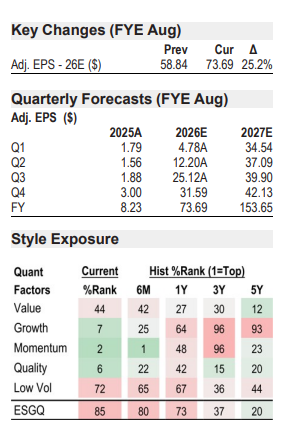
Barclays (Analyst Tom O'Malley): Price target raised from $1,175 to $2,000, based on 12 times CY27 EPS of $166.74. The report states that the SCA details are "better than expected," viewing these agreements as "substantially positive for downside protection," while the supply-demand imbalance will not dissipate in the short term, leaving upside potential.
Morgan Stanley (Analyst Joseph Moore): Price target raised from $1,050 to $1,200, based on 30 times through-cycle earning power (EPS of $40). The through-cycle EPS estimate was raised from $35 to $40, citing that the earnings run rate is approaching $200/share.
JPMorgan (Analyst Harlan Sur): Price target substantially raised from $550 (Dec 2026 target) to $1,540 (Dec 2027 target), based on 10 times (10-year median P/E) FY28 EPS of $154. The report characterizes the SCA expansion as a "step-change," fundamentally altering the nature of Micron's business model.
Behind these model changes, the key variable is profit sustainability.
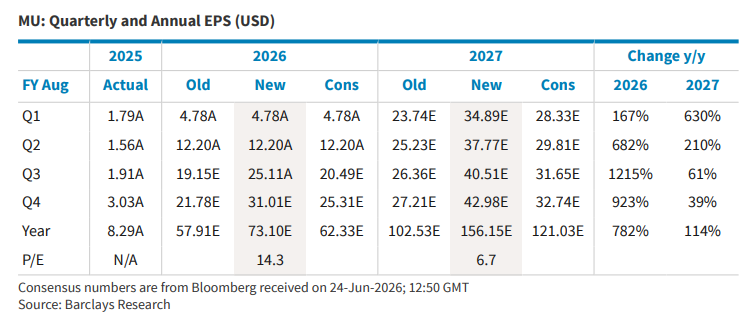
Micron's May quarter revenue reached $41.456 billion, up 73.7% sequentially. The August quarter revenue guidance midpoint is $50 billion, with a non-GAAP EPS guidance midpoint of $31. The single-quarter numbers are already high, but SCAs provide the market with another question: if prices stop rising rapidly, can Micron still maintain high gross margins and high free cash flow?
The current framework's answer is: a portion of revenue has stronger protection, but not all revenue. Price ceilings, future expansion, and the sustainability of AI demand remain boundary conditions.
Deposits and Cash Flow Open Up Capital Return Potential, but Timing is Constrained
SCAs also bring a change to the balance sheet: deposits will flow into Micron's hands. Although they must eventually be returned to customers, they will increase cash levels in the short term.
As of the May quarter, Micron had approximately $26 billion in cash and investments. Operating cash flow for the quarter was $25.4 billion, and adjusted free cash flow was $18.3 billion. The company also expects to receive approximately $10 billion in customer cash deposits in the August quarter.
The path for capital returns is also becoming clearer. Restrictions related to the US CHIPS Act currently constrain Micron's ability to conduct share buybacks in the short term. After December 9, 2026, as the restriction window passes, the company's guidance leans towards returning 100% of excess cash to shareholders over time, with buybacks being the primary method.
This part is not directly an SCAs revenue contribution, but it is another side of how SCAs change the market narrative: if high profits are sustained and cash accumulates rapidly, Micron may no longer just be "making money from cycles" but could enter a more stable cash return framework.
The Earnings Report Itself: Record Gross Margin, Next Quarter Guidance Exceeds Expectations Again
Beyond the SCAs, Micron's May quarter (FY3Q26) earnings data was also robust:
- Revenue of $41.456 billion, up 73.7% QoQ, significantly exceeding the market expectation of $35.6 billion
- DRAM revenue of $31.3 billion (QoQ +67%), NAND revenue of $9.9 billion (QoQ +99%)
- DRAM ASP up ~60%+ QoQ, NAND ASP up ~mid-80% QoQ
- Gross margin of 84.9%, an all-time high, above the market expectation of ~81.8%-81.9%
- EPS of $25.11-$25.12, significantly exceeding the market expectation of ~$20.49
August quarter (FY4Q26) guidance:
- Revenue guidance of $50 billion (midpoint), above the market expectation of ~$43.1-$43.6 billion
- Gross margin guidance of ~86%, continuing to exceed market expectations
- EPS guidance of $31.00 (midpoint), above the market expectation of ~$25.31-$25.72


