






AC exits Sonic board: DeFi godfather pulls off another escape act


- Core Thesis: Andre Cronje (AC) has stepped down from the Sonic board to shift focus to his new project, Flying Tulip. This reflects a trend in crypto where project value hinges on founder reputation rather than fundamentals, while secondary market investors bear the brunt of the decline, and capital is accelerating its flight from the industry.
- Key Points:
- When AC exited the Sonic board, the S token had fallen from its early-year high of $1.03 to $0.028, and the on-chain TVL had evaporated 98% from its peak of $1.14 billion to approximately $20 million.
- In his statement, AC precisely delineated his responsibilities, claiming he was only responsible for technical support on Sonic, and that decisions on tokenomics, migrations, etc., were not led by him. He noted that his main focus over the past 18 months has been on the Flying Tulip project, valued at $1 billion.
- Flying Tulip’s ftPUT NFT grants primary holders a perpetual put option, allowing them to burn the token at any time and redeem their principal at the original price. However, secondary market buyers do not benefit from this protection.
- The funds raised by Flying Tulip are untouchable and are fully deposited into lending protocols to earn approximately 4% annual interest to cover operating expenses. The team has no initial token allocation.
- In the five months leading up to AC's departure from Sonic, the CEO and business lead had both resigned, resulting in a complete leadership overhaul. The new team frankly admitted, "The token price is down, and so is community sentiment."
Original Author: Ku Li, TechFlow by Shenchao
The feeling this year in crypto is roughly: watching the US stock market hit new highs every day, then opening your own portfolio, staying silent for three seconds, and closing it.
BTC is down nearly 20% year-to-date, ETH is even worse, and altcoins need no mention. In such a market, any L1 token dropping 90% is hardly news. But colder than the prices is the departure of people.
On June 19, DeFi godfather AC, along with two other founding directors, resigned from the Sonic Labs board. The S token was trading at 0.028, a mere fraction of its yearly high of 1.03, and the chain's TVL had fallen from a peak of $1.14 billion in May last year to $20 million. According to DefiLlama data, that’s a 98% evaporation.
The reaction to AC's departure within the industry was muted. After all, he had already "left" the space in 2022 before returning. This time, his exit statement was standard, stating he remains "bullish on Sonic" but will no longer be involved in business decisions.

But the next part stung.
He said his main focus over the past 18 months had been Flying Tulip. This project raised $200 million in a private round last August at a $1 billion valuation, and conducted a public sale on CoinList this February. Investors include names like Brevan Howard, DWF Labs, and Susquehanna.
In other words, during the period S dropped from 1.03 to 0.028, AC was busy building the stage for a brand new billion-dollar project.
What stings even more is Flying Tulip's token design.
Primary round investors received an NFT called ftPUT, essentially a perpetual put option. If the token’s price drops, they can burn the token at any time and redeem their principal at the original price. The CoinList public sale page clearly states that FT (the fungible token, i.e., the normal coin) bought on the open market does not carry this right; only primary participants have it.
In contrast, S token holders are left holding the bag on the secondary market. If it drops to 0.028, that’s it. No floor, no redemption, no one writing you an exit strategy...
Not My Problem
AC's exit statement, posted on X, was short, but every word seemed calculated.
He said he joined Fantom in 2018 as a technical advisor and officially became a director only in December 2022. He is not Fantom's founder, never was, just an early technical architect. He was responsible for the underlying technology, including the core system of Sonic and its cross-chain bridge.
Then came the key part, paraphrased:
"I take responsibility for the technical decisions I led. But decisions on the migration, airdrop, tokenomics, and handling of the old network—I was neither the initiator nor the final decision-maker."
With one sentence, he distanced himself from the 97% drop in the S token. The technology was my doing, and the technology is fine. As for why the coin you bought went from a dollar to three cents, that was someone else's decision.
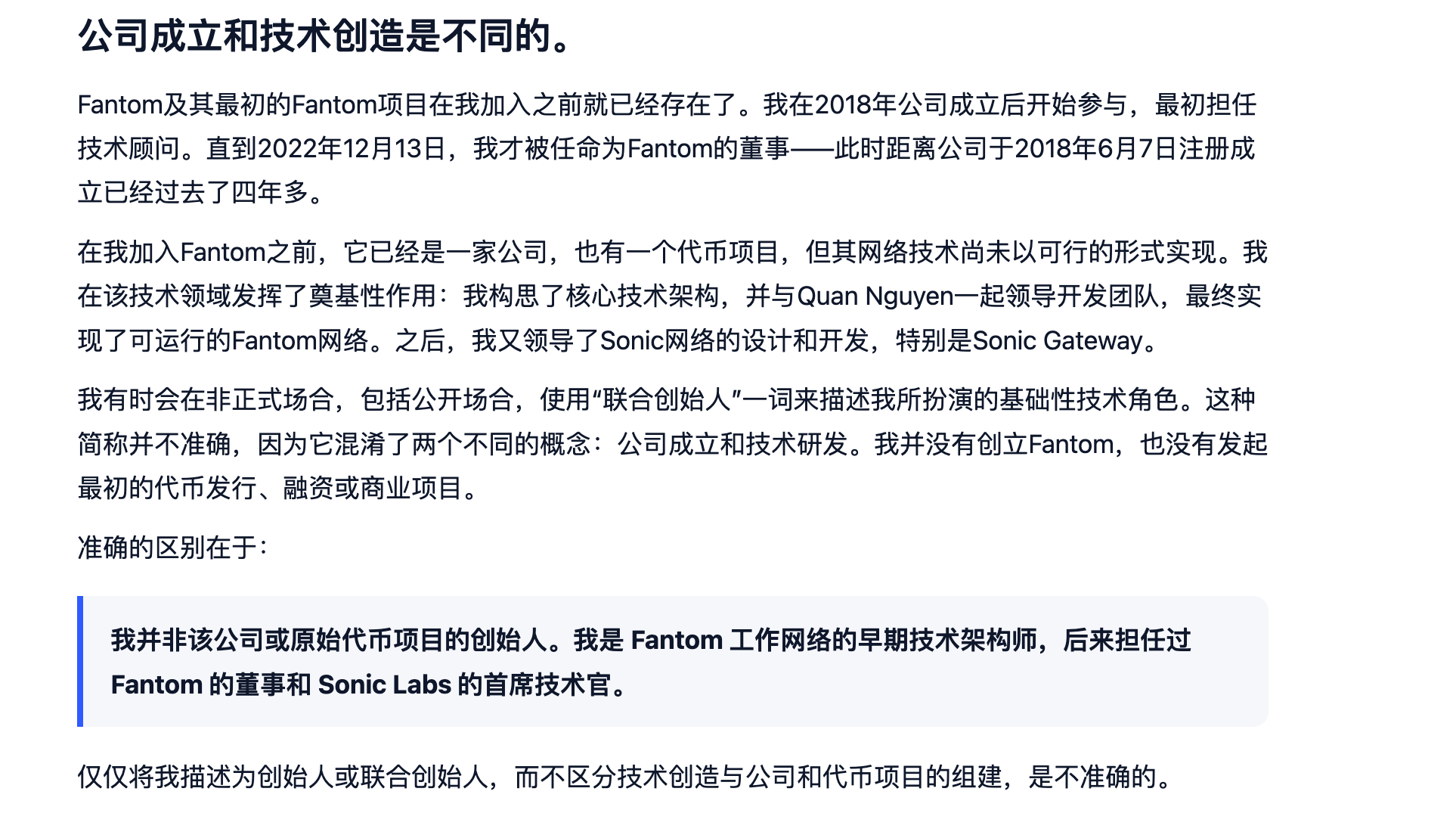
I won't judge whether this claim holds up, but I admit the clean break is impressive.
Most project founders when leaving either go silent and pretend to be dead, or issue a vague statement full of "we" and "the team," blurring all responsibility into a mess. AC is different. He draws his boundary of responsibility with surgical precision, so precise it’s hard to argue because he indeed didn't handle tokenomics.
And this wasn’t an afterthought.
In March 2022, AC announced his exit from the crypto industry, citing regulatory pressure and burnout. Fantom's TVL evaporated by nearly a third within a week, and the community was furious. A few months later, he quietly returned, and his task was the technical rebuild of Sonic.
When he left, he said he was tired. When he returned, he came without a word. When he leaves again, he says, "For the past 18 months, I've actually been busy with something else."
On the Sonic side, in the six months before he left, executives changed one after another. CEO Mitchell Demeter, hired just last September, resigned in February this year, along with the head of business. After the CEO left, the board managed things themselves for a few months. Now the board has also stepped down, replaced by a new CEO, Matt Visser, who has never managed a front-line L1 project before.
In five months, the entire management structure was overhauled. Sonic’s official statement didn’t mince words either, directly saying, "The token price is down, and community sentiment is down. We won't pretend otherwise."
This kind of "radical transparency" is rare in the crypto industry. But the problem is: the ones telling the truth are the new team; the one who left is the person whose name carries value.
The Cicada's Shell Game
Looking back at AC's trajectory over the past few years, a pattern emerges.
In 2020, he created Yearn Finance, a flagship product of DeFi Summer, with TVL peaking at tens of billions of dollars. He let go of it without much management. Yearn continued to operate reasonably well, but his connection to it was minimal.
Then he worked on Fantom’s technical architecture, and Fantom had a run. In March 2022, he announced his departure, and Fantom entered a long downtrend, later rebranding as Sonic for a relaunch. He returned with the CTO title. Sonic's initial TVL surpassed a billion, then collapsed down to its current state.
Each time, he extracted himself when the hype peaked or just began to cool, moving on to the next project. Each time, the old project's holders bore the brunt of the price decline after he left.
Flying Tulip is the fourth project he's currently working on. I think this time, he may have truly absorbed the lessons from the previous cycles and built them into the token design.
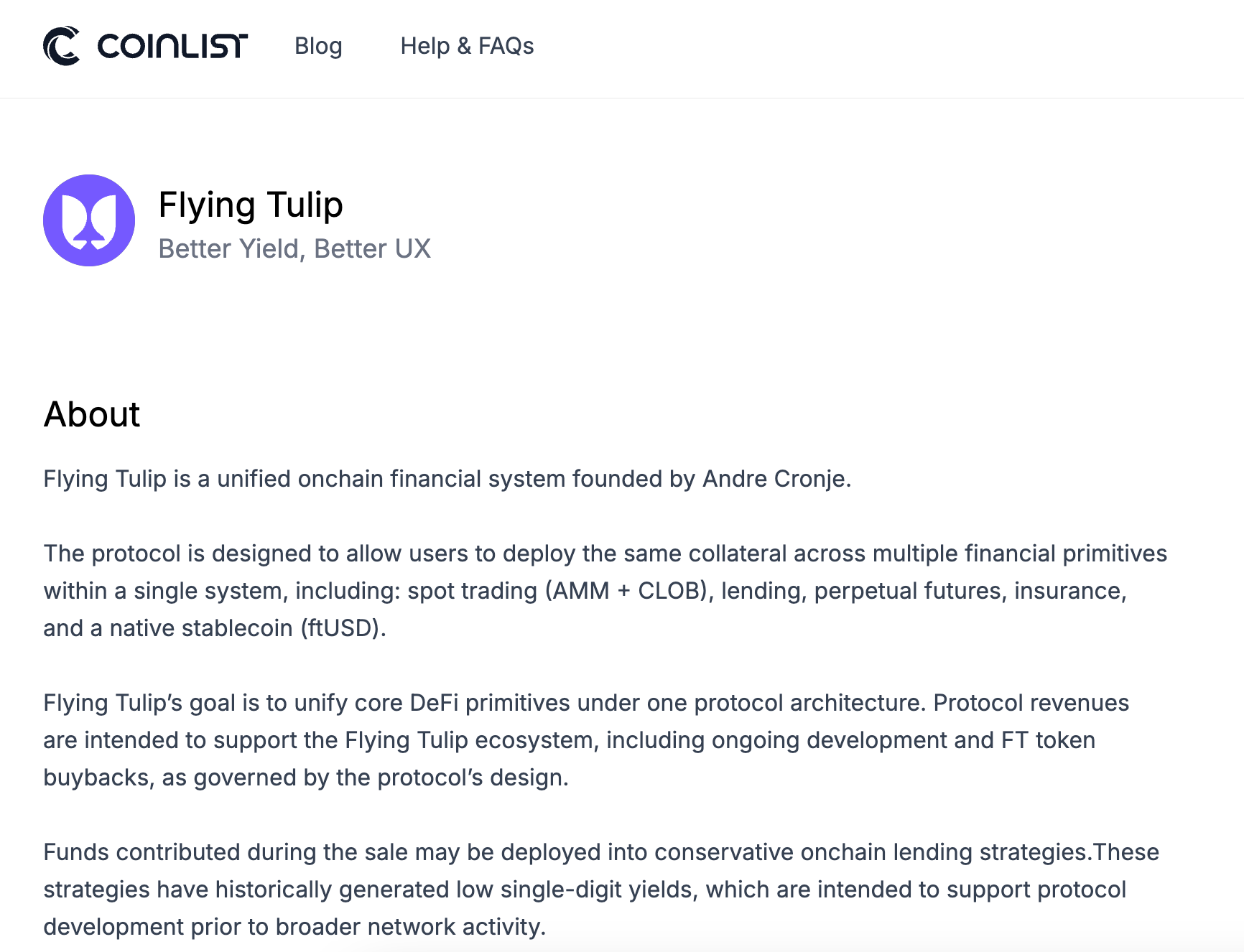
If you participate in the Flying Tulip public sale on CoinList, paying $0.10 for a FT, you don't get the token itself but an NFT called ftPUT, with the token locked inside it. This NFT *is* the perpetual put option. You have three choices.
First, do nothing. The token stays in the NFT, untradeable, but the redemption right is always there. Whenever you want out, burn the token and get your USDC or ETH back at the original price. No matter how low the FT drops on the secondary market, your principal is protected.
Second, withdraw the token from the NFT for free trading. But the moment you withdraw, the redemption right is permanently voided. The principal for the withdrawn portion is released to the protocol for buyback and burn.
Third, withdraw partially, leave partially. The portion remaining in the NFT continues to be protected; the withdrawn portion is exposed.
In an interview with The Block, AC said something quite interesting: because of the perpetual PUT, the funds raised actually cannot be spent at all.
The actual amount raised is effectively zero. So where do operating expenses come from?
All raised funds are deposited into lending protocols like Aave and Ethena for a conservative strategy, targeting an annualized yield of roughly 4%. Assuming a full raise of $1 billion, this produces about $40 million in interest per year to fund the team, development, and buybacks. The team receives no initial token allocation; all FT must be bought back from the open market using protocol revenue.
I have to admit, this design is quite ingenious within DeFi. It addresses the biggest problem in the crypto industry over the past few years: project teams running away with the money, or spending it recklessly, leaving investors with nothing. AC's solution essentially ties his own hands. The funds can't be touched, the team doesn't pre-allocate tokens, and investors can withdraw their capital at any time.
But ingenious as it is, this protection only exists in the primary market. Once FT is listed on exchanges, tokens bought on the secondary market do not come with ftPUT. The CoinList page states this clearly in bold.
Public market buyers see the same token but enjoy entirely different terms.
A Microcosm of the Industry
Money is flowing out of the crypto market this year; that's no secret.
BTC is down nearly 20% year-to-date, and the median decline for altcoins is far steeper. People in the space look at the Nasdaq hitting new highs, then switch back to their own portfolios. The feeling doesn't need my description.
Many people's real action this year has been to gradually shift their holdings into US stocks and stablecoin yield products. On-chain activity is visibly shrinking.
In this environment, AC's exit from Sonic is just the tip of the iceberg. The entire L1 sector is experiencing the same story: shrinking TVL, user loss, founding team turnover or outright disappearance. Sonic is just a prime example because of its high profile and extreme price drop.
But AC's case has a layer that other projects lack.
Flying Tulip's current valuation is around $1 billion. Sonic's current market cap is about $100 million. Same person, same timeframe, a tenfold difference. What's the distinction? It lies in whose name is attached to which project.
This is a truth in the DeFi industry that few are willing to openly admit.
Many project valuations are not built on revenue, users, or technological moats, but on a person's name. When the name is there, the money flows. When the name leaves, the money follows.
The bear market tears off this veil. In a bull market, all L1s go up, and you can't tell if it's fundamentals or the founder's name propping them up. When the tide goes out, what remains is clear.
There's one more detail I find most interesting.
Flying Tulip's initial deployment chain is Sonic. AC resigned from Sonic's board, no longer involved in any business decisions, yet his new project launches first on Sonic. He left, but his business remains.
The captain disembarked from the ship but opened a new shop right on the dock, selling goods more expensive than what was on the boat.


