






稀土上游已涨透?商务部制裁10家美企,真正的预期差可能在下游


- Core View: On June 22, 2025, China's Ministry of Commerce added 10 U.S. entities (including MP Materials) to its export control list. While this action has been partially priced into A-share rare earth stocks, with upstream resource stocks seeing significant gains, the relative valuation trough in mid-to-downstream magnetic materials and drone supply chains may present more noteworthy trading opportunities.
- Key Factors:
- The control list focuses on three major areas: military, drones, and rare earths, with MP Materials and USA Rare Earth as core targets. The move aims to cut off U.S. companies' access to Chinese dual-use items, thereby enhancing the scarcity value of Chinese enterprises.
- A-share rare earth upstream stocks (Northern Rare Earth at 52.9 yuan, Rising Nonferrous at 115 yuan) are near one-year highs. This round of controls primarily serves as a trend confirmation rather than a new starting point for rallies, making aggressive follow-on bets unattractive in terms of risk/reward.
- Mid-to-downstream rare earth magnet companies (TDT at 30.7 yuan, ZH Magnet at 13.7 yuan) are valued at the lower end of their one-year range, significantly lagging behind upstream stocks. Among them, TDT has the strongest correlation to the control list's military theme due to its core military magnet business.
- Avic (at 44 yuan, near one-year lows) is a leading military drone manufacturer. While it benefits from the inclusion of Red Cat on the list, its high valuation and volatile earnings pattern (peak-and-trough years) make it less stable, with future military trade orders being the key driver.
- The named U.S. stocks (MP, Red Cat) do not represent a one-sided negative development. The controls could potentially trigger increased support and orders from the U.S. Department of Defense. The true pricing impact will be confirmed after the market opens, and investors should monitor post-open trends.
Original Author: David
On June 22, the Ministry of Commerce issued Announcement No. 23 of 2026, placing 10 U.S. entities, including AEVEX Aerospace, Red Cat Holdings, and MP Materials, on an export control list, banning the export of dual-use items to them; on the same day, another 46 U.S. companies were added to a government procurement restriction list.
(Author's note: Dual-use items refer to goods, technologies, and services that have both civilian and military applications or contribute to enhancing military potential.)
This marks another round in the normalization of China's rare earth countermeasures since October 2025. The 10 U.S. companies named are primarily concentrated in the military, drone, and rare earth sectors.
The two most prominent names on the list are MP Materials and USA Rare Earth, both flagships of the U.S. rare earth industry. China's action against them led the market's initial reaction to be bullish for A-share rare earth stocks: with competitors constrained, domestic players become more scarce and valuable.
The question is, since the rare earth sector has been rising since last October and upstream leaders are now near their yearly highs, is it already too late to react now?
If it is too late, where might the capital flow next?
This latest control list from the Ministry of Commerce impacts more than just the rare earth sector. The fully-priced rare earth sector may still have further catalysts, and some overlooked, less-followed plays might not yet be on anyone's radar.
We attempt to map out the potential implications of these clues and place them on a price coordinate for your reference.
Key Conclusions
① A-share rare earth upstream stocks have already priced in gains; this control measure is not a new catalyst.
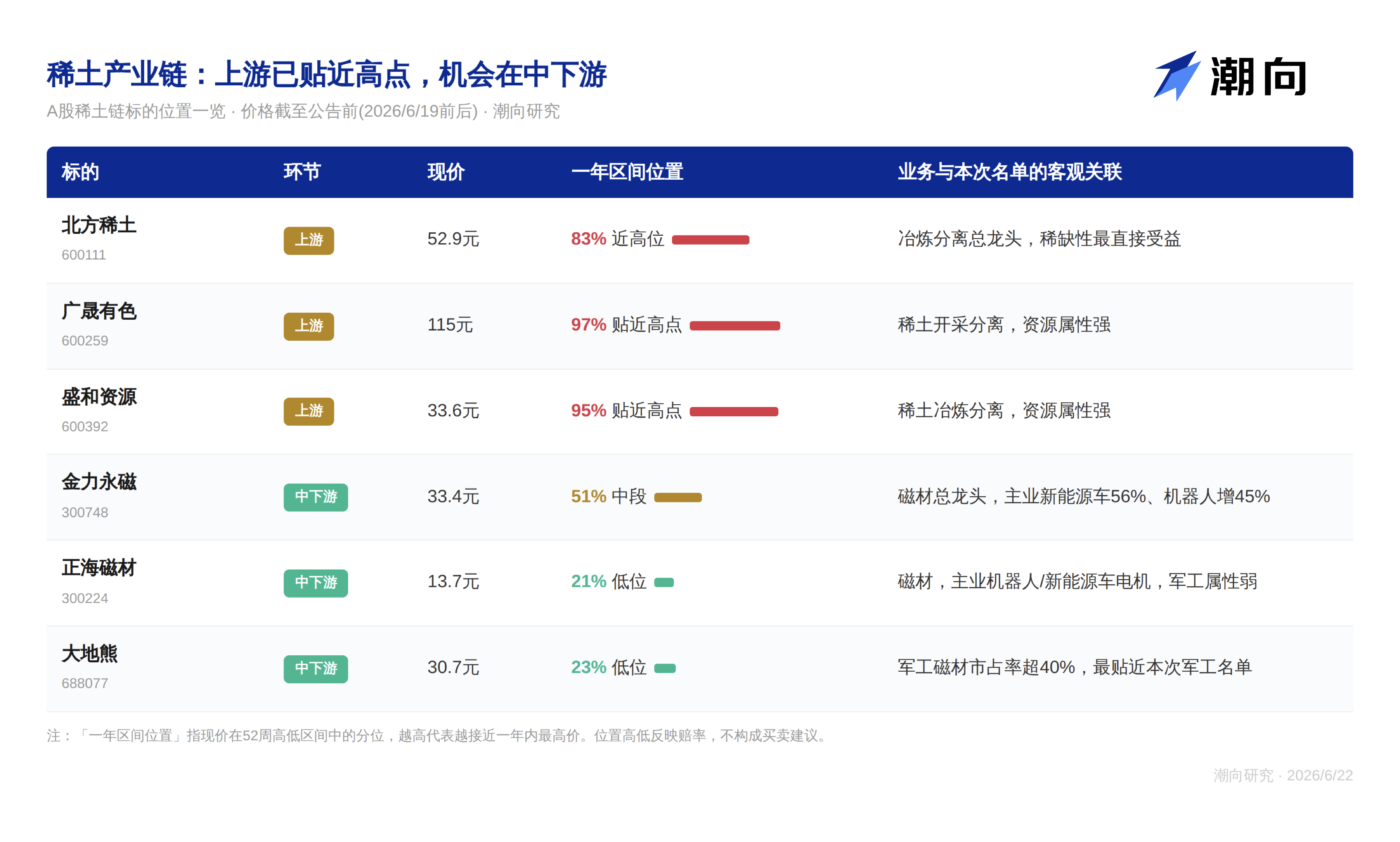
Northern Rare Earth's current price of 52.9 yuan is only about 20% away from its yearly high of 63.6 yuan; Rising Nonferrous Metals is at 115 yuan, and Shenghe Resources is at 33.6 yuan, both near their one-year highs. These upstream resource stocks have been trending upward since October last year, with the 'rare earth countermeasure beneficiary' logic largely already priced in. For the upstream rare earth industry, this control measure is more of a reconfirmation of the existing trend rather than a new starting point for a rally.
② Relatively underpriced segments are the mid-to-downstream rare earth magnet sector and the drone industry chain.
Within the same rare earth chain, the valuation of mid-to-downstream segments is significantly lower than the upstream:
In the magnet sector, Earth-Panda Advanced Magnetic Material is at 30.7 yuan, and Zhenshenghai Magnetic Material is at 13.7 yuan, both near the lower end of their yearly range, significantly lagging behind upstream resource stocks. The drone sector, corresponding to Red Cat and Teal Drones on the control list, is even quieter, with AVIC (China) UAS Co., Ltd. near its yearly low and receiving limited market attention. The pricing progress across different links varies even under the same event.
③ The named U.S. stocks do not necessarily constitute a unilateral negative; this needs to be verified after market opens.
MP Materials and USA Rare Earth are core assets in the U.S. domestic rare earth supply chain, with MP Materials having an investment from the U.S. Department of Defense.
For such companies, China's export controls and U.S. policy support are two coexisting forces whose impact direction may not necessarily align. None of the three stocks were at low levels before the announcement. Since the announcement was made on Monday before the U.S. market opened, their actual pricing reaction awaits the market's verdict.
Investors holding related positions should pay close attention to post-open trends.
Why Is Restricting Exports Beneficial for Domestic Rare Earths?
Many might initially find this counterintuitive: banning exports means Chinese companies lose business, so how can it be positive?
The key lies in the direction of the control. This ban prevents China from selling rare earth-related items to those 10 U.S. companies, cutting off the supply source for these U.S. entities, not disrupting the raw material procurement of Chinese manufacturers.
China possesses the most complete global chain for rare earths, from mining and smelting/separation to magnet manufacturing, achieving self-sufficiency without relying on imports from the U.S. This means the announcement does not affect the upstream of Chinese suppliers; they can continue production and export as usual.
The ones truly constrained are on the U.S. side.
Companies like MP Materials and USA Rare Earth seek to build supply chains independent of China but still depend on it for separation technology, equipment, and some intermediate materials. With competitors constrained, this inversely enhances the scarcity and bargaining power of Chinese manufacturers in the global rare earth landscape, which is the real reason the market interprets this as bullish for A-share rare earth stocks.
Upstream Rare Earth Stocks Are Fully Priced, Capital Hasn't Flowed Downstream Yet
Let's clarify the chain first. Rare earths are mined, then smelted and separated into raw materials like praseodymium neodymium oxide – this is the upstream, involving companies like Northern Rare Earth, Rising Nonferrous Metals, and Shenghe Resources.
These raw materials are further processed into neodymium iron boron (NdFeB) permanent magnet materials, used in various motors – this is the mid-to-downstream, where companies like JL Mag Rare-Earth, Zhenshenghai Magnetic Material, and Earth-Panda operate.
The upstream sells raw materials; the downstream sells magnet materials.
In this recent market movement, capital has mainly concentrated upstream. Northern Rare Earth is at 52.9 yuan, Rising Nonferrous Metals at 115 yuan, and Shenghe Resources at 33.6 yuan – all three are near their one-year highs. The logic is straightforward: every time China's strategic position in rare earths is emphasized, the first beneficiaries are upstream companies with mines and smelting capacity; their scarcity is tangible.
I believe this control event is a positive catalyst in the same direction for the upstream, but prices have largely absorbed this expectation. Entering now feels like chasing momentum at highs, with unfavorable risk-reward odds.
Moving downstream to the magnet sector, the pricing progress is noticeably slower.
Among the three leading magnet companies, JL Mag, with 7.7 billion in revenue and doubled net profit, has seen its stock price rise over 90% in 2025, not at a low level. However, Zhenshenghai and Earth-Panda remain near the lower end of their one-year price range, not keeping pace with the upstream rally.
There is an easily overlooked background here:
Since the second half of 2025, China has actually relaxed exports of magnet materials to the U.S. For instance, JL Mag's U.S. sales reached 500 million yuan for the full year, up 40%; both Zhenshenghai and Earth-Panda also obtained export licenses to the U.S. This addition of 10 companies to the control list is a precise action under the framework of 'allowing general commercial customers while specifically cutting off supply to certain military entities', not a comprehensive embargo.
Therefore, the impact of this logic on the financials of magnet companies is actually limited.
The 10 restricted U.S. companies were not major clients for them anyway. The real revenue for JL Mag and Zhenshenghai comes from new energy vehicles and robot motors, with little connection to U.S. military exports.
This control measure is more of a sentiment boost for magnet stocks rather than translating into concrete orders. However, what I think is worth watching in the downstream rare earth sector is which company's business aligns closely with the military theme of this list.
In this regard, Earth-Panda aligns better than the other two.
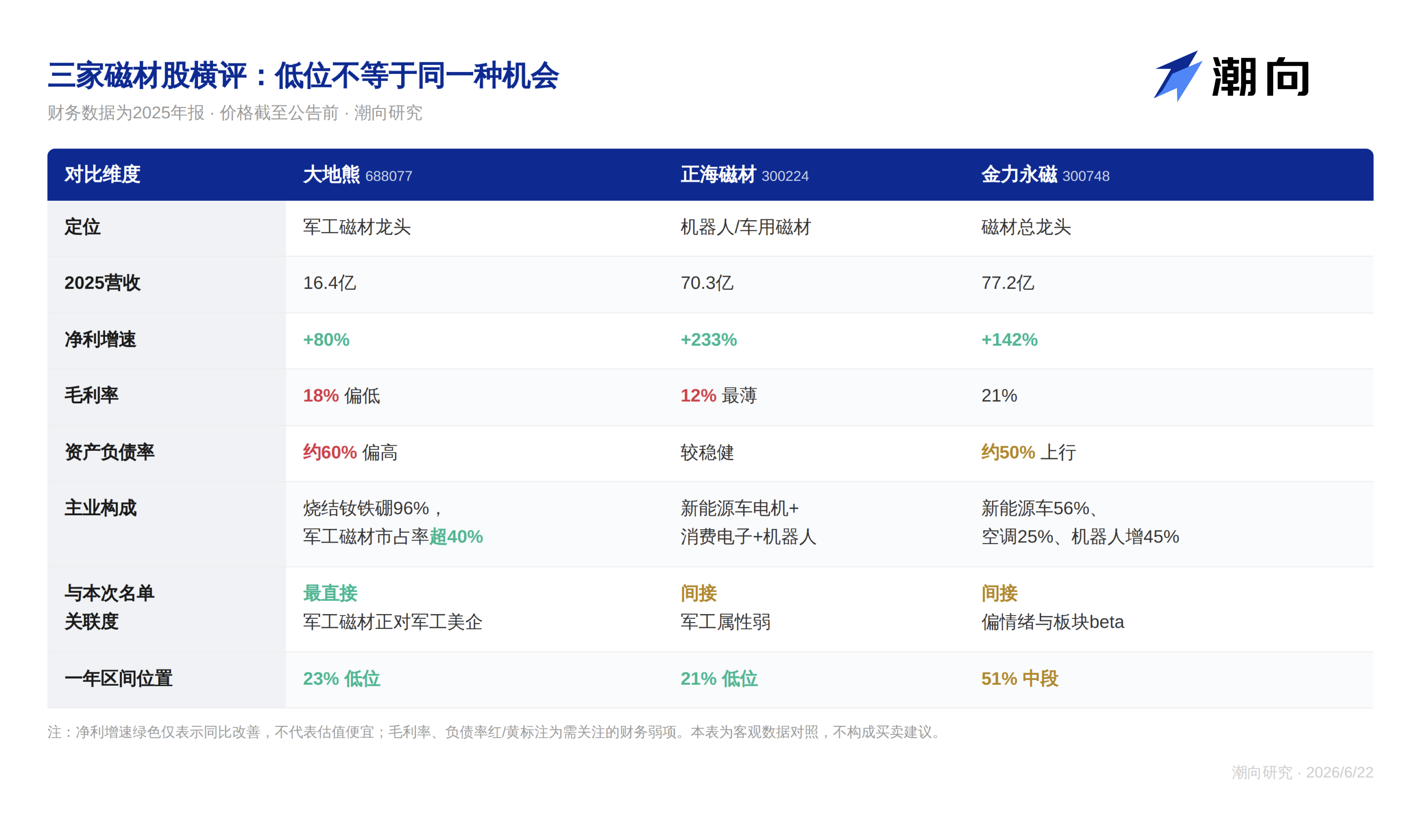
Earth-Panda has a smaller market cap, with 2025 revenue of 1.6 billion yuan and net profit of 57.4 million, but it is a major domestic supplier of military-grade magnet materials, holding over 40% market share in this segment, as per public data. Its products are used in equipment like aircraft engines and missiles, directly matching the military and drone U.S. companies targeted in the control list. This is its most direct narrative link to this event.
However, a correct narrative doesn't guarantee safety: its gross margin is only 18%, its debt ratio is approaching 60%, making its profitability and financial safety cushion thinner than peers. Combined with its smaller market cap, its stock price can spike quickly but also drop sharply.
It suits those who can tolerate volatility and prioritize the 'purest theme', but not those seeking a stable core holding.
Zhenshenghai Magnetic Material is a different type. Its net profit more than doubled in 2025, a stronger turnaround than Earth-Panda, but the driver is humanoid robots and new energy vehicle motors, largely unrelated to this military list. Its lower price level is more because the robot narrative hasn't been fully priced in by the market.
So, reading the rare earth line, the upstream and downstream are in two different situations.
The upstream holds tangible resources with the most solid scarcity, but the price has already reflected the positives, now it's a high-level game. The downstream magnet sector is still at lows; Earth-Panda fits the military list theme better but comes with a small market cap and weak financials; Zhenshenghai is cheaper but has weak correlation.
Drones: The List Points to This Sector, But No Direct Positive Catalysts
Red Cat Holdings and its subsidiary Teal Drones on the control list are U.S. manufacturers of military reconnaissance and strike drones, exactly the type of military drone supplier the U.S. wants to foster to replace Chinese products.
The market might naturally associate this with the A-share military drone sector, but the bullish logic here is likely different from rare earths. This will not directly bring orders to a specific Chinese drone company. It more prominently highlights the 'U.S.-China rivalry in military drones', prompting the market to refocus on the strategic value and export competitiveness of domestic military drones.
Following this line in the A-share market, the most directly corresponding target is AVIC (China) UAS Co., Ltd. (Zhong Wu Ren Ji).
It is a leading manufacturer of large military drones in China, with its core product being the Wing Loong series of reconnaissance/strike integrated UAVs. Drone systems account for over 90% of its main revenue, primarily exported through military trade, making it China's main export model for military drones.
In terms of business alignment, it is indeed in the same arena as the U.S. drone companies named on the list, making it the most relevant stock in this line.
Its current price of 44 yuan is near the low end of its one-year range, but this position is the result of a pullback from highs, not a lack of upward movement.
According to its 2025 financial report, the company's performance surged with a significant increase in military trade orders. Revenue in the first three quarters grew over three times year-on-year, and its stock price once reached 48 yuan. The current pullback is more likely a cooldown after this price realization.
It's important to note that military trade revenue is highly dependent on large, individual orders. Revenue in 2024 fell 70% year-on-year, leading to a loss, followed by a strong rebound in 2025. This boom-bust cycle characteristic makes judging its value based on price position unreliable. The true variable is the signing and delivery pace of subsequent military trade orders. In terms of valuation, the company's price-to-earnings ratio has been in the tens for a long time, which doesn't indicate it is undervalued.
Export Restrictions: Not Entirely Bearish for Corresponding U.S. Stocks
This is the crucial question for holders of the relevant U.S. stocks, and the answer might differ from intuition: Not necessarily.
The most significant names on the export control list, MP Materials and USA Rare Earth, are core vehicles for the U.S. to reduce dependence on Chinese rare earths. MP Materials is the only vertically integrated rare earth company of scale in the U.S. and, having received an investment from the U.S. Department of Defense in 2025, is itself an object of national strategic support. This identity creates a dual situation:
While China cuts off their access to Chinese dual-use items, the U.S. government might, precisely due to supply chain security concerns, grant them more orders and subsidies.
Pre-announcement price action supports this view. MP Materials, USA Rare Earth, and Red Cat Holdings were not at low levels before the control news broke; the market did not preemptively sell them off as potential victims. Investors had not simply priced them in as being negatively impacted.
Of course, the final direction awaits the market's verdict. Since the announcement was made on Monday before the U.S. market opened, whether the sanctions are interpreted as a material negative or are offset by expectations of supportive policies will only be revealed by trading activity after the open.


