






揭秘Citrini背后“投研之神”:Substack常年霸榜第一,一篇报告让美股蒸发数千亿


- 核心观点:บทความแนะนำ James van Geelen ผู้ก่อตั้งข้ามสายงานของ Citrini สถาบันวิจัยอิสระ ซึ่ง凭借着 "二阶思维" และรูปแบบที่ขับเคลื่อนด้วยการเล่าเรื่อง สามารถทำนายกระแสการเทขายหุ้นเทคโนโลยีของสหรัฐฯ ที่เกิดจาก AI ความเสี่ยงทางภูมิรัฐศาสตร์ และคุณค่าของแพลตฟอร์มคริปโต RWA อย่าง Hyperliquid ได้อย่างแม่นยำ สร้างความปั่นป่วนในตลาด
- 关键要素:
- James van Geelen ผู้ก่อตั้ง Citrini ไม่ได้จบการศึกษาด้านการเงินโดยตรง แต่มีปริญญาตรีสองใบจาก UCLA สาขาชีววิทยาและจิตวิทยา เคยทำงานเป็นเจ้าหน้าที่กู้ชีพฉุกเฉินและก่อตั้งบริษัททางการแพทย์
- ในเดือนกุมภาพันธ์ 2025 รายงาน "วิกฤตอัจฉริยะโลก 2028" ที่ Citrini เผยแพร่ทำให้เกิดกระแสเทขายหุ้นเทคโนโลยีของสหรัฐฯ หุ้น IBM, American Express ฯลฯ ร่วงลงอย่างหนัก ดาวโจนส์ร่วงกว่า 800 จุด มูลค่าตลาดหลายแสนล้านหายไป
- ในเดือนเมษายน 2025 นักวิเคราะห์ของ Citrini ลงพื้นที่สำรวจช่องแคบฮอร์มอซด้วยตนเอง เผยให้เห็นรูปแบบการดำเนินงาน "ด่านเก็บค่าผ่านทาง" ของอิหร่าน และชี้ว่าปริมาณการขนส่งทางเรือจะเพิ่มขึ้นอย่างต่อเนื่อง ไม่ใช่หยุดชะงัก
- ในเดือนพฤษภาคม 2025 Citrini พูดถึง Trade.xyz บนระบบนิเวศ Hyperliquid โดยยืนยันฟังก์ชันการกำหนดราคาหุ้นสหรัฐฯ ก่อนเปิดตลาด ซึ่งช่วยผลักดัน "กระแสสินทรัพย์ RWA หุ้นสหรัฐฯ"
- รูปแบบการลงทุนของเขานั้นเน้น "二阶思维" และการเปลี่ยนแปลงเชิงโครงสร้างในระยะยาว ใช้การตั้งสมมติฐานสถานการณ์เพื่อจับแนวโน้ม และสามารถวางเดิมพันได้อย่างแม่นยำกับโอกาสในช่วงแรกของ AI (Nvidia) และยาแก้โรคอ้วน GLP-1 เป็นต้น
Original by Odaily Planet Daily (@OdailyChina)
Author: Wenser (@wenser2010 )
In this bull market for US stocks, aside from the "Silver-haired Stock God" Serenity, who is active in the public sphere as an individual, another independent research institution named Citrini has also garnered significant attention. It has consistently ranked number one in the finance category on Substack, with nearly 250,000 subscribers.
In February of this year, Citrini released "The 2028 Global Intelligence Crisis", which once triggered a "sell-off wave in US software stocks," exacerbating the panic psychology surrounding layoffs in Silicon Valley. In April, a report titled "Research Report on the Strait of Hormuz" written by Citrini analyst Analyst#3, who traveled to the region, sparked strong reactions, peeling back layers of fog to reveal the true nature of this conflict-ridden chokepoint. Most recently, Citrini's semiconductor analyst Jukan accurately predicted the importance of the copper foil industry in the AI and semiconductor sectors, driving a new wave of investment fervor.
Behind this research institution stands a founder without a formal financial background: James van Geelen. Holding a double degree in Biology and Psychology from UCLA, he has worked as an emergency medical technician, founded a medical company, and pivoted into the investment circle mid-career. Now, he is hailed as the "God of Investment Research." In this edition, Odaily Planet Daily will unveil James's cross-industry legend.
Citrini Founder: The Narrative Master of Second-Order Thinking
When mentioning Citrini, the crypto community may have first noticed this research account back in May of this year, ahead of the Cerebras (CBRS) IPO. He posted that "fund managers were conducting price discovery early on Trade.xyz (on the Hyperliquid ecosystem)." The tweet was subsequently forwarded and confirmed by Shokun, the founder of Trade.xyz.
Citrini: The "Traditional Finance Whistleblower" for Hyperliquid and Trade.xyz
It is no exaggeration to say that as a research account that once published the popular article "The 2028 Global Intelligence Crisis", Citrini's ripple effect on the traditional finance circle is evident.
Its strong endorsement of the Hyperliquid ecosystem and Trade.xyz's role in pre-market pricing of US stocks has genuinely brought crypto market RWA platforms, pre-US stock market contract platforms, and on-chain US stock trading platforms into the spotlight for a wider audience, to some extent fueling this year's "US stock RWA asset craze."
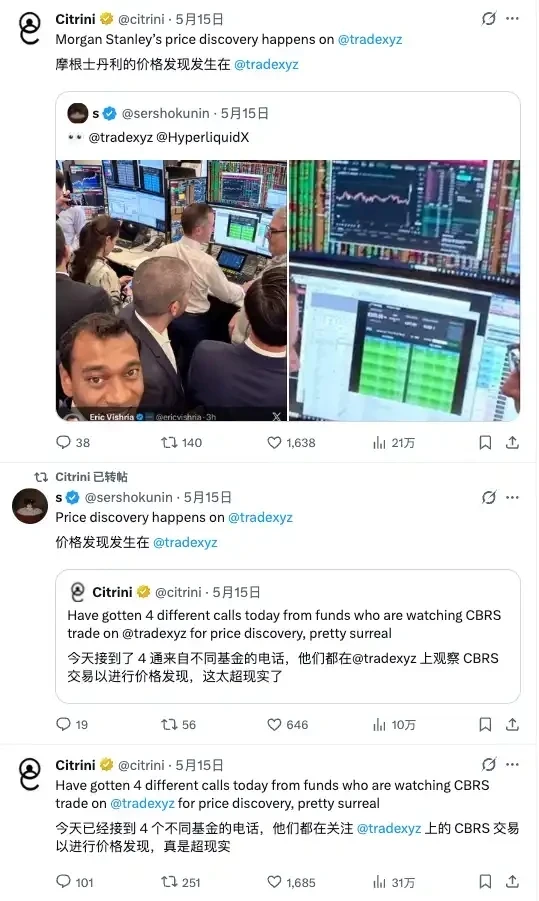
In a sense, Citrini serves as a bellwether, sending "warning signals" to the traditional financial world. It uses accurate information to caution traditional financial markets that previously inconspicuous crypto players are now eyeing the "big pie" of traditional financial markets like barbarians.
Behind Citrini stands a founder who believes in "second-order thinking" and "long-termism" – James van Geelen.
Diverse Labels: Dual Degree in Bio-Psychology, Medical Emergency Practitioner, "AI Panic Whistleblower"
At 33 years old, James van Geelen (hereinafter referred to as Geelen) probably never imagined that a "popular AI discussion post" could trigger the rapid evaporation of hundreds of billions of dollars in market value from the US stock market. Earlier in his career, he had nothing to do with AI at all.
Public information shows Geelen graduated from the prestigious UCLA, earning a dual degree in Biology and Psychology. He also worked as an emergency medical technician and paramedic in downtown Los Angeles. A background from a top university and experience as a medical emergency professional shaped his personality, which values efficiency and meticulous planning. As he himself puts it, "If you don't have a plan, you're going to have a bad time." Additionally, he considers himself a "musical genius," though he doesn't have any notable works to show for it.
According to Geelen's original plan, he was supposed to become a doctor saving lives. However, by a twist of fate, he ended up on the entrepreneurial path. He first founded a healthcare company, sold it to a private equity fund, thereby successfully breaking free from the "elite school - employee - professional manager" cycle. Subsequently, he founded Citrini.
Notably, as mentioned by him on the Odd Lots podcast in 2023, he also co-founded one of Connecticut's earliest medical marijuana dispensaries. This shows he is far from the stereotypical "straight-laced doctor" that people might imagine.
In 2018, with some seed capital, Geelen started his personal investment career under the name Citrinitas Capital, capturing early opportunities in AI (like Nvidia) and GLP-1 weight-loss drugs (like Ozempic/Wegovy).
In 2023, Geelen officially founded Citrini Research, dedicated to "cross-asset, multi-dimensional investment analysis," offering in-depth reports on thematic equity investment and global macro trading. It quickly grew into a top-tier creator in the finance category on Substack. (Odaily Planet Daily Note: It offers both individual and institutional subscription models.)
On May 31, 2023, the model portfolio Citrindex, built on personal research, was officially launched with an annual subscription fee of $1,250. According to statistics, the portfolio has accumulated returns exceeding 200%, outperforming the S&P 500 in monthly gains multiple times.
In March 2024, he boldly predicted Trump would win the election. In July 2025, amidst the turmoil surrounding former Fed Chair Powell's departure, he advised over 50,000 subscribers to "buy 2-year US Treasuries and short 10-year US Treasuries" to hedge against policy risks.
In December 2025, according to PitchBook information, Citrini completed a seed round of approximately $5.05 million. With a team of only about 10 employees, the company remains privately held.
Then, time moved to February of this year. He co-authored with Alap Shah, who has a traditional finance background, the "The 2028 Global Intelligence Crisis" that shook the US stock market. Although he repeatedly emphasized the report was merely a "thought experiment" and scenario hypothesis rather than a predictive analysis, the phenomena it mentioned – "mass white-collar unemployment, declining consumer spending, economic contraction (Ghost GDP)" – still triggered panic and concern in the capital markets, leading to a sharp decline in logistics, payment, and software stocks. Among them, IBM's stock price on February 23 recorded its largest single-day drop since 2025; American Express and Blackstone fell over 8%; the entire software stock sector dropped nearly 5%; companies like DoorDash, Uber, Mastercard, Visa, Capital One, and Apollo Global Management Inc. saw their stock prices fall by up to 3%. Multiple US stock sectors were swept into the sell-off wave, with the Dow Jones Industrial Average once falling over 800 points. Alap Shah later publicly stated their investment stance as "bearish on actions, bullish on positions," meaning they short companies they believe will be disrupted by AI while holding semiconductor tech stocks that benefit from AI.
It is no exaggeration to say that Citrini's report caused the US stock market to hemorrhage, evaporating hundreds of billions of dollars in market value overnight, triggering follow-up reports from international media such as Bloomberg and the Wall Street Journal.
On April 6, this year, Citrini's "Analyst #3" personally traveled to the Strait of Hormuz – a key chokepoint in the US-Iran conflict – for research. The report disclosed many little-known firsthand observations, revealing on the ground the specific operational model of Iran's "toll station" in the strait, and provided a series of counterintuitive conclusions, such as: Regardless of how the situation develops, shipping volume through the strait will gradually increase; Iran does not want to close the Strait of Hormuz. Firstly, shipping volume will continue to increase. Secondly, regarding the diplomatic "toll station," surprisingly, the traffic order in the strait is actually very standardized. Thirdly, the contradictory nature of escalation: even if ground operations commence, shipping volume through the strait might still increase. Fourthly, it's about geopolitical realignment, not a winner-takes-all confrontation. This conflict is not a simple "two-sided fight" but a multi-party game. Geographical disputes within great power games are also a key subject within Citrini's 'range of research.'''
When asked why he named the company "citrinitas," Geelen replied: The inspiration came from financial mogul George Soros's book 'The Alchemy of Finance.' It is actually a stage in alchemy. However, most people don't know that during this transitional phase, lead begins to transform into gold but hasn't fully become gold yet." This is also his favorite moment of "making a difference" – seeing the birth of "gold" before others notice the change in the lead.
Investment Style: Second-Order Thinking, Narrative-Driven, Reverse Scenarios
As for Citrini's investment style, thanks to its founder's cross-industry experience and diverse labels, it highly advocates "second-order thinking."
As Geelen himself says: "Most investors only focus on the ball itself, but I focus more on where the ball will bounce next."
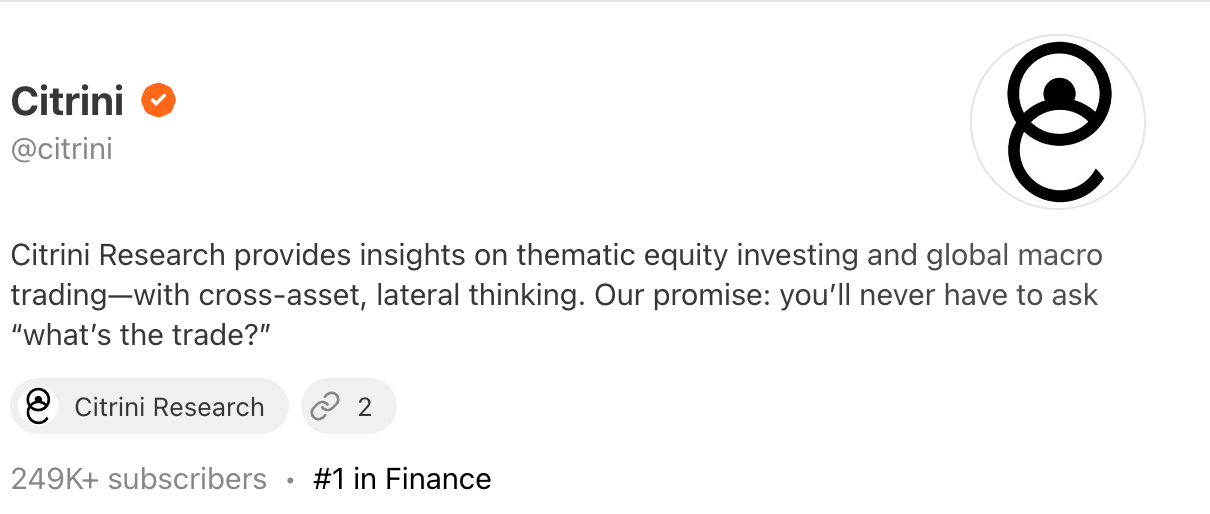
Based on Citrini's past content and public information, this research institution focuses on long-term "super trends" such as AI, robotics, energy demand, fiscal policy, geopolitics, and modern warfare. Additionally, it aims to provide actionable "baskets of investment references" and tactical macro trading ideas, with its assessments leaning towards long-term structural changes rather than short-term trades. In its Substack homepage bio, we can see its emphasis on practice, stating: 'You (the reader) will no longer need to ask, "What is the trade?"
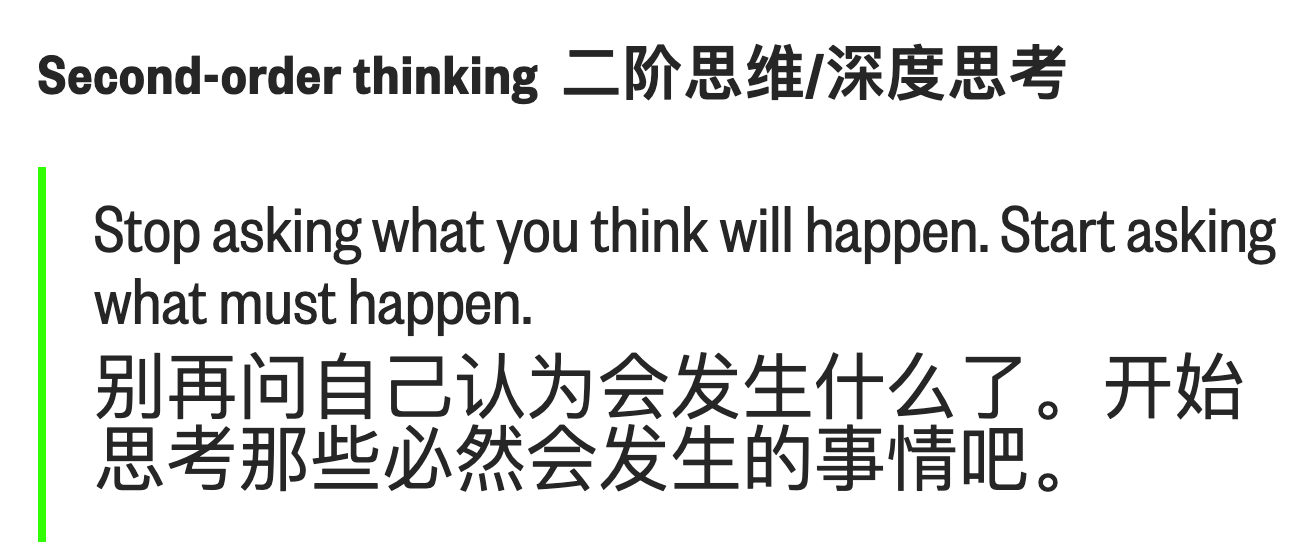
Furthermore, Citrini frequently uses "scenario hypotheses" to help readers understand second/third-order effects. Geelen once mentioned: "Don't just think about what you think will happen. Think about what is inevitable. How will the market's reaction change the reality? What secondary effects will there be? What obstacles exist for a trend to continue, and where will the capital flow to overcome these obstacles?" Previously, in March 2023, when Silicon Valley Bank collapsed, he boldly bought overnight financing rate call options, easily bagging nearly 50x returns. Before the US launched a military operation in Venezuela in December last year, he shared views on investment opportunities in Venezuelan sovereign bonds.
Since the beginning of this year, Citrini has onboarded several independent analysts, including macro analyst Nick Reece, Korean semiconductor industry analyst @jukan05, and AI chip industry analyst @zephyr_z9, to some extent filling gaps in industry details, technical processes, and shifts in industry trends. Currently, this research institution still maintains a founder-driven production model collaborating with an anonymous team of elite experts.


