






Morgan Stanley Digital Asset Head: Bitcoin Breaking $1 Million Wouldn’t Be Surprising, but a Crisis That Shatters the Old System May Be Needed to Really Ignite It


- Core View: Amy Oldenburg, Head of Digital Asset Strategy at Morgan Stanley, believes Bitcoin’s next major surge may not come from new products or favorable policies, but rather requires a crisis powerful enough to shatter the existing traditional financial system as a catalyst. At the same time, she wouldn’t be surprised to see Bitcoin break $1 million within five years, but she hopes for a more moderate rise.
- Key Elements:
- Morgan Stanley’s spot Bitcoin ETF (MSBT) set a record for the bank’s highest first-day issuance, driven primarily by client demand. However, its status as a bank holding company subjects it to strict Federal Reserve oversight, preventing it from moving as quickly as independent asset managers.
- Most financial advisors still do not actively recommend Bitcoin. One reason is that since Morgan Stanley officially issued allocation recommendations (2%-4% for moderately aggressive portfolios), Bitcoin’s price has been range-bound and lacked upward momentum, reducing advisors’ incentive to recommend it.
- Educational and awareness gaps are key obstacles. This includes both clients and advisors failing to fully understand the difference between Bitcoin and other crypto assets, as well as the essential distinction between holding ETP shares and holding spot Bitcoin (self-custody).
- Global mainstream capital attention is diverted by other assets (such as gold and AI). Coupled with regulatory and capital efficiency constraints, banks have limited motivation to hold Bitcoin and prefer assets with more efficient capital treatment.
- Oldenburg believes Bitcoin adoption will be a slow, gradual climb rather than a "J-curve" style explosion. Its future value may need to be revalidated through a crisis event (such as the collapse of the traditional system) to achieve a greater breakthrough.
Compiled & Edited by: Shenchao TechFlow
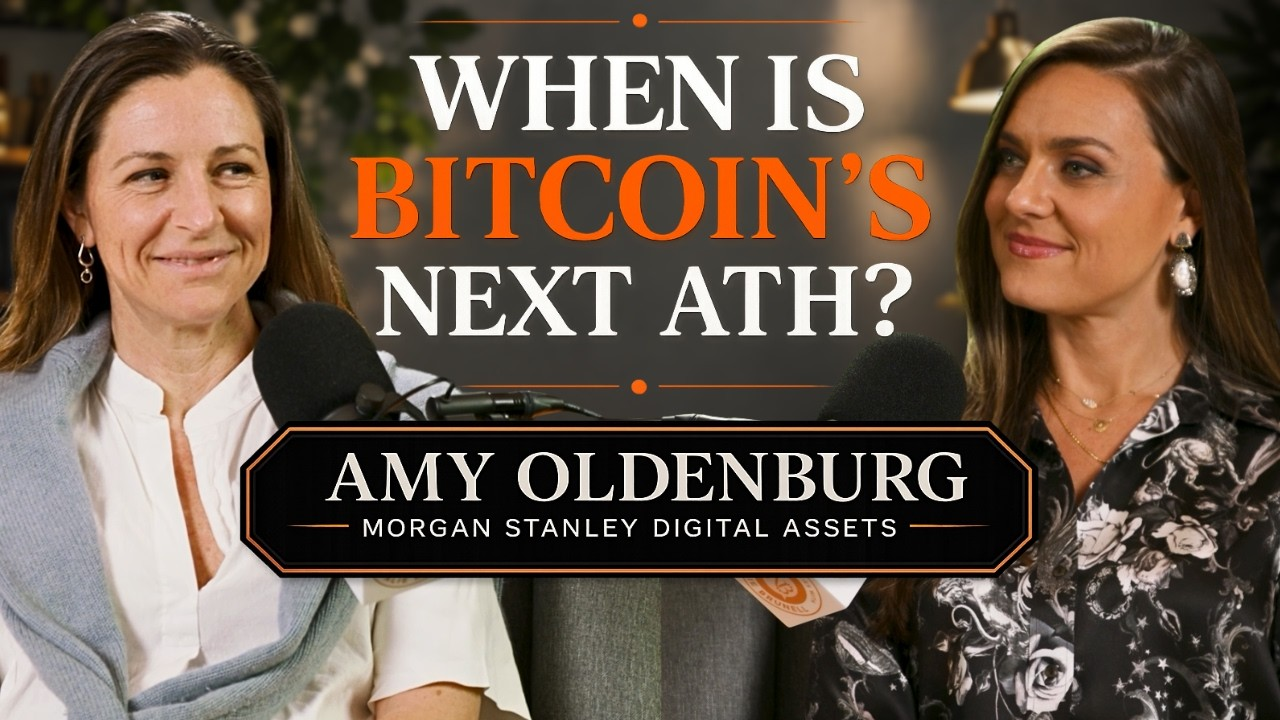
Guest: Amy Oldenburg, Head of Digital Assets Strategy, Morgan Stanley
Host: Natalie Brunell
Podcast Source: Natalie Brunell
Original Title: When Will Bitcoin Hit a New ATH? Wall Street Insider Explains
Air Date: June 10, 2026
Key Takeaways
Morgan Stanley, managing trillions of dollars in assets, is now pushing Bitcoin towards its clients. In this conversation, Amy Oldenburg, the head of digital assets strategy, reveals a paradox: MSBT set a record for the bank's best-ever ETF first-day launch, while most financial advisors remain reluctant to recommend it to clients because Bitcoin's price has mostly moved sideways since the advisory was issued. She doesn't believe the next major rally will come from a new product or policy catalyst, but might instead require an event that truly shatters the traditional financial system, leaving Bitcoin as the only intact asset. She wouldn't be surprised to see Bitcoin break $1 million within five years, but she hopes the ascent will be gradual.
Highlights and Key Insights
Tech Roots: From the 1999 Tech Bubble to Emerging Markets
- "At every stage of my life, I was surrounded by a technological change that seemed extremely obscure at the time, and even faced massive skepticism online. It's only today that I can clearly see how the whole historical puzzle fits together."
- "The veteran traders I dealt with daily back then – the OG players – weathered the 2008 global financial crisis with me. It was the core group among them who later became some of the earliest, hardest-core Bitcoin buyers."
- "Bitcoin's earliest evangelists and power users weren't just from the Silicon Valley geek circle, but also massively from the cross-border and international finance markets – people on the front lines of trading, desperately seeking alternatives to the traditional centralized banking system."
Why Bitcoin Made Sense Early On
- "In those underdeveloped markets, the traditional physical banking system is incredibly backward. Most of the population can never open a bank account in their lifetime, so they have to fully rely on and embrace mobile money."
- "You're in a small village where even electricity isn't available 24/7, and the roads are dirt. But there's a Vodafone kiosk, like a lemonade stand, with 'M-Pesa' written on it. That's where you put cash onto your phone."
- "Because we've been deeply involved in so many emerging markets, we know firsthand that people there have ample reason to embrace decentralization. The traditional financial infrastructure is extremely unreliable, lacks any contract spirit, and is often riddled with severe systemic corruption – corruption we witnessed firsthand on the trading desk."
Why Haven't Institutional Investors Gone All-In on Bitcoin?
- "Our entire group is structured legally as a bank holding company. This means we must adhere to a much stricter set of capital adequacy and risk control requirements that belong purely to the banking system – because we have the Federal Reserve watching over us very closely."
Record Demand for MSBT
- "Of course, you'll talk up your own product, but you don't really know what will happen until it goes live. The result surprised many people."
- "Combining a GSIB-level issuer with GSIB-level custody was our first objective to bring to the market, and also a way to understand what else the ecosystem needs to develop further."
Will Morgan Stanley Issue Digital Credit?
- "I know there's something in digital credit – but most people haven't even figured out Bitcoin yet, let alone the more advanced products built on top of it."
- "Education is what's limiting the community and the financial advisor community from embracing these products."
- "Some products have very appealing elements, but there's always something that makes them not quite complete – kind of like the early BlackBerry story."
The Advisor Gap: Why Isn't Everyone Recommending Bitcoin?
- "If we had given the recommendation at $10,000 or $15,000, and it later went to $100,000, the momentum would be behind us. But interestingly, since the recommendation, we've largely been trading sideways in a range."
- "Financial advisors have a fiduciary duty to choose the right assets for their specific clients. Not every client is a growth investor."
What's Holding Bitcoin Back?
- "We always get caught up in a black-and-white debate: will Bitcoin ultimately succeed or fail? But we live in a very complex world where different narratives are mixed together, diverting attention and capital allocation."
- "Global mainstream capital's attention and liquidity for asset allocation are brutally fragmented."
- "I hate to say it, but it might really take a crisis – one where we shatter the existing system, and Bitcoin is the only thing left intact."
Corporate Balance Sheets
- "Banks don't hold Bitcoin because they dislike it, but because there are more capital-efficient assets. If the capital regulation conditions don't improve, we will focus our energy on those more favorable assets."
- "If no one really needs tokenized stocks, there's no reason for us to spend a lot of money on it. When demand comes, we'll do it. It's the same logic with Bitcoin."
The Future of Bitcoin
- "I don't think we'll see a magical J-curve and a sudden takeoff in 2027. It's more likely that we'll continue to climb slowly, with more participants gradually entering, getting educated, and slowly understanding."
- "Bitcoin at a million dollars? That's great. I don't see why it's impossible. Given everything I've seen in my life, I believe anything is possible."
Winner-Takes-All Tech vs. Redundant Finance: The Future of the Industry
- "That 'winner-takes-all' culture you see in tech and many tech-related fields is completely mismatched with financial services, whose essence is redundancy and multiple participants."
- "When we run an RFP, we start with a dozen candidates and hope to narrow it down to three finalists. But in tech, there's often only one, at most two, that can truly meet our hard requirements."
Responding to Critics of Big Banks
- "In emerging markets, the people's 'distrust' of the traditional official financial system isn't some abstract theory from a textbook; it's a bleeding, brutal reality happening every day."
- "From the perspective of a die-hard Bitcoiner, taking spot Bitcoin and putting it into an ETP from a traditional financial institution is heresy to many. But it's happening at a scale I wouldn't have predicted."
- "Holding an ETP share is not the same as holding Bitcoin – you own price exposure. This needs to be constantly re-educated."
Tech Roots: From the 1999 Tech Bubble to Emerging Markets
Host Natalie Brunell: Our guest today is Amy Oldenburg, Head of Digital Assets Strategy at Morgan Stanley. Amy, I'm particularly eager to hear your story of how you got involved with Bitcoin and your legendary over-two-decade journey at Morgan Stanley.
Amy Oldenburg:
I have been at Morgan Stanley for twenty-six years, though it wasn't my plan. I grew up in a small Midwest town in Ohio. It's funny – like you asked me in our pre-show chat: 'How did you end up here? How did you get on this crazy journey of digital assets and Bitcoin?'
I'm a hardcore Gen Xer like you, and I completely resonate with your experiences. Sometimes I look at those online memes about what growing up in the 80s and 90s was like – you realize that tech has been subtly reshaping us from a very early age. I remember being seven or eight, spending hours in the basement with my cousins playing Atari, and then the NES arrived, and we were obsessed with Super Mario Bros. It felt like every key milestone in my life was accompanied by some disruptive technological wave.
One Christmas, my dad got us a Tandy computer, and we started fiddling with early computer games – it seemed incredible. Then tech kept evolving. In high school, we were learning basic typing in the computer lab. By college, technology had cut deeper into our daily lives.
I remember a professor getting early access to a BlackBerry, and our entire marketing class became its seed users. We sat in the classroom, completely clueless about what to do with it – it didn't even have apps, it was just a block of hardware. We joked, 'Okay, what's the difference between this and a high school pager? It can send letters and numbers, but none of our friends have this thing, who would we send it to?' Eventually, it evolved into the version with the iconic full keyboard, reaching near-ubiquity, before being suddenly rendered obsolete. And indeed it was.
Even funnier was my major in college. I was an accounting major, but the school policy didn't allow accounting majors to study abroad. Back then, my one thought was to escape Ohio as far as possible. Since I couldn't go abroad, the school had a domestic exchange program in San Francisco. I was studying in New York at the time, so in 1999, I packed my bags for San Francisco – and stepped right into the heart of the Dot-com Bubble.
Young and naive, I had no idea how crazy the world was. In Silicon Valley, I started an internship the next day at an internet startup helping Fortune 500 companies build websites. Two months into the paid internship, I decisively dropped my accounting major. The feeling was overwhelming – this technological change unfolding was absolutely going to reshape the future.
We went to industry conferences with the company. Back then, Google was just a small startup. They could only hand out little slips of paper at these events trying to recruit: 'If you're interested, please visit our Craigslist page to apply for a job at Google.' We raised an eyebrow: 'Google? What kind of name is that? The business model makes no sense – who would use it to search for things? No way it'll succeed.'
So you see, at every stage of my life, I was surrounded by a technological change that seemed extremely obscure at the time, and even faced massive skepticism online. It's only today that I can clearly see how the whole historical puzzle fits together.
As for how I ended up in digital assets and Bitcoin – I actually only joined Morgan Stanley after the tech bubble burst. I stayed with that San Francisco startup through the crash and was later transferred back to New York headquarters full-time. But everyone knew the environment was completely broken – we even had to withdraw our S-1 filing, didn't go public, and then underwent two brutal rounds of layoffs. I needed a Plan B immediately because I had rent to pay – and returning to Ohio was absolutely out of the question.
Around that time, I stumbled into Morgan Stanley. A close friend of mine was in HR there. She came to me and said, 'I know you're not into traditional finance right now, you're all about tech. But I have tons of open positions that need filling. If you know anyone looking for a job or an interview, send them my way.' I thought, maybe I should try it myself, just to have a backup plan.
That's how I crossed over into the Emerging Markets team. The aftermath of the Asian Financial Crisis (1997) hadn't fully faded, and the Tequila Crisis (1994) had just passed – the whole emerging markets landscape was a mess. The team I joined went through several leaders in just a few years. At the same time, we were feeling the severe impact of the tech bubble burst on financial assets – around 2000, 2001. Then, exactly nine months into my tenure, 9/11 happened. It was one crisis after another, all while underlying technological change was racing forward.
At Morgan Stanley, I spent several years on the trading desk, focusing on Programmatic Trading and Emerging Markets FX Trading. The veteran traders I dealt with daily back then – the OG players – weathered the 2008 global financial crisis with me. It was the core group among them who later became some of the earliest, hardest-core Bitcoin buyers.
Bitcoin's earliest evangelists and power users weren't just from the Silicon Valley geek circle, but also massively from the cross-border and international finance markets – people on the front lines of trading, desperately seeking alternatives to the traditional centralized banking system.
Because we've been deeply involved in so many emerging markets, we know firsthand that people there have ample reason to embrace decentralization. The traditional financial infrastructure is extremely unreliable, lacks any contract spirit, and is often riddled with severe systemic corruption – corruption we witnessed firsthand on the trading desk.
So, through these experiences on the financial front lines, combined with my early network in the tech world (some friends were early into P2P file-sharing software), I became extremely, early-sensitive to Bitcoin. Those skills in digital trading and risk mitigation from years back later migrated very smoothly into the digital assets space.
Why Bitcoin Made Sense Early On
Host Natalie Brunell: Since you got into this space so early, did you jump in and invest early yourself, or did you stay on the sidelines until traditional financial institutions formally entered and the whole industry became more compliant?
Amy Oldenburg:
Actually, no. It's funny – my brother was over last week, and we were reminiscing. Around 2012, he excitedly came to me wanting to set up some machines to mine Bitcoin. I laughed at him, saying we didn't have the kind of hardware at home that was powerful enough for a mining rig.
And you have to understand, the crypto environment back then was extremely dangerous and Wild-West-like – nothing like today where you just download a nice, elegant Coinbase app and can securely deposit and withdraw Bitcoin with a few clicks. Honestly, back then, if you wanted to buy coins, your only option was to deal with a shaky platform like Mt.Gox. I was at Morgan Stanley, thinking: If I touch this thing, I'll probably get fired tomorrow. The compliance risks and operational costs were just too high for me then. So, while I was heavily following it and spent a lot of time passively observing its evolution, I was absolutely not one of those hardcore early miners coding away on a computer.
Host Natalie Brunell: Let's zoom out a bit. Looking back at your years of investment experience in Emerging Markets, was there a core conclusion that directly aligns with the subsequent powerful rise of Bitcoin? Was there a lesson learned the hard way in emerging markets that made you wake up and think, 'Oh! So that's why Bitcoin makes sense! The root is here!'


