






9 Taiwanese stocks, three main themes: "New Stock God" Serenity's AI Industry Chain Taiwan Map


- Core Viewpoint: Analyst Serenity proposes that the core opportunity in the Taiwan AI industry chain lies in CPO (Co-Packaged Optics) technology, and has identified 9 Taiwanese stocks covering the three main themes of CPO, ASIC, and Compound Semiconductors. He believes the current industry chain has no bubble, with the primary risk being changes in the capital expenditures of hyperscale cloud service providers, rather than geopolitical factors.
- Key Elements:
- CPO is defined as the next major industry theme. Goldman Sachs predicts the global CPO market size will explode from $164 million in 2026 to $91 billion in 2028, with the core driver being the mass production of TSMC's COUPE platform in 2026.
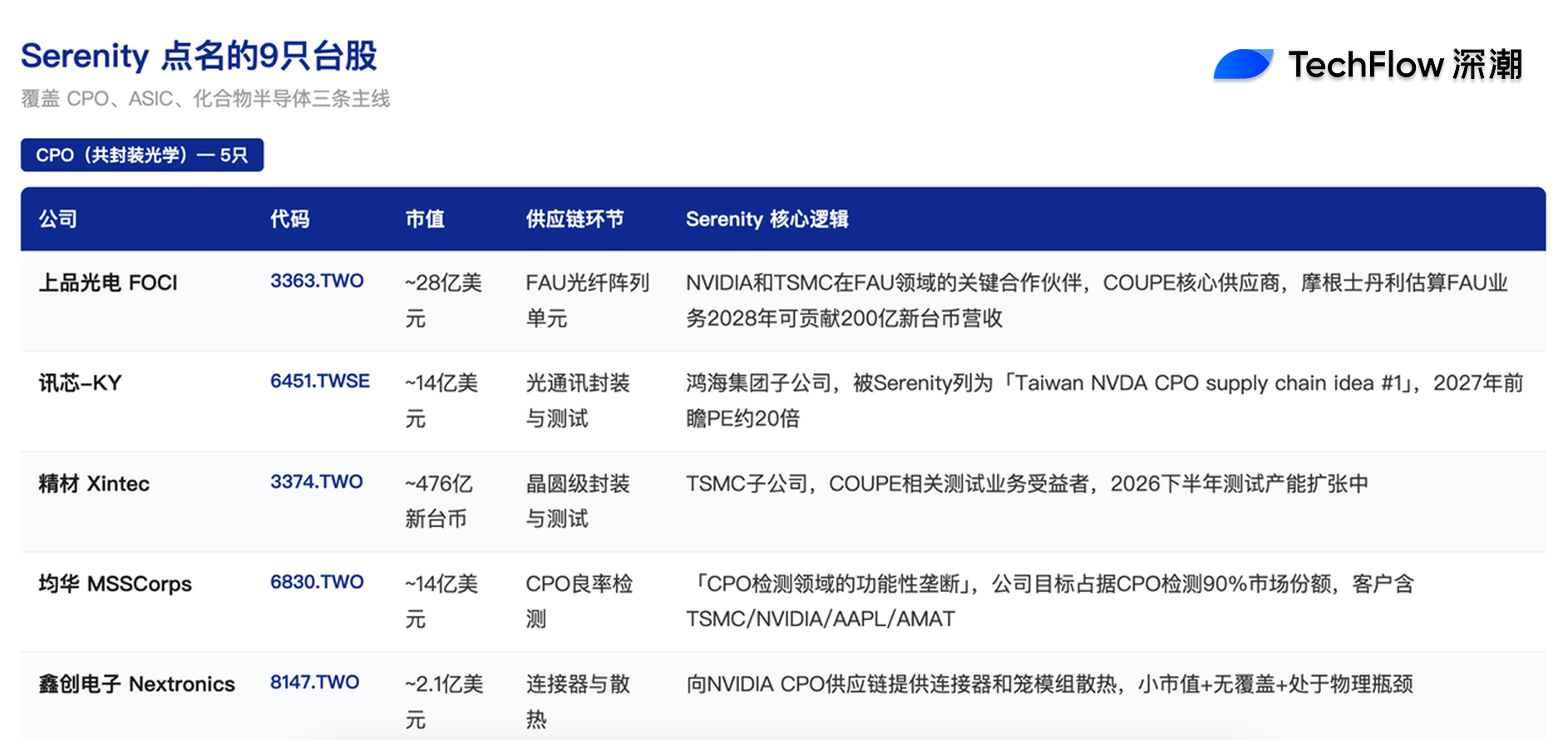
- Serenity identifies 5 Taiwanese stocks benefitting from CPO: FOCI (core supplier of FAU, Morgan Stanley estimates 2028 revenue could reach NT$20 billion), ShunSin Technology (Foxconn's optical communication packaging, NVIDIA CPO supply chain), Xintec (TSMC wafer-level testing), Gallant Micro. Machining (monopoly in CPO testing functions), and AP Memory Technology (small-cap CPO connectors and cooling).
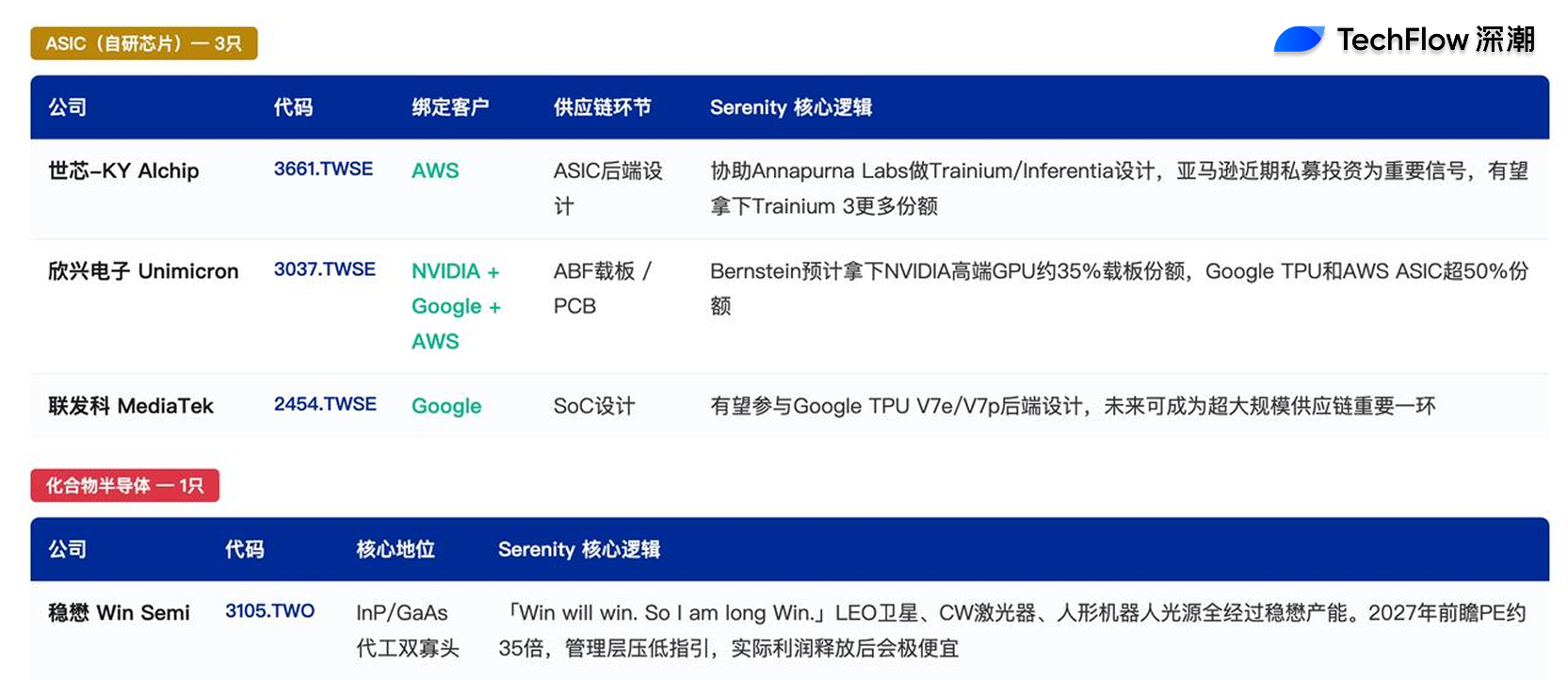
- The ASIC theme involves three Taiwanese firms: Alchip Technologies (tied to AWS Trainium/Inferentia design), Unimicron Technology (securing over 50% of ABF substrate share for NVIDIA GPUs and Google/AWS ASICs), and MediaTek (potentially participating in Google TPU backend design).
- In Compound Semiconductors, WIN Semiconductors is noted as one of the duopoly foundries for InP/GaAs, with future growth potential in LEO satellites, lasers, and other fields, yet its valuation has not been fully priced in by the market.
- The industry chain panorama cannot ignore upstream materials (TSMC's 2026 CapEx locked at $52-56 billion) and energy/liquid cooling (Delta Electronics, Auras Technology, etc.). Goldman Sachs predicts the global server cooling market will reach $17.6 billion in 2026.
- Serenity believes the real risk lies in a reduction of CapEx by hyperscale cloud providers, not geopolitics. The recent disappointing AI revenue guidance from Broadcom caused the Philadelphia Semiconductor Index to plummet 10.26% in a single day, triggering market turmoil.
Original Author: Ada, Deep Tide TechFlow
Serenity, a "new stock guru" sought after on X, recently shared a systematic view of Taiwan's AI industry chain. The nine Taiwanese stocks he named cover three main themes: CPO (Co-Packaged Optics), ASIC (Application-Specific Integrated Circuits), and compound semiconductors. He characterized CPO as "the biggest industrial theme of the next phase." Goldman Sachs predicts the global Optical TAM will surge from $15 billion in 2026 to $154 billion in 2028, with CPO's share growing from $164 million to $91 billion. He also clearly stated that there is no bubble in the Taiwanese AI industry chain, and the real risk lies not in cross-strait tensions, but in the capital expenditures of hyperscale cloud service providers.
Countdown to TSMC COUPE Mass Production in 2026, Five Taiwanese Stocks Each Holding a Link
The hard timeline anchor supporting Serenity's thesis on the CPO theme is TSMC's COUPE (Compact Universal Photonic Engine) platform entering mass production in 2026.
According to TrendForce on April 1, citing Hou Shang-Yu, Director of TSMC's Advanced Packaging Integration Department, speaking at SEMICON Taiwan, COUPE integrates electronic ICs and photonic ICs heterogeneously based on SoIC technology, with mass production scheduled for 2026 as planned. Hou also identified three major bottlenecks for CPO scaling: wafer-level testing, fiber array unit (FAU) integration, and high-speed optical packaging assembly. The five Taiwanese CPO stocks named by Serenity correspond precisely to these three bottleneck areas and their ancillary components.
First is FOCI (Foci Fiber Optic Communications, 3363.TWO), with a market cap of approximately $2.8 billion. FOCI is a key partner for NVIDIA and TSMC in the FAU field and a core supplier within the COUPE architecture. Serenity stated on X that FOCI's current market cap of about $2.8 billion "has not yet fully reflected its strategic position in the supply chain." Morgan Stanley estimates that FOCI's FAU business alone could contribute approximately NT$20 billion in revenue by 2028, compared to nearly zero currently. As early as March, Hunterbrook Media and Citrini Research cross-referenced four patents from FOCI, Himax, and TSMC, confirming a "fingerprint-level" correspondence for the three companies on a 22-channel FAU — the strongest external evidence of FOCI's entry into COUPE's core supply chain.
Second is Shunsin Technology (訊芯-KY, 6451.TWSE), with a market cap of about $1.4 billion. Shunsin is a subsidiary of the Hon Hai Group (Foxconn) focusing on optical communication packaging and testing. Serenity once listed Shunsin on X as "Taiwan NVDA CPO supply chain idea #1," reasoning that "Hon Hai is NVIDIA's ODM, similar to Celestial going public on MRVL's coattails." He estimated Shunsin's forward P/E ratio for 2027 at around 20x.
Third is Xintec (精材, 3374.TWO), with a market cap of about NT$47.6 billion. Xintec is a subsidiary of TSMC specializing in wafer-level packaging and testing, chaired by CH Chen, focusing on wafer-level chip-scale packaging and wafer testing. According to a DIGITIMES report on May 29, 2026, Xintec is preparing capacity for the expansion of its testing business in the second half of 2026. Serenity categorized Xintec as a "beneficiary of COUPE-related testing business" in a recent interview.
Fourth is MSSCorps (均華, 6830.TWO), with a market cap of about $1.4 billion. Serenity explicitly stated on X that he had built a position in MSSCorps, offering a strong assessment: "This looks like a functional monopoly in the CPO inspection field. The market might be confusing it with the material/failure analysis oligopoly of MA-tek and iST." He later cited MSSCorps' own statement — "the company aims to capture 90% of the CPO inspection market share" — as confirmation. MSSCorps' client map includes TSMC, NVIDIA, AAPL, AMAT, and others. Among the three CPO bottlenecks identified by TSMC, "wafer-level testing" is the specific link where MSSCorps directly positions itself.
Fifth is Nextronics Engineering (鑫創電子, 8147.TWO), with a market cap of about $210 million. Serenity's rationale for building a position in Nextronics is its supply of "CPO connectors and Cage Thermal Modules" to NVIDIA's CPO supply chain. Nextronics is the smallest among the five Taiwanese CPO stocks by market cap, fitting Serenity's consistent stock-picking profile of "small market cap + no analyst coverage + positioned at a physical bottleneck."
The five stocks can be roughly ordered along the supply chain as: FAU interface (FOCI), optical communication packaging and testing (Shunsin Technology, Xintec), yield inspection (MSSCorps), and connectors and thermal management (Nextronics). The downstream customers for this entire chain are highly concentrated, primarily NVIDIA and TSMC.
Three Taiwanese ASIC Companies Each Tied to a Hyperscaler's Custom Chip
Beyond NVIDIA GPUs, the continuous ramp-up of custom ASICs by hyperscale cloud service providers like AWS Trainium, Google TPU, and Microsoft Maia forms the second major theme in Serenity's Taiwanese stock list.
Alchip Technologies (世芯-KY, 3661.TWSE) is the most representative target in this line. Founded in 2003 and headquartered in Taipei, Alchip specializes in advanced CMOS ASIC design and manufacturing. According to supply chain data compiled by Global Tech Research, Alchip primarily assists Amazon's Annapurna Labs with the backend design of AWS Trainium and Inferentia series chips, currently handling projects including Trainium 1 and Inferentia 2. Serenity recently stated that Alchip is likely to gain more market share in the design of AWS Trainium 3. Notably, Amazon's recent private placement investment in Alchip is interpreted by the market as a significant signal. Alchip's collaboration with Ayar Labs in the CPO field also represents a further expansion of its addressable market.
Unimicron (欣興電子, 3037.TWSE) benefits from the ASIC theme through its ABF substrates and PCBs. According to a May 4 Bernstein research report cited by Gotrade News, Unimicron is expected to capture about 35% of the ABF substrate share for NVIDIA's high-end GPUs and over 50% for ASIC chips like Google TPU and AWS Trainium. Bernstein named TSMC and Unimicron as "the two most representative Taiwanese stocks in the Asian market AI Capex cycle." Unimicron's Q1 2026 revenue grew 8% quarter-over-quarter, with a gross margin of 18%.
MediaTek (聯發科, 2454.TWSE) has seen its Google TPU collaboration news widely circulate in the market. According to Global Tech Research, MediaTek may potentially participate in backend design support for Google's TPU V7e/V7p in the future. Serenity recently stated that while some of this positive news might already be partially priced into the stock, he believes MediaTek's future ASIC business growth remains worth watching. In the coming years, MediaTek has the potential to become a very important part of the hyperscale supply chain for major US cloud providers.
These three Taiwanese companies are embedded in the core of hyperscaler custom chip development from three different dimensions: design services, substrate packaging, and SoC design.
Win Semiconductor: An Underappreciated InP/GaAs Duopoly
Serenity's most firmly held and directly expressed position among Taiwanese stocks is Win Semiconductor (穩懋, 3105.TWO).
Win Semi is one of the world's leading compound semiconductor wafer foundries, forming a duopoly with GlobalFoundries for InP (Indium Phosphide) and GaAs (Gallium Arsenide) foundry services. The market's traditional perception of Win Semi is tied to its relationship with the SpaceX Starlink and Broadcom (AVGO) supply chains.
Serenity's recent statement on X was: "Win will win. So I am long Win." His core thesis is that Win Semi, as one half of the InP/GaAs foundry duopoly, will see its manufacturing capacity utilized for future LEO (Low Earth Orbit) satellite constellations like SpaceX Starlink, continuous wave (CW) lasers, and the visual and radar light sources for humanoid robots.
He estimates Win Semi's 2027 forward P/E ratio at around 35x. While this might not seem cheap, he believes "management has an incentive to keep guidance low, so the P/E will look extremely cheap once actual profits are released." The business of Win Semi helping silicon photonics companies scale up laser production capacity is, in Serenity's view, the core future growth engine, and this part hasn't been fully priced in by the market yet.
InP is the same link in the supply chain where AXTI, Serenity's earliest US stock position described as a "Strait of Hormuz" type of asset, operates. He analogizes InP substrates to "the oil of the future AI optical communications era." Win Semi's position in the Taiwanese market represents the downstream foundry node in this supply chain.
Serenity Didn't Mention, But Essential for the Full Picture: Upstream Materials, Energy, Liquid Cooling
The nine Taiwanese stocks named by Serenity are concentrated in the midstream segments of CPO and ASICs. For a complete picture of the Taiwanese AI supply chain, upstream materials and downstream energy/liquid cooling sectors are equally indispensable. Serenity didn't directly cover these in his public remarks, but they cannot be omitted for a complete understanding of the Taiwanese AI landscape.
On the upstream materials side, TSMC itself (TSMC, 2330.TWSE) is the central node of the entire picture. According to Bernstein's forecasts, TSMC's profit growth in 2026 will be around 40%, with a 2027-2028 CAGR of about 20%. The company has locked its 2026 capital expenditure guidance in a high range of $52-$56 billion. In the upstream transmission chain of AI Capex, TSMC acts as both an amplifier and a throttle; its CapEx direction directly dictates the order rhythm for all downstream Taiwanese companies in packaging testing, substrates, inspection, connectors, etc.
Regarding energy and liquid cooling, Taiwan's AI data centers are facing substantial pressure on power supply. According to Reccessary in December 2025, citing Yi Xu-Quan, Head of Taipower's System Planning Division, global supplies of key grid equipment like transformers and gas turbines are in shortage. Delivery times for gas turbines have stretched from 2-3 years to 7-8 years, with prices doubling. "The speed of grid construction simply cannot keep pace." This supply-side bottleneck has created structural opportunities for three key Taiwanese stocks.
First is Delta Electronics (台達電, 2308.TWSE), a leader in power management and integrated liquid cooling solutions, which has penetrated both the "white space" (IT computing) and "gray space" (power and cooling) of AI data centers. Second is AVC (奇鋐, 3017.TWSE), a global leader in thermal solutions covering full-stack technologies like cold plate liquid cooling and immersion cooling. Third is Auras Technology (雙鴻, 3324.TWSE), specializing in liquid cooling module manufacturing and a Tier 1 supplier to NVIDIA. Goldman Sachs predicts the global server cooling total addressable market will grow by 111%, 77%, and 26% in 2025, 2026, and 2027 respectively, reaching $17.6 billion in 2027. This growth curve is synchronized with the CPO growth curve within the AI Capex cycle.
The Real Risk Isn't Cross-Strait Tensions, but Hyperscaler CapEx
Serenity's assessment of the overall risk for the Taiwanese AI industry chain diverges from mainstream market narratives.
He recently stated that the Taiwanese AI supply chain currently does not exhibit a bubble, with valuations of many Taiwanese companies still undervalued compared to their US Nasdaq-listed counterparts. Geopolitical risks are being overstated by the market because Taiwan is already an indispensable part of the global tech supply chain. He believes "no country would choose zero-sum, large-scale supply chain destruction." Looking at a 7-10 year horizon, the US is building a local supply chain through companies like Intel, but no major systemic risk exists within the next 2-3 years.
He pointed out that the real risk worth tracking is the capital expenditure of hyperscale cloud service providers. The sustained expansion of investments by major cloud players like Microsoft, Amazon, Google, Meta, and Oracle is the core driver of the current AI industry boom. "As long as these companies continue to increase AI infrastructure spending, the Taiwanese supply chain will continue to benefit. However, if hyperscalers begin to cut CapEx, the Taiwanese AI supply chain could experience a significant valuation adjustment."
Initial signs of a "stress test" for this assessment have begun to appear.
A marginal change that just emerged in the market is worth noting as a tracking clue. On June 3, Broadcom reported results for its fiscal Q2 2026. Its Q3 FY2026 AI chip revenue guidance was $16 billion, approximately $1.2 billion below the sell-side consensus of $17.2 billion compiled by LSEG. Broadcom CEO Hock Tan maintained the full-year AI semiconductor revenue guidance of $56 billion unchanged during the earnings call, without raising it. The market interpreted the "no raise" as negative. On June 5, the Philadelphia Semiconductor Index (SOX) plummeted 10.26% in a single day, its largest drop since March 2020. On the same day, South Korea's KOSPI fell 5.54%, and on June 8, the KOSPI opened down 8.37%, triggering a circuit breaker.
However, the key reference currently observed is that TSMC's 2026 CapEx is locked in the high end of the $52-$56 billion range, with no substantial downward revision yet. The CapEx guidance from the hyperscalers themselves is still on an upward trajectory. Whether Serenity's identified "real risk" is triggered will depend on the CapEx guidance provided by Microsoft, Amazon, Google, Meta, and Oracle in their Q2 and Q3 2026 earnings reports. This is the core premise supporting Serenity's Taiwanese stock list and the most critical marginal variable to track over the next quarter.


