






HIP-4 Opens Permissionless Deployment: Can Hyperliquid Kill Polymarket?


- Core Thesis: Hyperliquid has announced the opening of permissionless deployment for its HIP-4 prediction market, attempting to replicate the success of its HIP-3 perpetual contract market. However, its current scale is far inferior to Polymarket, and it faces issues such as high staking thresholds and missing the World Cup window, making it difficult to disrupt the prediction market landscape.
- Key Factors:
- Since its launch in May 2026, the HIP-4 market has performed poorly, with a cumulative trading volume of only $216 million over the past three months and a maximum of 7,000 daily active users; in comparison, Polymarket's monthly trading volume reaches $4.587 billion.
- HIP-4’s permissionless deployment requires staking 500,000 HYPE (approximately $30 million), a high barrier that may exclude small startup teams, limiting the number of tradable events and innovation capacity.
- Hyperliquid missed the crucial time window of the 2026 FIFA World Cup, whereas Polymarket recorded a single match final (Argentina vs. Spain) trading volume of $83.75 million.
- The success of the HIP-3 perpetual contract market was partly fueled by weekend trading demand triggered by the U.S.-Iran conflict; currently, a similar catalyst to drive the HIP-4 market is lacking.
Original by Odaily (@OdailyChina)
Author: Golem (@web3_golem)
Just after the World Cup concluded, Hyperliquid dropped a "nuclear bomb" into the prediction market arena.
On July 20, Hyperliquid announced that HIP-4 will soon support permissionless deployment, similar to HIP-3. The staking requirement for HIP-4 deployers is also 500,000 HYPE, which will be locked for 6 months. HIP-4 deployers can set a fee split of up to 50% in deployed markets. This feature will first launch on the testnet before going live on the mainnet.
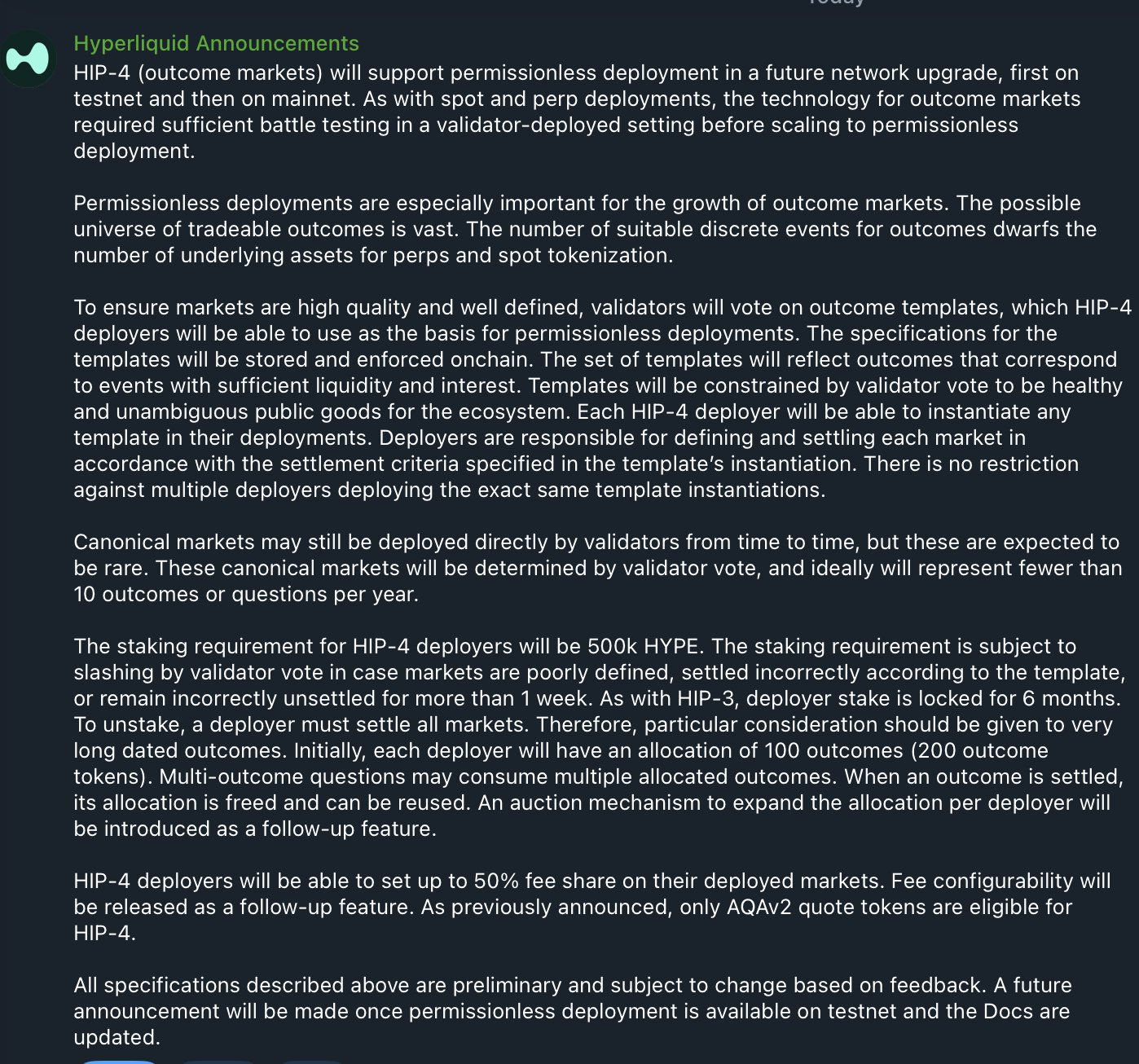
Hyperliquid announces permissionless deployment for HIP-4
Although this is just a preliminary announcement and the specific launch time for HIP-4's permissionless deployment is not yet confirmed, the market has already become excited following the news.
The reason Hyperliquid has become the world's largest platform for equity tokens and on-chain perpetual contracts for commodities, and has even beaten traditional financial markets to price IPOs for enterprises, is thanks to the launch of HIP-3 in October 2025, which allowed third parties to permissionlessly create perpetual contract markets.
Therefore, this time, investors believe Hyperliquid can once again leverage the power of "decentralization" to surpass all leaders in the prediction market sector.
Who Will Be the Next Trade.xyz?
Hyperliquid launched the HIP-4 market on May 2, 2026, marking its official entry into the prediction market. Before its launch, the market widely expected HIP-4 to become Hyperliquid's next core narrative. However, nearly three months since its actual release, its performance can only be described as poor.
According to Hyperliquid's official data, the HIP-4 market has accumulated a total trading volume of only $216 million over the past three months, with an average daily volume of just $10 million, a peak daily active user count of only 7,000, and total fee revenue of a mere $442.38. In contrast, according to DeFiLlama data, Polymarket saw a trading volume of $4.587 billion and fees of $50 million in just the past month.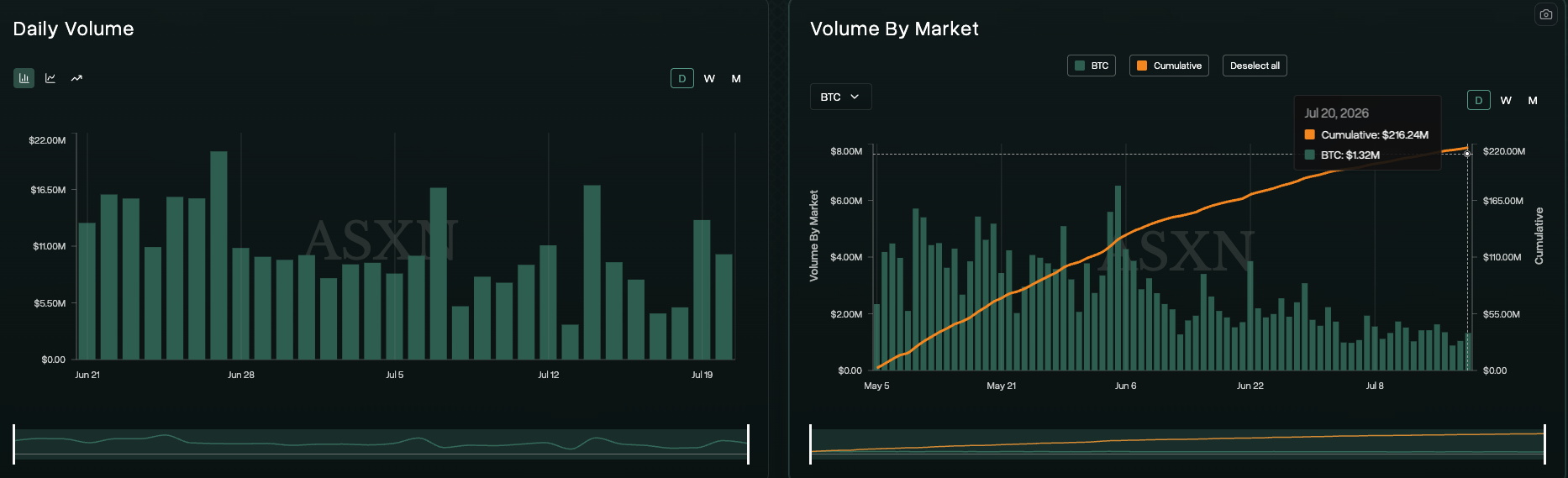
HIP-4 average daily volume and total volume
Not only are user numbers and trading volume low, but the number of events with tradable outcomes on HIP-4 is also quite limited. Currently, there are only 6 prediction markets on HIP-4, which is a drop in the ocean compared to Polymarket in both quantity and variety.
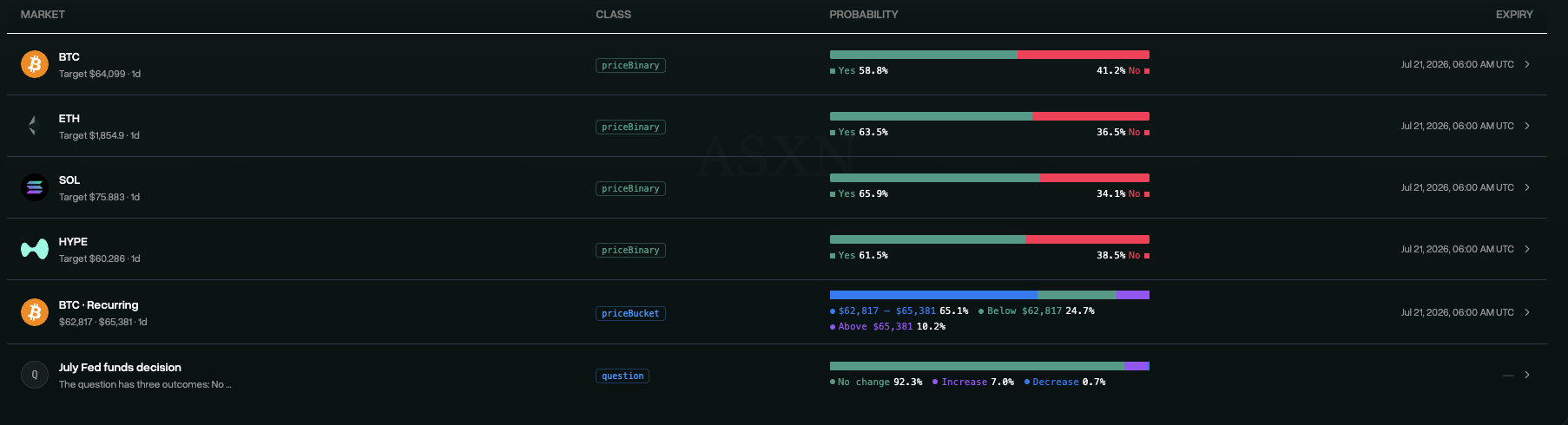
Currently tradable events on HIP-4
Faced with such a vast disparity in scale, Hyperliquid chose path dependency, following the successful formula of HIP-3. Since it couldn't make it work alone, the stage was handed over to the community to create another Trade.xyz within HIP-4.
Opening permissionless deployment for the HIP-4 market is equivalent to Polymarket allowing users to independently create prediction market events. Hyperliquid founder Jeff also stated that permissionless deployment is particularly crucial for the growth of outcome markets (HIP-4), as the range of tradable outcomes is extremely broad, and the number of independent events suitable for outcome trading far exceeds the number of underlying assets used for derivatives and real-world asset tokenization.
Furthermore, having the community or third parties deploy prediction market events offers greater flexibility. Currently, the creation of prediction market contracts is mainly handled by the team or requires community review, making the process insufficiently decentralized. Team members cannot be experts in every field. Especially for hot topics occurring in the real world, this model slows down the time from reacting to a market trend to the final execution and launch.
However, in the HIP-4 market, as long as enough HYPE tokens are staked, third parties can list prediction market events according to their own standards without needing approval from the Hyperliquid team. Hyperliquid has also stated that it will not restrict multiple deployers from deploying identical events simultaneously. This will incentivize healthy competition in the HIP-4 market, where only those providing users with more comprehensive events and deeper liquidity can succeed.
Hyperliquid's product philosophy consistently adheres to a win-win strategy. The HIP-3 market has already fostered the behemoth Trade.xyz, which commands over 90% of the HIP-3 market share. The top 10 perpetual contract assets listed on it have all seen trading volumes exceeding $10 billion.
Perhaps many teams are already gearing up. The day Hyperliquid's mainnet opens permissionless deployment for HIP-4, we might witness a spectacular "Clash of the Titans."
Can Hyperliquid Disrupt the Prediction Market Landscape?
But can Hyperliquid really rely on its "one-trick pony" to dominate everywhere?
Firstly, Hyperliquid is not what it used to be. The HYPE price has stabilized above $60, and the requirement for deployers in the HIP-4 market to stake 500,000 HYPE (approximately $30 million) effectively bars small startup teams. Today, a crypto project might not even raise $30 million in a single funding round. A prediction market project capable of raising $30 million would likely prefer to develop its own independent platform.
Therefore, the high staking threshold for HIP-4 deployers could severely reduce the number of third-party competitors. Ultimately, only "well-funded" prediction market projects might come as guests to drive traffic, limiting the number of tradable independent events and significantly hindering the innovation dynamism of the entire HIP-4 market.
Secondly, the timing of Hyperliquid's launch of permissionless deployment for HIP-4 was too late, missing even the last train. A primary reason 2026 has become a golden opportunity year for the prediction market sector is the dense schedule of sports events in recent years, especially catching the quadrennial World Cup. Various prediction markets have been focusing on World Cup matches. For instance, the total trading volume for the Argentina vs. Spain match event on Polymarket on July 20 alone reached $83.75 million.
However, Hyperliquid completely missed this crucial World Cup window, which is undoubtedly a major strategic oversight. Even the success of the HIP-3 market was a confluence of various favorable factors. The volatility in international crude oil prices triggered by the U.S.-Iran conflict in February this year served as a key catalyst for the HIP-3 market's development. The first day of the conflict fell on a weekend. With traditional markets closed, traders needing urgent position adjustments and hedging had to find new tradable markets, making Hyperliquid's HIP-3 market the preferred choice.
When Hyperliquid launched HIP-3, it didn't emphasize its purpose for equity and commodity tokenization, but it eventually led to the creation of Trade.xyz and Hyperliquid's current leadership in the tokenized trading market. If Hyperliquid hadn't seized the opportunity presented by the U.S.-Iran conflict, it might not have a place in today's tokenized trading market.
Similarly, having missed the World Cup, how confident can Hyperliquid be now in disrupting the prediction market giants?


