






SPCX could really go to $400? Gamma squeeze scenario analysis on the first day of options listing


- Core View: ZeroHedge believes that after SPCX options open, the low float, concentrated retail buying, and market maker hedging demand could trigger a gamma squeeze, potentially pushing the stock price to $400 in an extreme scenario, but this is merely an extreme case rather than market consensus.
- Key Elements:
- SPCX has limited tradable tokens available in its early listing stage. The low float makes the price highly sensitive to buying pressure, exhibiting price elasticity similar to small-cap stocks.
- The listing of options (as early as Tuesday) introduces out-of-the-money call options. Retail investors' low-cost bets could force market makers to buy the underlying stock to hedge, creating a positive feedback gamma squeeze mechanism.
- Vanda data shows SPCX has been the top retail net buy for two consecutive days, with a single-day net purchase of approximately $93.8 million, accounting for 73% of the total retail net buy amount that day. However, this capital is highly concentrated rather than reflecting a broad market risk appetite expansion.
- The $400 price corresponds to a fully diluted market cap of approximately $5.2 trillion, close to Nvidia's valuation. However, the supporting foundations differ: the former relies on trading structure, while the latter is based on fundamental validation.
- The gamma squeeze requires verification through data such as actual options chain trading volume, out-of-the-money option open interest, implied volatility, and the stock's ability to hold at high levels. Currently, only the conditions for the mechanism to be initiated are in place.
TL;DR
- ZeroHedge suggests that the opening of SPCX options could trigger a gamma squeeze, potentially pushing the stock price towards $400 in extreme scenarios.
- For now, we can only confirm the volatility channel has opened, not treat $400 as market consensus.
- Related assets: SPCX, NVDA, MSFT, AAPL, SQQQ, SOXS.
ZeroHedge posted on social media, stating that the opening of SPCX options could trigger a gamma squeeze, potentially pushing SpaceX's stock price towards $400. As an influential and aggressive financial media and trading account in the U.S. stock market, it has long specialized in discussing macro liquidity, position structures, and extreme trading scenarios together. This time, it directly linked SPCX's options listing, gamma squeeze, and the $400 stock price target.
SPCX surged over 25% on its first day of trading, reaching a valuation exceeding $2 trillion. Overnight and after-hours quotes briefly approached $230, but this is not an official closing price and does not directly represent long-term capital's willingness to purchase at this level. For ordinary readers, what matters more than the number of IPO shares issued is the limited tradable shares in the early stage of listing, the high concentration of retail buying, and the impending options launch.
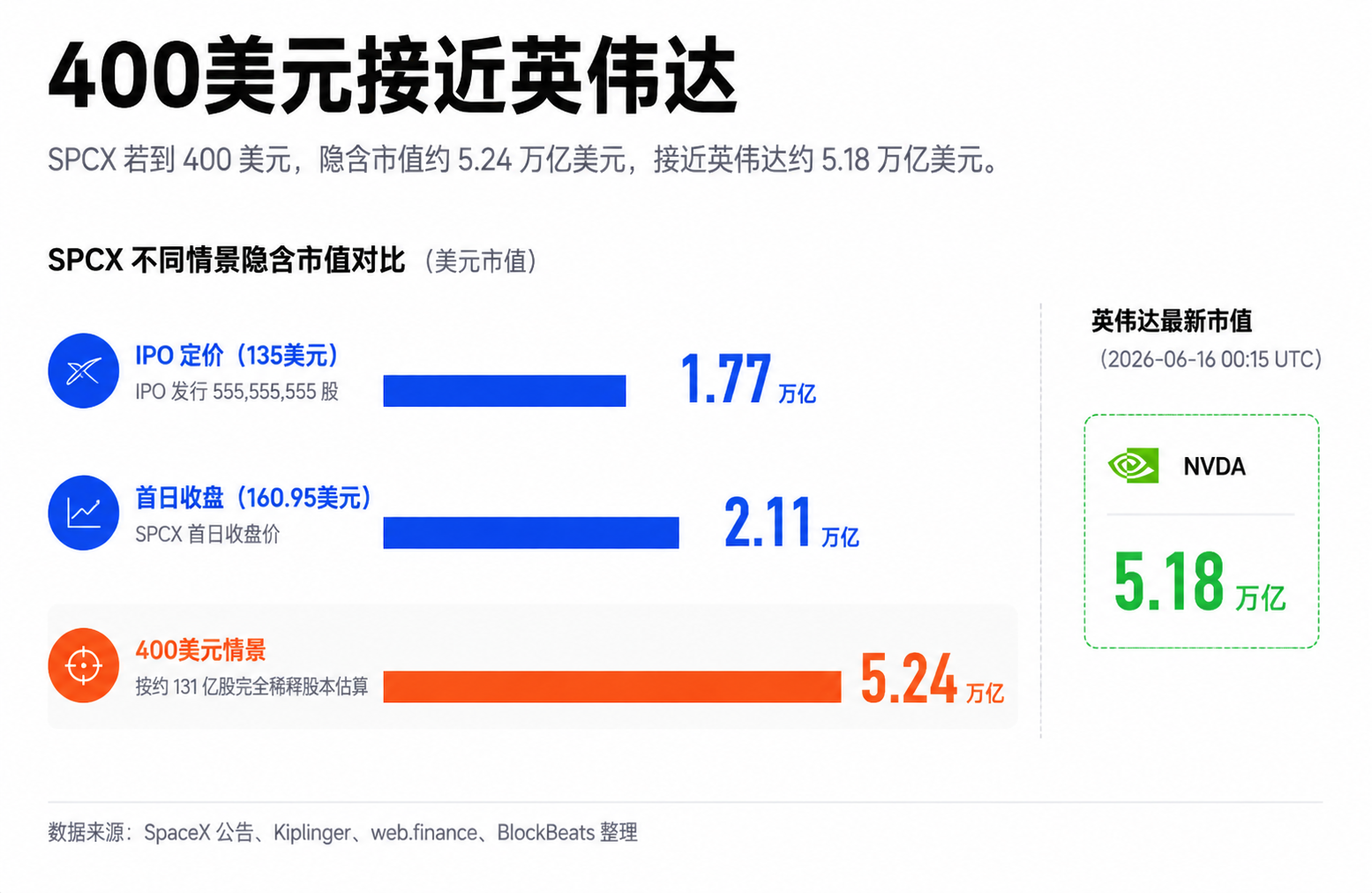
This is where the $400 narrative truly warrants discussion: the figure itself is exaggerated, but it points to a market structure that requires vigilance. ZeroHedge believes that the combination of SPCX's low float, retail buying, and the options listing could trigger an effective gamma squeeze. Based on an estimate of approximately 13.1 billion fully diluted shares, a $400 price would correspond to a market cap of about $5.2 trillion, bringing SpaceX very close to or briefly surpassing Nvidia.
Why Can SPCX Behave Like a Small-Cap Stock?
SPCX's uniqueness lies not in the small size of the company, but in the limited number of shares available for trading in the early stage.
Low float refers to the limited proportion of shares freely tradable in the market. Even if a company's total market cap is large, if only a small fraction of shares enter the secondary market at the start of listing, the short-term price will be more sensitive to buy orders. The pool is large, but the amount of 'tradable water' that can actually be scooped out is small.
This is also the difference between SPCX and stocks like Apple, Microsoft, and Nvidia. Mature large-cap stocks have huge free floats, institutional holdings, index fund allocations, market makers, and arbitrage funds. Moving the market cap of such a stock by hundreds of billions of dollars in a single day requires massive capital and broader consensus.
SPCX is in the early stage of its listing. SpaceX's official announcement confirmed the IPO share count and overallotment arrangements, but relative to the company's overall valuation, the initial public float remains low. The combination of low float and the Musk narrative will make the stock price behave more like a new stock concentrated by capital flows in the short term, rather than a mature mega-cap stock.
This also explains why the after-hours price is closely watched by the market. After-hours trading has worse liquidity and thinner order books. Once capital chases the same stock, price elasticity is amplified. After-hours quotes briefly approaching $230 indicate tight supply at that time, but do not directly prove that long-term capital has accepted this valuation.
The first layer of ZeroHedge's $400 projection is based here: if a trillion-dollar company trades in the short term like a low-float small-cap, it can experience price jumps that are rarely seen in normal large-cap stocks.
Options Listing Adds Leverage to Volatility
Options are important because they convert retail directional bets into passive hedging demand for market makers.
According to a Reuters report, SPCX options could begin trading as early as Tuesday, with Cboe expected to open them on Tuesday. The report cites market participants' expectations that early trading could be heavy and volatile, with premiums also being expensive.
For ordinary investors, this means SPCX is no longer just about buying the underlying stock. After options are listed, a large number of cheaper, higher-leverage, and riskier call options will appear in the market.
The easiest way to ignite sentiment is through out-of-the-money (OTM) call options, which are call contracts with a strike price higher than the current price. They are relatively cheap and more like lottery tickets. If the stock price surges quickly enough, the returns can be very high. If it doesn't rise, the options can quickly expire worthless. Retail investors typically favor such contracts on hot stocks because they allow betting on larger upside with smaller capital.
The core mechanism of a gamma squeeze occurs right here.
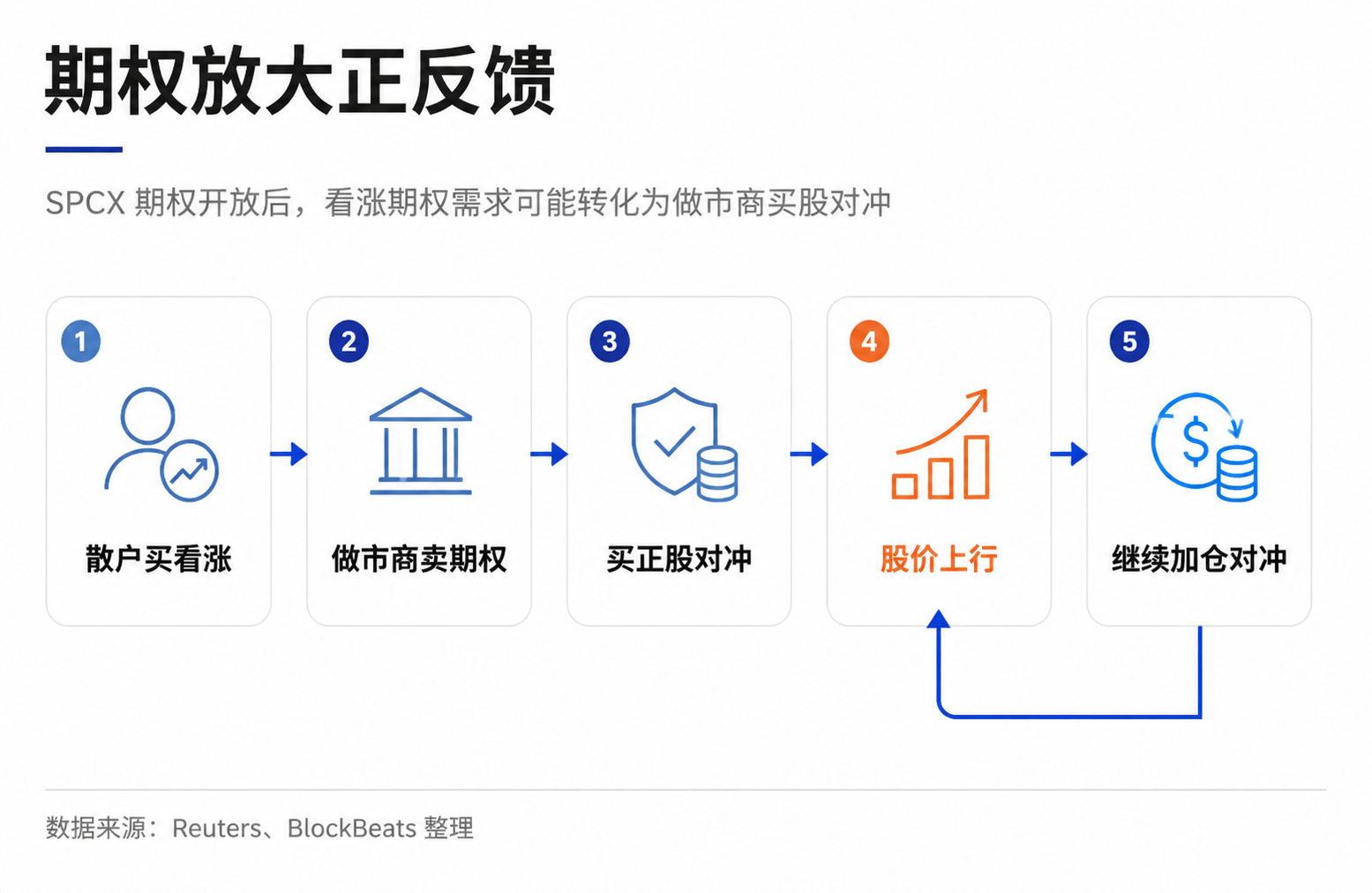
When a large number of investors buy call options, the party selling the options is usually the market maker. To control risk, market makers often need to buy some of the underlying stock to hedge. The more the stock price rises, the closer the option gets to being in-the-money, potentially requiring the market maker to buy more stock. This creates a positive feedback loop: retail buys calls, market makers buy stock, the rising stock price leads market makers to buy more to hedge, and the rise attracts even more buying.
Applied to SPCX, this mechanism has great speculative potential. It simultaneously possesses low float, a hot narrative, retail attention, an options listing window, and the significant price volatility seen in the early days of listing. ZeroHedge believes that if demand for OTM call options is sufficiently concentrated, market makers' hedging buying could push the stock price towards $400 in a short period.
Boundaries must also be clearly defined. The $400 figure is ZeroHedge's extreme upside scenario, not a baseline judgment independently derivable from current evidence. That options are about to open only indicates a new leverage channel has appeared. To prove a gamma squeeze is forming, we need to see the actual trading volume on day one and subsequent days, OTM call open interest, strike price distribution, implied volatility, and market makers' net gamma exposure.
What we can say now is that the machine has the conditions to start. What we cannot say is that the machine has definitely started.
Vanda Data Supports Crowded Trade, But Doesn't Equal Broad Mania
If one only looks at SPCX's price action, it's easy to conclude that retail investors are fully piling back into risk assets. However, Vanda's flow data provides a narrower interpretation.
According to ZeroHedge citing VandaTrack data, SPCX ranked first in retail net buying for the second consecutive trading day, with a single-day net purchase of approximately $93.8 million, accounting for about 73% of the total US single-stock retail net buying that day. This set of data has not been cross-verified through independent public channels and is better used as a reference for observing retail crowding rather than a multi-confirmed market fact.
Even so, this data still supports part of ZeroHedge's judgment: SPCX indeed exhibits a rare concentration of capital. For low-float stocks, concentrated buying alone is sufficient to significantly influence the price. If options trading further amplifies this directional betting, volatility could continue to widen.
However, this data also imposes constraints. While semiconductor stocks saw some modest inflows during the same period, it did not show a state of indiscriminate risk appetite spreading across the entire market. Short or inverse leveraged ETFs like SQQQ and SOXS still saw buying activity, indicating that retail investors are not broadly charging into risk assets, but concentrating their attention on the single SPCX narrative.
This distinction is very important.
If it were a broad expansion of risk appetite, SPCX's rise could be understood as part of broader market sentiment. If it's a single-asset crowded trade, the faster the price rises, the more fragile the position structure becomes. The more concentrated the capital, the stronger the short-term upward momentum, but once expectations are dashed, option premiums fall, or after-hours liquidity deteriorates, the reversal can be equally violent.
This is also the part most easily misinterpreted in comparisons of SPCX's market cap with Nvidia. Nvidia's valuation comes from sustained validation of AI chip revenue, data center demand, profit margins, and long-term growth expectations. SPCX' s current short-term trading is more driven by the initial listing's liquidity structure, the Musk narrative, and expectations of options leverage. Both can achieve high valuations, but the supporting mechanisms are different.
The $400 Target Awaits Option Chain Verification
The most important variable for SPCX going forward is not whether more people shout '$400' on social media, but what the options market actually looks like.
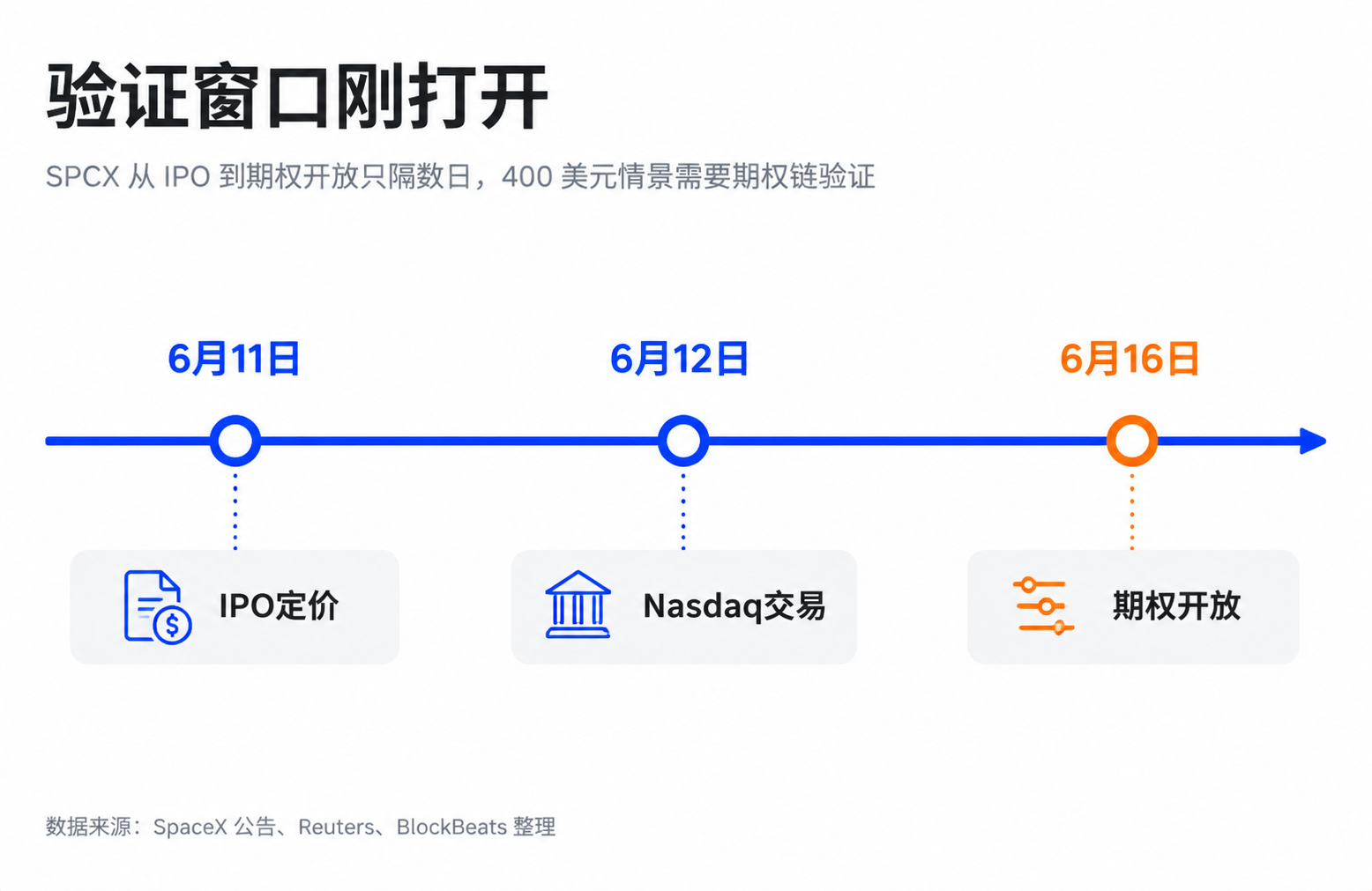
For ZeroHedge's extreme scenario to remain valid, we first need to see sufficiently concentrated trading and open interest in out-of-the-money (OTM) call options. Options listing and active trading alone are not enough. The key is whether buying is concentrated in call contracts above the current price and whether these contracts force market makers to continuously buy the underlying stock to hedge.
Implied volatility (IV) must also be monitored. When options first list, premiums can be expensive. For the buyer, even if the underlying stock continues to rise, if implied volatility falls quickly, option profits can be eroded. For market structure, high premiums can suppress subsequent chasing and may lead early buyers to take profits.
The absorption of buying in the underlying stock is equally important. Low float can amplify both upside and downside moves. After-hours high prices proved tight liquidity but do not prove that long-term capital is willing to continuously absorb supply. If option buying isn't as strong as expected, or if early profit-takers emerge, SPCX could also experience a negative feedback loop.
Finally, we return to the fundamental anchor. SpaceX's long-term story is not weak. Starlink, launch services, space infrastructure, and potential telecommunications synergies are all reasons the market is willing to assign a high valuation. However, moving from a valuation near $3 trillion to over $5 trillion in the short term looks more like an extrapolation of trading structure rather than a revaluation already confirmed by financial data.
In the coming days, what investors really need to watch is the strike price distribution on the option chain, OTM call open interest, changes in implied volatility, and whether there's genuine buying support for the underlying stock at high prices. Only when all these data points point in the same direction will ZeroHedge's $400 scenario shift from an extreme projection to a risk that the market must price in.


