






Avenir Group 下注 WasabiCard:为什么 U 卡退潮,稳定币支付反而更香了?


- 核心观点:稳定币支付竞争正从C端U卡产品转向B端底层基础设施,资本押注如WasabiCard这类提供发卡、API、清结算与合规能力的服务商,其增长可借企业客户扩量形成复利,行业格局或因此重塑。
- 关键要素:
- WasabiCard完成近1000万美元Pre-A轮融资,投资方包括李林家族办公室Avenir Group,累计融资近千万美元,聚焦全球发卡资源与合规体系建设。
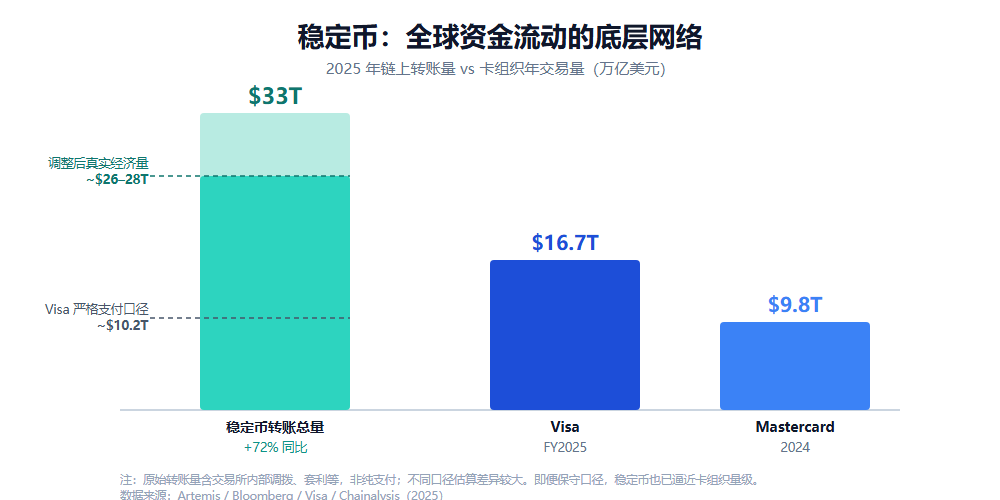
- Fireblocks报告显示,近九成机构已接触稳定币支付,其中49%用于支付场景,全球稳定币链上转账量达33万亿美元,同比增72%,超Visa与Mastercard总和。
- C端U卡模式(如RedotPay:600万用户、年交易额100亿美元)依赖外部发卡和合规合作,难以长期维持;B端基础设施(如BVNK:年处理额300亿美元)被Mastercard以18亿美元收购,显示更高护城河。
- WasabiCard已服务500多家企业客户、发卡超50万张、交易额突破10亿美元,支持多链接入,定位于“白标”全球发卡和支付API基础设施,主导B端 payout(41%最看重)与合规(34%)能力。
- 传统支付巨头加速布局:Stripe以11亿美元收购Bridge,Mastercard拟18亿美元收购BVNK,Visa计划扩展稳定币关联卡至100多国,表明基建是战略卡位关键。
Li Lin is placing another bet.
On June 3, 2026, WasabiCard, a global stablecoin payment infrastructure platform, completed its Pre-A funding round. Combined with earlier rounds, cumulative financing has approached nearly $10 million. Investors include Vernal Capital, Avenir Group, Vision Plus Capital, and 01VC. Among them, Avenir Group is Li Lin's family office.
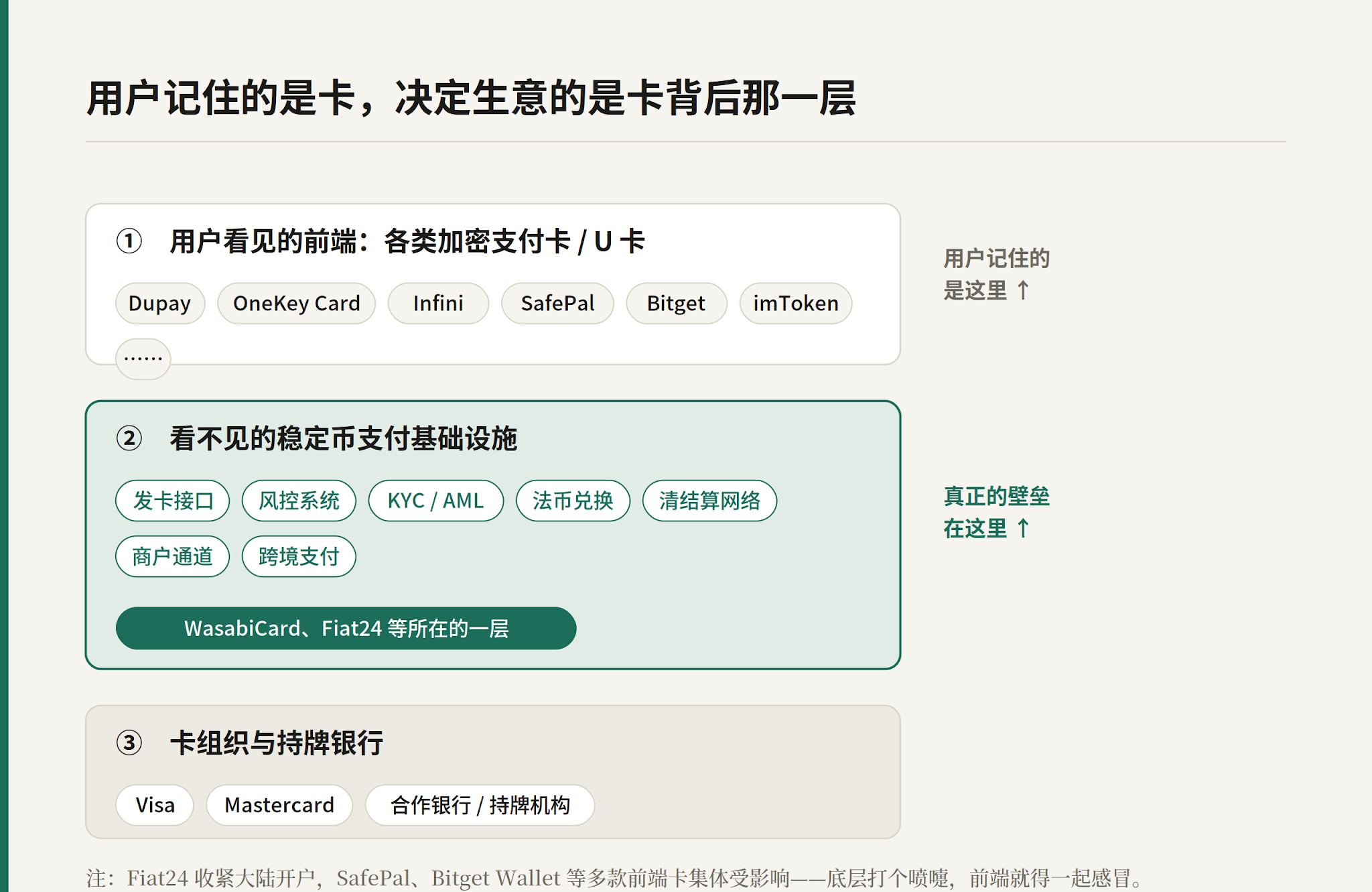
Interestingly, almost simultaneously, another piece of news swept through community groups: Fiat24 suspended new account applications in Mainland China. Meanwhile, several crypto payment card services familiar to Chinese users, such as SafePal and Bitget Wallet, have their card issuance capabilities tied to Fiat24.
On one hand, capital is betting on an "invisible" payment infrastructure company; on the other hand, a policy adjustment by an underlying service provider directly impacts several front-end card products. Viewed together at this point in time, this provides a new perspective for re-evaluating the stablecoin payment track.
And behind this perspective lies a rapidly expanding real-world demand.
1. The Ebb of U Cards: It’s the Model, Not the Demand
According to Fireblocks' "State of Stablecoins 2025" report, 49% of surveyed institutions already use stablecoins for payments, while another 41% are in testing or planning stages. This means nearly 90% of institutions are engaging with stablecoin payments in some form.
Demand is rising, but the way it is being met is changing.
As we know, for years, the most discussed form of stablecoin payments in the Chinese market was almost exclusively the "U Card": users transfer stablecoins like USDT or USDC into the card product for online subscriptions, consumption, or offline payments. This model is also the easiest for people to understand and adopt.
But the U Card is just the visible front end for users.
Behind every card lies a much more complex reality: issuing licenses, card network partnerships, KYC/AML compliance, risk control systems, stablecoin-to-fiat conversion, clearing and settlement networks, merchant channels, and cross-border payment capabilities. Users often only remember front-end brands like RedotPay, KAST, or Crypto.com, while institutions like WasabiCard remain largely unknown.
In fact, thanks precisely to infrastructure companies like WasabiCard, today, simply "issuing a card" is no longer a difficult task.
Project teams can outsource all the complex steps—stablecoin acceptance, quota allocation, card issuance, and consumption channels—to third-party service providers. They only need to apply their brand and complete the front-end launch. In a sense, this is a key reason U Card products proliferated so rapidly in recent years.
So, Fiat24 tightening account openings is just a trigger.
The real issue is that the widely proliferated consumer U Cards of the past few years are essentially a "light front-end, heavy external dependency" model. They outsourced the hardest parts and kept primarily the brand, user acquisition, and the user interface. While this solved the "how to spend your U" problem, it didn't solve the "how to run this business long-term, stably, and compliantly" problem.
The contraction and even withdrawal of several front-end card products over the past year have repeatedly shown that relying solely on front-end experience cannot sustain a payment business capable of weathering market cycles.
This point is crucial.

U Card products can be copied, subsidies can be matched, and users will quickly migrate based on fees, risk control, and usability. The truly difficult thing to replicate is the back-end capability:
- Can it maintain stable issuing and acquiring partnerships across multiple markets?
- Can it handle identity verification and anti-money laundering requirements in different jurisdictions?
- Can it maintain consistency in fund flow and information flow across stablecoin top-ups, fiat conversion, card spending, and merchant settlements?
- Can it develop a mature enough risk control system for handling abnormal transactions, high-risk addresses, chargebacks, refunds, freezes, and compliance reviews?
This is the logical starting point for institutions like Avenir Group betting on WasabiCard – what they see isn't just another crypto card product, but a stablecoin payment business transitioning from "the card" to "the infrastructure."
2. Why Avenir Group is Betting on WasabiCard
The crypto market has seen no shortage of grand narratives in recent years.
From DeFi, NFTs, and GameFi to public chains, L2s, Restaking, and AI + Crypto, industry cycles are often driven by asset prices, token expectations, and liquidity expansion. However, payments have always been a somewhat different business. It’s less glamorous and harder to create extreme valuation imagination quickly, yet it is closer to real-world transaction needs.
Because whenever a transaction occurs, every specific step—payment, currency exchange, card issuance, settlement, acquiring, and cross-border transfer—presents an opportunity to generate revenue.
The scale of this business is now impossible to ignore. Artemis data shows that in 2025, global stablecoin on-chain transfer volume reached $33 trillion, a 72% year-over-year increase, surpassing the combined volumes of Visa and Mastercard. Even after excluding non-payment uses like internal exchange transfers and arbitrage, the real economic volume is approaching the scale of traditional card networks.
Whether these fund flows ultimately correspond to trading, allocation, or settlement, it means stablecoins have become a crucial underlying network for global fund movement. But precisely because of this, for an on-chain USDT/USDC transfer to truly become a usable payment for businesses, salary for employees, acceptable settlement for merchants, or spendable card balance for users, a whole set of off-chain financial infrastructure is needed to support it.
This is the opportunity for companies like WasabiCard.
They focus on the "heavy lifting," such as connecting with card networks and issuing resources, building enterprise APIs, handling fund settlement, managing risk and compliance, and enabling business clients to embed stablecoin payment capabilities into their own operations. These tasks are unlike issuing a token, which can quickly grab market attention, but once proven, their capabilities offer much stronger reusability.

Because from a business model perspective, B2B infrastructure and C-end card products are fundamentally different types of businesses.
C-end card products require continuous user acquisition, subsidies, and education, while constantly facing user comparisons regarding fees, usability, and brand trust. In contrast, once a B2B payment infrastructure is integrated by exchanges, wallets, payment companies, or overseas expansion enterprises, it has the potential to benefit continuously from the clients' own transaction volume growth. The former is trapped in a cycle of acquiring users, while the latter more easily creates compounding effects.
More importantly, once a project integrates a specific payment API into its business, the switching cost becomes high, and the partnership is more likely to deepen based on transaction volume, settlement size, and business scale. This is the beauty of underlying infrastructure: It doesn't have to outrun everyone itself; as long as any of its clients achieves scale, it can share in the growth dividends.
Breaking this down explains why capital is more inclined to pay attention to the underlying layers:
- Payments are one of the easiest scenarios for stablecoins to generate real cash flow. Compared to Web3 narratives still reliant on token cycles and liquidity expectations, it's closer to real transaction demand. It's a business model driven less by market sentiment and more by transaction throughput and network scale;
- Service providers like WasabiCard already have operational and compliance foundations, having accumulated reusable capabilities through B-end client relationships and highly compliant systems. For investors, "has been integrated" is far more valuable than "plans to be integrated";
- Capital isn't buying a single product; it's buying a scalable infrastructure. Its growth can be "piggybacked" on the growth of its clients, rather than requiring new customer acquisition for every single transaction;
For investors, the ceiling of a single U Card product depends on how many end users it can capture and how frequently they spend. The potential of a stablecoin payment infrastructure, however, depends on how many enterprise clients it can serve, how many payment scenarios it covers, and whether it can become the universal capability layer behind more front-end products.
From this perspective, Avenir Group's investment in WasabiCard looks less like some authoritative endorsement and more like a seasoned, savvy crypto player making a directional bet on stablecoin payment infrastructure.
Where it points might be more important than the funding round itself.
3. Not Size, but Position: Where is the B-end Moat?
Of course, this doesn't mean the infrastructure model is inherently easier to succeed. In stablecoin payments, C-end cards and B-end infrastructure are distinct tracks. Comparing absolute scale is meaningless; the key is positioning and moat.
Take the benchmark on the C-end track, RedotPay. It boasts over 6 million users, covers more than 100 countries, processes an annualized transaction volume of approximately $10 billion, generates over $150 million in annual revenue, and has raised $194 million in total by 2025, reaching a valuation of over $1 billion.
It represents almost the pinnacle a U Card can reach. Yet, strikingly, even this champion relied on licensed entities like Reap for its card BIN, integrated with Fireblocks and Sumsub for compliance, and connected with Circle's network for cross-border payouts.
In other words, even the leading card sits on top of a layer of underlying infrastructure.
Now look at the "graduate" on the B-end track, BVNK. Processing over $30 billion in annual payment volume, covering 130+ countries, holding licenses like MiCA, it was ultimately acquired by Mastercard for up to $1.8 billion, becoming the largest stablecoin infrastructure acquisition to date.
It presents another possible endgame for this track: not competing for C-end users, but building deep underlying capabilities, continuously refining compliance, and eventually being integrated into a global network by a giant.
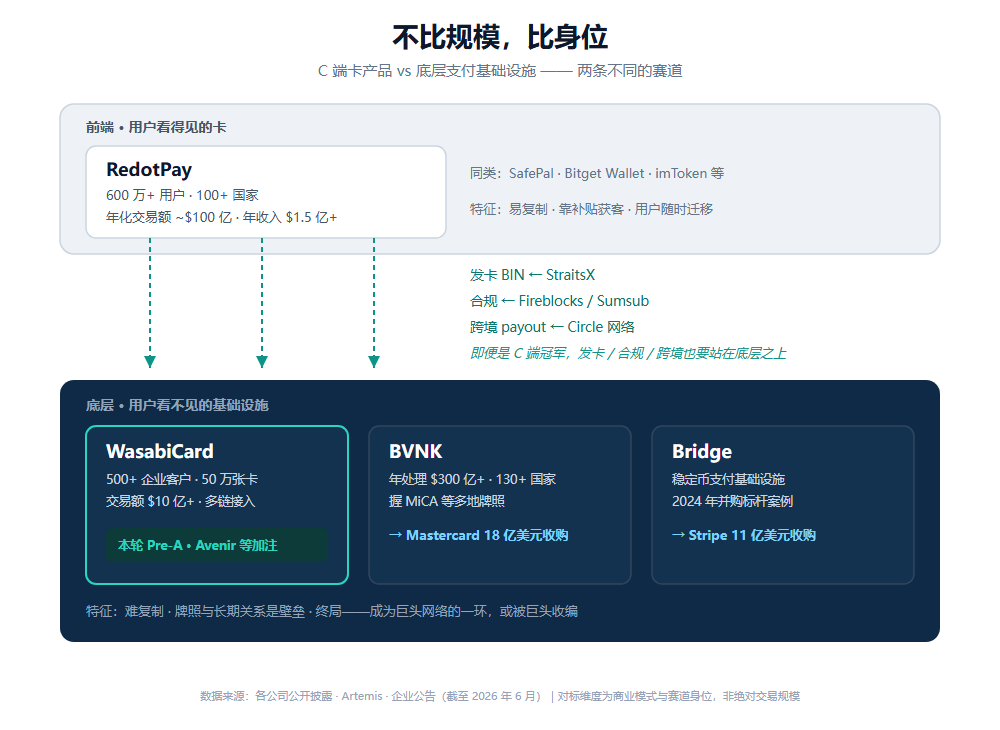
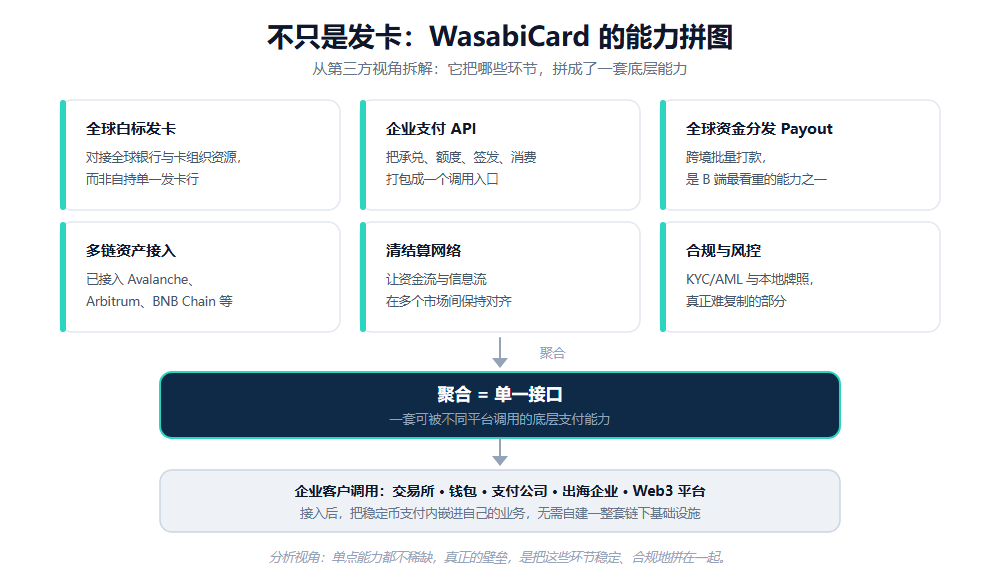
WasabiCard is also on this track. As of this funding round, it officially disclosed serving over 500 enterprise clients globally, issuing over 500,000 cards, processing over $1 billion in transaction volume, and completing integration with multiple chains like Avalanche, Arbitrum, and BNB Chain. It recently joined Circle's partner program.
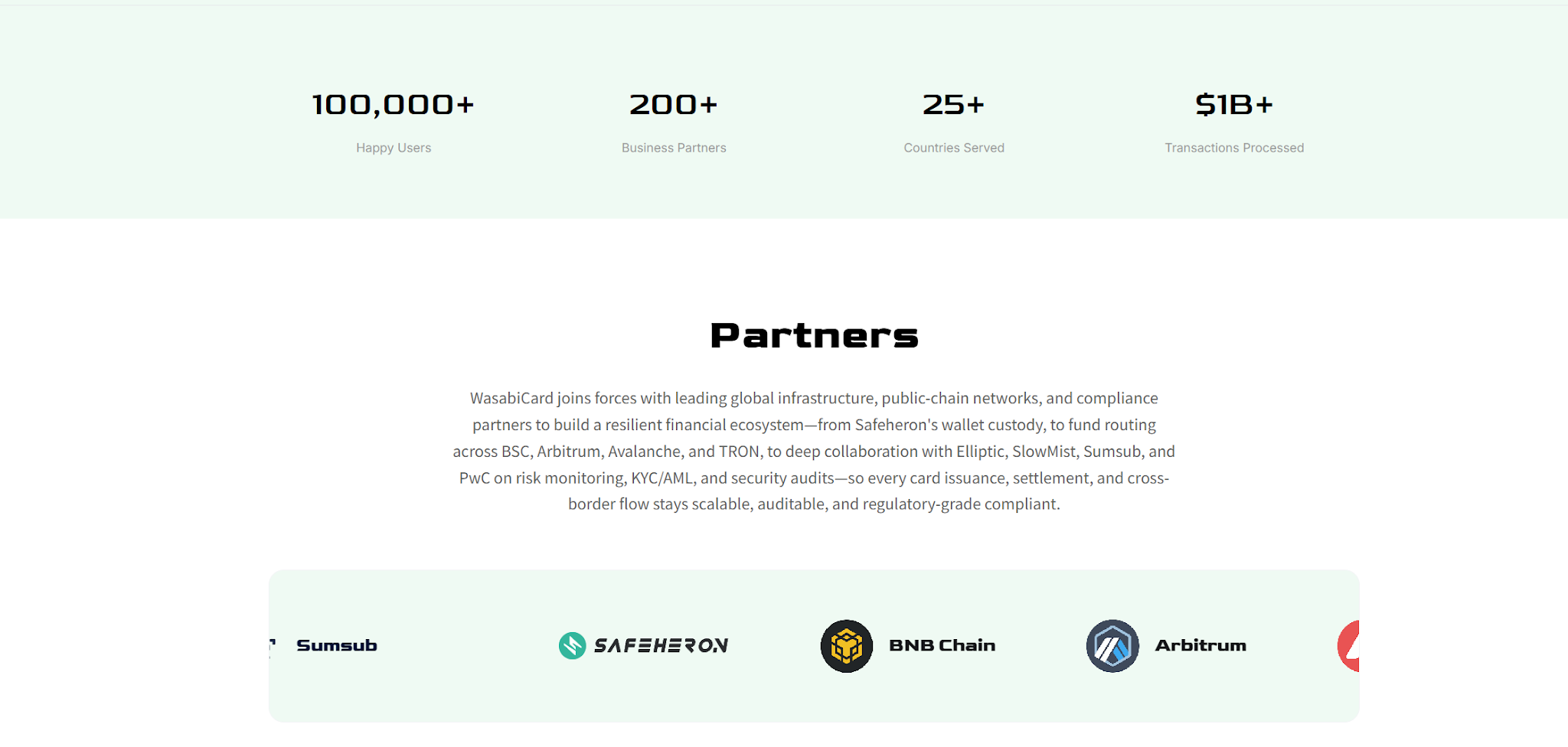
It aggregates card issuance, API, settlement, and payment capabilities into a single interface. Its key feature is a localization strategy partnering with banks in major global markets. It positions itself as an infrastructure company capable of offering global white-label card issuance, APIs, clearing & settlement, and payment capabilities "out of the box." This localization allows WasabiCard to leverage local banking capabilities to compliantly issue cards to local users worldwide. Consequently, its enterprise clients only need to integrate the API once to enable global card issuance.
More critically, based on public information, WasabiCard's focus isn't solely on consumer card issuance. It is continuously expanding global issuing resources, enterprise payment APIs, global fund disbursement (Payout) capabilities, multi-chain asset access, and compliance systems. This indicates it offers not a single payment product, but a foundational payment capability that can be invoked by different platforms and commercial scenarios.
So, where exactly is the moat for this capability layer?
The Fireblocks report provides evidence: when banks and payment institutions select stablecoin infrastructure providers, 41% prioritize "fast and reliable payouts," and 34% prioritize compliance. In short, payout and compliance are the two most valued factors in enterprise selection – precisely the elements that simply issuing a card cannot replace.
For representative B-end players like WasabiCard, this means proving not just that they can issue cards, but that they can serve as the stablecoin payment operating system behind different enterprise clients, catering to broader internet enterprises and cross-border commercial scenarios.
4. PayFi: The Time for the 'Infrastructure' to Be Seen Again?
If the most vibrant part of stablecoin payments in previous years was the U Card, the next phase might be more focused on PayFi infrastructure.
For a long time, PayFi was often oversimplified as "issuing cards" or "cashback rewards," making it look more like a consumer product track than a financial infrastructure track.
But in the last two years, the situation has been changing noticeably.
Financial infrastructure related to stablecoin issuance, payments, and settlement has become one of the few asset classes in the crypto industry capable of generating stable cash flow. Consequently, the PayFi track, which is tied to it, has attracted almost all types of players, from crypto-native projects, traditional payment giants, stablecoin issuers, and exchanges to specialized stablecoin public chains, all jockeying for position in their own ways.
The most telling signs are the consecutive moves by traditional payment giants:
- In October 2024, Stripe acquired the stablecoin infrastructure company Bridge for approximately $1.1 billion, considered one of the largest acquisitions in crypto at the time;
- A year and a half later, in March 2026, Mastercard announced its plan to acquire stablecoin infrastructure provider BVNK for up to $1.8 billion, paying about $700 million more than Stripe did, setting a new record;
- Around the same time, Visa expanded its partnership with Bridge (now under Stripe), planning to expand stablecoin-linked cards from 18 countries to over 100;
- Even earlier, PayPal had launched its own stablecoin, PYUSD;
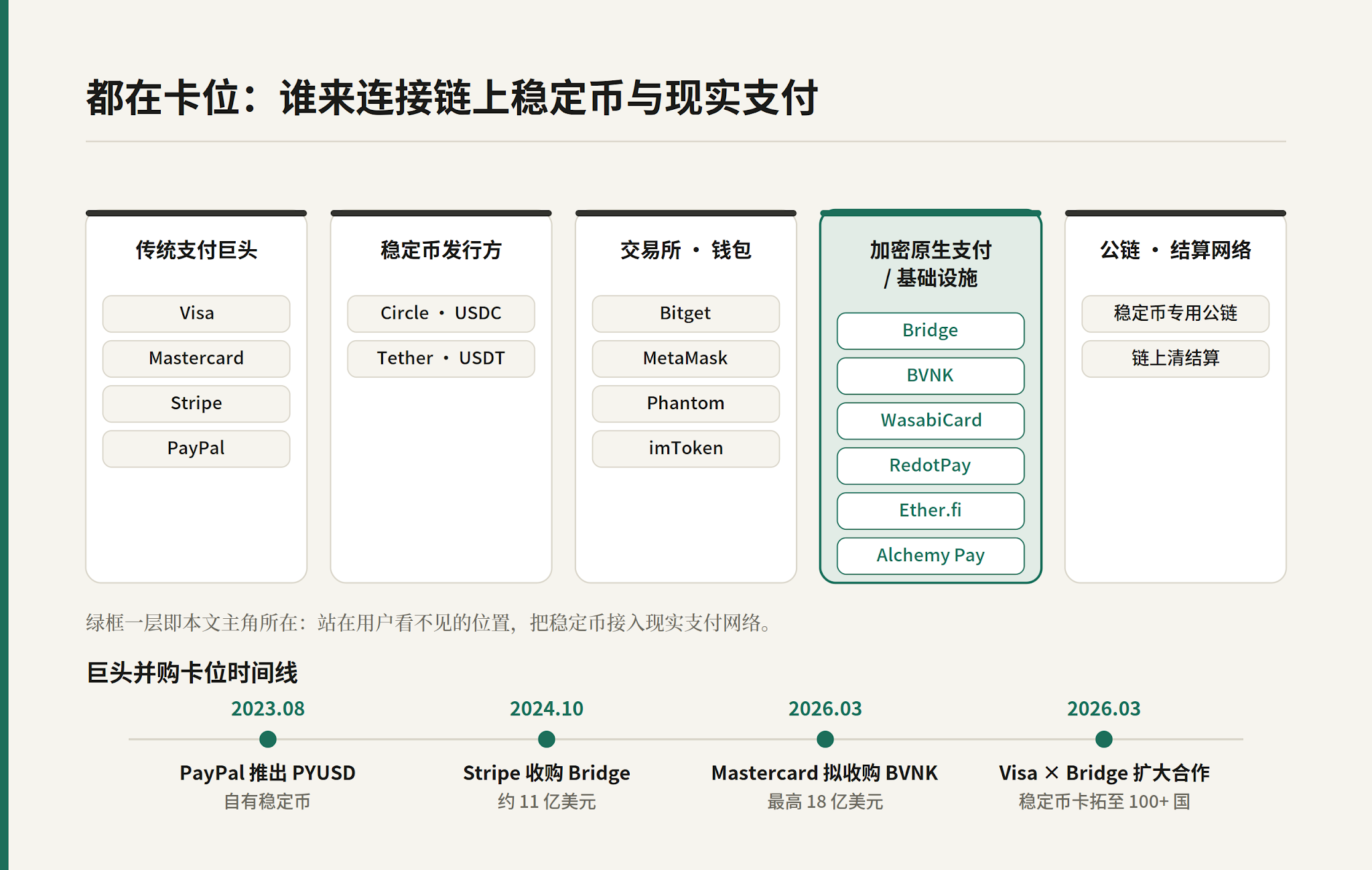
Putting these moves from payment giants, card networks, and large fintech companies on the same map reveals it's not an isolated bet on crypto payments by one company. It's a preemptive positioning by the entire payment industry around the stablecoin on-ramp.
Because stablecoins impact not just the payment experience, but also the deeper profit and power structures within the traditional financial system – it directly relates to who will control the accounts, cross-border channels, and even clearing and settlement in the new era. From this perspective, giants actively connecting on-chain accounts, stablecoin assets, and merchant payment terminals is less about embracing innovation and more about not wanting to be bypassed and left behind in the next restructuring of payment and settlement.
However, when giants start directly competing for the underlying infrastructure, the window for independent infrastructure players becomes sharply defined. They must either become an irreplaceable link in the giants' networks or grow into a network themselves. After all, regulation and licensing, KYC/AML, card network partnerships, and localized compliance – these are precisely the hardest parts for C-end U Card products, which grew on user traffic and subsidies, to sustain in the long run.
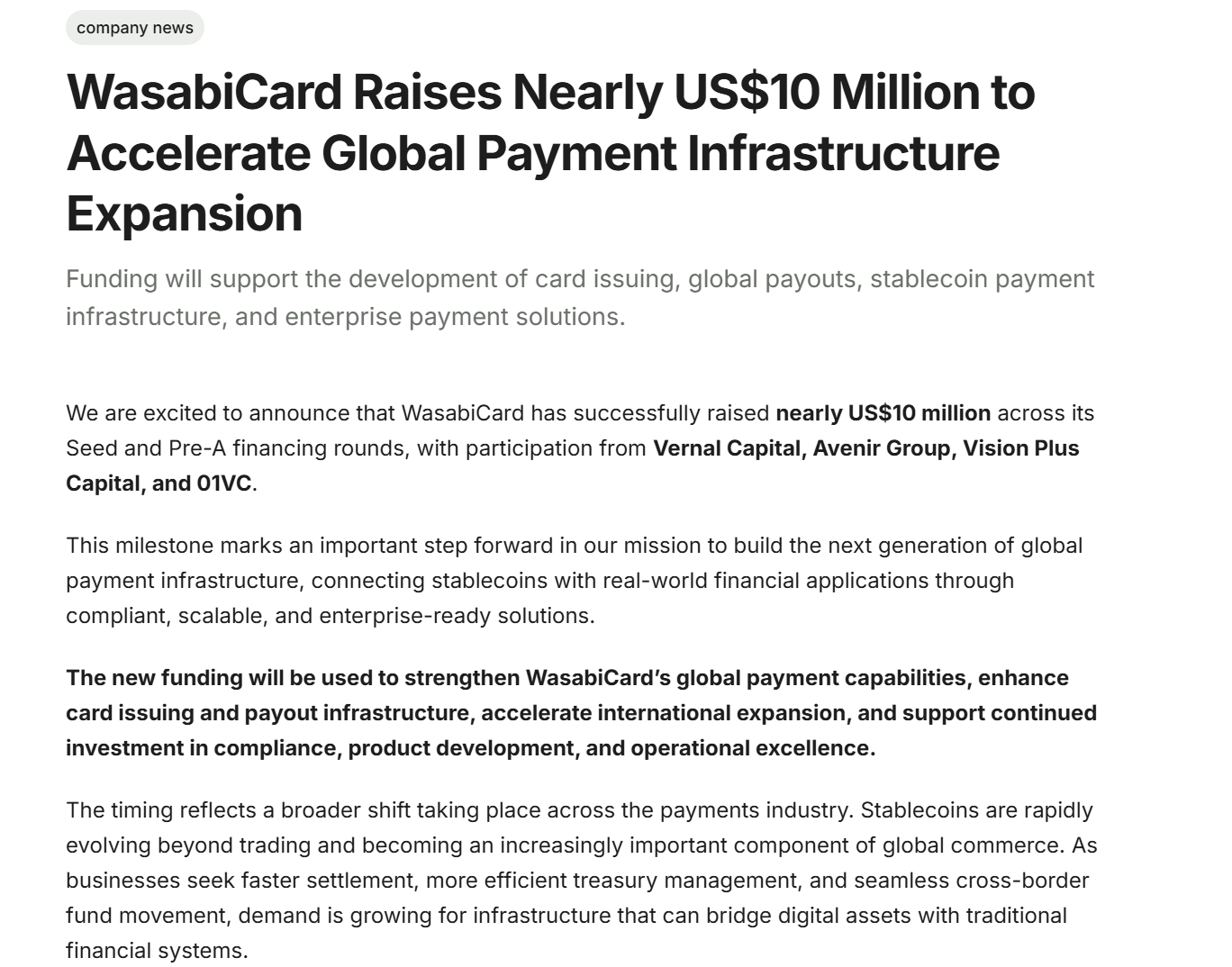
This explains why companies like WasabiCard plan to use this round of funding primarily for global compliance system development, multi-banking network connections, and core clearing and settlement system upgrades. These directions aren't glamorous, but they are exactly the underlying capabilities that must be built when stablecoin payments evolve from a user product into financial infrastructure.
Looking further ahead, PayFi's potential could even extend to AI Agent payments. If AI agents truly start representing users in automated transactions, then payment infrastructure cannot be designed solely around "humans." Machines will also need callable accounts, verifiable authorizations, controllable quotas, auditable transaction records, and the ability to execute high-frequency micro-payments automatically within compliance boundaries.
This could make the ultimate goal for stablecoin payment infrastructure more complex. Of course, this remains a longer-term vision.
But it at least shows that the value boundary of stablecoin payments extends far beyond a single U Card.
Final Thoughts
Crypto payment cards are undoubtedly a good business.
They connect stablecoins with real-world spending, allowing users to intuitively feel for the first time that "U can be spent." This is precisely why U Cards broke out so quickly in the Chinese market, becoming the most easily understood entry point to PayFi for ordinary users.
But the biggest gains may not lie with the card itself.
In the past, the market tended to remember a specific card, an app, a cashback campaign, or a low-fee entry point. However, as stablecoins enter larger-scale real-world business scenarios, what truly determines the long-term structure of the


