






韩三大交易所被TradFi入股:韩国加密市场正在被「收编」?


- 核心观点:韩国严格的金融监管下,仅5家持牌交易所掌控法币出入金通道,使其成为连接零售储蓄与数字资产的战略管道。传统金融机构正加速入股这些交易所,以获取合规资质与用户基础,抢占即将全面落地的《数字资产基本法》市场先机。
- 关键要素:
- 韩国监管要求法币出入金必须通过实名银行账户与仅有的5家持牌CEX完成,交易所成为唯一入口。
- 「金融与加密分离」原则下,传统金融机构被禁止直接开展加密业务,收购交易所成为最快的合规路径。
- Mirae Asset以约9200万美元收购Korbit 92.06%股权,旨在押注牌照与托管能力而非交易量。
- Hana Financial以6.67亿美元收购Dunamu(Upbit运营方)6.55%股权,为传统银行与数字资产公司的首笔重大交易。
- OKX Ventures与韩国投资证券各出资约5300万美元,共同获得Coinone 19.6%股权,策略性避开20%持股上限。
- 《数字资产基本法》预计将单一股东持股上限设为20%,促使传统金融与时间赛跑,加速股权收购。
- 交易量的低迷对收购方无关紧要,因为合法受保护的出入金管道价值是结构性的,而非周期性的。
Original Author: @xparadigms
Original Translation: AididiaoJP, Foresight News
In Asia, the role of centralized exchanges (CEXs) differs significantly from that in the West. Retail traders rely more on exchanges rather than managing their own assets through non-custodial wallets. This dependency is most extreme in South Korea, where regulations strictly limit fiat on-ramp and off-ramp channels to just five licensed CEXs.
CEXs: The Sole Gateway for Korean Users to the Crypto World
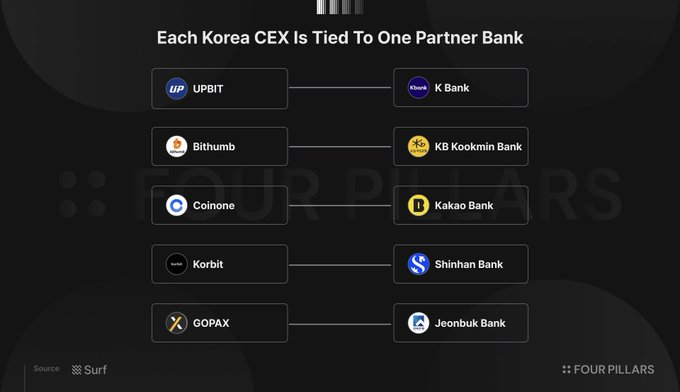
Exchanging Korean Won for cryptocurrency, and vice versa, must go through a tightly controlled channel: a user's CEX account must be linked to a bank account under their real name, with each exchange partnered exclusively with one designated bank.
Since the Financial Supervisory Service (FSC) implemented the real-name system on January 30, 2018, deposits and withdrawals are only possible between a bank account and an exchange account under the same bank name. Third-party transfers are prohibited, anonymous virtual accounts are not allowed, and initially, foreigners and minors were barred from participating.
All Virtual Asset Service Providers (VASPs) must first register with the Korea Financial Intelligence Unit (KoFIU) to operate in South Korea. Registration itself requires obtaining ISMS information security certification from the Korea Internet & Security Agency (KISA) and establishing a complete Anti-Money Laundering (AML) system. However, even passing this stage only permits crypto-to-crypto trading.
To open a Korean Won market, an exchange must also secure a "real-name bank partnership contract." Banks bear the compliance risks of these contracts, making them extremely cautious in issuing them. Consequently, the vast majority of registered VASPs are still limited to crypto-to-crypto trading. Ultimately, only five exchanges have crossed both hurdles—"VASP registration" and "real-name bank contract"—allowing them to offer fiat-to-crypto exchange services. Each exchange is locked into a single partner bank.
Traditional Finance Taking Equity Stakes in CEXs at the Cycle Bottom
For years, Korean crypto exchanges and traditional financial institutions existed in separate worlds, divided by the regulatory principle of "Separation of Finance and Crypto" (금가분리). Although not fully enshrined in law, this principle was strictly enforced by financial authorities, effectively prohibiting banks and securities firms from engaging in crypto businesses.
In 2026, this line began to blur. Within about four months, three of the four largest exchanges in South Korea brought in significant traditional financial shareholders.
Now, exchanges are no longer seen merely as machines generating trading fees. They are viewed as customer gateways and liquidity venues for the next phase of Korean finance—including Korean Won stablecoins, custody services, and RWA products. For banks or securities firms, directly purchasing equity is the fastest way to acquire VASP licenses, an existing user base, and deep Korean Won liquidity, positioning themselves before the full implementation of the Digital Asset Basic Act (DABA).
This race is also a race against time. The FSC is expected to set a 20% cap on a single major shareholder's stake in a crypto exchange under DABA (agreed upon on March 3, 2026). Two major transactions have occurred in the past four months, and the key event to watch in the second half of the year is whether the merger between Upbit and Naver Financial will ultimately be completed.
Case 1: Korbit & Mirae Asset, The First Mover (February 2026)
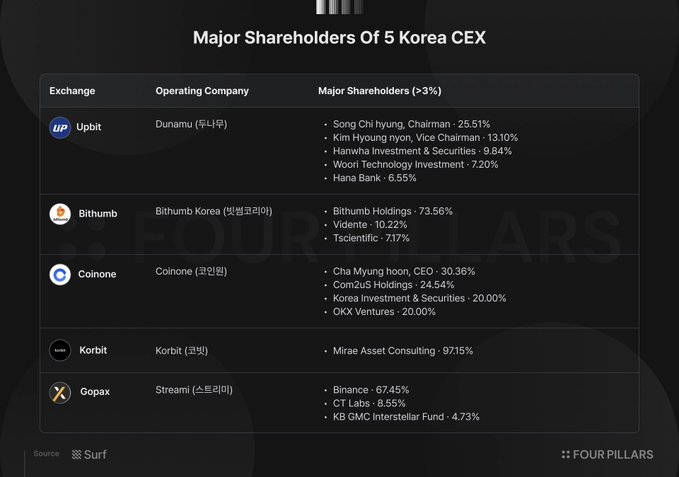
Mirae Asset, South Korea's largest securities firm, acquired a 92.06% stake in Korbit for approximately $92 million, buying out shares from NXC and SK Square. It also announced plans to acquire an additional 5.42%, eventually reaching a 97.15% stake. Given Korbit's market share of only about 1%, this deal appeared more focused on betting on its license, custody capabilities, and operational experience, rather than trading volume.
Case 2: Upbit & Hana Financial, The Largest and Most Symbolic Deal (May 2026)
Hana Financial Group agreed to acquire a 6.55% stake in Dunamu (Upbit's operating entity) from Kakao Investment for approximately $667 million. This marked the first major equity transaction between a traditional Korean banking group and a digital asset company.
Case 3: Coinone, OKX Ventures & Korea Investment & Securities (May 2026)
OKX Ventures and Korea Investment & Securities (KIS) each invested approximately $53 million to jointly acquire a 19.6% stake in Coinone, Korea's third-largest exchange. The two parties deliberately split their shareholdings to circumvent the expected 20% cap while allowing the CEO to retain management control.
The Crypto Market Is Too Big to Ignore
What traditional finance is truly buying is not a stream of trading fees, but rather the Korean Won-denominated fiat on-ramp and off-ramp pipelines themselves. In a market where only five licensed CEXs can convert Korean Won into cryptocurrency, owning equity in an exchange means owning the conduit connecting Korean retail savings to digital assets.
From this perspective, low trading volumes are almost irrelevant to the acquirers—the value of a legally protected channel is structural, not cyclical.
Acquisitions are also the fastest path to "getting a license." Applying for VASP registration from scratch and securing a real-name bank contract would take a bank or securities firm years, with absolutely no guarantee that regulators and the partner bank would ultimately approve.
The number of available acquisition targets is also dwindling. Korbit has been taken, Coinone is in play, and Upbit and Bithumb are too large and may face a 20% ownership cap under the expected DABA rules. It is foreseeable that valuations in subsequent deals will appear unreasonable based on fee metrics, but entirely logical as strategic options on Korean Won fiat gateways.
Now, crypto is simply too big for traditional financial companies to ignore.


