






Polymarket launches testing, Kalshi receives approval – prediction market duopoly enters perpetual contracts


- Key Insight: Prediction market platforms Polymarket and Kalshi are simultaneously entering the perpetual contract space. Through product testing and regulatory approval respectively, they are expanding their business from event trading into more standardized derivatives markets, marking a shift in their transformation into exchange models.
- Key Elements:
- Polymarket's perpetual contract Beta version has been opened for testing to a select group of users, with plans to gradually expand access over the next 4 weeks. The current phase focuses on product stability and user experience optimization.
- Kalshi has received approval from the US CFTC to list the Bitcoin perpetual contract BTCPERP, becoming the first US regulated exchange to bring such a product within a compliant framework, marking a significant milestone.
- Polymarket faces challenges such as liquidity and trading latency. Furthermore, the high leverage and liquidation mechanisms introduced by perpetual contracts pose learning and loss risks for prediction market users.
- While Kalshi's compliant pathway offers regulatory certainty, its expansion speed is constrained by the pace of regulation, making it difficult to rapidly roll out a large number of trading pairs like offshore exchanges.
- The core test for both pathways lies in their ability to convert event trading flow into perpetual contract trading flow and compete with established trading platforms like Hyperliquid and Binance.
Original: Odaily (@OdailyChina)
Author: Asher (@Asher_0210)

Prediction markets are venturing into perpetual contracts, finally moving from official announcements to concrete implementation.
Last week, both Polymarket and Kalshi saw key developments. Polymarket opened its Perpetuals Beta to a select group of users for testing, with plans to gradually expand access over the next four weeks. Meanwhile, Kalshi received approval from the CFTC to list a Bitcoin perpetual contract, BTCPERP.
In fact, Odaily has previously discussed this trend in articles like "Polymarket and Kalshi Move into Perpetuals, While Exchanges Eye Prediction Markets" and "What Does the US Government's First Approval of Crypto Perpetuals Mean for the Market?", analyzing how prediction market platforms are expanding into perpetuals and exchanges are moving into event trading, blurring the lines between the two.
Now, both directions have clearer focal points. One is starting with small-scale product testing; the other is securing regulatory approval first. The paths differ, but the signal is the same: prediction market platforms are no longer content with event trading alone; they are beginning to move into higher-frequency, more standardized derivatives markets.
Polymarket Opens Perpetuals Beta, Gradual Expansion Over Next 4 Weeks
Polymarket Officially Launches Beta Test
Last week, Josh Stevens, VP of DeFi Engineering at Polymarket, announced on X that the Polymarket Perps Beta is now live on polymarket.com for some users and will be rolled out more broadly over the next four weeks. He later added that some users who had previously applied were added to the test list via DM, and a few more slots might be opened, but no new testers will be added for now.
Currently, Polymarket has not disclosed the full list of supported trading pairs, leverage limits, margin rules, or funding rate mechanisms for Perps. This suggests that the Beta is more of a small-scale product test than a full-scale public launch. Polymarket's immediate priority isn't short-term trading volume but ensuring that this new trading feature runs smoothly and stably.
This is evident from Josh Stevens's comments. When recruiting test users, he asked for feedback on what they "didn't like" and what UI improvements could be made. In other words, Polymarket is currently focused on order flow, position display, mobile responsiveness, and overall user interaction. For a feature as close to an exchange as perpetuals, product experience is the first hurdle.
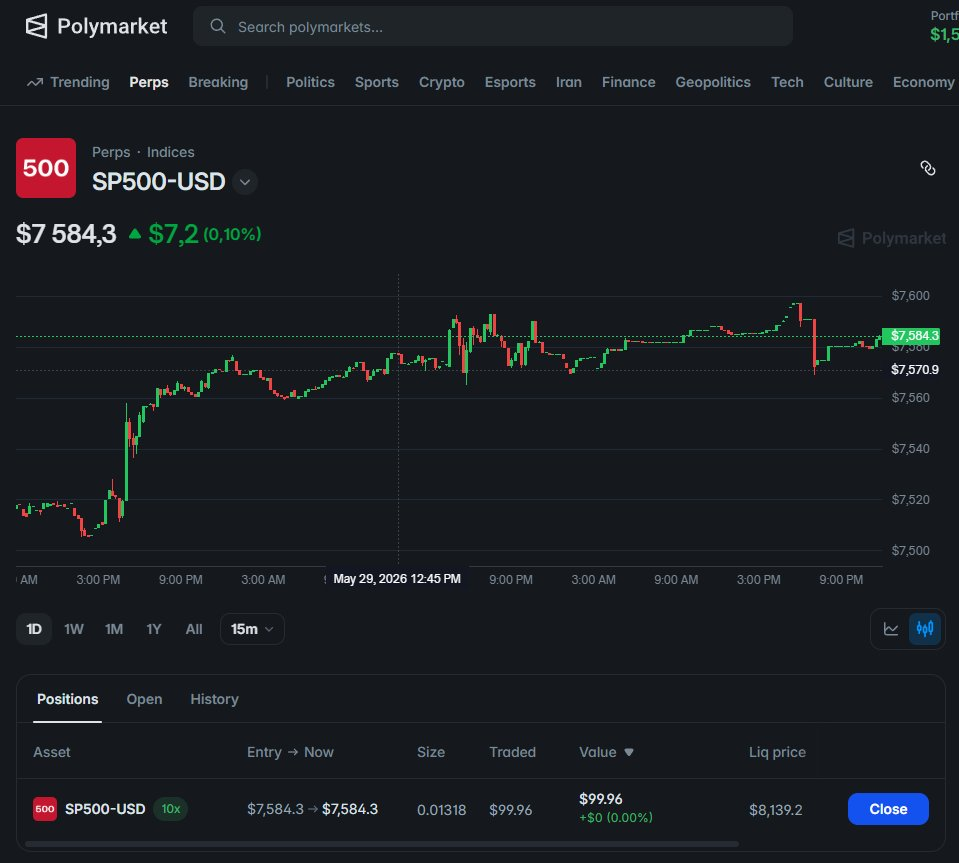
Based on feedback from some test users on X, the Polymarket Perps Beta already supports basic position opening. Some users mentioned opening long BTC leveraged positions in the test interface, and screenshots show assets like crypto and indices as underlying instruments. However, these are still early-stage feedback; the final list of trading pairs and specific features await official confirmation.
Early Feedback Focuses on Access, Liquidity, and Trading Experience
In early feedback, the most common issues raised by users were test eligibility and KYC requirements. The Beta is only open to a limited group. Early applicants needed to apply via X DMs, and some testers had to complete KYC verification. While there is some community talk that restrictions might be eased for the official version, issues like "needing verification," "not getting early access," and "whether this affects future airdrops or points" have already caused some user dissatisfaction.
A more fundamental concern is liquidity. Opening a position is just the beginning. The real test of a perpetuals exchange is order book depth, slippage control, and trade execution stability during volatile markets. Some community members rightly point out that Perp liquidity is the real challenge.
Another issue is user habits. Polymarket's core users are accustomed to binary event contracts—buying Yes or No and waiting for settlement. Perps introduce leverage, liquidation, funding rates, and continuous position management. While these mechanics are familiar to professional traders, they represent a significant learning curve and higher risk of loss for the large number of users coming from prediction markets.
Furthermore, Polymarket has faced past criticisms regarding latency, order lag, and ghost fills. Some users worry that similar issues in the Perps environment would have a greater impact than in regular prediction markets. A few seconds of delay in a prediction market might mean missing a better price; in high-leverage trading, delays, abnormal fills, or unstable position displays can directly impact profit and loss.
Therefore, Polymarket Perps is currently in a磨合 phase. On one hand, early test feedback isn't overwhelmingly negative; many users appreciate the clean interface and straightforward functionality. On the other hand, access barriers, liquidity, leverage risks, and trading stability are all problems that must be solved before a full launch.
Kalshi Opens Perpetuals Door with Regulatory License
Unlike Polymarket's small-scale testing, Kalshi's progress is more directly on the regulatory front.
On May 29, the US CFTC approved Kalshi to list a Bitcoin perpetual contract, which will reference the spot price of Bitcoin and be traded as a futures product. According to the announcement, after reviewing the product under Section 5c(c)(4) of the Commodity Exchange Act and Regulation 40.3, the CFTC determined that BTCPERP complies with relevant regulations and core principles applicable to Designated Contract Markets (DCMs).
The significance of this step goes beyond Kalshi adding a BTC contract. It represents placing a product primarily found on offshore exchanges and crypto-native platforms within the framework of a regulated US exchange. Perpetuals are one of the highest-volume and most familiar derivatives in the crypto market, but such products have long been absent from the US regulated market. Kalshi's approval has now opened a door for a "US-compliant crypto perpetual."
This aligns with Kalshi's established strategy. Rather than using aggressive products to attract users first and then addressing regulation later, Kalshi first secures regulatory approval and then uses its compliant status to expand its trading categories. Previously, Kalshi used its DCM status to package event contracts on politics, economics, weather, and sports as regulated financial products. Now, it is replicating this path for crypto perpetuals. In other words, Kalshi aims to be more than just a prediction market; it's becoming a broader compliant derivatives exchange.
However, the regulatory green light also means clearer boundaries. While approving BTCPERP, the CFTC also noted that perpetual contracts are not suitable for all asset classes, and market participants must submit new products for review under Regulation 40.3. This means Kalshi can leverage regulatory certainty to build an advantage, but it will find it difficult to rapidly list numerous trading pairs like offshore exchanges or crypto-native platforms. Its expansion will be slower and more influenced by the regulatory pace.
This highlights the key difference between Kalshi and Polymarket. Polymarket seems to validate market demand first, then gradually navigate regulatory boundaries. Kalshi secures regulatory space first, then uses that certainty to expand products. The former's advantages lie in crypto-native traffic and product speed; the latter's strengths are its US compliance status and institutional narrative.
Therefore, the approval of BTCPERP isn't simply Kalshi adding a new trading product. It signals a transformation in Kalshi's identity. Kalshi is moving from a "prediction market platform" closer to being a "regulated derivatives exchange."
The Real Test Begins After Entering the Perpetuals Arena
Both Polymarket and Kalshi pushing into perpetuals simultaneously isn't just about adding a feature to a prediction market. It's fundamentally about pushing their business boundaries further towards exchanges.
Prediction markets themselves are not short of trading scenarios. Elections, sports, macroeconomic data, crypto prices, corporate events, and breaking news can all be packaged as tradable markets. Polymarket and Kalshi have already proven event trading is a profitable business. But perpetuals open up another layer of growth: they are more standardized and better suited to attract capital and trading habits from mature traders. Platforms are adding Perps not because prediction markets aren't profitable, but because they want to build another, more mature derivatives business alongside event trading.
However, this path won't be easy. By entering the perpetuals space, Polymarket and Kalshi face competition not just from other prediction markets, but from established crypto trading platforms like Hyperliquid, Binance, OKX, and Bybit. Users will directly compare liquidity, slippage, matching engine stability, leverage experience, and risk management capabilities. The brand and traffic of a prediction market won't automatically translate into competitiveness in contract trading.
So, the real test for perpetuals isn't whether platforms can list more new trading pairs, but whether they can convert event-driven traffic into trading flow. Only when users are willing to trade volatility and manage positions on these platforms long-term, not just for major events, will these prediction market platforms truly grasp the essence of the exchange business.


