






Tiger Research: In-Depth Analysis of Circle’s Financial Report, Where Is the Next Phase of Crypto Heading?


- Core Thesis: Circle is transitioning from a stablecoin issuer reliant on USDC reserve interest into a comprehensive infrastructure operator centered on its own L1 network Arc, payment network CPN, and AI payment stack Agent Stack. The goal is to diversify revenue streams and reduce dependence on interest rates.
- Key Elements:
- Q1 2026 revenue reached $694 million (up 20% YoY), with the RLDC profit margin hitting a record high of 41.4%, mainly due to the share of USDC usage on its own platforms surging to 17.2%, lowering the cost of revenue sharing with external platforms.
- Core business remains highly concentrated: USDC reserve interest accounts for 94% of total revenue. Net profit fell 15% YoY to $55 million, primarily impacted by increased equity incentive amortization post-IPO and higher R&D spending on Arc.
- Through a partnership with DEX platform Hyperliquid, USDC has been registered as a formal trading pair. It is expected that over the next three years, this platform can help drive circulating supply from $77 billion to $84 billion, sacrificing margins for scale.
- Its proprietary L1 network, Arc, is scheduled to launch its mainnet this summer. The core goal is to generate infrastructure fee income based on the CPN payment network and on-chain FX engine StableFX, severing direct reliance on interest rates.
- For the AI agent economy, Circle has launched Agent Stack, supporting micropayments (as low as $0.000001) and zero gas fee settlement. Full commercialization is not expected until after the GENIUS Act takes effect in 2028.
This report was prepared by Tiger Research. Circle has released its Q1 2026 financial results. Interest income from USDC reserves still accounts for over 90% of total revenue. To break away from this highly concentrated structure, Circle is advancing initiatives including the Ark network. What lies ahead in the next phase?
Executive Summary
- Using Q1 2026 results as an inflection point, Circle is accelerating its paradigm transformation – from a pure stablecoin issuer to a comprehensive infrastructure operator for the digital asset industry. Its forward-looking business strategy revolves around three core pillars.
- Maximize USDC Profitability and Circulation: Reserve interest accumulates both on external platforms and proprietary platforms. This quarter, increased usage of USDC on Circle's proprietary channels (CPN) pushed the RLDC margin to a historic high of 41.4%. To scale issuance, Circle partnered with DEX platform Hyperliquid.
- Launch Proprietary L1 Network "Arc" to Diversify Gas and Fee Revenue: Currently, 94% of Circle's revenue comes from USDC reserve interest. Once Arc expands Circle's platform business and generates platform fee income, the structural over-reliance on reserve interest will be fundamentally addressed.
- Capture the AI Payment Gateway via Agent Stack: Circle is vying for the standard-setting power in autonomous micro-payments between AI agents. With infrastructure development progress and the enactment timeline of the GENIUS Act as benchmarks, full commercialization is targeted for 2028.
In summary, Circle's near-term focus is aggressively expanding USDC issuance volume via anchor platforms like Hyperliquid, while vertically integrating its financial stack around its own L1 (Arc), payment network (CPN), and AI nano-payments (Agent Stack). The key is the self-reinforcing positive cycle between USDC circulation growth and infrastructure diversification.
Circle is transforming from a pure interest-income business into a platform business driven by transaction volume and fees.
Q1 2026 Review: Margins Are Recovering
1. Revenue Growth and Margin Improvement – Proprietary Platform Share Enhances Profit Quality
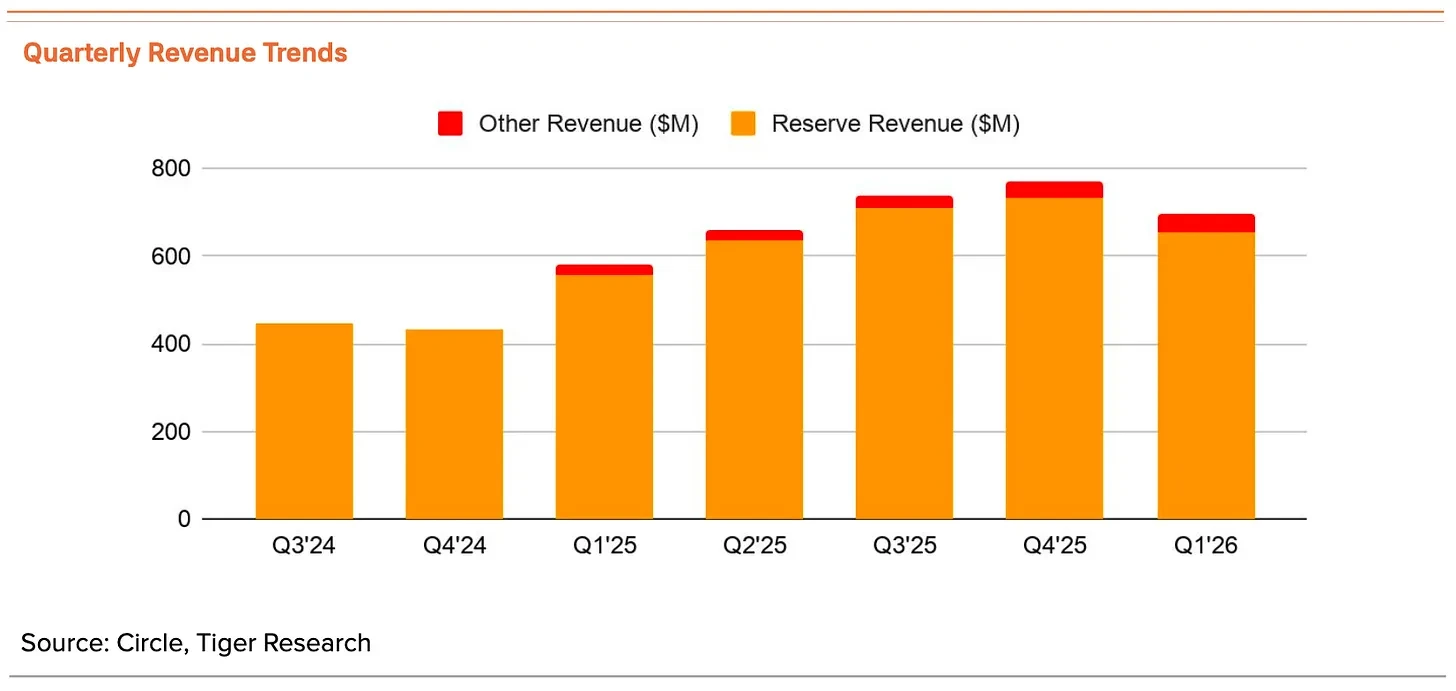
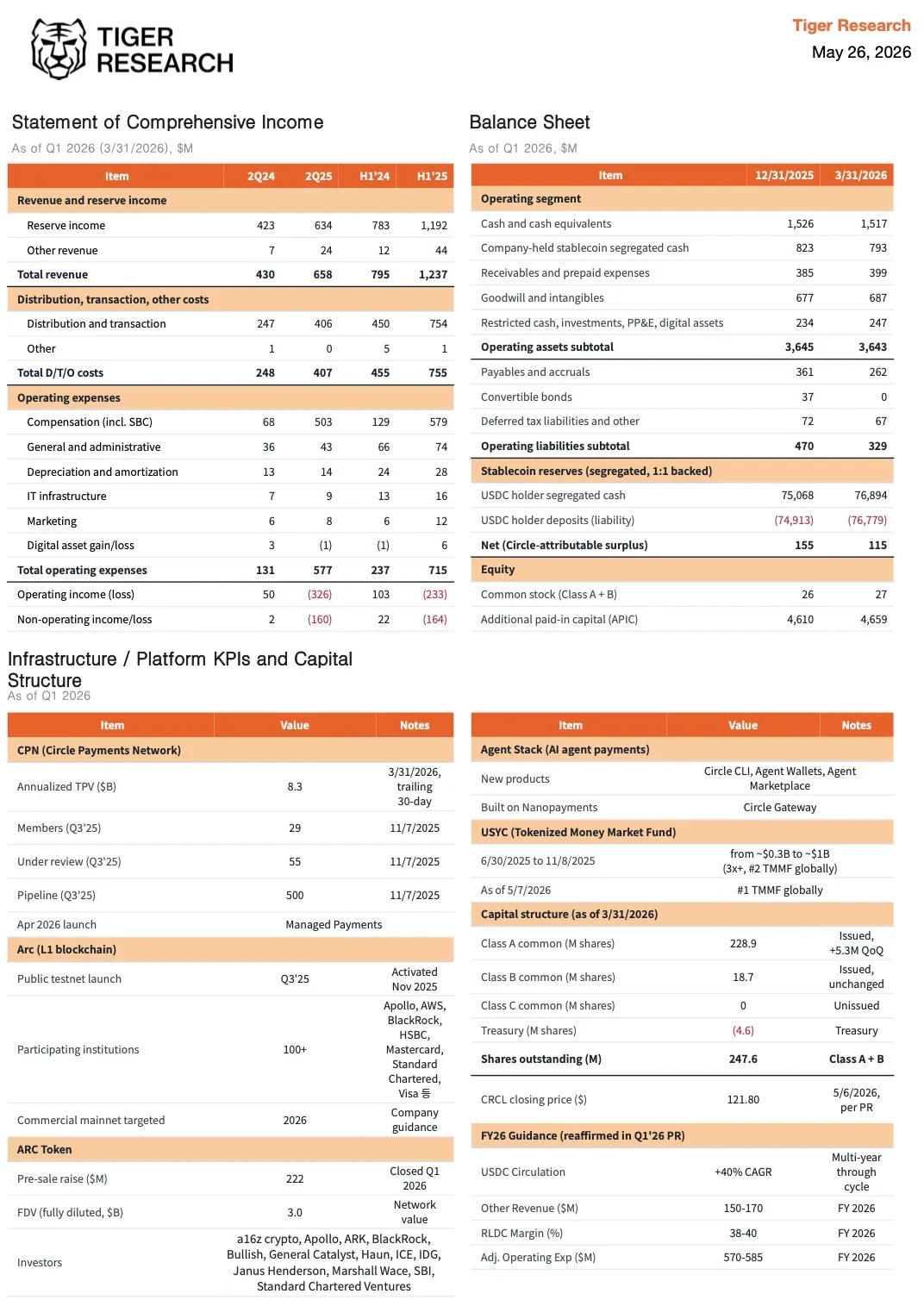
Q1 2026 revenue reached $694 million (YoY +20%), with adjusted EBITDA of $151 million (YoY +24%) and an adjusted EBITDA margin of 53%, showing improved profitability. Currently, 94% of Circle's total revenue relies on reserve interest income.
Reserve yield declined 31 basis points quarter-over-quarter (from 3.81% to 3.50%), putting direct pressure on revenue. Despite this, the RLDC margin rose for the third consecutive quarter, hitting a record high of 41.4%. Even as interest-dependent income faced pressure, Circle still managed to improve its core profit quality.
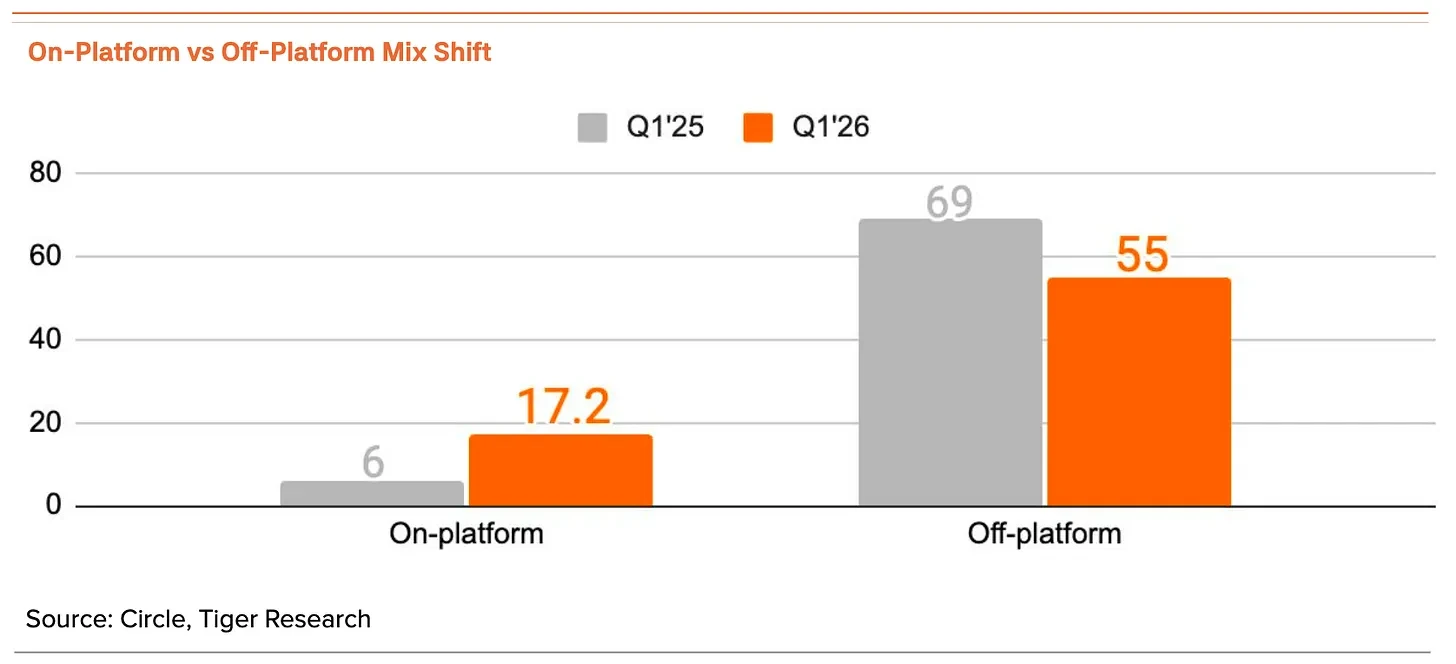
The key driver of margin improvement is the increasing proportion of USDC usage on Circle's proprietary platforms. This quarter, the on-platform share jumped from 6% to 17.2% (YoY +1,149 basis points), while the off-platform share narrowed to 55%.
This shift reflects the results of institutional client onboarding on Circle's proprietary payment network, CPN (Circle Payments Network). The number of member financial institutions grew to 136 in the single quarter (QoQ +36%), and annualized total payment volume (TPV) expanded to approximately $8.3 billion (QoQ +17%).
The phased rollout of CPN payment product lines supports this trend.
- Fiat Payments (Launched Q2 2025): Covers cross-border payments in over 50 countries, supporting local currency send and receive.
- Stablecoin Payments (Launched Q3 2025): Direct payments and settlements in compliant stablecoins (USDC, EURC) in over 180 countries.
- Custody Payments (Q2 2026, launched in April): Circle provides licensing, custody, compliance, and USDC liquidity via a single integrated API. Partners only need to handle fiat currency, without bearing the burden of digital asset custody, operations, and compliance.
This is crucial for long-term profit quality because the way revenue is recognized differs significantly based on where deposits are held. Balances held on external platforms like Coinbase require sharing reserve interest with the platform, whereas balances held on Circle's proprietary platforms like Circle Mint and CPN allow Circle to retain the full interest.
In other words, the higher the on-platform share, the lower the partner revenue share cost, and the higher the RLDC margin. This enhances Circle's actual profitability at the same revenue scale.
Of course, CPN's own usage fee income hasn't scaled yet. As CFO Jeremy Fox-Geen pointed out in the previous quarter's earnings call, the current priority is expanding the network scale, not rapid monetization. Currently, CPN acts more as a channel to attract funds onto Circle's proprietary platforms rather than a direct fee channel. As a transitional strategy to defend against external distribution costs, the Q1 results confirm this path is effective.
2. The Signal in Declining Net Profit Hides Behind Growth
However, a clear divergence from revenue growth and margin improvement is the net profit trend. Q1 net profit was approximately $55 million, down 15% YoY.
The main reasons are the amortization of equity incentive expenses post-IPO and a significant surge in infrastructure and R&D spending ahead of the Arc launch. After adjusting for one-off and non-cash items, the adjusted figures remain solid. Nevertheless, the net profit trend warrants continued attention.
Circle Moves Towards Full Vertical Integration
1. USDC: Strengthening the Core, Expanding Issuance
In Q1 2026, reserve interest income reached $653 million, accounting for 94% of total revenue. Circle's core business is heavily concentrated on reserve interest, and revenue growth is predicated on the continuous expansion of USDC issuance volume.
Current USDC circulation stands at approximately $77 billion. The core proposition for Circle's structural growth is how high this circulation ceiling can be pushed. USDT's previous rapid expansion relied on securing early positioning in trading pairs on Binance.
Circle plans to replicate this "first-mover" strategy on the DEX platform Hyperliquid. Coinbase's recent acquisition of Hyperliquid's native stablecoin, USDH, is a classic case – Hyperliquid didn't deploy USDH as its native platform trading pair but instead sold it, registering USDC as the official base trading pair.
Deposit growth on Hyperliquid directly drives USDC issuance. Hyperliquid's TVL grew from $2 billion in Q1 2025 to $4 billion in Q1 2026, peaking at $6 billion. Since Hyperliquid uses USDC as its base deposit asset, platform growth directly translates into new USDC issuance. The circulation outlook based on this is projected below.
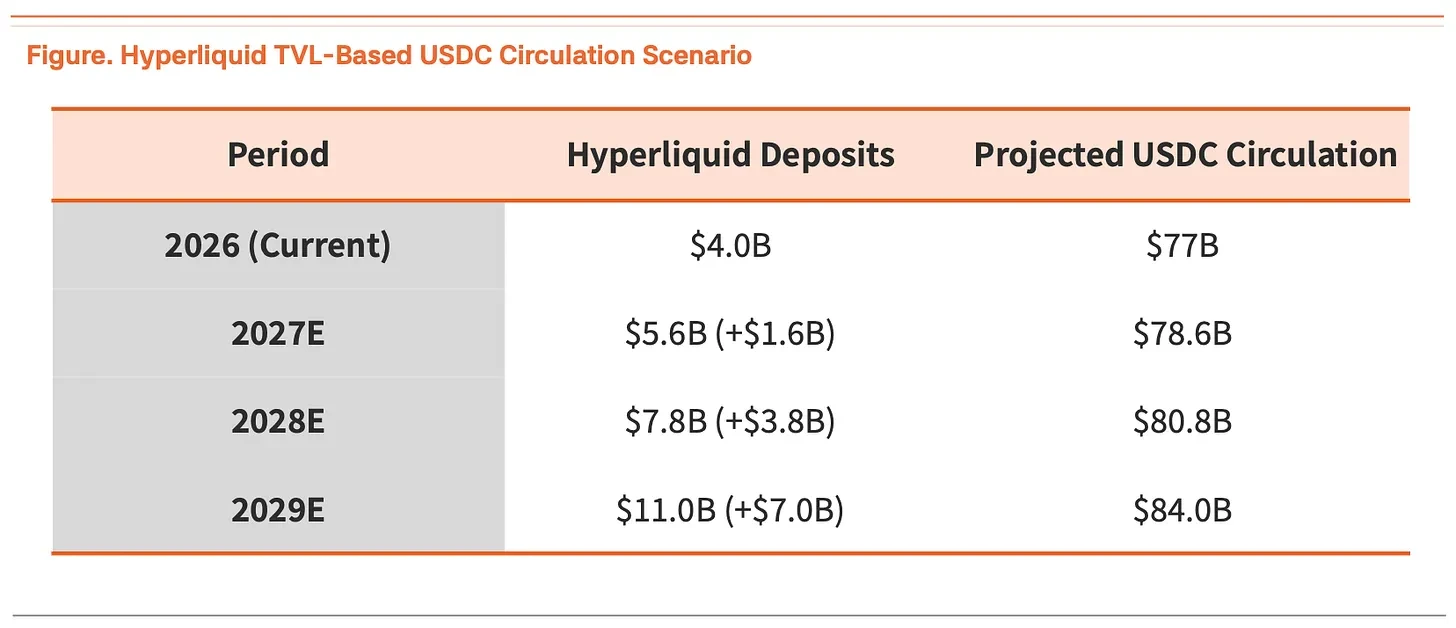
In this scenario, the incremental contribution from Hyperliquid alone could boost total USDC circulation from $77 billion to $84 billion within three years. A single platform would contribute over 10% of total circulation, becoming a crucial issuance channel.
Passing on 90% of reserve interest income to the platform does compress near-term margins. However, the reward is an irreplaceable scale – roughly 15 trillion KRW (approximately $11 billion) in daily trading volume and a 17% market share in DEX derivatives. This trade-off is arguably acceptable.
If Hyperliquid's derivatives product line further materializes, this positive cycle will become even more robust. For Circle, which prioritizes circulation expansion over margins, even if it means sharing profits, Hyperliquid is a strategic stronghold worth securing.
2. Arc: How Circle Breaks Free from Interest Rate Dependence
As mentioned, Circle's revenue is highly concentrated in reserve interest, making its business structure structurally vulnerable during rate-cutting cycles. Arc is still in the testnet phase and hasn't generated visible revenue. With recent institutional funding of approximately $222 million, Arc has emerged as the core infrastructure to fundamentally sever the dependence on interest rates.
Arc's primary target market is global cross-border payments. According to a World Bank report (RPW Issue 54), the global average remittance cost is 6.36%, with bank remittance costs reaching up to 14.99%. This high-cost structure stems from SWIFT's multi-tier intermediaries, opaque foreign exchange spreads, and weekend settlement delays.
Targeting these inefficiencies in traditional financial rails, Circle aims to build platform business revenue on Arc. The infrastructure fee income, reducing interest rate dependence, rests on two main pillars.
Circle Payments Network (CPN): Connecting global institutions and enterprises to Arc for cross-border payments and settlements, charging processing fees on the traffic. Q1's institutional onboarding is laying the groundwork for transaction revenue post-Arc mainnet launch.
On-Chain Forex Engine (StableFX): Supporting on-chain stablecoin swaps, replacing the high intermediary spreads of traditional FX. Upon execution, smart contracts collect a preset fee from each transaction's pair.
StableFX uses an RFQ quote model, unlike SWIFT's fixed cost structure. Market makers compete in real-time, offering the best wholesale spreads. Large transfers can settle 24/7 without SWIFT fixed fees or slippage.
The greater the CPN traffic and StableFX transaction volume on Arc, the higher the direct infrastructure and fee income. This creates a closed-loop, non-interest income structure.
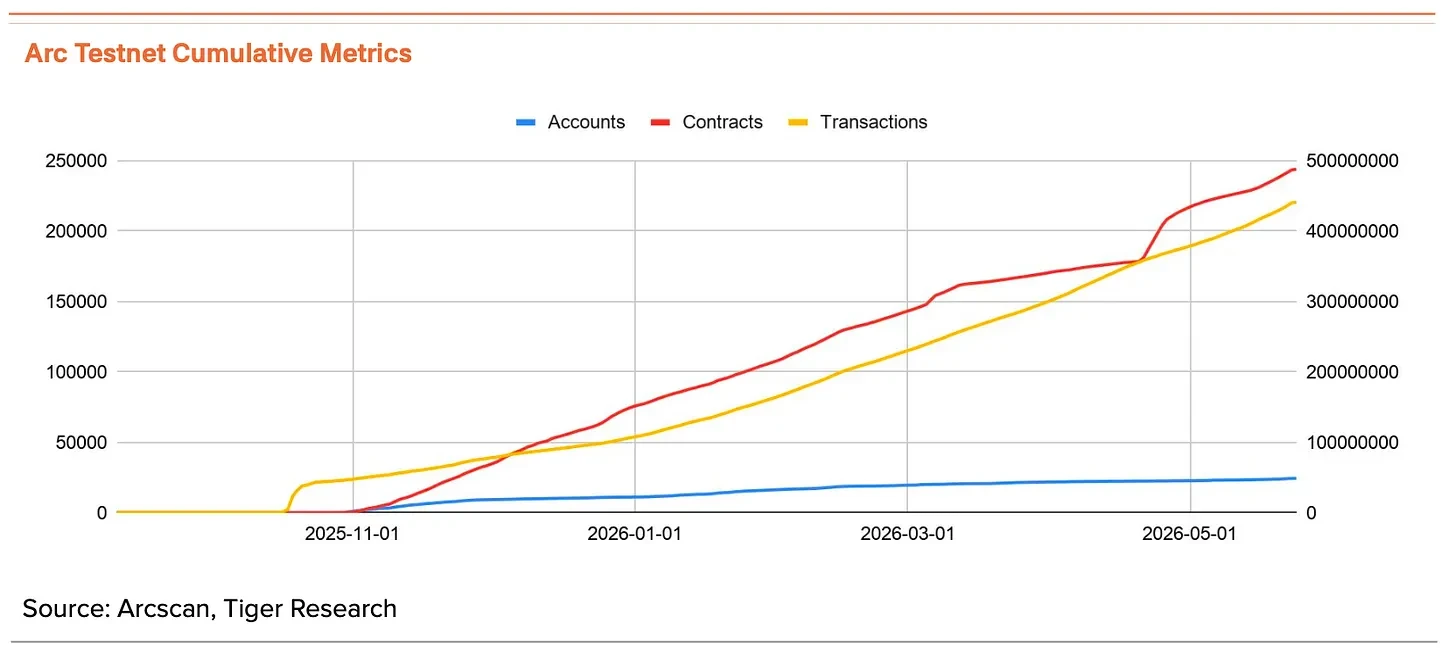
This transformation has already been validated via the testnet and participating enterprises. According to Arcscan data, the public testnet has accumulated approximately 430 million transactions since its launch, with roughly 3.26 million in the last 24 hours. Over 100 institutions globally have participated, including BlackRock, HSBC, Visa, and AWS.
Beyond traditional financial institutions, blockchain prediction market Polymarket has also joined the ecosystem.
This isn't just piloting products and platforms. Arc is attracting real enterprises and driving real transaction traffic. If Arc performs as expected, Circle's revenue structure will expand from USDC reserve interest to include infrastructure operation income. Arc is the first step in uncoupling from interest rates.
According to the roadmap, the Arc mainnet is scheduled to launch this summer. Meaningful Arc revenue is expected to materialize gradually after the mainnet launch.
3. Agent Stack: A Blueprint for Autonomous AI Payments
The "agentic economy," where AI agents make decisions and execute transactions autonomously on behalf of humans, is approaching. Global tech giants like Google and OpenAI are already actively deploying such autonomous systems.
The bottleneck is payment infrastructure. Fees incurred by AI agents calling APIs are priced at sub-cent (sub-granular) levels, which traditional payment systems cannot handle. Routing such micro-payments through credit card networks would make fees exceed the principal – a loss on every transaction. Agent payments are structurally incompatible with existing card rails.
Circle is targeting this gap by launching "Circle Agent Stack," using USDC as the settlement asset, alongside a toolkit for building the supporting environment.
- Agent Wallets: AI agents autonomously hold and send USDC within rules set by humans (e.g., spending limits).
- Agent Marketplace: A store where AI agents purchase API services and settle per call.
- Agent Nanopayments: Instant USDC settlement for amounts as low as ~$0.000001, with zero gas fees.
- Circle CLI: A command-line tool for creating wallets and connecting agents.
- Circle Skills: Functional components that allow AI agents to directly invoke Circle's financial product modules.
Currently, this revenue segment is also not yet visible. The path to market adoption and revenue recognition is expected to follow this phased roadmap.
2026 (Infrastructure Phase): Building the technical foundation to handle large-scale nano-payments stably. The Arc mainnet activates this summer, anchoring partner integrations with Circle CLI and financial modules.
2027 (Regulatory Anchoring Phase): The GENIUS Act goes into effect, providing institutional safeguards for enterprise adoption. Stablecoin securities exemptions and 100% safe asset backing are legally established. Even legal teams at conservative enterprises can safely trial the USDC payment system internally without risk.
2028 (Commercialization & Monetization Phase): Technical foundation and regulatory legitimacy are fully aligned. The agentic economy becomes fully commercialized. Enterprises grant AI agents real spending authority, large-scale transactions occur, and Agent Stack's contribution is formally reflected in financial statement revenue.
Therefore, until traffic-driven revenue fully materializes in 2028, Agent Stack will mostly be priced into the stock as a "premium for future expectations" – a valuation by the capital market for future market positioning, rather than a realization of current-period revenue.


