






Tiger Research: As DeFi Yields Decline, What Real Value Does RWA Offer?


- Key Insight: The DeFi token incentive model is no longer sustainable. The industry is shifting towards a real-yield system anchored by Real World Assets (RWA), with institutional capital driving the construction of sustainable on-chain financial infrastructure.
- Key Elements:
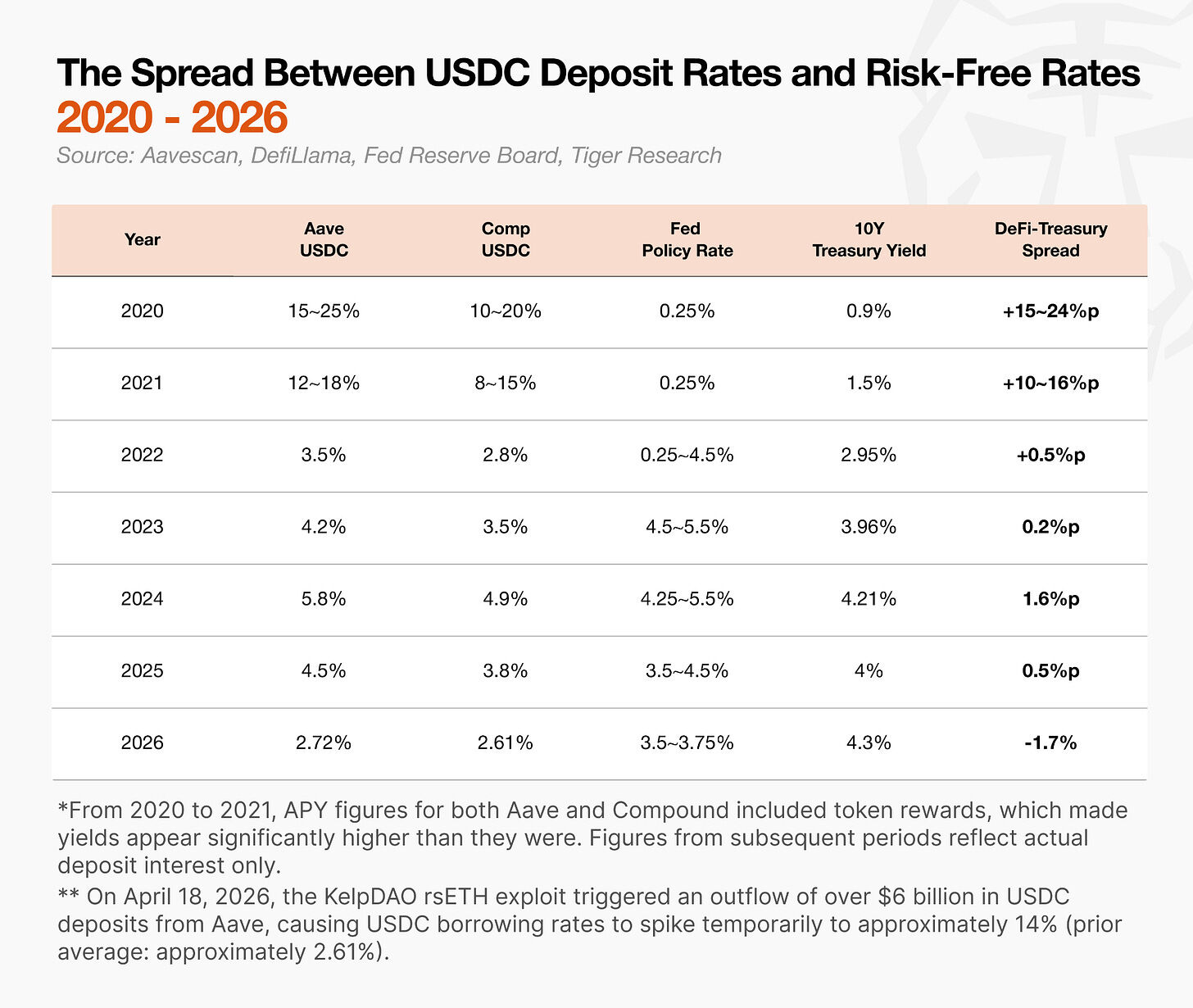
- DeFi yields continue to decline. The USDC deposit rate on Aave V3 (2.7%) is now lower than the US 10-year Treasury yield (4.3%), making traditional finance yields more attractive.
- The failures of Compound, Curve, and OlympusDAO reveal a core lesson: models reliant on token incentives and internal circulation are prone to collapse when external capital dries up, lacking real value backing.
- The RWA and stablecoin market has grown to hundreds of billions of dollars. Institutional products like BlackRock's BUIDL and Franklin's BENJI tokenize real-world assets such as US Treasuries, providing a source of genuine yield.
- Yield-bearing stablecoins (YBS), such as Ethena's sUSDe and Sky's sUSDS, embed yields directly into the token. They function essentially as on-chain money market funds, offering the advantage of composability.
- Projects like Theo, Plume, and Morpho are building a "value grid" connecting physical assets with on-chain finance by focusing on asset selection, foundational infrastructure, and lending functions, respectively.
- The industry is establishing mechanisms for collaborative governance and accountability. For instance, the DeFi United alliance has raised over $300 million to address losses from hacking attacks, signaling increased industry maturity.
Core Highlights
- This report is written by Tiger Research.The USDC deposit rate on Aave V3 is currently 2.7%, lower than the 4.3% yield on the US 10-year Treasury bond. The short-term dividends brought by speculation in DeFi are fading.
- The market is not dead. Although yields are generally declining, Real World Assets (RWA) and stablecoins have grown into a multi-hundred-billion dollar track, and the industry is moving towards a new development direction.
- The collapses of projects like Compound, Curve, and Olympus reveal a profound lesson: a model based on tokens supporting each other will collapse instantly once external incremental capital dries up.
- The DeFi of the past was like a power strip without an external power source; RWA is now connecting this circuit to a real external value grid.
- The industry is maturing: anchoring value in RWA while gradually establishing mechanisms for co-governance and accountability, as exemplified by industry initiatives like DeFi United.
1. Declining Yields, Growing Market
Decentralized Finance (DeFi) is no longer a high-yield product.
Since 2022, the spread between DeFi yields and Treasury yields has narrowed to near zero, occasionally even inverting. As of April 2026, the USDC deposit rate on Aave V3 is approximately 2.7%, lower than the US federal funds rate (3.5%) and the US 10-year Treasury yield (4.3%).
In the past, users had a clear reward logic for taking risks.
Back then, on-chain yields were much higher than bank deposits, an incomparable advantage. But the situation has now reversed. After accounting for various on-chain risks like hacks and stablecoin de-pegging, if the actual return on DeFi is lower than traditional financial products, the incentive for ordinary retail investors to actively participate in DeFi will significantly diminish.
However, the entire industry is continuously developing in a new direction. While native DeFi yields are declining, the **Real World Assets (RWA)** and stablecoin markets are deeply integrating with traditional finance, with their scale reaching hundreds of billions of dollars. The entry of institutional capital is the core factor driving this shift.
However, institutions often overlook DeFi's development history and native community ecology, blindly copying the rules and paradigms of traditional finance. Before the large-scale entry of institutions, DeFi was a market primarily driven by token incentives. Many protocols used incentive mechanisms to gain market recognition and reshaped the operating logic of the entire industry. This model still profoundly influences DeFi today. Aave, the leading protocol born from DeFi Summer, has now become the benchmark interest rate benchmark for the entire DeFi industry.
For new institutional participants, deeply understanding the core market players who have weathered cycles and survived is a necessary foundational lesson before entering the market. This article will review the key protocols that shaped the industry's core narratives throughout DeFi's complete development cycle and summarize the lessons learned by the market.
2. DeFi History: From Experimentation, Collapse, to Reshaping
DeFi was not initially built on promises of token incentives. The starting point was very simple: Can we lend, borrow, exchange, and collateralize assets on the blockchain without intermediaries?
The early days of the industry leaned more towards a financial experiment. The core value was in the model itself: Lending without banks, asset exchange without centralized exchanges, and the ability for any user holding collateral to provide liquidity autonomously. But after 2020, the market sentiment rapidly shifted, and token incentives became the primary means of attracting capital. A flood of protocols and innovative ideas emerged, but ultimately only a few projects survived the cycles. The industry learned lessons and continuously corrected its development direction through successive narrative shifts.
Compound integrated its native token $COMP into the yield incentive system to attract massive liquidity. However, when similar projects replicated this strategy, the inflow of new capital dried up, fully exposing the structural fragility of its model.
Curve transformed its governance voting mechanism into a competitive arena for the distribution of yields across liquidity pools, turning yield competition into a battle for protocol control. This made the market realize that DeFi governance could also become a tool for monopolizing power and incentives.
OlympusDAO was the most extreme case. This project attempted to prove the viability of DeFi having self-owned liquidity without external capital, using exorbitant annual percentage yields (APY). However, the vast majority of its yield did not come from real cash flow but relied on token inflation and new capital inflows. Once capital inflow slowed down, the price of its governance token, OHM, crashed, and market confidence in the protocol completely disintegrated.
These three projects collectively served as a wake-up call for the industry: If the core source of yield is the protocol's native token, this business model will ultimately be unsustainable. This past experience completely reshaped the understanding of DeFi among ordinary users, development teams, and institutional capital.
It was precisely after the bursting of this model bubble that new tracks emerged: EigenLayer, Pendle, YBS, and RWA.
2.1. Compound: A Bubble Built on Token Distribution
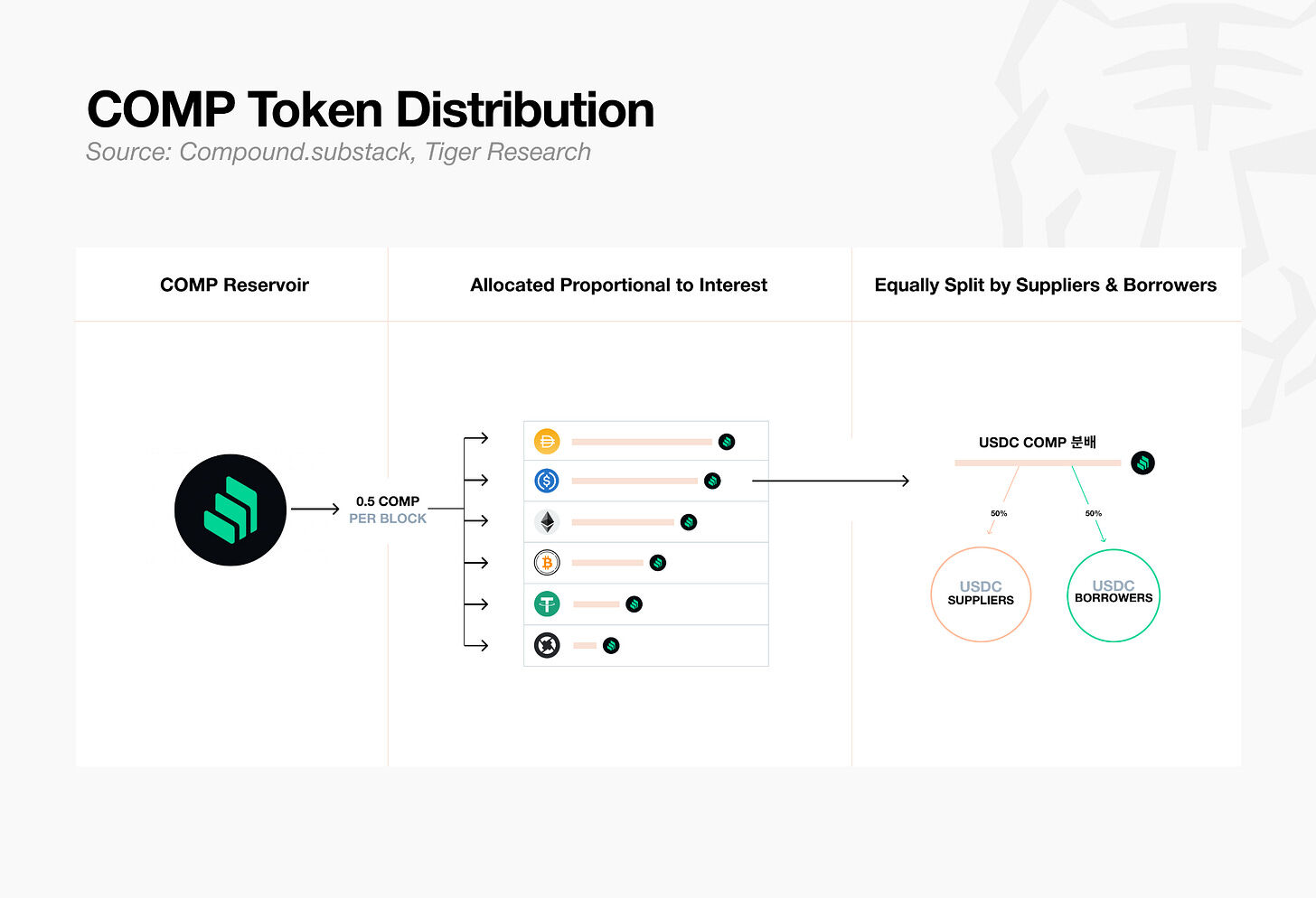
In June 2020, Compound began distributing governance tokens to users, rewarding both depositors and borrowers. In some phases, the COMP rewards even exceeded the borrowing costs, creating the peculiar phenomenon where borrowing money could actually be profitable.
This pioneered a new industry paradigm. As users flooded in, transaction fees on the Ethereum network soared, with single transfer fees often reaching tens of dollars. Depositing and borrowing were no longer just pure financial operations; they became tools for farming rewards, with capital chasing high yields rapidly moving between protocols.
This period is known in the industry as "DeFi Summer". Projects like Uniswap, Aave, and Yearn Finance rose in succession, firmly establishing on-chain finance as an independent track. But the model Compound ultimately built was essentially one that attracted capital with token incentives, which in turn pushed up the token price, creating a positive feedback loop. The behavior of DeFi users today, highly sensitive to yields, liquidity, and reward mechanisms, was gradually solidified during this phase.
2.2. Curve and veCRV: The Beginning of the Curve Wars
Curve initially started as a trading platform focused on stablecoin swaps, but the introduction of veCRV completely rewrote its underlying logic. The longer users locked their CRV, the more veCRV they received; veCRV represented voting power, determining the distribution of CRV rewards among different liquidity pools.
From then on, the core of industry competition was no longer about yield levels but about the power to control yield distribution. Entities holding large amounts of veCRV could direct more token rewards to their own pools. Protocols began hoarding veCRV, engaging in fierce competition, and the Curve Wars were ignited.
Initially, this mechanism was attractive to both retail investors and projects: the longer retail investors locked their tokens, the higher their yield; projects could use it to reduce token circulating supply and direct liquidity to target pools. Consequently, similar lock-to-govern models quickly spread across the ecosystem, such as Balancer's veBAL and Frax's veFXS.
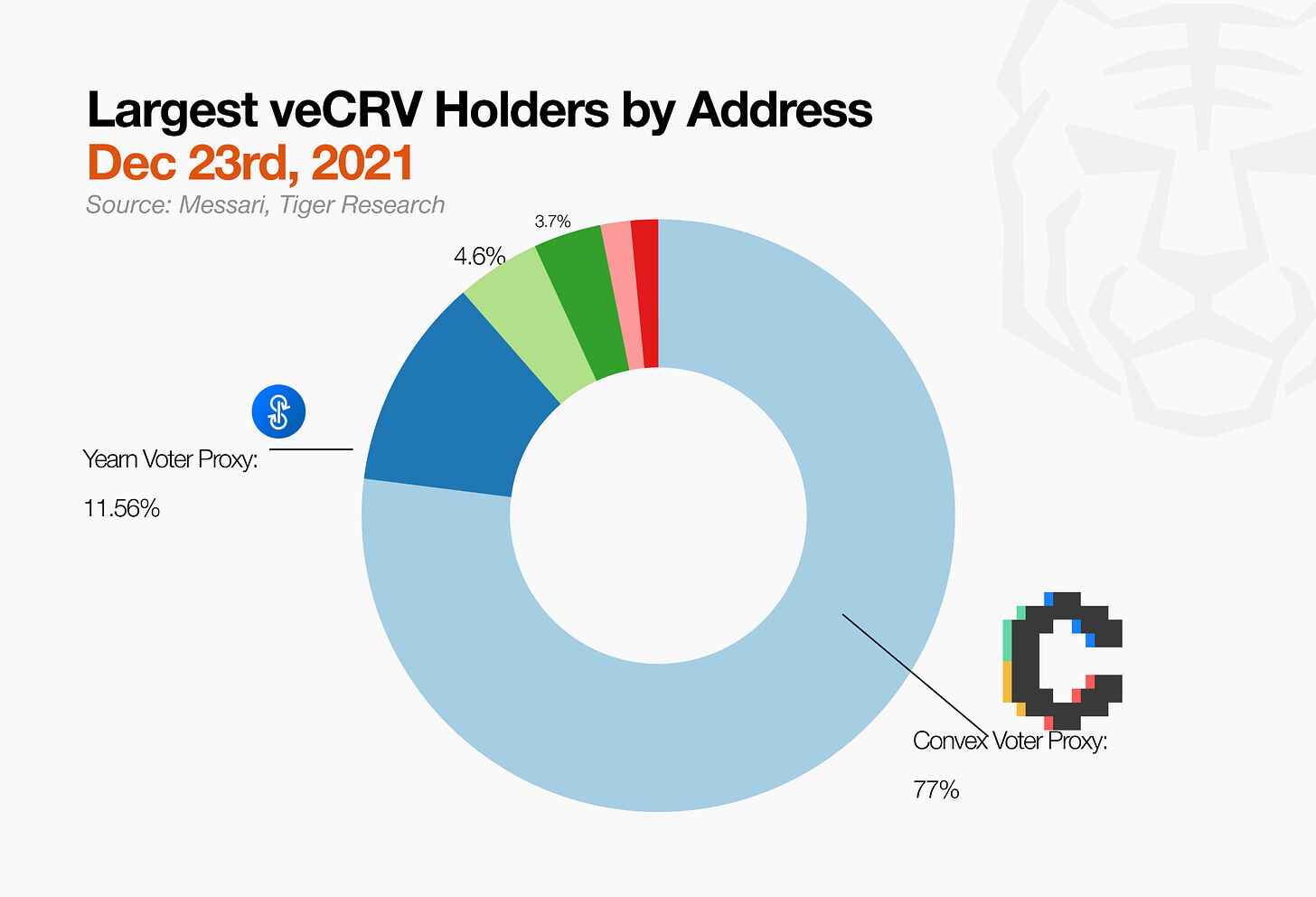
But over time, governance power ceased to be in the hands of ordinary users. Meta-protocols like Convex began aggregating and locking CRV on behalf of users, concentrating veCRV voting power in exchange for higher boosted rewards. The Curve Wars escalated, with the main battlefield shifting to Convex.
veCRV ultimately proved a core conclusion: control over yield distribution is far more attractive than the yield itself. Users no longer directly held governance power but delegated it to more efficient intermediaries like Convex. Curve also showed the market that DeFi governance rights themselves can become yield-bearing assets, and such power tends towards centralization and monopoly.
2.3. OlympusDAO: A Golden Age Built on Game Theory
Even after Curve's veToken mechanism, liquidity remained the biggest long-standing challenge for DeFi. Externally sourced liquidity would immediately withdraw if higher incentives appeared elsewhere; this capital was essentially speculative and profit-seeking.
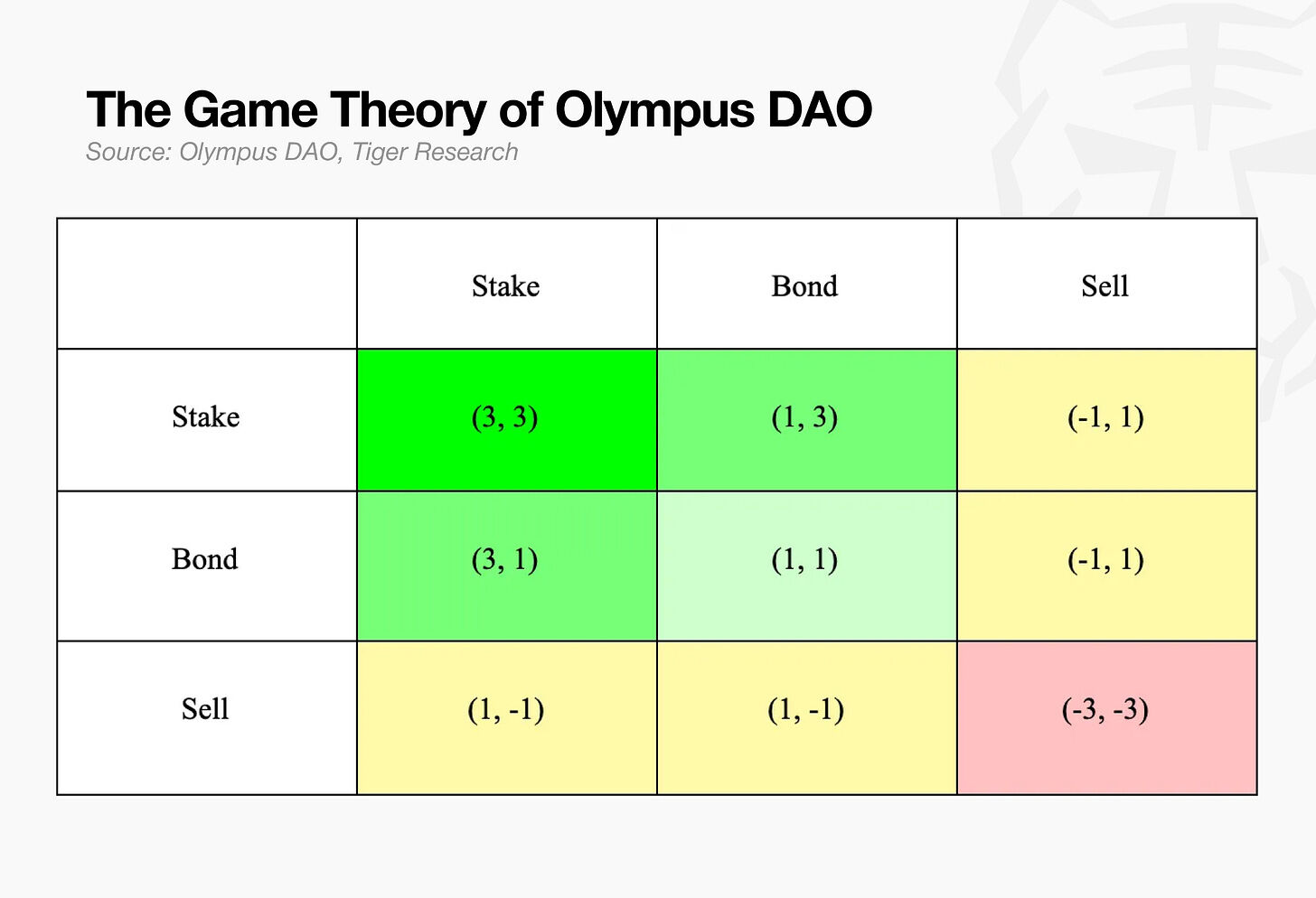
OlympusDAO, born in the second half of 2021, was once hailed as a solution to this problem. Its core design featured three elements: Protocol Owned Liquidity (POL), where the protocol directly holds its own liquidity; the (3,3) game theory model, suggesting that the optimal global outcome occurs when all users choose to stake and lock tokens; and an exorbitant APY exceeding 200,000% at its launch.
But this model ultimately proved unsustainable. OHM's yield was highly dependent on token inflation, not real business cash flow. Its bond mechanism spawned numerous fork projects, and the OHM token price eventually crashed over 90%. After this ordeal, the mindset of developers and users fundamentally changed: before chasing "how high can the yield be," people started prioritizing an examination of the yield's true source.
2.4. EigenLayer and Pendle: From Horizontal Yield Farming to Vertical Leverage
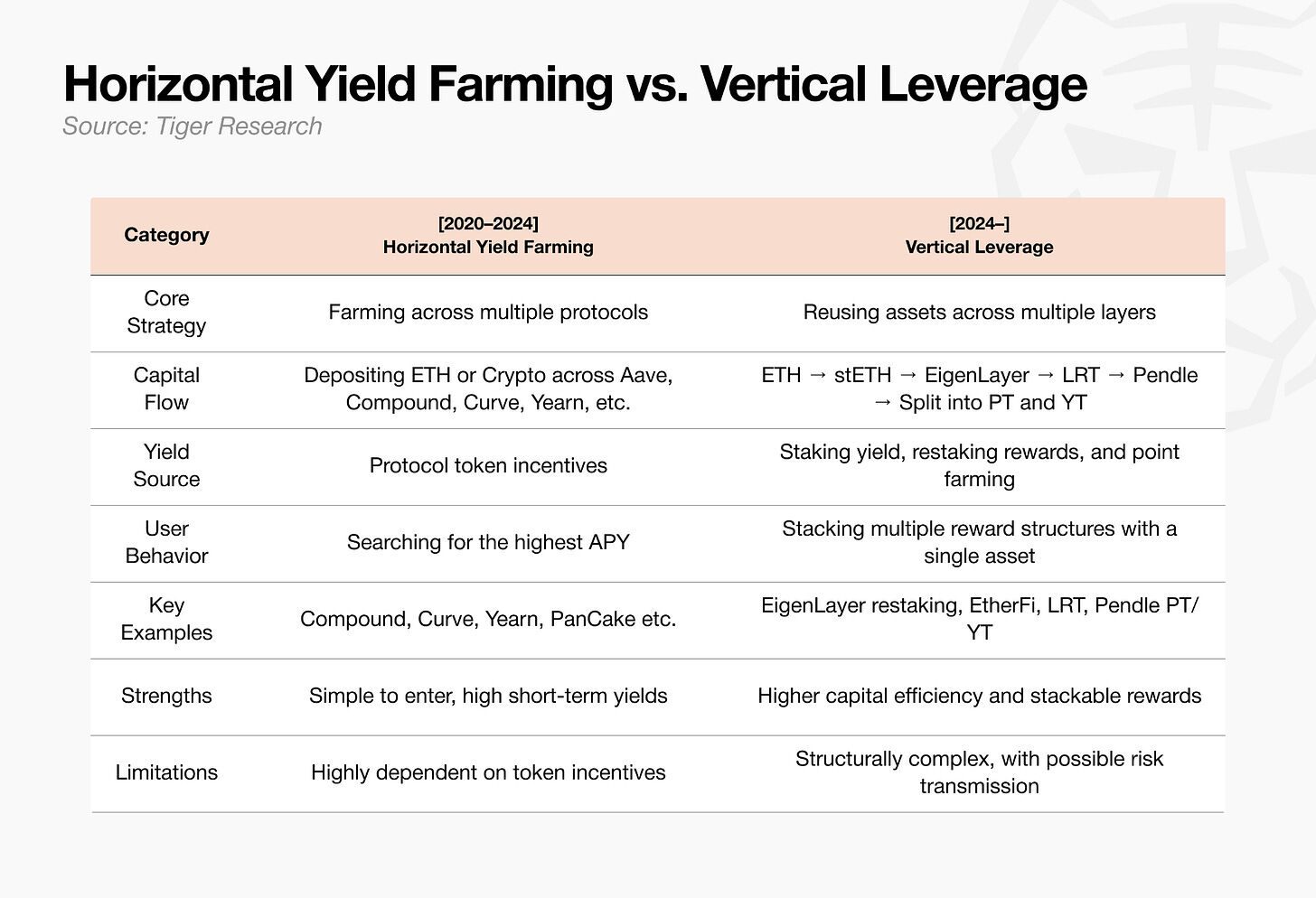
This crash fundamentally changed the behavior of retail investors. The strategy from 2020 to 2022 was simple and brutal: Farm the incentives first, then cash out. It was common for the same user to spread their capital across multiple protocols simultaneously. The farming of that era was horizontal arbitrage: capital flowing rapidly between different protocols, chasing higher APY.
After 2022, the efficiency of this model dropped sharply. Token incentive models proved unsustainable, and airdrop competition became increasingly fierce. Simply depositing capital across multiple platforms yielded diminishing marginal returns. The market direction shifted, and capital began to seek multi-layered yield stacking on a single asset: re-staking of staked ETH (stETH), reinvesting Liquid Restaking Tokens (LRT) into DeFi, splitting yield ownership to capture points and potential future returns.
EigenLayer and Pendle became the core representatives of this transformation. Starting in 2024, EigenLayer introduced a restaking architecture, allowing already staked ETH and Liquid Staking Tokens (LST) to earn additional rewards. In just about six months, its Total Value Locked (TVL) surged from less than $400 million to $18.8 billion, clearly confirming that capital was moving en masse from simple deposits to the restaking track.
Pendle splits yield-bearing assets into Principal Tokens (PT) and Yield Tokens (YT). PT represents the principal with near-principal protection; YT encompasses all interest, farming rewards, and point rights during the token's lifespan. YT expires worthless but maximizes the capture of points and yields during its holding period. Even without understanding the complex underlying mechanisms, buying YT evolved into a mainstream farming strategy utilizing both time and capital leverage.
The industry strategy thus transformed: from casting a wide net and diversifying across protocols to focusing on a single underlying asset and stacking multi-layered yields for compound returns.
3. Profit Model Reconstruction: RWA and YBS
In the past, projects were highly dependent on token incentives to inflate Total Value Locked (TVL). As TVL grew, the protocol appeared to be expanding, and the token price would rise accordingly. But the core problem always remained: external liquidity came and went quickly, making it difficult to retain.
Today, TVL remains an important industry metric, but the industry's focus has completely shifted to: fee revenue, real asset backing, and compliance capabilities. The key variable behind this is the entry of institutional capital. Institutions rigorously scrutinize the source of yield and the true quality of underlying collateral. A new generation of products is iterating and upgrading, simultaneously catering to retail user needs and institutional compliance requirements.
3.1. Real World Assets (RWA): Institutional Entry in Force
Since 2024, traditional financial institutions like BlackRock, Franklin Templeton, and JPMorgan Chase have entered the on-chain market, primarily through Real World Assets (RWA). Their operating model involves tokenizing off-chain real-world assets such as US Treasury bonds, money market funds, private credit, gold, and real estate, issuing and circulating them on the blockchain.
The on-chain RWA market has grown from tens of billions of dollars in 2022 to hundreds of billions of dollars by April 2026. Treasury tokenization and private credit are the core drivers of this growth.
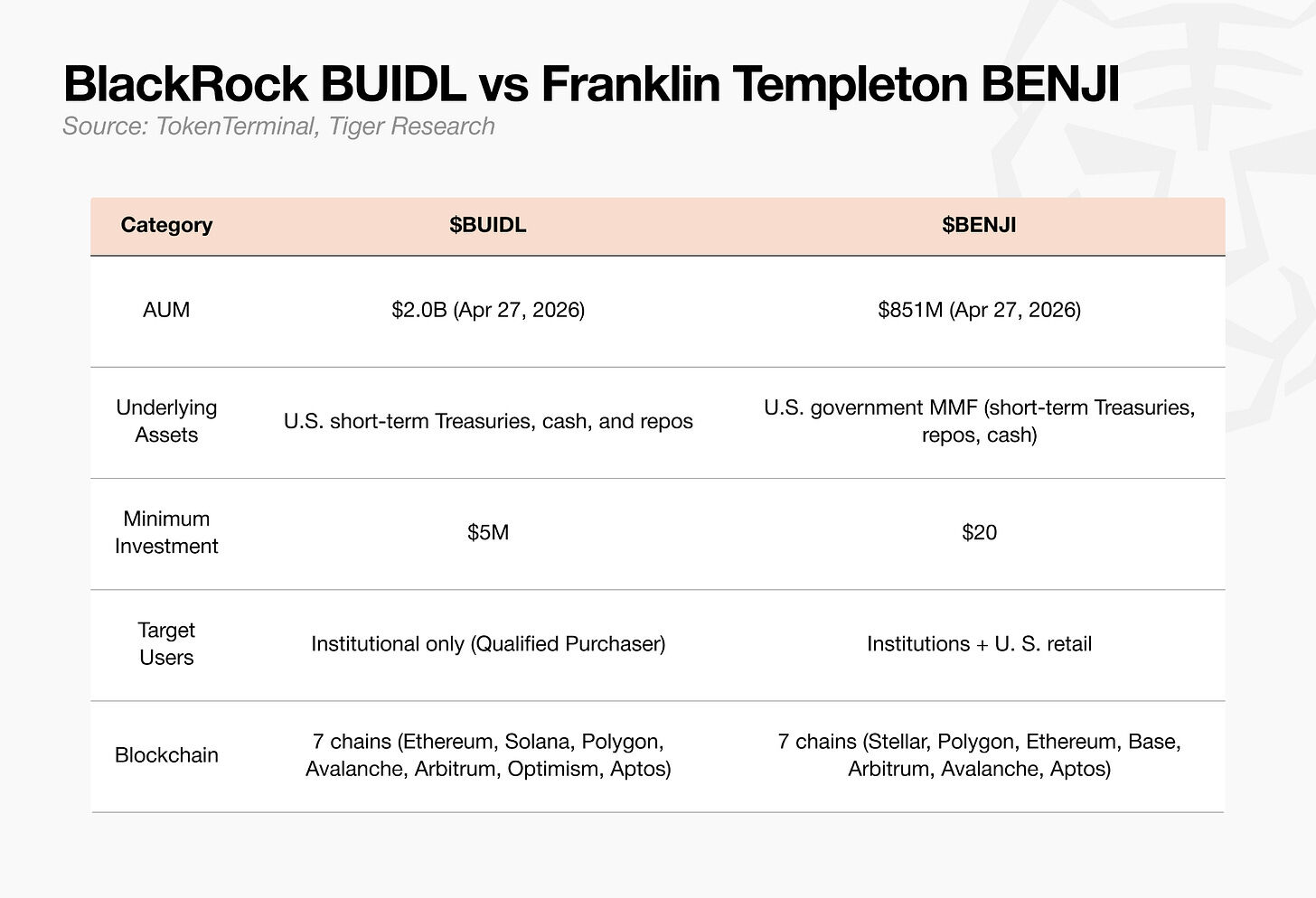
Currently, the leading institutional-grade products are represented by BlackRock's BUIDL and Franklin Templeton's BENJI. Both product types have similar underlying assets but differ in operation: BUIDL is strictly for institutional investors, while BENJI has a minimum entry requirement of only $20, making it accessible to ordinary US retail investors.
Furthermore, asset management giants like Apollo, Hamilton Lane, and KKR are partnering with on-chain issuance platforms like Securitize to accelerate the tokenization of private equity funds and private credit.
For traditional institutions, the on-chain market is not a completely new, unknown territory but a new distribution channel for assets. Therefore, various protocols serving institutional clients are building supporting systems: compliant KYC/AML mechanisms, custody infrastructure, multi-jurisdictional legal adaptability, and professional risk management frameworks.
3.2. Yield-Bearing Stablecoins (YBS): Dollar Assets with Built-in Yield
The most noteworthy sub-sector currently is Yield-Bearing Stablecoins (YBS). Yield-bearing stablecoins are stablecoin products that embed yield mechanisms directly into the token itself. Ondo USDY, Sky sUSDS, Ethena sUSDe, as well as the previously mentioned BlackRock BUIDL and Franklin BENJI, belong to this category.
By simply holding these assets, users automatically accumulate yields generated by the underlying assets. These underlying assets include US Treasury bonds, funding rate yields, staking interest, and money market funds. The entire structure is essentially an on-chain migration of traditional Money Market Funds (MMFs).
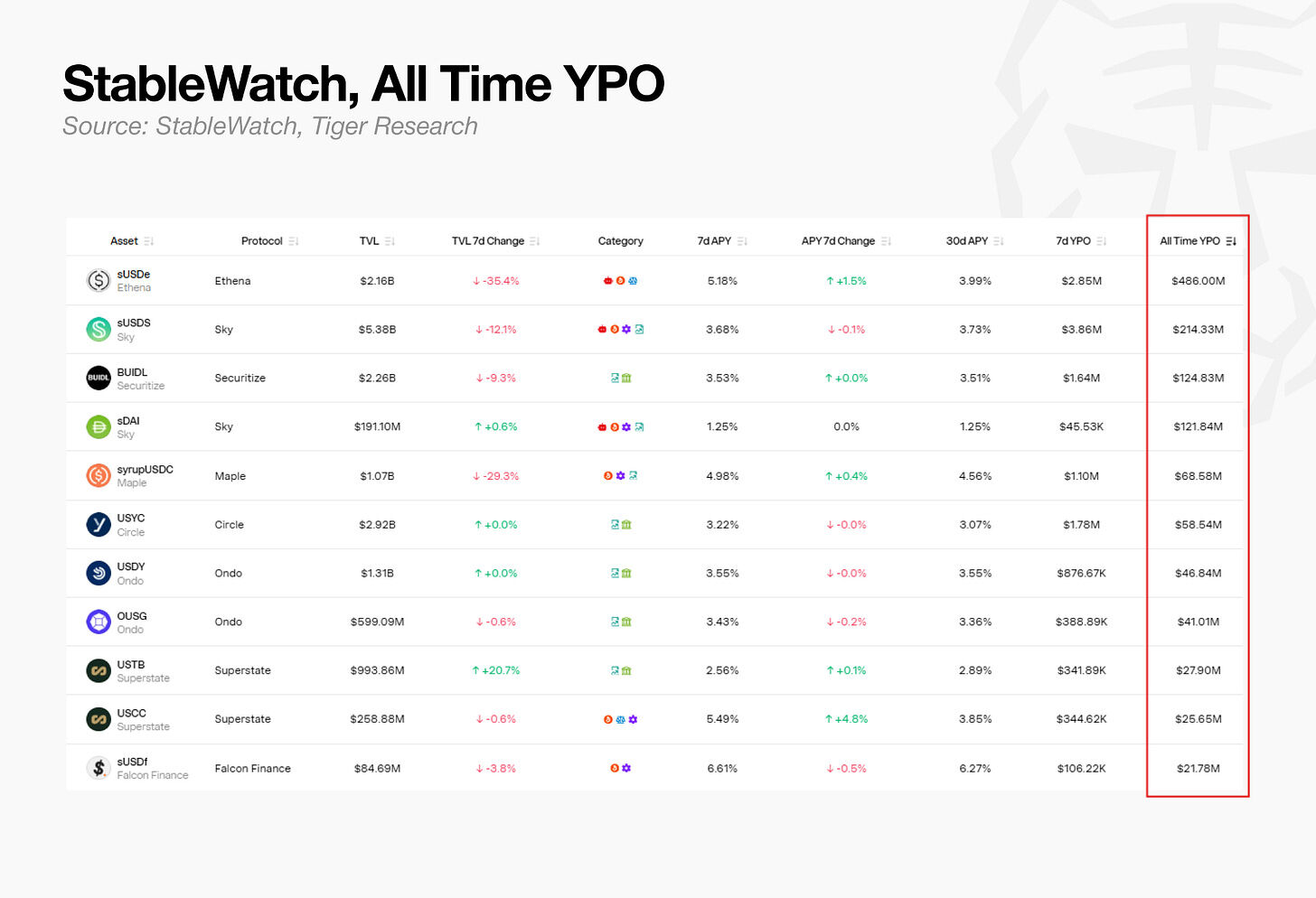
According to StableWatch's Yield Produced Outstanding (YPO) data, Ethena sUSDe, Sky sUSDS, BlackRock BUIDL, and Sky sDAI are among the top products in the market for cumulative yield payouts. While figures may vary slightly depending on the data source, it is undeniable that yield-bearing stablecoins have moved beyond the small-scale experimental phase and matured into a track capable of consistently distributing real interest.
Even so, simply moving money market funds onto the chain does not constitute a core differentiator. The real barrier lies in composability. BlackRock's BUIDL accounts for 90% of the reserves backing Ethena's USDtb stablecoin, and USDtb can in turn be used as collateral within Aave's lending ecosystem.
In other words, basic financial products originally serving as RWA tools have now transformed into stable underlying components of on-chain finance. DeFi is no longer barely functioning on limited "internal batteries" but is beginning to connect to real external value energy.
4. Building the RWA Value Grid: Learning from Past Failures
Before this, DeFi was essentially doing one thing: creating a self-referential, nested loop of power strips, glorifying it as a growth flywheel.
Layer upon layer of leverage and derivatives were stacked, everything closed in a self-contained loop. The fatal flaw was that energy never came from outside; the vast majority of yield was artificially created by protocol-issued token incentives. Compound lent against its native token, Curve used its token to retain liquidity providers.
On the surface, parties supported each other in a circular flow, but in reality, the entire system shared a single, limited battery


