






จาก "ฮันตัน" สู่ "ไวรัสอีโบลาสายพันธุ์ย่อย": หากความเสี่ยงด้านสาธารณสุขโลกปะทุขึ้น หุ้นสหรัฐฯ ตัวใดบ้างที่อาจถูกประเมินมูลค่าใหม่?


- ประเด็นหลัก: แม้การระบาดของไวรัสฮันตันและไวรัสอีโบลาในสาธารณรัฐประชาธิปไตยคองโกเมื่อเร็ว ๆ นี้จะไม่ใช่เหตุการณ์ซ้ำรอย COVID-19 แต่ตลาดการเงินซึ่งอาศัยความทรงจำทางประวัติศาสตร์ ได้เริ่มประเมินความเสี่ยงของสินทรัพย์ในห่วงโซ่การเดินทางใหม่ และเริ่มทบทวนมูลค่าของสินทรัพย์เชิงรับ (Defensive Assets) เช่น วัคซีนและการทำงานทางไกล
- ปัจจัยสำคัญ:
- กลไกการแพร่ระบาดของเหตุการณ์ด้านสาธารณสุขทั้งสองเหตุการณ์ (ไวรัสฮันตันและอีโบลา) นั้นแตกต่างจาก COVID-19 และปัจจุบันยังไม่มีสัญญาณของการกลายเป็นโรคระบาดใหญ่ทั่วโลก องค์การอนามัยโลก (WHO) ก็ยังไม่ได้จัดให้เป็นโรคระบาดใหญ่เช่นกัน
- ปฏิกิริยาของตลาดขับเคลื่อนด้วยคำหลักที่กระตุ้นความทรงจำ เช่น "เรือสำราญ + การเดินทางข้ามพรมแดน + การกักตัว" โดย优先กดดันสินทรัพย์ในกลุ่มที่มีการสัญจรหนาแน่น เช่น ธุรกิจการบิน (DAL.M), การท่องเที่ยวออนไลน์ (ABNB.M), และความบันเทิงแบบออฟไลน์ (DIS.M)
- ในการระบาดของอีโบลา แม้อัตราการเสียชีวิตตามประวัติของไวรัสสายพันธุ์ Bundibugyo (25%-50%) จะต่ำกว่าสายพันธุ์ Zaire แต่เนื่องจากความเสี่ยงในการแพร่กระจายแบบแฝง จึงเป็นบททดสอบที่รุนแรงกว่าต่อประสิทธิภาพการตอบสนองด้านสาธารณสุข
- ตรรกะของการให้ความสนใจสินทรัพย์เชิงรับนั้นไม่ได้มาจากการได้รับประโยชน์โดยตรง แต่มาจากการสำรองขีดความสามารถ: แพลตฟอร์มวัคซีน (MRK.M, PFE.M) สะท้อนถึงขีดความสามารถในการวิจัยและพัฒนาการตอบสนอง ส่วนยาต้านไวรัส (GILD.M) ถูกมองว่าเป็นแนวทางแก้ไขที่เป็นไปได้
- การทำงานทางไกล (ZM.M, MSFT.M) ปัจจุบันมีแนวโน้มไปทาง "ออปชั่นหางยาว" (Tail Option) มากกว่า โดยตรรกะของมันจะแข็งแกร่งขึ้นอย่างชัดเจนเมื่อความเสี่ยงพัฒนาไปสู่ข้อจำกัดในการทำงานอย่างกว้างขวางที่เหนือกว่าระดับภูมิภาค
- การบริโภคเชิงรับด้านการแพทย์ (UNH.M, WMT.M, COST.M) เนื่องจากความต้องการที่แข็งแกร่ง จึงกลายเป็นที่หลบภัยของเงินทุนที่มั่นคงยิ่งขึ้นเมื่อความเสี่ยงในการลงทุนลดลง
Recently, two public health incidents have successively entered the global spotlight.
First was the Hantavirus event that has been brewing for over a month, where 18 passengers repatriated to the US from the M/V Hondius cruise ship were required to undergo quarantine monitoring until May 31. Meanwhile, after some passengers disembarked, new cases were also reported in France, Spain, and Canada.
Subsequently, as one wave subsides, another rises, with the Democratic Republic of the Congo (DRC) and Uganda experiencing an outbreak of Bundibugyo ebolavirus. As of this writing, the WHO has classified this outbreak as a Public Health Emergency of International Concern (PHEIC) but has also clearly stated that it has not yet met the criteria for a pandemic emergency.
Objectively speaking, neither of these outbreaks currently shows signs of becoming a global pandemic, nor are they suitable to be simply compared to COVID-19. However, for markets, the impact of public health risks often begins to manifest well before things get truly out of control.
Historically, once public health risks escalate, the first assets to be re-evaluated are often highly liquid ones like airlines, cruise lines, hotels, tourism, and offline consumption. Meanwhile, vaccines, antivirals, diagnostics, medical equipment, PPE, remote work tools, health insurance, and essential consumer goods may also re-enter the market's hedging list.
In trading, one must prepare for a rainy day. This article attempts to draw a map of US stocks to watch under public health risks from an asset perspective.
1. From Hantavirus to a 'Subtype' of Ebola: Is Global Public Health Risk Rising?
First, let's look at Hantavirus.
It is not a new virus, nor is it a highly efficient respiratory virus like SARS-CoV-2. It is primarily transmitted through rodents, with humans usually infected after contact with air, dust, or environments contaminated by rat urine, feces, or saliva. The CDC also points out that the Andes virus is the only known type of Hantavirus capable of human-to-human transmission, and this transmission typically occurs among people in close contact with a patient.
This is precisely why Hantavirus itself cannot simply be analyzed using the COVID-19 model.
The reason the M/V Hondius incident has garnered attention isn't necessarily the scale of global transmission it has already caused, but rather that it combines several elements that easily trigger market memory: a cruise ship, enclosed spaces, international passengers, quarantine monitoring, cases in multiple countries, and notifications from public health authorities.
In other words, Hantavirus itself may not have the same transmission characteristics as COVID-19, but the combination of 'cruise ship + cross-border passengers + quarantine + multinational response' naturally makes the market recall the impact pattern of early 2020 public health events on airlines, cruises, tourism, and offline consumption.
Next, consider the Bundibugyo ebolavirus.
As is well known, Ebola is a group of diseases with extremely high fatality rates. According to WHO data, the case fatality rates in historical Ebola outbreaks have ranged from 25% to 90%. Among them, the Bundibugyo virus, Sudan virus, and Zaire virus are all known types capable of causing large Ebola outbreaks.
However, Bundibugyo ebolavirus is not a new virus either. It was first discovered in Uganda in 2007, with 131 cases and 42 deaths reported then, resulting in a case fatality rate of about 32%. Recent CDC FAQs also mention that the historical case fatality rate for Bundibugyo virus disease is roughly between 25% and 50%.
This means that compared to the more common and deadly Zaire ebolavirus, the historical case fatality rate of the Bundibugyo type is relatively lower. However, the problem is that "lower" does not equate to "low risk." A historical case fatality rate of 25% to 50% is enough to put any public health system on high alert. This brings up a lesser-known cold fact of public health:
For a virus, being 'more deadly' doesn't necessarily mean 'easier to spread.' If a virus quickly causes severe illness, death, or incapacitation, it is more likely to be detected earlier by the healthcare system. Conversely, a virus with a relatively lower fatality rate and early symptoms resembling common fever or muscle aches, when combined with diagnostic delays, community movement, and cross-border travel, may actually have a longer window for stealthy transmission.
The risk of Bundibugyo ebolavirus lies precisely here. While its historical fatality rate is lower than that of the Zaire type, 25% to 50% is still an extremely high level. Coupled with the current lack of specific vaccines and therapies, difficulties in early identification, an increasing number of suspected cases, and the risk of cross-border transmission, it may not be a 'fiercer' Ebola, but it is a type of Ebola that tests the efficiency of public health response.
This is one reason why this outbreak has attracted more attention compared to many past Ebola events.
Overall, although there is no clear evidence yet that we are facing another systemic global pandemic shock, the US stock market has reached a point where risk premiums need to be re-evaluated under these latent public health risks.
2. Transportation & Leisure Chains Under Pressure: High-Sensitivity Consumer Scenarios Repriced First
Once public health risks enter the market's field of vision, the first assets to be scrutinized are often not pharmaceutical companies, but those highly correlated with 'movement/travel/gathering.'
The reason is simple: These companies may not suffer an immediate earnings impact, but they are most sensitive to risk expectations. As soon as the market begins discussing cross-border monitoring, travel advisories, and reduced physical footfall, these related assets are prone to being treated as risk exposures first.
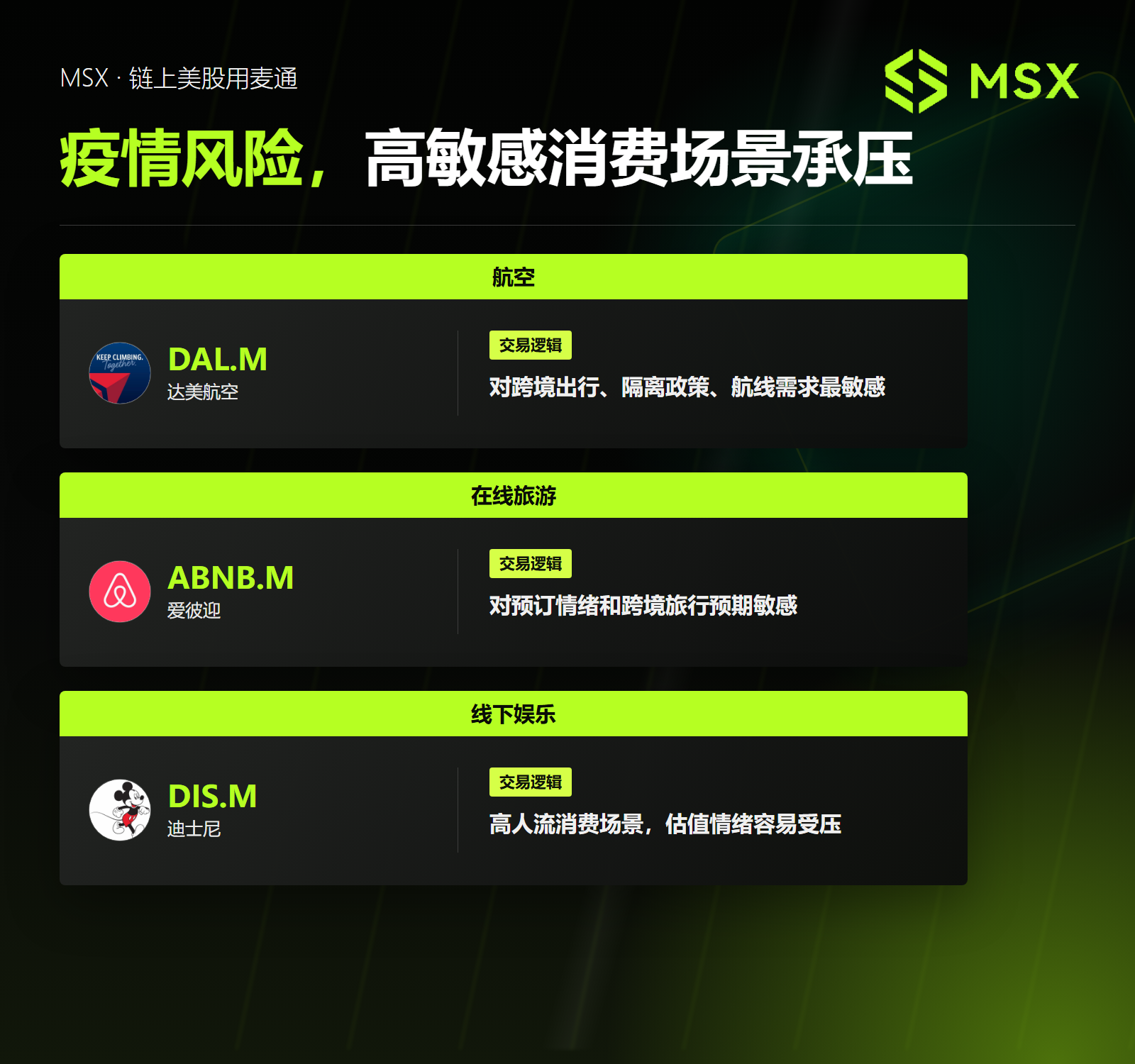
First is the airline industry.
Companies represented by DAL.M are most sensitive to expectations around cross-border travel, quarantine policies, route demand, and business travel. After all, the business model of airlines heavily relies on load factors and aircraft utilization (and fuel costs were already precarious amid high oil prices). Once the market starts worrying about escalating public health risks, capital may start discounting airline valuations even before large-scale flight suspensions or travel bans occur.
This isn't to say airline fundamentals will deteriorate immediately, but rather that the aviation sector is naturally at the very front of the public health risk transmission chain. Especially in the current macro environment, airline stocks are already squeezed by both oil prices and consumption resilience. If a public health incident is layered on top, the market is more likely to perceive them as 'highly sensitive assets.'
Secondly, online travel.
ABNB.M represents another type of asset more tied to consumption expectations. Compared to traditional airlines and hotels, Airbnb has a more decentralized business model and isn't entirely equivalent to a single hotel chain. However, it is highly correlated with leisure travel and longer-term stays. The impact of public health risks on ABNB.M may not manifest as an immediate ban on bookings in a specific country, but more through changes in travel planning cycles and consumer risk appetite.
If users start worrying about cross-border travel or flight uncertainties, what changes first is often not already-occurred consumption, but future bookings. In other words, online travel platforms essentially trade on 'future travel intention.' Once public health risks rise, these assets are easily used by the market to reflect expectations of cooling tourism consumption.
Thirdly, offline entertainment.
DIS.M is one of the most typical representatives here. Disney is, of course, not purely an offline consumption company; it also has streaming, content, IP, and film businesses. However, from a public health risk perspective, the market's most sensitive parts remain its theme parks, resorts, offline entertainment, and family travel scenarios.
The common characteristic of these businesses is high foot traffic, long dwell times, and strong family consumption attributes. Once public health risks rise, the market naturally contemplates changes in family travel plans and offline entertainment spending.
Similarly, this doesn't mean DIS.M will face an immediate material impact from a single regional outbreak, but it is easily placed by the market into the 'high-foot-traffic consumption scenario' for reassessment. Especially when market risk appetite declines, the valuation sentiment for offline entertainment often reacts earlier than actual operating data.
However, it needs to be reiterated that, at least as of this writing, the current public health risk has not evolved into global travel lockdowns. For instance, the WHO does not recommend simply treating the Ebola outbreak scenario as a reason for comprehensive border closures or flight suspensions. The core response measures remain risk communication, travel health notices, border surveillance, case identification, laboratory testing, and preparation of isolation facilities.
Therefore, for airlines, online travel, and offline entertainment, the current situation is more about sentiment-driven risk premium adjustments rather than a confirmed fundamental collapse. What truly needs monitoring are three variables:
- Whether more cross-border imported cases appear;
- Whether major countries raise travel advisories or strengthen entry screening;
- Whether airports, ports, hotels, and high-foot-traffic consumption venues begin implementing stricter containment measures;
If these variables continue to escalate, assets in the transportation and leisure chain could become the first batch of targets to be repriced in the US stock market, potentially transmitting pressure to subsequent categories of assets 'most easily explained as risk exposures during a pandemic narrative.'
3. Defensive Chain Heating Up: Capital Seeks Public Health 'Insurance Assets'
Corresponding to the pressure on the transportation & leisure chain is the heating up of the defensive chain.
After public health risks emerge, the market often seeks the most familiar 'insurance hedging directions' amidst uncertainty. These can be mainly categorized into four types: vaccine platforms, antivirals/candidate therapies, remote work tools, and healthcare & defensive consumption.
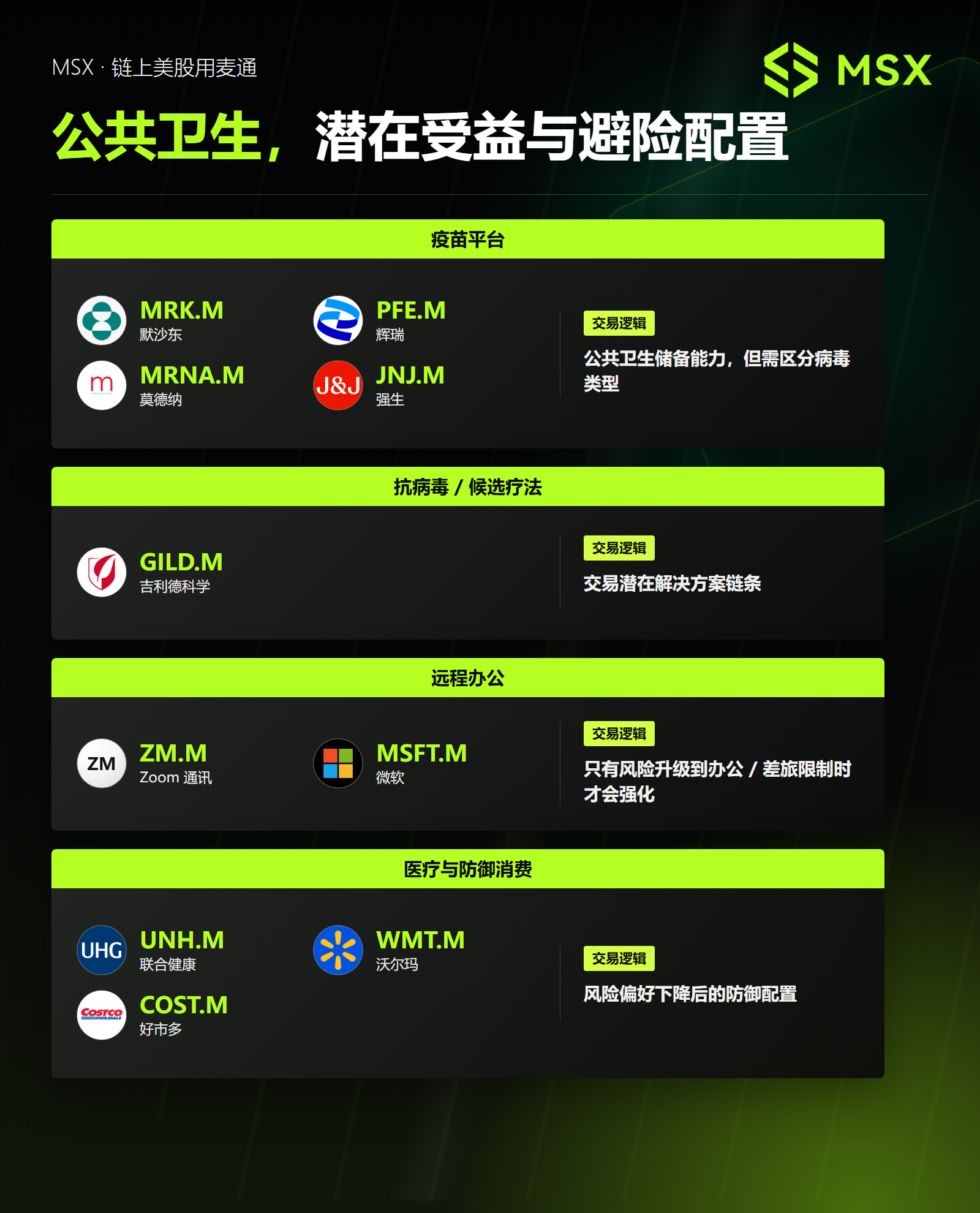
First are vaccine platforms. MRK.M, PFE.M, MRNA.M, and JNJ.M are the most easily recalled set of targets by the market. They collectively represent large pharmaceutical companies, vaccine R&D, manufacturing platforms, and public health stockpiling capabilities.
However, it's important to note that the current event concerns Bundibugyo ebolavirus, not the more common Zaire ebolavirus. Taking MRK.M as an example, Merck's ERVEBO is an approved Ebola vaccine, but it primarily targets the Zaire ebolavirus and does not necessarily cover all types of Ebola viruses.
Therefore, MRK.M is better understood as a representative of 'Ebola vaccine stockpiling capability' and 'public health assets,' rather than a direct cure for the current Bundibugyo outbreak. PFE.M, MRNA.M, and JNJ.M follow a similar logic: they attract attention not because they hold a definitive solution for this specific outbreak, but because large pharmaceutical companies and vaccine platforms naturally come into the market's focus during public health events.
In other words, the trading logic here is not about revenue from a single drug, but about the capacity for R&D, manufacturing, and stockpile response under public health risk.
Second are antivirals and candidate therapies.
In the final list of targets, GILD.M serves as a representative for this direction, as Gilead has a strong label in antiviral R&D, making it easy for the market to include it in the potential solution chain during public health events. However, the trading logic for this type of asset is also more about potential solutions rather than immediate short-term profit realization.
Especially for diseases like Bundibugyo ebolavirus, which currently lack approved specific vaccines and therapies, the market will pay more attention to candidate drugs, trial progress, the possibility of emergency use, and procurement expectations from public health institutions. That is, the key point for GILD.M is not how much revenue a single outbreak can immediately contribute, but the fact that as public health risks rise, capital will re-evaluate the strategic value of antiviral R&D capability itself.
Third are remote work tools.
ZM.M and MSFT.M represent a very familiar memory line from 2020 for the market. If offline work, business travel, cross-border meetings, and travel activities are restricted, companies would likely rely again on video conferencing, online collaboration, cloud office, and digital work tools. However, this time, remote work tools seem more like a tail option than a core asset. The reason is that the current public health event has not yet evolved into widespread work restrictions or a phase where global business operations are forced to restructure.
If the risk remains confined to localized areas, specific travel scenarios, and regional outbreaks, it would be difficult for remote work assets to replicate the extreme moves of 2020. So for ZM.M and MSFT.M, the remote work logic will only significantly strengthen if the public health risk escalates from a regional event to one imposing work restrictions and operational adjustments. Until then, it remains more of a backup hedge in the market's memory rather than the primary theme.
Fourth are healthcare and defensive consumption.
UNH.M, WMT.M, and COST.M represent another class of assets that benefit from declining risk appetite: those with more stable cash flows, more inelastic demand, and stronger defensive characteristics.
UNH.M corresponds to health insurance and the medical payment system. It is not simply a 'pandemic beneficiary stock,' as public health events can also bring changes in medical utilization, claims costs, and operational pressure. However, when risk appetite declines, assets related to medical payments, health coverage, and healthcare services are generally viewed by the market as a more stable direction compared to discretionary consumption.
WMT.M and COST.M correspond to the logic of essential consumer goods and household restocking. As public health risks rise, consumers may reduce non-essential travel and high-risk consumption, but demand for daily necessities, food, medicine, household supplies, and membership-based retail tends to show more resilience.
Overall, 'insurance assets' under public health risk are not limited to pharmaceutical stocks. Instead, they form a more complete defensive chain: the front end consists of vaccines and antivirals, the middle includes operational alternatives like remote work tools, and the back end encompasses medical payments and essential consumer goods.
Final Thoughts
Objectively speaking, the transmission mechanisms of Hantavirus, Bundibugyo ebolavirus, and SARS-CoV-2 are completely different.
Hantavirus is more related to rodent exposure, while Bundibugyo ebolavirus primarily relies on bodily fluids and close contact. Neither is suitable for being simply analyzed using the 2020 COVID-19 model.
But financial markets never wait for all facts to be completely confirmed before reacting.
Once the wind changes direction, they often perform a rapid-fire rehearsal of the transmission chain based on historical memory. For instance: Airlines, cruises, hotels, and tourism consumption get suppressed first; Vaccines, antivirals, diagnostics, PPE, medical equipment, and remote work tools regain speculative interest; Health insurance, pharmacies, essential consumer goods, and defensive assets are re-evaluated as risk appetite declines.
It is precisely for this reason that public health events may not necessarily become long-term themes, but they are sufficient to alter capital's risk preferences in phased trading.
Now, against the backdrop of the AI boom, interest rate dynamics, and geopolitical conflicts, whether global public health risk is re-entering the pricing framework could be becoming a dark horse factor that the US stock market hasn't seriously traded for a long time.


