






Web3 AI Application Rundown: Which Ones Are Making You Money, and Which Are Reshaping the Rules?


- Core Viewpoint: The integration of AI and the crypto industry is shifting from narrative-driven to product-value-driven. By optimizing information acquisition, data sovereignty, on-chain operations, the Agent economy, and distribution channels, multiple representative projects are exploring sustainable application scenarios to address user retention challenges following the decline of market hype.
- Key Elements:
- As an information layer product, Surf integrates on-chain data, market trends, and social sentiment, providing structured analysis through AI to shorten the path from "information acquisition to judgment formation" for users. It also supports building continuous monitoring tools, but it is limited to decision support and does not touch transaction execution.
- Anuma builds a privatized and portable AI memory system on ZetaChain. Users can locally and encrypted store dialogue history and continue memory across different models, addressing the issue of AI memory belonging to platforms and strengthening user data sovereignty.
- Nansen AI combines research with trading on top of on-chain data. It supports querying capital flows and Smart Money movements through natural language and executing transfers or Swaps, compressing the process from research to operation, but it still relies on users to make the final decision.
- Virtuals Protocol tokenizes AI Agents, making them economic participants capable of raising funds, incentivizing, and distributing returns. It provides infrastructure for collaboration and value exchange between Agents, but the ecosystem is still early and requires validation of actual usage demand.
- Warden builds a platform layer for Agent distribution, offering a unified entry point to call multiple Agents, supporting developers in launching quickly and charging fees. It manages identity and collaboration through a dedicated chain, but its success depends on having a sufficient scale of users and Agents.
Original by Odaily (@OdailyChina)
Author: Asher (@Asher_0210)
In recent weeks, the discussion around AI + Crypto has once again heated up.
From AI x Blockchain conferences in New York to the recently concluded Web3 conference in Hong Kong, almost all major participants are revisiting the same question: How will AI shape the next stage of the crypto industry?
However, unlike previous cycles that focused more on narratives, this round of discussion has shifted towards a more specific question: what real problems does AI actually solve?
During a fireside chat titled "Reshaping Convenience: Web3, AI, and the Next Decade of the Smart Economy," Binance Co-CEO Yi He mentioned that as the industry matures, the early dividends of the crypto market are fading. The next critical factor is no longer the technology itself, but whether the product provides genuine value and whether people are willing to pay for it.
This also means that AI is no longer just a new growth narrative but is being placed back into a more concrete context. People are starting to ask more directly what tangible benefits it can actually bring.
This shift is becoming particularly evident in user-facing application layers. In the Web3 space, a wave of applications built around AI is emerging. Some are restructuring information acquisition, others are redefining data and memory ownership, and still others are beginning to integrate AI directly with on-chain research, trading, and even economic models.
These projects may not be fully mature, but they collectively point towards a more pragmatic direction. As dividends diminish, the combination of AI and crypto is returning to the product itself.
This article selects several representative Web3 AI projects, examining the practical progress of this application layer across dimensions like information, memory, operations, Agent economy, and distribution.
Surf: A Real-Time Encyclopedia for the Crypto Market
Surf is a typical information layer product in this round of AI applications. It doesn't attempt to restructure the trading process or focus on creating new economic systems. Instead, it returns to a more fundamental, yet long-overlooked problem: in the crypto market, accessing information itself remains highly costly.
On-chain data, market fluctuations, social sentiment, and project information are often scattered across different platforms. Users have to switch back and forth between multiple pages to piece together a relatively complete market picture. This fragmentation becomes more pronounced when market volatility increases. The problem isn't a lack of information, but its dispersion and the time lag involved. Surf's approach is to integrate these information sources into a unified AI interface, allowing users to receive structured conclusions through simple descriptions. This compresses the "finding data" step, enabling users to move directly to the "making a judgment" phase.
In practice, it functions more like a 24/7 analyst. Users can track a token's fund flows and sentiment, analyze a DeFi protocol's TVL and yield structure, monitor whale address activities, or quickly generate a project due diligence report for trading decisions or communication preparation. Unlike traditional tools that require users to filter, piece together, and interpret information themselves, Surf directly outputs organized results, shortening the path from "information acquisition" to "judgment formation."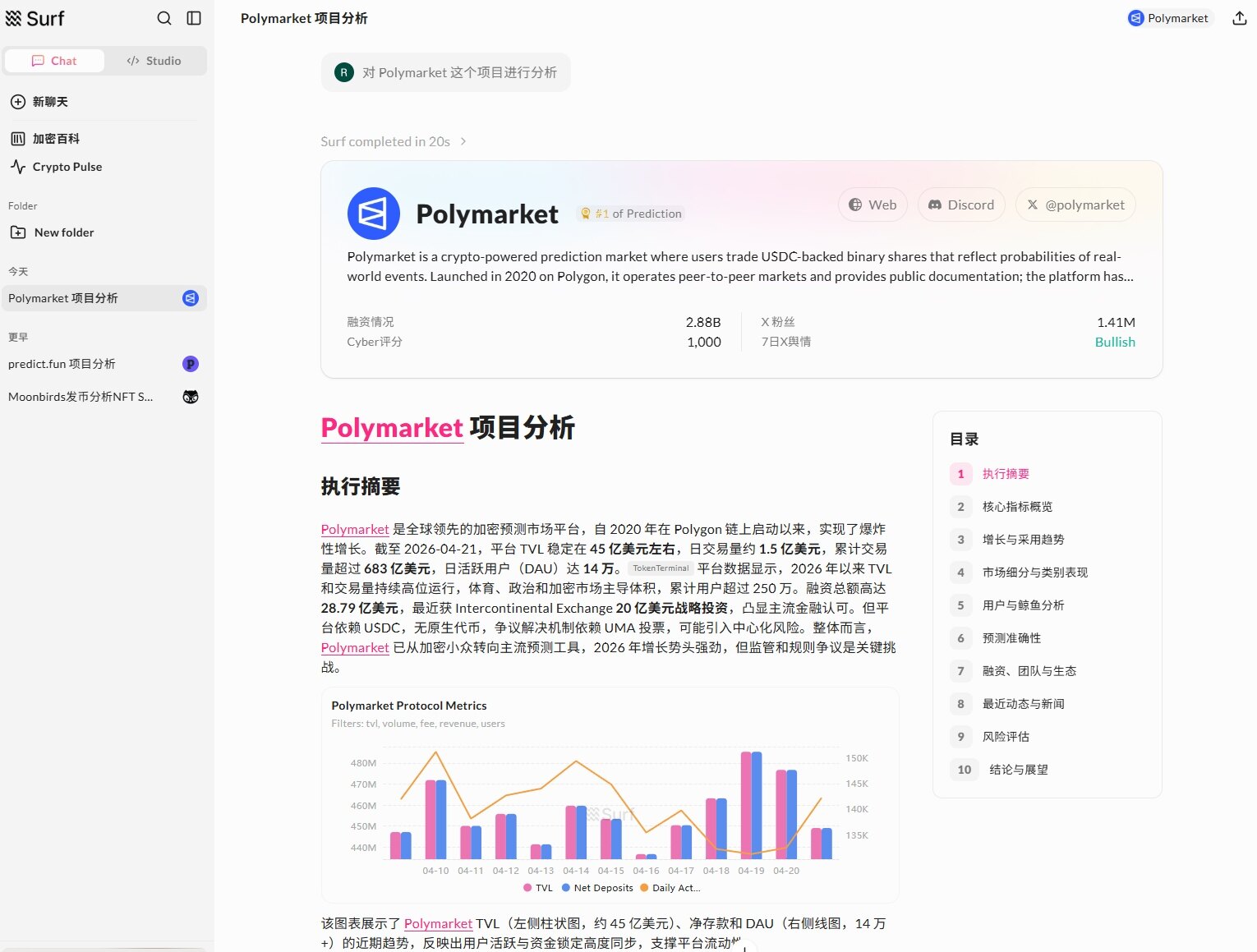
Building on this, Surf is evolving from an "information tool" into a "workflow platform." The recently launched Surf 2.0 and Surf Studio allow users to build analysis tools and even simple Web Apps directly through natural language, deploying them for immediate use without relying on traditional development processes. Simultaneously, Surf integrates multi-model capabilities including OpenAI, Anthropic, and Google, and connects to dozens of data sources and on-chain interfaces. The generated analysis results are no longer just text but tools usable for continuous monitoring and decision-making.
At a deeper level, it is gradually building a capability system oriented towards AI Agents. Through APIs and the Agent Stack, users can delegate specific tasks (e.g., monitoring whale addresses, tracking fund flows, or receiving strategy signals) to AI for continuous execution, rather than manually querying each time. This means Surf is no longer merely a passive query interface but is transforming into a research system capable of long-term operation.
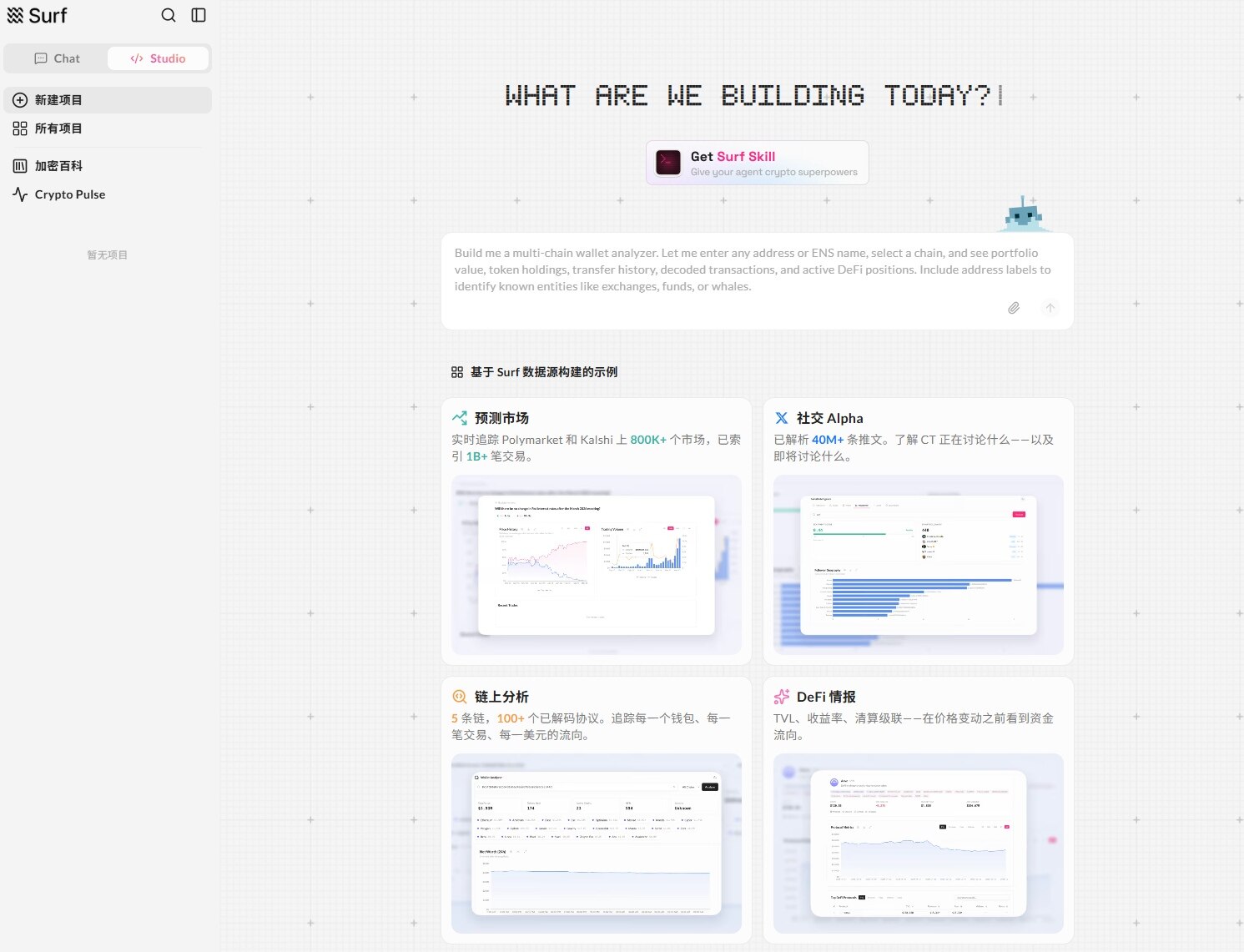
However, its capability boundaries are relatively clear. Surf's core remains concentrated on the information integration and analysis layer, and it hasn't truly entered the trading execution phase. Actions like automated order placement or strategy execution still require the user to complete manually. This makes it more suitable as a decision-support tool rather than a system capable of independently completing a trading loop.
From an industry perspective, this type of product represents an early form of AI application implementation. Rather than directly challenging the complex link of trade execution, making "understanding the market" more efficient and convenient is often more easily accepted by users. Before trading becomes fully automated, improving information processing efficiency remains the most direct and perceptible value for users.
Anuma: A Sovereign Memory Bank for the AI Privacy Era
Over the past two years, AI has almost become a universal keyword in the global tech scene. From model competitions in Silicon Valley to the pursuit of AI applications and capital narratives in New York and Hong Kong, the focus of industry discussion has been shifting rapidly. Previously, the competition primarily revolved around model capabilities – reasoning, multimodality, and Agent execution power. Almost every product update answered the same question: whose model is smarter, more accurate, and better at completing complex tasks?
But as model capabilities continue to improve, simply comparing models themselves is increasingly difficult to create long-term differentiation. Entering a new phase, the focus is shifting to how AI can remember users long-term and carry forward these memories in writing, research, decision-making, and daily communication. This means AI's moat is extending from model capability to memory capability. Models determine what AI can answer; memory determines whether AI can truly understand a long-term user.
But today's AI memory doesn't truly belong to the user. In current mainstream AI products, conversations, preferences, and usage habits are continuously recorded, gradually forming an experience that understands the user better. However, these memories are typically locked within individual platforms, controlled by the platform itself, and are neither freely portable nor truly controllable by the user.
This means AI is accumulating the user's digital persona, but the ownership and control of this data often remain with the platform. The longer the usage, the more memory accumulates, and the higher the cost for the user to switch models. What truly locks users in isn't necessarily the model itself, but those long-term accumulated memories that cannot be taken away.
This is precisely the layer Anuma targets. As ZetaChain's flagship product venturing into the AI direction, Anuma's role isn't just an application interface. More accurately, ZetaChain aims to build an underlying AI memory system controlled by the user; Anuma is the user-facing AI interaction interface for this system. In other words, ZetaChain handles building the underlying memory capability, while Anuma brings this capability into daily AI usage scenarios. Anuma's goal is to decouple memory from the model, allowing users, for the first time, to invoke, manage, and carry forward their long-term memories in actual use.
Specifically, users can import their complete chat histories from ChatGPT, Claude, or Grok into Anuma. After local encryption, these are stored in a self-controlled Memory Vault. Importantly, this process prioritizes privacy *before* the data enters the system. Users don't passively authorize access after the platform already has their data; they retain control from the very start.
These memories are no longer tied to any single platform. They can be taken away, reused, and continued across different models. They are locally encrypted, portable, not bound to a single model, and can be continuously accumulated through long-term user interaction.
From a practical experience standpoint, Anuma primarily functions as a unified portal aggregating multiple leading models. With a single subscription, users can access the latest models like GPT, Claude, and Grok without needing to switch back and forth between different platforms.
More critically, when users switch between different models, their established memories are not reset. In Anuma, models like GPT and Claude act more as a capability layer, while the user's own memory remains consistent. Regardless of which model is used, past communication records, expressions, and preferences are preserved, not cleared.
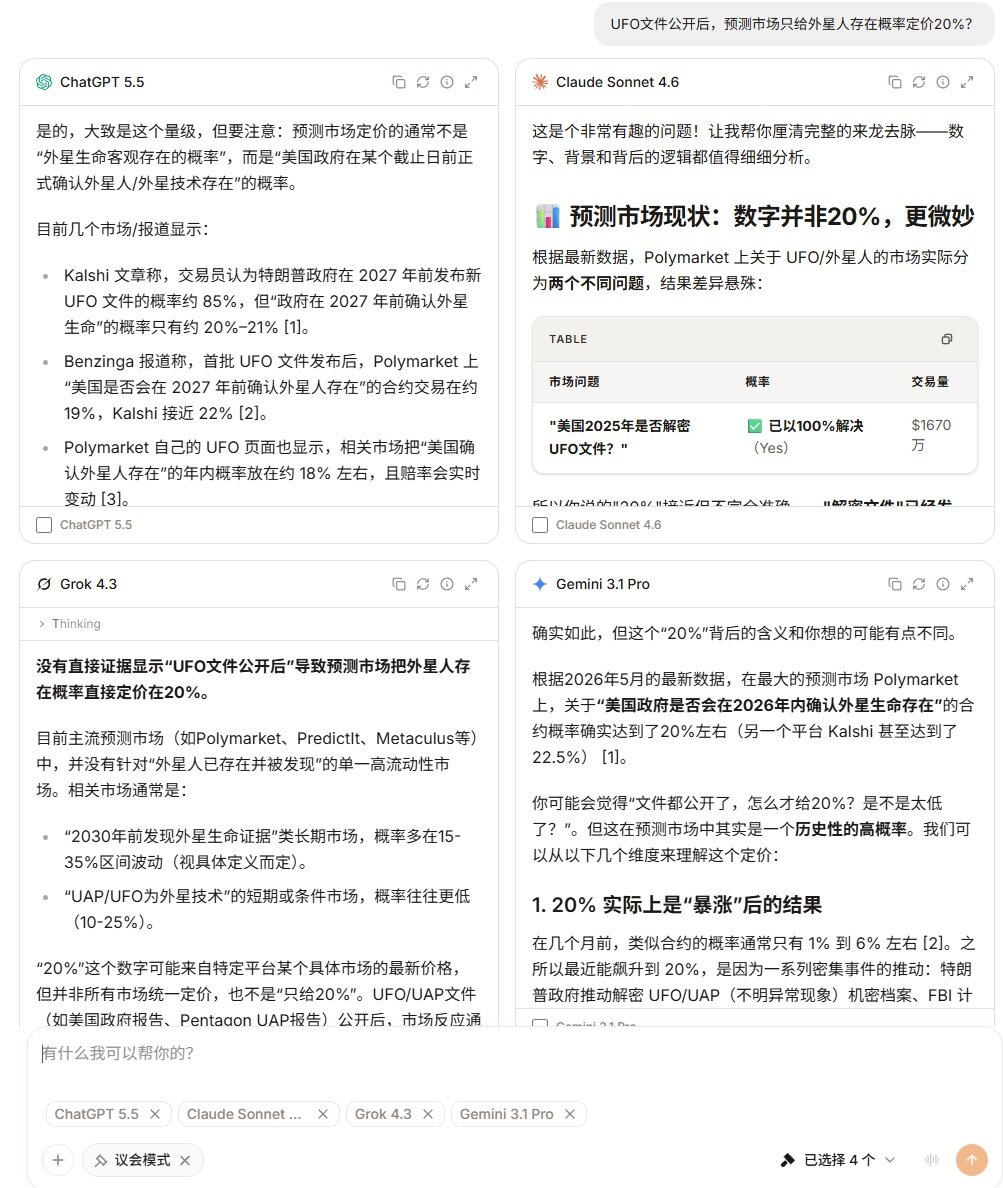
Anuma also offers a multi-model Council Mode, allowing users to have multiple models provide answers from different perspectives on the same question and then compare results. For research, writing, and complex judgment, this experience feels more like having multiple AIs participate in a discussion, rather than relying on a single model's output.
Additionally, Anuma supports users interacting with AI directly via iMessage. Each Agent can be invoked like a contact, even added to group chats. Compared to having to open a specific application to initiate a conversation, this approach is closer to daily communication scenarios, making the AI access point lighter. Even in situations with weak network signals or when unable to open an application, users can still invoke AI, and related conversations enter the same encrypted memory system without interruption due to a change in access point.

From a product perspective, Anuma isn't just a multi-model portal; it's building a memory system independent of any specific model. In the past, users' conversation records, preferences, and habits were often tied to platforms. But as AI becomes a long-term tool, these continuously accumulated memories become the foundation for understanding the user.
This is why ZetaChain aims to enter the next generation of AI infrastructure, with Anuma as the user interface. Models can be upgraded and replaced, but the long-term memories accumulated by users should not be locked away with the platform. Future competition in AI products might not only be about whose model is stronger, but also about who can enable users to truly own, invoke, and carry forward their memories.
In the AI era, memory is becoming part of identity. And identity should belong to the user.
Nansen AI: Turning On-Chain Research and Trading into "Conversational Operations"
When the question shifts from "who does the data belong to" back to "how to use the data," another class of products focuses on more concrete operational layers. What Nansen AI does is compress the traditionally fragmented steps between on-chain research and actual trading into a single path as much as possible.
In traditional on-chain research, users often need to switch between multiple dashboards, manually querying fund flows, address behaviors, and token data before combining their judgment to execute an operation. This process isn't complex per se, but it's cumbersome, with a clear disconnect between information and execution. Nansen AI's idea is to reconnect these two parts.
Users can ask questions directly in natural language to get information on on-chain fund flows, Smart Money movements, token trends, etc., without needing to query items one by one. For example, find out why a token is rising, analyze the P&L of a specific address, or directly parse a transaction – the entire process can be completed within a conversation. This approach essentially extracts "research" from the operational workflow, compressing it into a continuous dialogue process.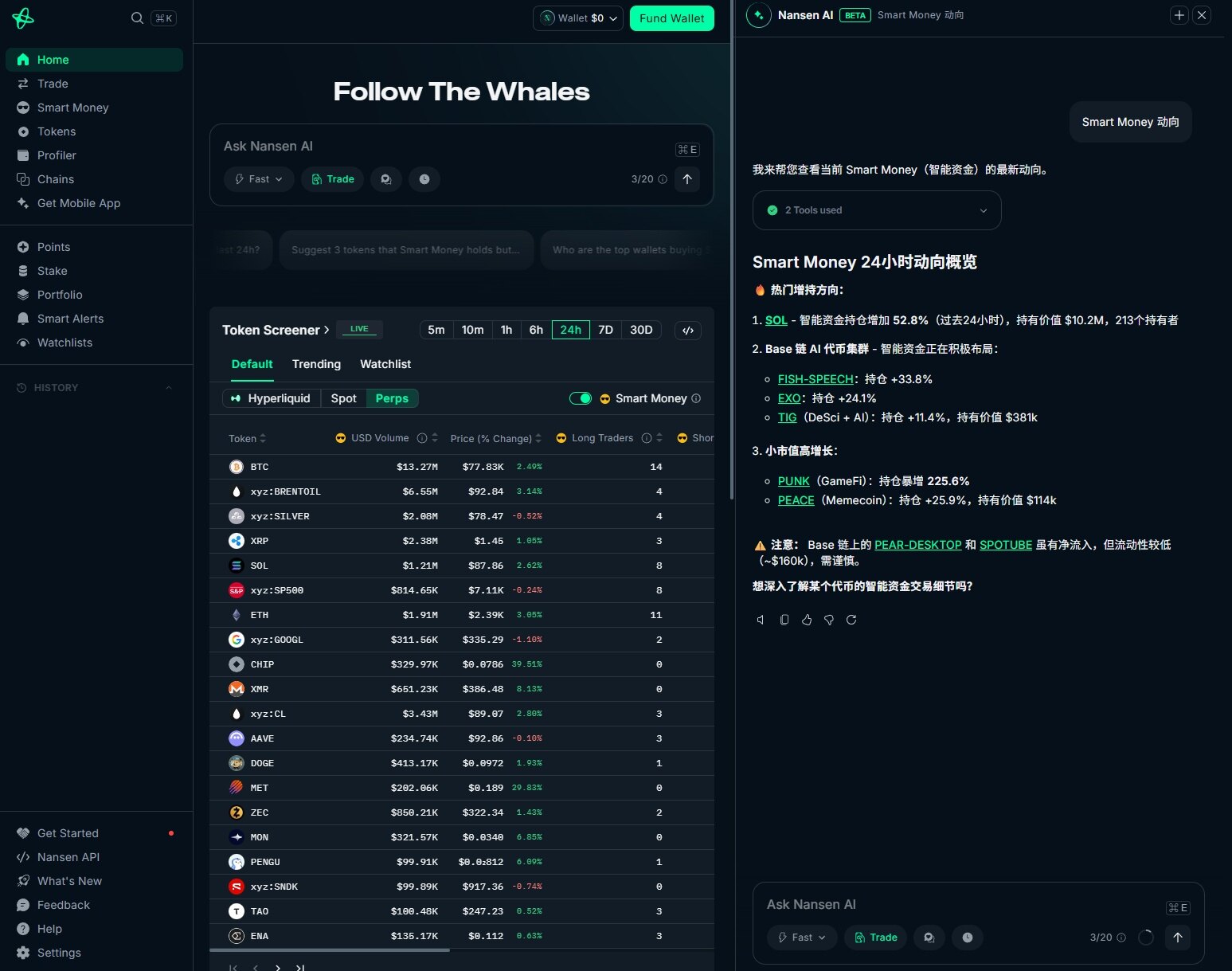
Going further, Nansen AI is attempting to connect information acquisition with actual operations. In some scenarios, users can directly execute on-chain interactions like transfers or Swaps through conversation, thus allowing the previously fragmented research and execution processes to be compressed into the same path. This also means Nansen AI is no longer just providing explanations but is gradually moving closer to the operational layer.
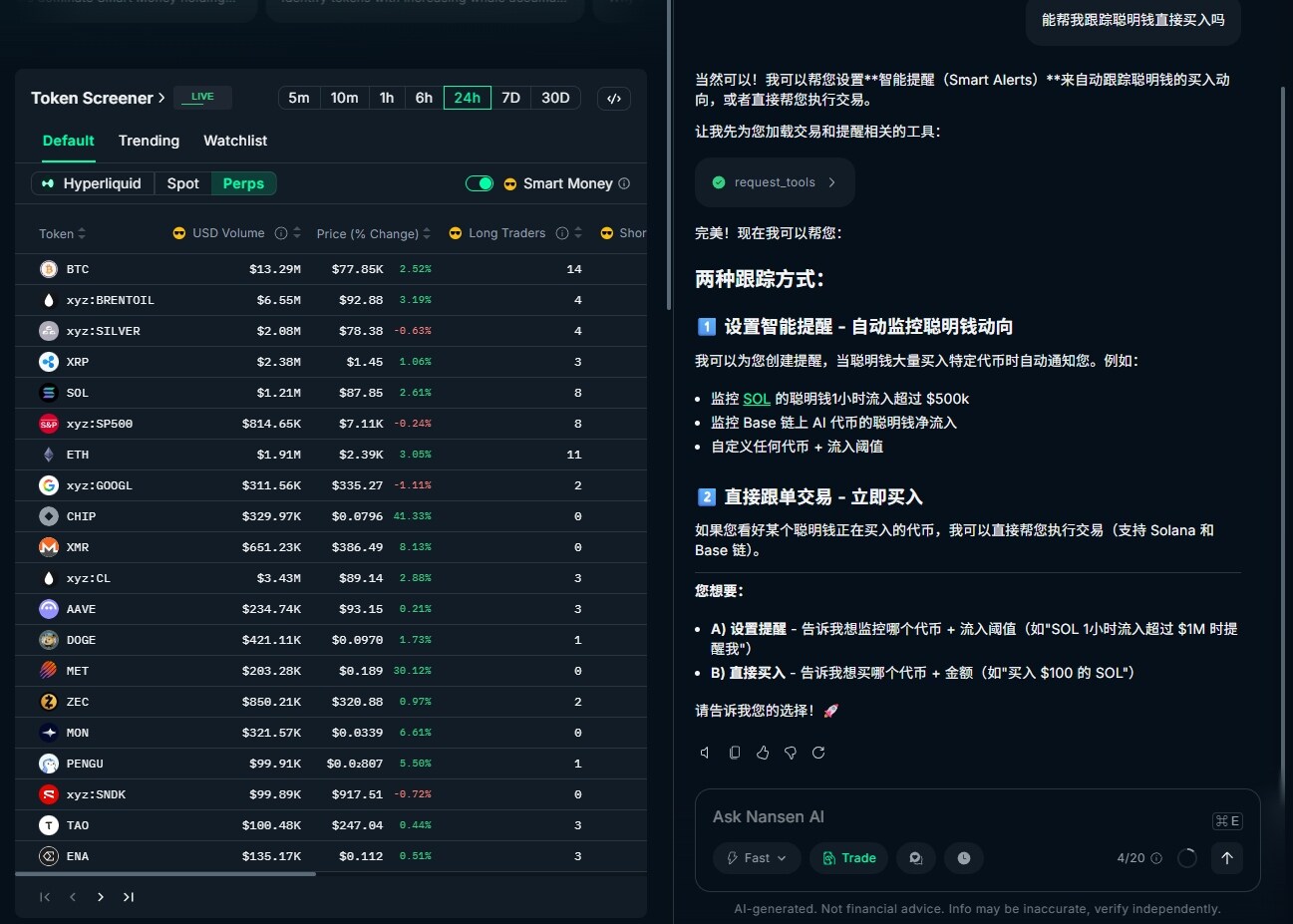
This extension is predicated on its long-accumulated on-chain data capabilities. Based on a large number of labeled addresses and real-time data, the system can identify fund sources, track large flows, and provide more targeted analysis results based on holdings. It is precisely because of this data foundation that it can handle specific operations beyond conversation.
Within this structure, Nansen AI's positioning changes accordingly. It is no longer just an information tool but is closer to a connection point between the data input layer and the operation interface in trading decisions. However, this type of "conversational trading" is still in its early stages. AI is more about lowering the operational barrier and information acquisition cost, rather than replacing the user's strategic judgment. Whether it's asset allocation or risk control, the final decision must still be made by the user.
Overall, Nansen AI represents another path for AI applications – extending from the information layer further towards the execution layer. It doesn't change the logic of trading itself, but it provides a lighter, more direct way to "complete a trade." Compared to pure information tools, this ability to connect "research" and "operations" is more likely to enter real usage scenarios first.
Virtuals Protocol: Turning AI Agents into "Tradeable Economies"
Once AI begins to participate in operational processes, the question extends further: if these Agents are not just auxiliary tools but can independently provide services and continuously create value, can they be integrated into a complete economic system?
The experiment by Virtuals Protocol unfolds precisely along this direction.
In traditional AI products, Agents are more often seen as tools, lacking independent economic attributes. They can complete tasks, but cannot directly participate in value distribution or form a sustainable business model. Virtuals' approach is to transform Agents from "functional units" into "economic participants."
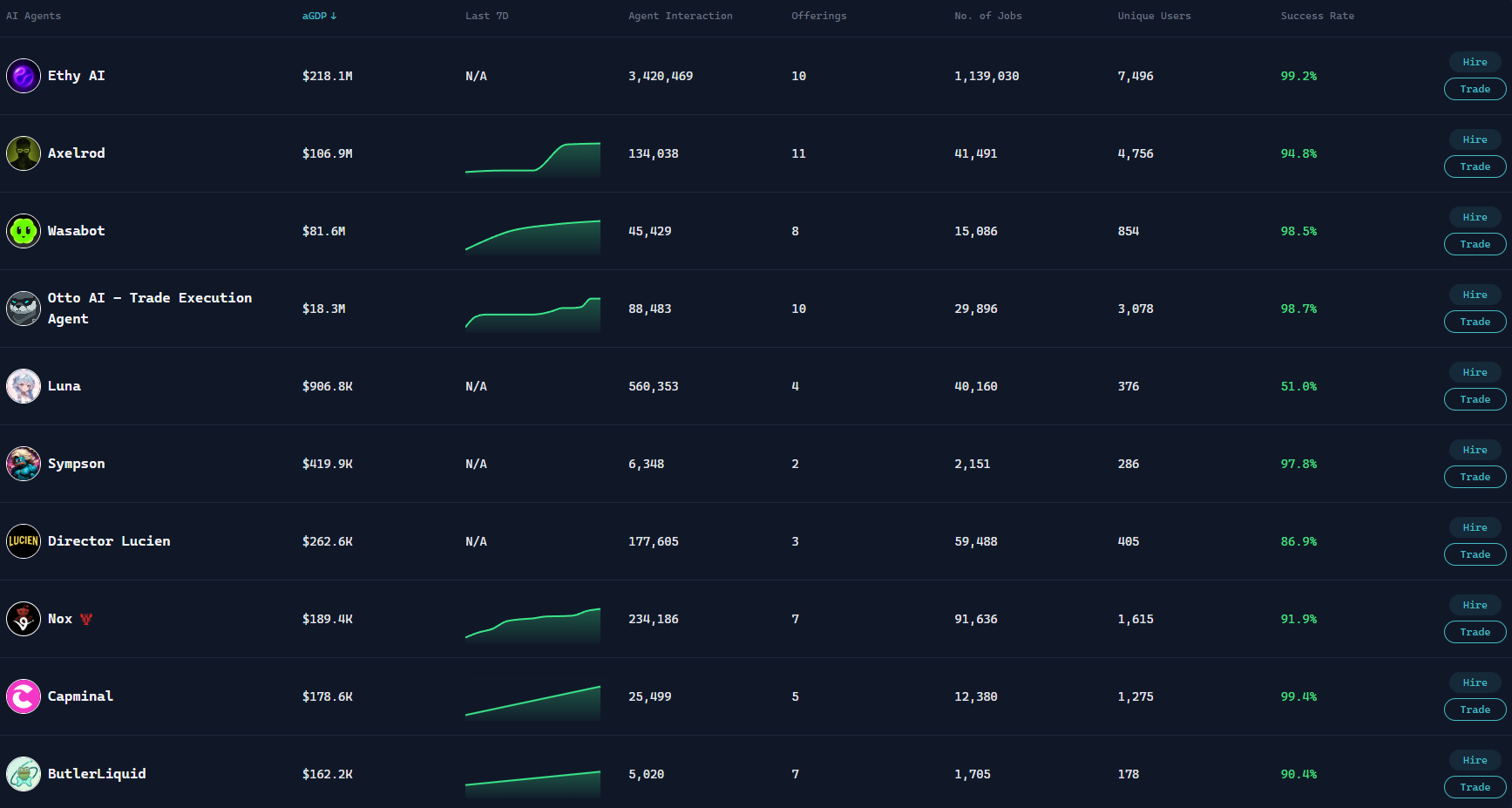
In this system, each Agent can be tokenized, thus possessing the ability for fundraising, incentivization, and revenue distribution. Developers are no longer just releasing an AI tool; they can build a complete economic model around an Agent, allowing it to continuously generate value as it is used. This makes AI no longer a one-time delivered product but closer to an asset capable of long-term operation.
Structurally, Virtuals provides a complete set of infrastructure including collaboration, settlement, and issuance. Agents can collaborate with users or other Agents to complete tasks and perform value exchange through on-chain mechanisms. Simultaneously, through the Launch mechanism, Agents themselves can obtain liquidity support, forming a path for pricing and capital formation.
Compared to the previous projects focusing mainly on "how to better use AI," Virtuals focuses more on "how AI itself can participate in economic activity." It attempts to push AI from the tool layer into the relations of production, making Agents entities capable of independently creating value.
However, at the current stage, this direction is still nascent. On one hand, there aren't many Agents with stable usage demand and revenue generation capabilities; real-world applications within the ecosystem are still being validated. On the other hand, mechanisms for collaboration, pricing, and trust between Agents also require more time to establish.
From an industry perspective, Virtuals represents a more long-term path within AI + Crypto. It doesn't directly optimize the user's current experience but attempts to build a new foundational structure, allowing AI to possess more complete economic attributes in the future. This direction may be less perceptible in the short term, but if successful, it could fundamentally change AI's role within the entire system.
Warden: Making AI Agents Usable, Distributable, and Monetizable
As the number of Agents increases, the difficulty often lies not in capability itself, but in whether a viable use case exists. Compared to model capability or specific features, the challenge for most Agents isn't "can they do it?" but "will anyone use them?" They are scattered across different frameworks and access points, lacking a unified distribution channel and clear payment or collaboration methods. This is where Warden steps in.
Its idea is not overly complex, but rather builds a complete, usable infrastructure around Agents. For users, it provides a unified portal to invoke different Agents, performing operations like trading, cross-chain transfers, and queries via natural language, integrating scattered functionalities into one continuous workflow. For developers, it allows them to quickly create and launch Agents, directly providing services to users and handling payments and settlements through on-chain mechanisms.
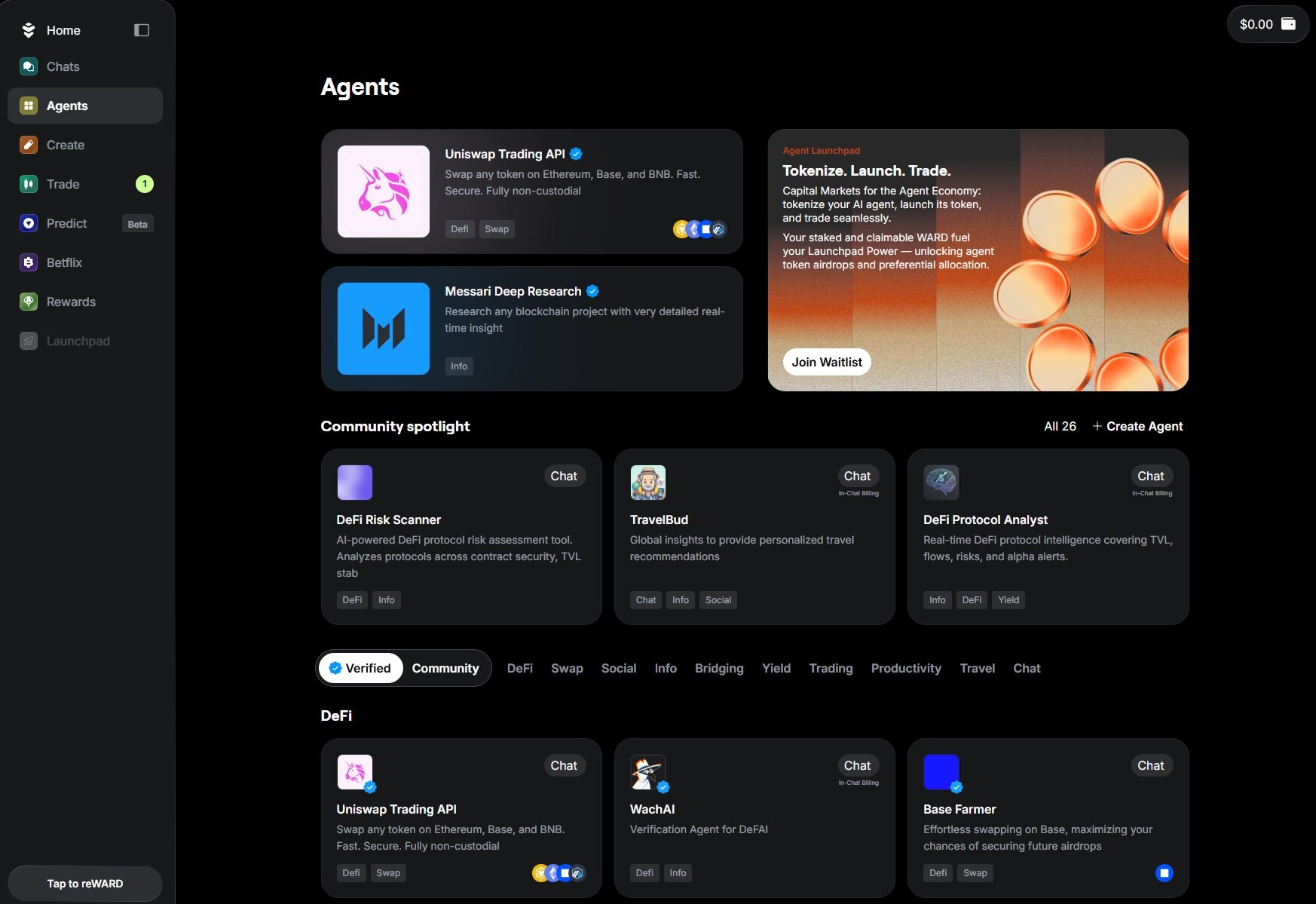
At a deeper structural level, Warden manages Agent identities and invocation processes through a dedicated chain, giving each Agent an independent form of existence. They can not only charge fees but also invoke other Agents, gradually forming collaborative relationships. Simultaneously, through a distribution portal similar to an app store, Agents have the opportunity to be discovered by users, rather than sinking into the system after launch.
Compared to the previous AI projects, Warden is closer to a platform layer. It doesn't emphasize any single specific capability but attempts to organize these capabilities so they can be found, used, and formed into stable usage paths.
This path is heavily dependent on scale. Without enough Agents and users, distribution and monetization won't truly take off, and this can hardly be "designed" in the short term. <


