일반 주요 CEX 암호화폐 주식 상품 솔루션 총정리


- 핵심 관점: 2025-2026년 시장 사이클에서 전통 금융(TradFi) 자산, 특히 주식은 중앙화 거래소(CEX)의 핵심 확장 방향이 되고 있다. 각 주요 플랫폼은 실물 주식 중개, 토큰화 증권, 주식 무기한 계약 및 Pre-IPO 상품 등 다양한 모델을 통해 단순 암호화폐 거래소에서 종합 금융 거래 플랫폼으로 진화하고 있으며, 이 트랙은 폭발적 성장기에 진입했지만 전체적으로는 여전히 초기 단계에 있다.
- 핵심 요소:
- 시장 폭발적 성장: CoinGecko 통계에 따르면, 상위 13개 거래 플랫폼의 주식형 무기한 계약 월간 거래량은 2025년 7월 약 8억 3,100만 달러에서 2026년 5월 약 340억 달러로 약 40배 증가했다. 같은 해 5월, 주식, 상품, 지수를 포함한 TradFi/RWA 무기한 계약의 월간 거래량은 3,471억 7,000만 달러에 달했으며, 연간 누적 거래량은 1조 3,200억 달러를 초과했다.
- 토큰화 주식 상용화: xStocks 체계를 예로 들면, 2026년 7월 기준 누적 거래량이 350억 달러를 초과했고, 전 세계 보유자는 약 20만 명에 달하며, 대상 자산은 미국에서 홍콩, 유럽, 한국 등 시장으로 확장되었다. Binance, OKX, Bitget, Gate 등 주요 플랫폼은 모두 이러한 자산을 지원하거나 연동하고 있다.
- 네 가지 상품 구조 분화: 현재 암호화폐 주식 시장은 네 가지 유형으로 구분된다: ①실물 주식 중개 서비스(예: Binance Stocks, Coinbase Stocks); ②실물 주식 기반 토큰화 증권(예: bStocks, xStocks, rToken); ③총수익/합성형 토큰(예: Ondo Stocks); ④1:1 준비금이 없는 주식 무기한 계약 및 CFD(예: 각 플랫폼의 TradFi Perps).
- 플랫폼별 모델 차이显著: Binance, Kraken 등은 "실물 주식-토큰화 증권-파생상품"의 다층 폐쇄형 체계를 구축했다; OKX는 제3자 xStocks와 Ondo 솔루션을 도입했다; Bitget, Gate는 파트너를 통해 전통 증권사를 연동하고 자체 준비금 토큰(예: rToken, gStocks)을 적극 추진한다. Coinbase 및 Backpack은 규제 준수에 중점을 두며 증권 권리 또는 1:1 양방향 전환을 강조한다.
- 경쟁 진입장벽과 트렌드: 이 트랙은 증권 라이선스, 청산·수탁 및 역내외 규제 준수를 수반하므로 중소 거래소는 진입이 어렵다. 경쟁의 본질은 플랫폼이 기존 Crypto 사용자를 TradFi 상품으로 전환할 수 있는 능력이며, 사용자 규모와 인프라 우위는 기존 산업 계층 구조를 더욱 강화할 것이다.
In this market cycle, TradFi is becoming one of the most clearly defined expansion directions for centralized exchanges, with equity assets gradually emerging as the core product entry point in this round of competition.
In fact, entering 2026, more and more exchanges have begun incorporating US stocks, ETFs, and even Pre-IPO assets into their trading systems. Product formats have also evolved from simple price derivatives to tokenized stock spot trading, on-chain transferable assets, stock contracts, CFDs, and direct stock trading services connected to traditional securities markets.
According to CoinGecko statistics on major crypto trading platforms, the monthly trading volume of equity-based perpetual contracts on the top 13 trading platforms grew from approximately $831 million in July 2025 to approximately $34 billion in May 2026, an increase of nearly 40 times in less than a year.
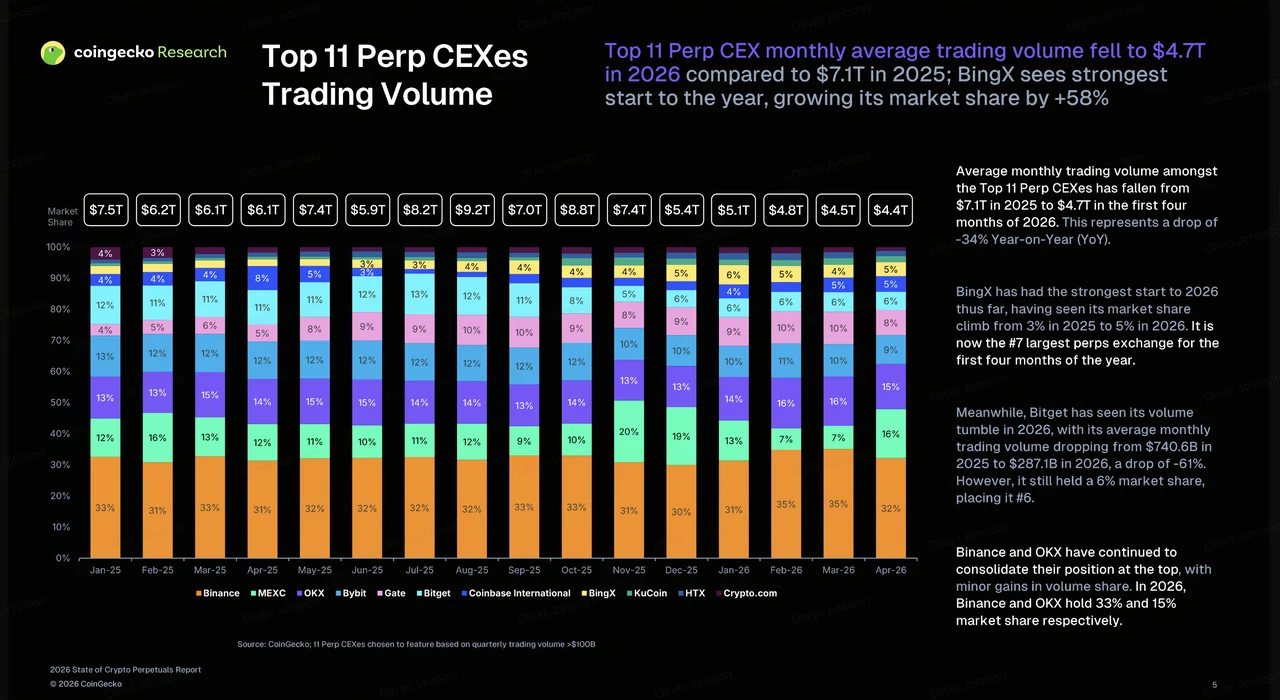
In the first five months of 2026 alone, the cumulative trading volume of equity-based perpetuals has already exceeded the full-year total of 2025. Including stocks, commodities, indices, and other TradFi/RWA perpetual contracts, the monthly trading volume reached $347.17 billion in May 2026, with the cumulative volume exceeding $1.32 trillion during 2026.
In the spot and on-chain tokenized stock direction, taking xStocks, one of the most prominent tokenized stock systems, as an example: as of July 2026, its officially disclosed cumulative trading volume has exceeded $35 billion, with nearly 200,000 global holders. It is now expanding from US stocks and ETFs further into markets such as Hong Kong, the UK, Europe, and South Korea.
Given the pace of product iteration and the recent investments by major exchanges, it is increasingly difficult to view this as a marginal RWA experiment. This track is gradually becoming a significant competitive arena for CEXs extending from Crypto to TradFi, and it remains in a period of explosive growth.
Of course, from the perspective of the entire global stock market, crypto stocks are still in a relatively early stage. According to CoinGecko data, trading activity in stock-based crypto derivatives currently accounts for less than 1% of traditional stock market volume. This also indicates that the overall room for development remains enormous.
If we further focus on the individual CEX solutions, it becomes apparent that each exchange has taken a different path into this track.
This article will systematically review and compare the current crypto stock solutions of several major platforms, including Binance, OKX, Bitget, Gate, Kraken, Coinbase, and Backpack, to help readers and traders better understand the current crypto stock market and its landscape.
Overview of Major CEX Crypto Stock Platform Solutions
Binance
Binance's layout in the crypto stock direction is no longer limited to a single Tokenized Stocks product. It has gradually formed a multi-layered product system covering real stock trading, tokenized securities, stock perpetual contracts, and Pre-IPO derivatives, including Binance Stocks, bStocks, TradFi Perps, and Pre-IPO Perps.
By splitting the same stock underlying into multiple different trading formats, users can directly hold stocks, convert some stocks into Tokens to bring them on-chain, or use perpetual contracts for leveraged trading.
- Binance Stocks
Unlike bStocks, Binance Stocks is not actually a tokenized stock. This service is provided by Nest Trading Limited, Binance's broker-dealer under the ADGM framework, and is connected to external securities brokerage and clearing systems. After purchasing stocks, users become the beneficial owner of the corresponding securities. The stocks are held in custody by partner brokers and, where applicable, users are entitled to dividends and rights arising from corporate actions such as stock splits.
Upon launch, Binance Stocks already supported 7,000+ US-listed stocks and ETFs, covering large-cap tech stocks, financials, consumer, energy, semiconductors, and a wide range of ETFs in the US market. The minimum investment threshold is only $5, with some stocks supporting fractional share trading. Stock purchases are primarily settled in USDC, while users can also directly use BNB, USDT, USD1, U, and other Binance account assets to place orders, with the system automatically converting to USDC upon execution.
Binance Stocks supports regular US trading hours, pre-market and after-hours trading, and some securities further support Overnight Trading, enabling up to 24/5 trading. Market Orders are primarily executed during regular US trading hours, while Limit Orders can cover extended hours and overnight sessions.
Binance Stocks aims to allow crypto users who already hold assets in their Binance accounts to directly enter the US stock market without needing to open a traditional brokerage account.
- bStocks
bStocks is issued by BTech Holdings Limited, an affiliated entity of the Binance Group. Its full name is bStocks Tokenized Securities, classified under ADGM's legal framework as Certificates as defined by FSMR Schedule 1 Paragraph 92. Each bStock is 1:1 backed by corresponding US stocks held by regulated custodians, but users hold rights to the underlying securities held by the issuer and are not directly registered as traditional shareholders of the listed company.
Binance has directly connected its "real stock accounts" with "on-chain stock Tokens." Eligible users can directly purchase bStocks, or first buy real stocks through Binance Stocks and then convert supported stocks into corresponding bStocks at a 1:1 ratio with zero conversion fees; conversely, bStocks can also be converted back to stock entitlements in Binance Stocks.
After conversion to Token status, the asset becomes a BEP-20 asset on BNB Smart Chain. Users can trade it 24/7 on Binance Spot or withdraw it to their BSC wallet and further integrate it with on-chain DeFi scenarios that support bStocks. Corporate actions such as dividends and stock splits are reflected in Token positions through Binance's designed Multiplier mechanism.
Binance currently supports including certain bStocks in Margin, Portfolio Margin, and collateral systems, fully leveraging asset composability in a DeFi manner.
Users can access on-chain perpetual contracts provided by Aster through Binance Wallet to trade certain blue-chip stocks, ETFs, and commodities. However, this trading actually occurs on the third-party DEX Aster, not within Binance CEX's own trading and clearing systems. Therefore, this article does not count it as a core Binance CEX stock product, but rather as a supplementary entry point within the Binance ecosystem.
- TradFi Perps
Unlike the previous two categories, TradFi Perps do not require users to hold or convert real stocks. They directly leverage Binance's perpetual contract system, which users are already familiar with, to provide stock price exposure.
Binance stock perpetuals use USDT settlement, 24/7 trading, and an 8-hour Funding structure, with a minimum notional trading amount typically of 5 USDT, and support Multi-Assets Mode. After May 2026, Equity TradFi Perps further introduced an Orderbook EWMA Index Mode during periods when the underlying securities market is closed, using the Impact Mid Price from Binance's order book combined with an EWMA mechanism to form a continuous index price.
Currently, Binance's stock perpetuals have expanded from early US stocks and crypto concept stocks such as MSTR, AMZN, CRCL, COIN, and PLTR to large-cap tech stocks, semiconductors, ETFs, and Asian markets. In addition to POPMARTUSDT corresponding to Hong Kong-listed Pop Mart, and ETF perpetuals such as TMF, TBT, and BITO, it has further listed Hong Kong and Korean stocks and ETF underlyings including ZhongJi Innolight, Samsung Electro-Mechanics, HANMI Semiconductor, LG Electronics, NAVER, and KODEX 200 ETF. Some contracts offer maximum leverage of 20-25x.
- Pre-IPO Perp
Binance officially launched Pre-IPO Perpetual Contracts in May 2026. At the time of product launch, the companies corresponding to these contracts were not yet publicly listed companies. For example, the first Pre-IPO Perp SPCXUSDT aims to allow users to trade the market's expectations for SpaceX's potential public market valuation through USDT-margined perpetual contracts before SpaceX's official IPO.
After SpaceX went public, this product directly converted from a Pre-IPO Perp to a regular TradFi Perpetual, with the index price switching to the official public market price. Meanwhile, users can also directly buy SPCX stock in Binance Stocks and obtain SPCXB through bStocks.
Therefore, Pre-IPO Perps support trading certain assets in Perp form before listing, trading real stocks after listing, further tokenizing real stocks into bStocks, and continuing to trade standard stock perpetuals.
Kraken
Kraken's product structure in the crypto stock direction is also relatively complete, mainly including real stock trading, xStocks tokenized stocks, and stock perpetuals and Pre-IPO Perps derived from xStocks.
Kraken's xStocks is a more foundational solution among many CEXs. It was initially launched through a partnership between Kraken and Backed. At the end of 2025, Payward announced the acquisition of Backed Finance, which is responsible for issuing xStocks, and completed the acquisition in January 2026. As a result, the issuance, trading, and settlement infrastructure of xStocks has been further integrated into the Payward/Kraken system. Kraken now possesses real securities brokerage entry points, Tokenized Stocks issuance infrastructure, and derivatives trading capabilities in this track.
- Real Stock Trading
Kraken actually began expanding toward traditional securities brokerage quite early. In April 2025, Kraken officially launched US stock and ETF trading. The US offering now covers 11,000+ stocks and ETFs, including securities from NYSE, Nasdaq, and AMEX markets, and supports managing them alongside Crypto assets in the same trading environment within Kraken App, Kraken Pro, and Kraken Desktop.
This portion is genuine securities brokerage business and serves as the underlying support solution for xStocks.
The securities services are provided by Kraken Securities LLC, an SEC-registered Broker-Dealer and a member of FINRA and SIPC. Users purchasing stocks on Kraken own real stocks, and the official documentation clearly states that stocks belong to users, with cash dividends credited directly to their accounts.
Trading hours also follow traditional securities market schedules. Regular US stock trading hours are Monday through Friday, 9:30 AM to 4:00 PM ET. While users can submit orders at other times, orders will queue for execution during the next trading session. Therefore, unlike xStocks and stock perpetuals, this does not truly operate 24/7.
According to Kraken's help center updated in July 2026, the stock business is currently available in most US states, with only Maine and New York not yet supported. In the European Economic Area, it has been opened to eligible users in Germany, the Netherlands, and France.
Meanwhile, Kraken continues to add traditional brokerage features. It currently supports transferring stocks and ETFs from other brokerage accounts into Kraken via ACATS, and also offers Stock Lending, allowing eligible users to lend out their actually held stocks and earn corresponding returns.
Kraken Securities thus embeds traditional securities accounts directly into Kraken, allowing users to truly hold stocks, while xStocks is responsible for further extending another portion of stock assets on-chain.
- xStocks
Kraken's most representative product in the crypto stock space is xStocks, a solution that has also been integrated by many CEXs and on-chain venues.
The basic structure of xStocks can be understood as purchasing real stocks/ETFs, with the custody system holding the underlying securities and issuing corresponding xStocks at a 1:1 ratio, ultimately circulating on the Kraken CEX and on-chain. Each xStock is 1:1 backed by the corresponding underlying stock or ETF, with underlying securities held through traditional securities brokerage and custody systems. Kraken collaborates with institutions such as Alpaca to complete underlying stock procurement and custody, and the xStocks issuance system then maps these securities into on-chain Tokens.
However, holding xStocks does not equal directly holding shares of the listed company. Users hold Tokens backed by real securities, not the underlying stocks registered in traditional securities accounts, and therefore typically do not have direct voting rights in the listed company. When the underlying stocks generate cash dividends, the corresponding economic benefits are typically reflected in Token positions through reinvestment and increases in xStock quantities.
Kraken currently has approximately 131 xStocks products (still being updated), including approximately 100 stocks, 27 ETFs, and a small number of other assets. Major underlyings include Apple, NVIDIA, Tesla, Microsoft, Amazon, Alphabet, Meta, Coinbase, Robinhood, Strategy, GameStop, as well as SPY, QQQ, and other stocks and ETFs.
However, a distinction should be made between Kraken's own tradable asset count and the entire xStocks ecosystem scale.
The xStocks issuance system has expanded to over 500 Tokenized Assets, but not all of them have been listed on Kraken.
Of course, similar to bStock, the biggest difference between xStocks and ordinary synthetic stocks within a CEX is that it is truly a movable on-chain asset. Users can directly buy xStocks on Kraken and then withdraw them to external on-chain wallets. Currently, xStocks operates on networks including Solana, Ethereum, TON, and Ink, fully leveraging composability in DeFi. This is why Kraken has been aggressively promoting its own chain recently — it actually wants to take more control into its own hands.
Currently, most xStocks can achieve near-24/5 trading, while core products such as TSLAx, QQQx, SPYx, NVDAx, CRCLx, AAPLx, HOODx, MSTRx, GLDx, and GOOGLx already support 24/7 trading on Kraken Pro.
Kraken is also continuously integrating xStocks into its existing Crypto product systems. Some core xStocks already support margin trading of up to approximately 3x and can serve as eligible collateral for Kraken Pro Futures and Margin. In other words, users can continue holding stock Tokens such as AAPLx, NVDAx, and SPYx while using them as margin assets without first selling them for stablecoins.
- Stock Perpetuals and Pre-IPO Perps
Building on the xStocks spot base, Kraken has further constructed xStocks Perpetual Futures.
Many CEX stock Perps solutions directly reference traditional securities market stock prices to construct indices. However, Kraken's xStocks Perps places greater emphasis on using a tokenized-equity benchmark — the xStocks price system — as an important reference before establishing perpetual contracts on that basis.
The advantage of this approach is that even when traditional US stock markets are closed, xStocks can continue price discovery on CEXs and on-chain, allowing corresponding stock perpetuals to maintain 24/7 trading.
Currently, the major xStocks Perps launched on Kraken include AAPLx, CRCLx, GOOGLx, HOODx, MSTRx, NVDAx, TSLAx, SPYx, QQQx, GLDx, and others. These contracts can offer up to approximately 20x leverage, and users can directly use their existing Kraken Crypto Perps margin accounts and collateral assets for trading, with support for both long and short positions.
So the same asset can exist in two completely different forms simultaneously on Kraken.
For example, NVIDIA: NVDAx is a Tokenized Stock 1:1 backed by real NVIDIA stock, while the corresponding NVDAx Perp is a leveraged perpetual contract further established on top of the NVDAx/stock price system.
Meanwhile, Kraken has extended this derivatives logic further into the pre-listing phase by launching Pre-IPO Perpetual Futures, with current representative products including OpenAI and Anthropic.
Since these companies do not yet have publicly listed stocks, Kraken uses a PreMarket Synthetic Index to address pricing. The platform first forms prices based on market trading in the Pre-IPO contract order book, then uses index and smoothing mechanisms to reduce the impact of individual orders or short-term volatility on prices. The Mark Price operates around this Synthetic Index.
When the company formally files IPO documents and actual share capital and issue prices gradually become clear, Kraken can perform a Rebase on existing contracts based on actual share counts. After the company formally lists, the price benchmark switches to the corresponding stock or xStocks price system, ultimately converting to standard stock perpetuals.
OKX
As another major CEX giant, compared to Binance, OKX's solution leans more toward a combination of Tokenized Stocks + Equity Perps + Web3/CeDeFi, primarily providing Crypto users with stock market exposure through different forms of stock Tokens and derivatives.
Breaking this down further, OKX's current stock-related products can actually be divided into three main paths:
- One is the Unified Tokenized Stocks within the CEX, currently primarily based on xStocks;
- The second is Ondo Tokenized Stocks accessed through OKX CeDeFi/DEX;
- The third is the larger-scale Stock/Equity Perpetuals.
Additionally, in certain regulated regions such as the EEA, OKX also offers a different contract structure solution called Equity X-Perps.
These product sets are gradually being integrated into the TradFi entry point on the OKX front end.
- OKX Unified Tokenized Stocks
OKX officially launched Unified Tokenized Stocks (UTS) in July 2026, directly integrating stock Tokens into the existing CEX Spot trading system. Users can trade Tokens corresponding to Apple, NVIDIA, Tesla, Microsoft, SPY, QQQ, and other stocks and ETFs directly in their OKX accounts with US