






十三배로 장신 테크놀로지(长鑫科技)를 낙관하다?


- 핵심 의견: 노무라 증권이 장신 테크놀로지에 대해 처음으로 커버리지를 개시하며 '매수' 의견과 116위안의 목표주가를 제시했습니다. 낙관론의 근거는 생산능력 확장, 기술 업그레이드 및 가격 상승에 있으며, 매출과 순이익이 고속 성장할 것으로 예상되나, 지정학적 리스크와 메모리 업종의 강한 경기 변동성에 주의해야 합니다.
- 핵심 요소:
- 장신 테크놀로지는 7월 27일 커촹반(科創板, 중국 기술주 시장)에 상장했으며, 공모가 대비 시초가가 470% 이상 급등했습니다. 시가총액은 3조 6천억 위안을 넘어 공상은행을 제치고 A주 시가총액 1위에 올랐습니다.
- 노무라 증권은 장신 테크놀로지의 2028년 매출이 7,733억 위안, 지배주주 순이익이 3,931억 위안에 달하며, 연평균 성장률이 각각 63%와 74%에 이를 것으로 예측했습니다. 이는 생산능력 확장과 DRAM 가격 상승에 기반한 전망입니다.
- 애플이 중국 시장용 보급형 아이폰에 탑재하기 위해 장신 테크놀로지의 DRAM 칩 테스트를 시작했습니다. 협력이 성사될 경우 글로벌 고객 인지도가 향상될 것입니다.
- 노무라는 장신에 대해 20배의 선행 주가수익비율(PER)을 적용했으며, 마이크론과 SK하이닉스의 PER 전망치가 각각 10배와 5배인 점을 고려할 때, 이는 A주 반도체 섹터의 밸류에이션 프리미엄에 기인합니다.
- 글로벌 AI 수요는 메모리 사용량 증가를 촉진하지만, 공급 확장은 제한적입니다. 노무라는 장신의 글로벌 DRAM 점유율이 약 10%에서 2028년 말까지 18%로 상승할 것으로 예상합니다.
- 주요 리스크는 미국의 MATCH 법안 등으로 인한 장비 및 소재 금수 조치에서 비롯됩니다. 최악의 시나리오에서 장신의 2027-2028년 매출과 순이익은 각각 13%-14% 및 30%-33% 감소할 수 있습니다.
Original Author: Su Yang
Original Editor: Xu Qingyang
Original Source: Tencent Tech
ChangXin Memory Technologies' IPO has become the hottest topic in China's tech sector.
On July 27, ChangXin Memory Technologies, the leading domestic DRAM manufacturer, was listed on the STAR Market. Its opening price was 49.50 yuan per share, surging over 470% from the IPO price of 8.66 yuan. Concurrently, with a market capitalization exceeding 3.6 trillion yuan, it surpassed Industrial and Commercial Bank of China to top the A-share market value rankings, and more than doubled the market cap of Kweichow Moutai, becoming the "King of A-Shares."
As the only IDM (Integrated Device Manufacturer) in China capable of mass-producing DRAM, ChangXin's net profit for the first half of the year has already surpassed 50 billion yuan. Its global market share has climbed from 3% to nearly 8%, carving out a significant presence in a market dominated by Samsung, SK hynix, and Micron for decades.
Alongside ChangXin, a report from Nomura also caught fire.
Before the market opened on July 27, international investment bank Nomura released a report initiating coverage on ChangXin with a "Buy" rating and a target price of 116 yuan. Compared to the opening price, this implied a potential increase of over 12 times, instantly thrusting ChangXin into the market spotlight. In its report title, Nomura even likened the industrial value of ChangXin's DRAM chips to "The Jewel in China's Crown."
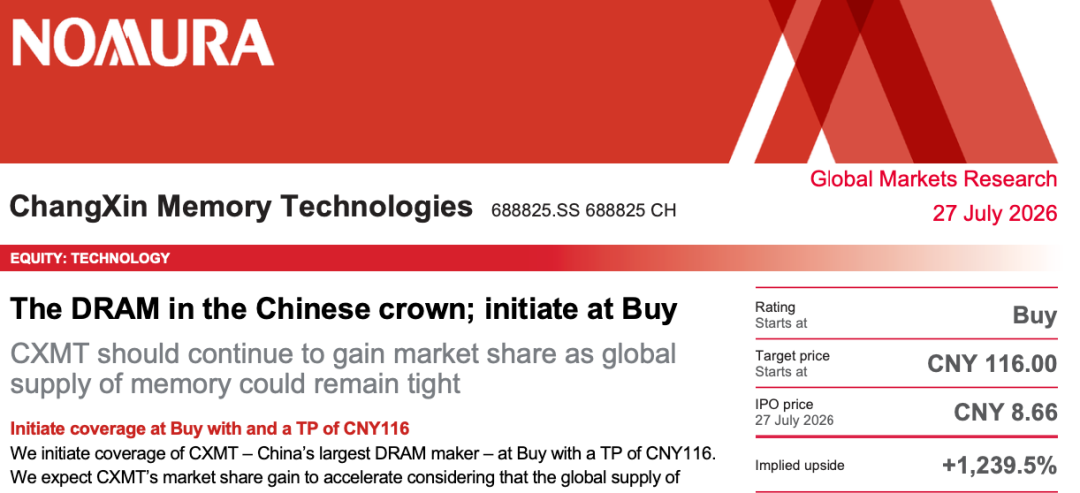
Nomura's research report on ChangXin
"A target price above 100 (meaning over 7 trillion yuan market cap) is somewhat aggressive," said an investor who has long followed China's semiconductor industry. "It's a possibility, but it would require exuberant market sentiment and would likely discount at least three years of future growth."
So, what is the underlying logic behind Nomura's 13x bullish call on ChangXin? And how does it assess the associated risks?
2027 Revenue Expected to Reach 560 Billion Yuan
According to data disclosed by ChangXin in its IPO press release, the company expects revenue of 110 billion to 120 billion yuan for the first half of 2026, representing a year-on-year increase of 612.53% to 677.31%. It expects net profit attributable to the parent company to reach 50 billion to 57 billion yuan, a year-on-year surge of 2244.03% to 2544.19%.
Regarding the performance growth, ChangXin stated, "In recent years, driven by factors such as the recovery in the memory industry, optimization of product mix, and the release of economies of scale, the company's operating performance has achieved rapid growth."
Compared to ChangXin's own performance estimates, Nomura's research report was more optimistic. According to its model projections, ChangXin's revenue will rapidly increase from 61.8 billion yuan in 2025 to 290.7 billion yuan in 2026, 560.8 billion yuan in 2027, and eventually 773.3 billion yuan in 2028.
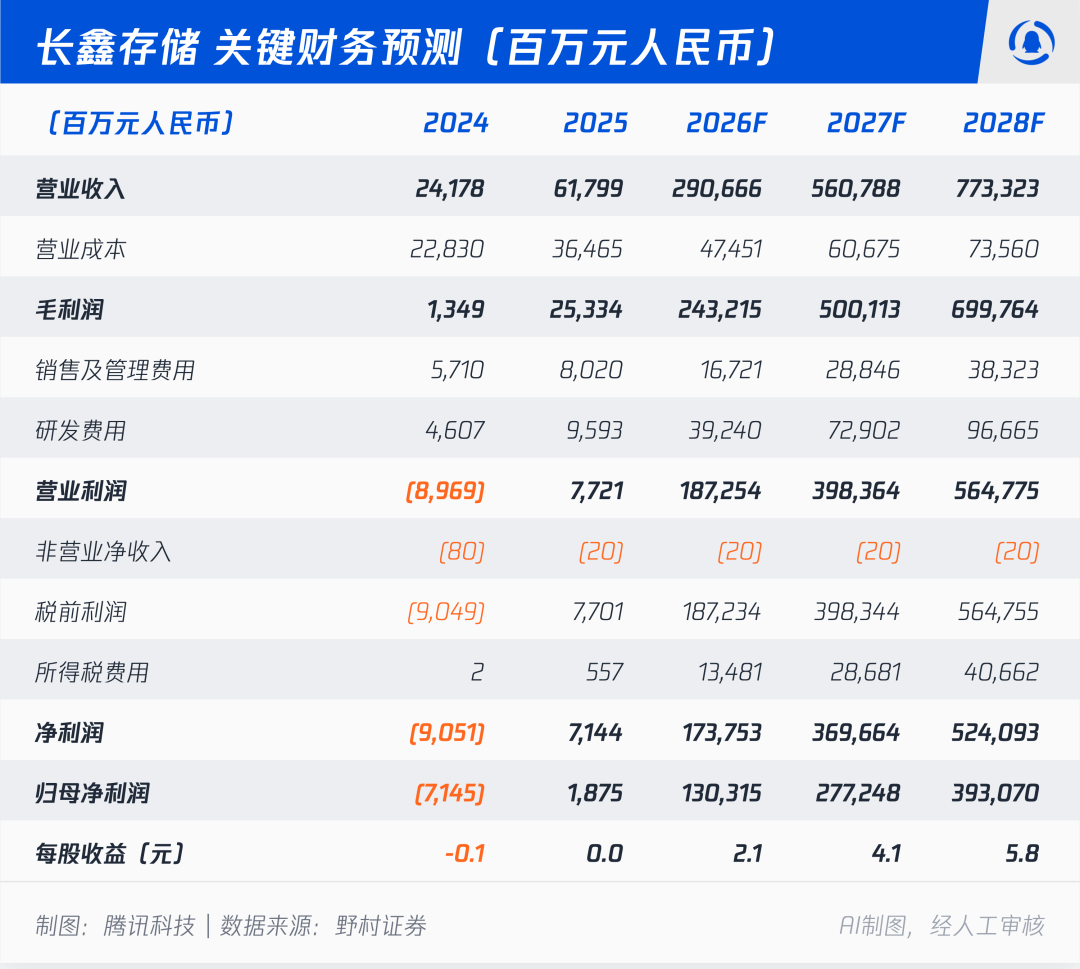
Nomura also forecasts that ChangXin's net profit attributable to the parent company, which was less than 1.9 billion yuan, will climb to 130.3 billion yuan, 277.2 billion yuan, and 393.1 billion yuan in 2026, 2027, and 2028, respectively. The compound annual growth rate for revenue is projected at 63%, and for net profit at 74%.
The underlying logic for these performance estimates revolves around three dimensions: capacity expansion, technological upgrades, and price increases. The first two dimensions are strongly correlated with the intended use of funds disclosed in ChangXin's prospectus.
Previously, ChangXin disclosed in its prospectus that the proceeds from this offering will be primarily used for projects such as the technological upgrade and transformation of memory wafer mass production lines, DRAM memory technology upgrades, and research and development of advanced dynamic random-access memory technologies, aiming to further enhance its advanced manufacturing capabilities and innovation level.
It's noteworthy that price increases primarily stem from two aspects: first, a rise in the average selling price per wafer driven by technological upgrades; second, a general price increase for memory chips amidst the so-called "super cycle."
"Since the second half of 2025, the continuous rise in product prices has led to a rapid increase in gross profit margins and profit levels, driving the company to achieve a turnaround from loss to profit in 2025," ChangXin stated earlier in the overview section of its prospectus.

The structure of ChangXin's product shipments is also upgrading.
In its previous responses to inquiries, ChangXin Memory Technologies disclosed that mobile terminal products are its current revenue mainstay. Smartphone manufacturers like Xiaomi, Transsion, Honor, vivo, and OPPO correspond to the LPDDR series products. Cloud providers like Alibaba and ByteDance primarily correspond to the DDR series products.
The revenue contribution ratio between these two customer types was roughly 9:1.
By May 17, 2026, revenue contributions from AI server-related products, represented by the DDR series, jumped to over 30%, but the LPDDR series product line remained the primary driver, accounting for over 66%.
During this phase of performance ramp-up, the actions of a heavyweight potential customer, Apple, warrant close attention.
According to a Financial Times report, Apple has begun testing ChangXin's DRAM chips, aiming to use them in devices like entry-level iPhones sold in the Chinese market. Concurrently, since around May or June of this year, Apple has been lobbying the U.S. government to seek relevant approvals.
If the collaboration ultimately materializes, ChangXin could potentially secure a portion of Apple's global DRAM procurement. The significance of this order extends far beyond the sales value itself; it marks a potential shift for a supplier previously labeled as a "domestic substitute" towards becoming a supplier recognized by mainstream global clients.
However, some institutions believe Apple might only be purchasing small batches from ChangXin, possibly using the new supply source as leverage in negotiations with Samsung and SK hynix.
Capacity Snapped Up, Valuation Rivals Twice Micron's
Based on Nomura's target price of 116 yuan, corresponding to earnings per share of 5.8 yuan in 2028, ChangXin's forward price-to-earnings (P/E) ratio would be approximately 20 times.
"Over 100 billion in profit supporting a 2 trillion market cap is reasonable," Chen Qi, an investor focused on the semiconductor industry, previously told Tencent Tech. "A 2 trillion market cap corresponds precisely to a 20x P/E."
For comparison, Wall Street's P/E expectation for Micron in calendar year 2026 is around 10 times, while SK hynix's is only about 5 times. Chen Qi remarked, "When the semiconductor cycle arrives, anything is possible."
In Chen Qi's view, a 10x P/E is reasonable, but a 20x P/E is also within the realm of possibility. "ChangXin's real opportunity lies in being positioned against Samsung, SK hynix, and Micron, truly representing Chinese memory at the table."
Nomura's 20x P/E for ChangXin also follows another logic: Micron can be viewed as a valuation anchor in the global DRAM sector, with its historical forward P/E center around 10x. Given that the A-share semiconductor sector has long commanded a valuation premium of 1 to 3 times over its US counterparts, taking the midpoint of about 2x would result in a P/E of 20x for ChangXin.
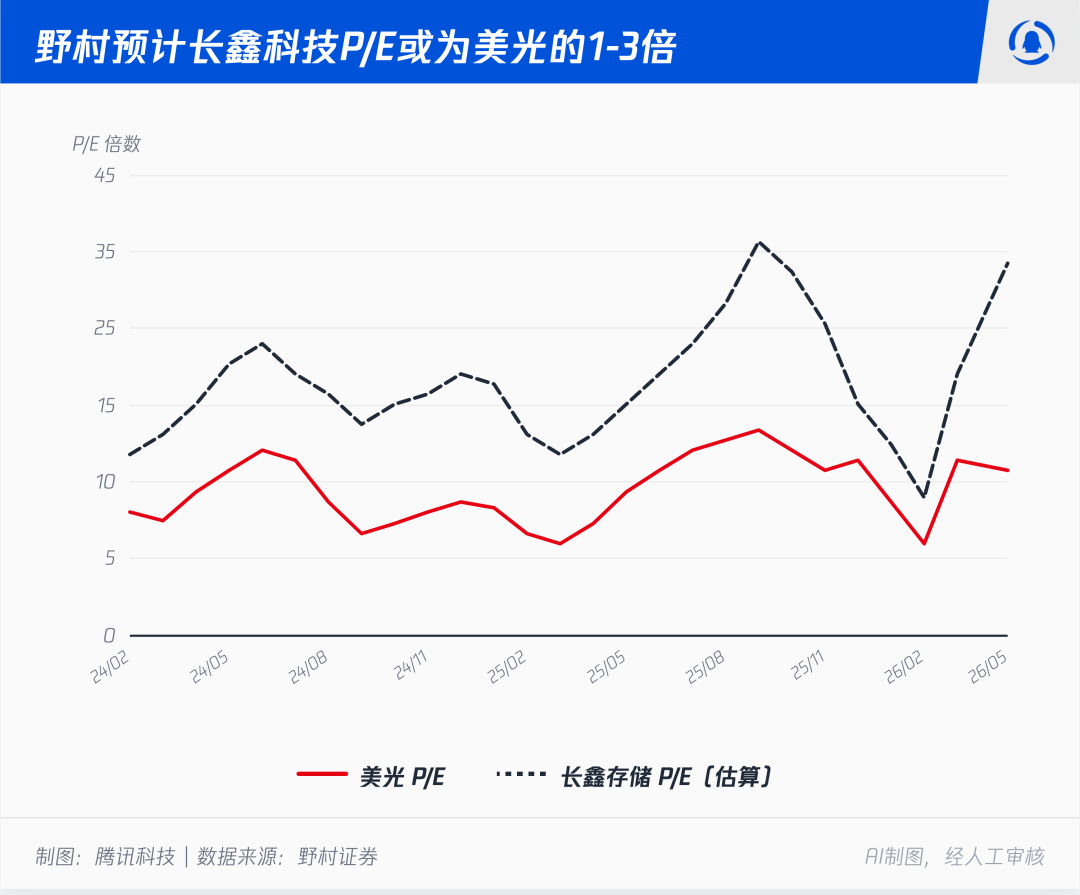
The core support for ChangXin's valuation is the exponential expansion in global memory demand driven by AI, while the supply side is constrained by physical bottlenecks and unable to keep pace. Nomura estimates that even factoring in a 60% efficiency gain from various memory-saving technologies, global memory demand for AI would still grow more than sevenfold between 2026 and 2030, representing a compound annual growth rate of over 60%.
Nomura even proposed a more extreme scenario: if AI robots operate autonomously without the constraints of human operational pace, the upper limit of demand would be determined only by authorization boundaries, infrastructure capacity, and capital expenditure budgets.
However, the rate of supply expansion is far slower.
Nomura expects industry capacity expansion to have a compound annual growth rate of only 30% to 40%. ChangXin's bit output CAGR between 2026 and 2030 is estimated at 40% to 45%, while higher than the industry average, still significantly lags behind demand growth.
Furthermore, around the same time Nomura's report was released, major Korean and American chip companies initiated a new round of consolidation.
On July 24, local time in the US, Samsung Electronics signed a memorandum of understanding worth over $200 billion with Broadcom, covering high-end memory supply such as HBM4, 2nm foundry services, and advanced packaging. Around the same period, SK Group and SK hynix reached a long-term cooperation intention with NVIDIA, valued at over $500 billion, focusing on joint development and stable supply of next-generation HBM.
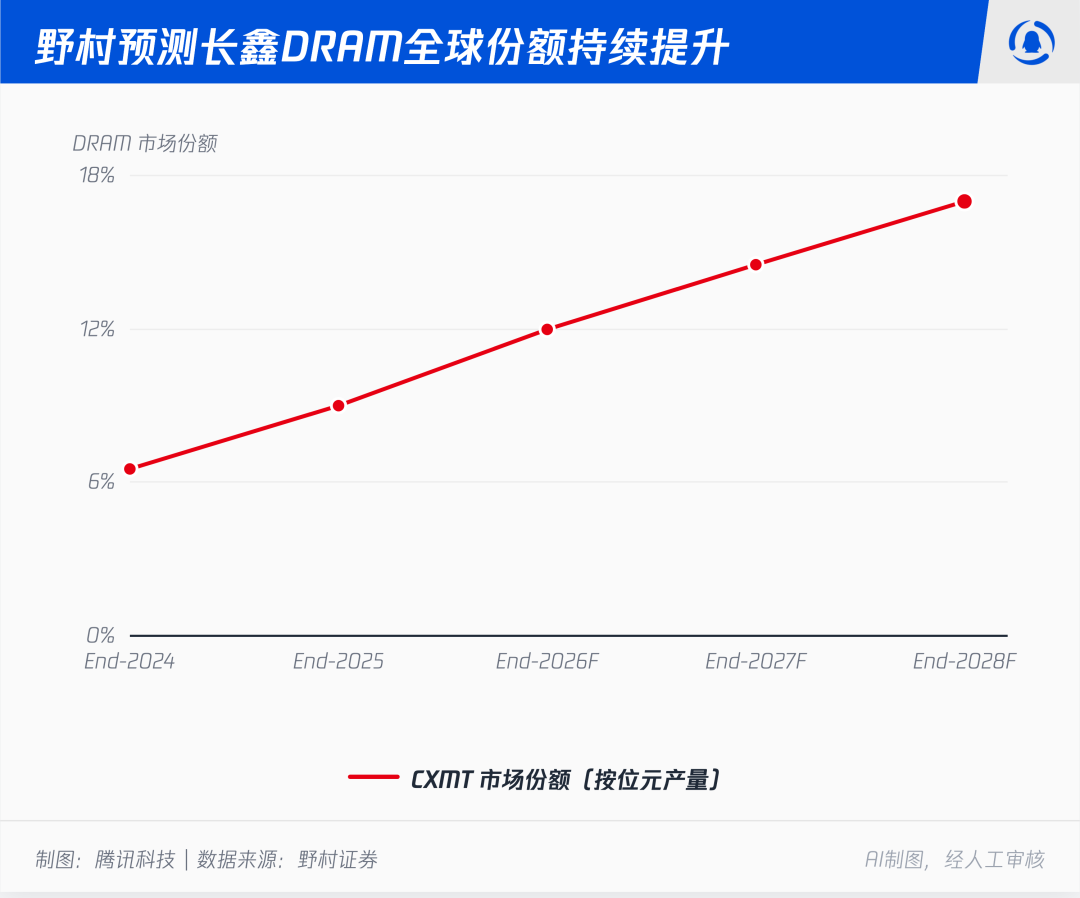
For ChangXin, the more focused the top players become on HBM, the larger the supply gap left in the traditional DRAM market. Nomura predicts ChangXin's share of the global DRAM market will increase from the current ~10% to 18% by the end of 2028.
Additionally, looking at the domestic Chinese market, there is ample room for increasing the self-sufficiency rate, providing a growth window for ChangXin's performance.
According to WSTS data, China accounted for approximately 25% of the global DRAM consumption market in 2025. However, based on production revenue, the global share of domestic manufacturers was only about 10%, implying a self-sufficiency rate of roughly 30%. Just within the Chinese market, the substitution potential is considerable.
A Dual Examination Under the Spotlight
While the prospects are enticing, Nomura also devoted significant space in its report to discussing risks.
The most prominent risk is the embargo on critical equipment and materials stemming from legislation like the US MATCH Act, including items like lithography and etching tools, as well as high-end photoresists. In a worst-case scenario, beyond capacity expansion constraints, ChangXin's revenue and net profit in 2027 and 2028 could shrink by approximately 13%-14% and 30%-33%, respectively.
These external risks significantly overlap with the shortcomings mentioned in the prospectus.
In its prospectus, ChangXin cited "geopolitical risks" related to the 1260H list, as well as competitive risks stemming from a highly monopolistic global market. Most critically, it highlighted the inherent cyclical risk of the industry: the strong cyclical nature of the DRAM industry and the risk of significant performance fluctuations.
Currently, the industry remains in an upswing super cycle, but cracks are appearing in the consensus regarding memory.
Take Micron, for example. After hitting a historical high of $1,255 on June 25, its stock fell to a low of $804 within just three weeks, representing a maximum drawdown of 36%. SK hynix's decline was even more dramatic. Its stock price in Korea dropped from a high of 2.987 million won on June 25 to 1.678 million won, a drawdown of 43.8%. Its ADR surged 27% on July 14, only to fall back 9% the next day.
The aforementioned investor focused on China's semiconductor industry told Tencent Tech that cyclicality ultimately reverts to basic supply and demand theory. "As long as the market is frothy, capacity expansion knows no bounds. Demand, however, can stop abruptly at some point. No market is an exception; memory is just a more extreme case."
The investor cited the case of Hua Hong in the 1990s, which invested heavily in memory during the height of the internet bubble, experienced severe price swings, and eventually pivoted to logic chip foundry, to emphasize the impact of memory cyclicality. "Few other markets experience 5-10x price increases in 1-2 years during boom times, only to see prices drop 90% in 1-2 years when the cycle turns. Since 1990, this has happened at least five times, roughly on a six-year cycle—a very regular pattern."
Therefore, how to maintain strict financial discipline during the favorable up-cycle and avoid aggressive capacity expansion will be a true test of ChangXin's long-term wisdom.


