SpaceX 상장 거래 핵심 창구: 7월 7일 나스닥 편입일과 7월 실적 발표 후 락업 해제 시점


- 핵심 관점: SpaceX가 곧 IPO를 실시하며, 발행가는 135달러, 초기 시가총액은 1.75조 달러에 달한다. 초기 유통 물량이 극히 적고(4.3%), 지수 펀드의 신속한 편입으로 인한 패시브 매수세가 더해져, 상장 초기에는 ‘주가 진공 구간’이 형성되어 주가가 두 배로 상승할 수 있다. 동시에 시장에서는 일론 머스크가 개인 세금 문제를 해결하고 자본 제국을 구축하기 위해 이 기회를 이용해 SpaceX와 테슬라의 ‘대등 합병(merger of equals)’을 추진할 가능성이 있다고 추측하고 있다.
- 핵심 요소:
- 극히 낮은 유통 물량(4.3%)과 나스닥, FTSE 러셀 등 지수의 신속 편입 규정이 결합되어, 7월 7일경 80억~180억 달러 규모의 패시브 매수세가 유입되며 강력한 주가 상승 동력이 발생할 것으로 예상된다.
- 초기 주식의 락업 해제 시점은 2분기 실적 컨퍼런스 콜과 정밀하게 연동되어 설계되었지만, 창업자 머스크의 엄격한 매각 금지 기간을 제외하면 실제 매도 압력은 10%~15%에 불과해 시장 예상치인 30%보다 낮다.
- 시장에는 ‘대등 합병’ 추측이 존재한다. 7월 7일 주가 정점과 7월 말 실적 발표 후 락업 해제 사이에, SpaceX와 테슬라의 ‘주식 맞교환(stock-for-stock)’ 합병이 발표되어 머스크가 8월 이전에 행사해야 할 스톡옵션으로 인한 70억 달러 규모의 세금 부담을 해결할 가능성이 있다.
- 이번 SpaceX IPO에는 찰스 슈왑, 모건 스탠리 등 이전에 머스크와 불화를 겪었던 투자은행들이 참여했다. 이는 막대한 경제적 이익을 제공함으로써 향후 테슬라 합병 투표에서 이들의 지지를 확보하기 위한 전략으로 풀이된다.
- SpaceX의 지배 구조(슈퍼 의결권, 강제 중재)는 창업자에게 절대적인 통제권을 부여하며, 이것이 테슬라 인수 주체로서 SpaceX가 가지는 우월성이다. 이는 근본적으로 창업자 통제권 문제를 해결하기 위함이다.
Original Author: Xu Chao
Original Source: Wall Street News
SpaceX is about to witness a historic IPO this Friday, with the offering price set at $135, translating to an initial paper market cap of $1.75 trillion. As a super unicorn of rare scale on Wall Street, its post-listing price trajectory and chip game are drawing feverish attention from global investors.
Prominent Tesla community opinion leader and former Wall Street analyst Alexandra Mertz (known online as Tesla Boomer Mama) recently had an in-depth conversation with host Herbert. Mertz believes that due to the extremely low initial public float (only 4.3%), SpaceX may encounter an unprecedented chip vacuum period in the early stages of its listing.
According to a Bloomberg report on Wednesday, index rebalancing forecaster Intropic estimates that because Nasdaq, FTSE Russell, and MSCI all plan to rapidly include SpaceX in their respective indices, passive investors are expected to hold approximately 30% of SpaceX's outstanding shares just 15 trading days after the IPO. In comparison, if the slower inclusion rules were followed, this proportion would only be around 4%.
Academics and market observers warn that mechanical demand of this magnitude, combined with market mania for Musk, SpaceX, and artificial intelligence, could form a self-reinforcing feedback loop, driving the stock price higher.
Mertz believes investors need to keep a close eye on two key time points with significant trading value: The passive buying peak triggered by "the official inclusion in the Nasdaq 100 on July 7th," and the overlap period of "the early shareholder lockup expiry and potential merger announcement two days after the Q2 earnings call in the second half of July." Hidden behind this meticulously engineered IPO is Musk's vast capital chess game, involving solving his own $7 billion tax event and using Wall Street investment banks for quid pro quo.
Key Takeaways Summary
July 7th Nasdaq Inclusion Day: The positioning of passive funds nationwide will collide head-on with the lowest level of public float in history. The market estimates this passive buying demand to be between $8 billion and $18 billion (closer to $15 billion). With old shareholders unable to sell shares at this time, the market's free float hits rock bottom.
Two Days After Q2 Earnings Call Lockup Expiry: The initial unlock amount appears to be 30%, but after deducting Musk's own 50% share subject to a 1-year absolute lock-up period, the actual selling pressure is only 10%-15%.
Speculation of a July "Merger of Equals": Musk faces a $7 billion tax liability from exercising his Tesla options before August 15th. Announcing a "stock-for-stock" merger of equals between the two companies, sandwiched between SpaceX's price peak on July 7th and the earnings lockup expiry at the end of July, would be a highly astute capital script characteristic of Musk.
Wall Street Investment Banks' Quid Pro Quo: Charles Schwab, Morgan Stanley, JPMorgan Chase, and other former institutional "adversaries" of Tesla have been unexpectedly allocated generous portions of the SpaceX IPO. This could be Musk's way of pre-emptively securing institutional "yes votes" for the merger vote at the November shareholder meeting.
1. Extremely Low Public Float (4.3%): Grok Model Predicts Stock Price Could Double on July 7th
SpaceX (tentative stock ticker SPCX) has set its IPO price at $135, giving an initial paper market cap of $1.75 trillion. The planned offering is for 555 million Class A common shares (approximately $7.5 billion in proceeds). With current market subscription interest already oversubscribed by 2 times, underwriters are highly likely to fully exercise the "greenshoe option" (over-allotment option) within 30 days, increasing total proceeds to $8.6 billion.
Despite the massive offering size, the Class A shares issued represent only 4.3% of the total market cap. This means the public float for SpaceX in the early stages of listing will be extremely tight, creating an intense chip vacuum period for SpaceX within the first 15 trading days.
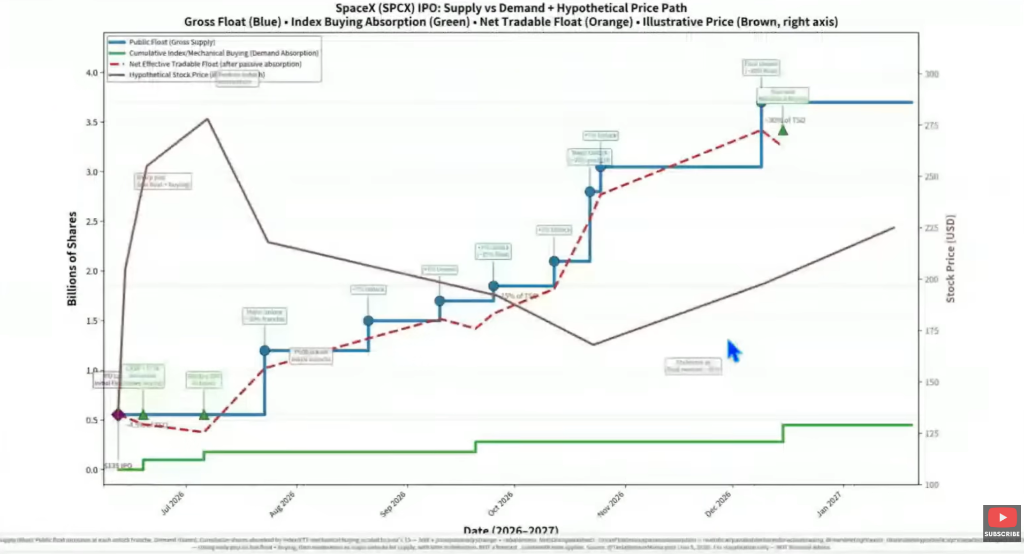
First Key Date: July 7th This is the first trading day after the Independence Day weekend and the 15th trading day post-IPO. The Nasdaq 100 index will officially include SpaceX.
At that time, major index funds like Vanguard CRSP and FTSE Russell must passively build positions in the open market based on a float-adjusted mechanism.
Market estimates for this passive buying demand range between $8 billion and $18 billion (closer to $15 billion). Since old shareholders cannot sell shares at this point, the market's free float is at its lowest.
2. "Precision Unlocking" Tied to Earnings Calls: Selling Pressure Halved, $135 Forms a Solid Floor
Typical IPO lock-up periods are simple (e.g., 180 days), but SpaceX's lock-up expiry schedule is precisely timed to coincide with the Q2 earnings conference call.
Second Key Date: Two business days after the Q2 earnings call (estimated around July 22nd or 29th)
Market rumors suggest that following the Q2 earnings call, early insider shareholders will face a massive first unlock tranche of up to 30%, sparking panic over selling pressure.
However, Alexandra clarified during the conversation that market analysts are ignoring the core shareholding structure: The majority (approximately 50%) of early insider shareholders is Musk himself. As the founder, Musk's shares are subject to a strict 366-day lock-up period.
Therefore, two days after the Q2 earnings call, the actual new unlockable shares hitting the public market are not 30%, but effectively only 10% to 15%.
Furthermore, the intent of major early shareholders appears highly aligned:
Ron Baron has explicitly stated he "won't sell a single share and plans to buy another $1 billion in the open market";
BlackRock has publicly expressed a strong intention to buy $5 billion to $10 billion during the IPO, exceeding the readily available market supply;
Ark Invest (ARC), while potentially selling some old shares due to single-stock position limits (max 10%), plans to add SpaceX positions in its other newly opened funds.
3. The July "Goldilocks" Scenario: The $7 Billion Tax Event and the "Merger of Equals" Speculation
Astute capital on Wall Street is connecting all the breadcrumbs. Alexandra points out a significant personal deadline for Musk: He must exercise his stock options from the 2018 Tesla compensation plan before August 15th this year. This will trigger a massive personal tax event of approximately $7 billion (due for tax payment in January 2028).
In the days surrounding the option exercise on August 15th, the higher Tesla's stock price is, the more favorable it is for Musk's personal net settlement or pledge loans. This is not small change; it's a massive multi-billion dollar game.
Consequently, the most plausible "Goldilocks scenario" whispered on Wall Street is emerging:
- Timing: During the power vacuum period between the Nasdaq inclusion on July 7th (SpaceX price potentially higher than double, market cap soaring to a peak) and the end-of-July earnings lock-up expiry (fresh shares flooding in).
- Strategic Move: SpaceX and Tesla announce a Merger of Equals via a "Stock-for-Stock" transaction.
Such a merger would automatically lock the two stock prices in perfect lockstep, driven by market arbitrage funds. By leveraging positive news from both companies and allowing the public market of "non-sellers" to inflate the market cap, this strategy would perfectly solve Musk's tax funding pressure.
4. Wall Street Banks' "Political Arbitrage": Swapping IPO Lucrativeness for November Merger Votes
The biggest suspense for the merger scenario lies in the November shareholder vote.
According to Alexandra's precise calculations: After exercising options, Musk will hold approximately 17.5% voting power in Tesla. Passing the merger requires an absolute majority of "50% plus 1 vote" of all outstanding shares, meaning Musk needs to secure an additional 32.5% of the votes.
Currently, Tesla's retail shareholder percentage has dropped from over half in the past to 31%, while institutional "Big Whales" engaged in aggressive secret buying in Q1. To succeed, support from Big Whales like Vanguard and BlackRock (together holding over 15%) is essential. Following relationship mending between BlackRock CEO Larry Fink and Musk at venues like the Davos Forum, the institutional base vote (~35%) seems initially secure. The remaining 15% gap needs to be filled by mobilizing half of the 31% retail base.
Intriguingly, SpaceX's IPO has unusually included Charles Schwab, Morgan Stanley, and JPMorgan Chase as key underwriters and distributors. Historically, these three institutions were leading "adversaries" voting against Musk in past Tesla compensation cases and the Texas relocation:
Wall Street's Political Bet: As one of the most lucrative and prestigious IPO allocations in Wall Street history, no investment bank can resist billions in commissions and client prestige.
Musk handing these three institutions this "fat meat" implies a hidden bargain: Take the SpaceX money, and must manipulate their custodial shares to vote "yes" for the merger at the November Tesla shareholder meeting.
Wall Street is mercenary; faced with immense economic benefits, they will not hesitate to compromise.
5. "The Perfect Fortress of Defense": Why Must SpaceX Acquire Tesla?
Addressing technical questions from some investors, the interview provides insightful answers with depths in law and corporate governance:
1. How can SpaceX acquire Tesla without having hundreds of billions in cash on its books?
This is absolutely not a cash deal; it's 100% pure equity swap. SpaceX currently has an authorized share limit of up to 36 billion shares. Post-IPO, it has only issued around 13 billion shares, leaving immense capacity for new issuance to directly swap for all Tesla shares.
2. Why can't it be the reverse, with Tesla acquiring SpaceX?
Because SpaceX's S-1 prospectus established a perfect "founder's defensive fortress."
Musk suffered immensely during the Tesla era from short-sellers, activist investors, and Delaware judges. SpaceX's governance structure was meticulously fortified from the ground up:
Super Voting Rights: SpaceX's Class B shares carry 10 times the voting power, with 97% firmly controlled by Musk himself;
Legal Firewall: All shareholder lawsuits are mandatorily subject to private arbitration, effectively disarming malicious litigation lawyers;
Inheritance Clause: Even if Musk passes away, the super control rights of his Class B shares would transfer directly to his family.
Tesla's current governance structure has inherent flaws, preventing Musk from gaining absolute control. Therefore, only by integrating Tesla entirely under SpaceX's legal framework can Musk permanently protect his absolute control over his business empire, shielding it from activist investors and local courts.
Below is the full text of the interview, AI-assisted translation.
Herbert:
Alright, everyone, welcome and thank you for joining us today. We are joined today by Alexandra Mertz, also known as Tesla Boomer Mama. I think this will be a very special episode. She's going to share what might be the definitive guide to the SpaceX IPO. We'll also share some very important slides with you. I want to give a little teaser now.
First, Alexandra has done a ton of work, outlining the steps one could expect if a merger is announced. Then, she'll walk us step-by-step through what happens on IPO day, when the Nasdaq inclusion happens, and when shareholders can sell after lockup. So thank you for all the work, Alexandra. I know the IPO is this Friday, so many people have been asking about this. Tell us what you have planned to share with us today.
Alexandra:
Hi, Herbert. Thanks for having me. Well, it all started—I mean, obviously, for weeks and months, we've been kicking around this idea of a merger. I'm a firm believer in this merger. I want to state upfront that nothing I say constitutes financial advice.
But personally, I bought a significant number of call options for August because I firmly believe in this. I did not participate in Tesla's—wait, yes, Tesla—I did not participate in the SpaceX IPO because, in my predicted scenario, the merger will be announced sometime in July or early August.
The timing of the SpaceX IPO now actually gives me a lot of confidence, which is why I wanted to do this episode. We've discussed before why this is crucial for those investing in SpaceX, those staying with Tesla, and those investing in both. I think there are several key dates you absolutely have to watch because SpaceX's stock price could jump all over the place, and no one knows what will happen, not even Elon. So, Herbert, let's go slide by slide. Which one do you want to start with?
Herbert:
Yes, this one looks like the most important. First, thank you to Aurelius, who put this together, right?
Alexandra:
Exactly. Aurelius read my article about the specifics of the SpaceX IPO, which is pinned to the top of my X profile. You can go see it, and you'll find his comment below. He said, "I fed all your data into Grok."
Then Grok gave me this chart, which is highly interesting. You might need to zoom in so everyone can see. Well, maybe they don't need to see our faces again, I don't know. Move it a bit to the left, if you can, to the left—I can't control that. Okay, it all starts with the IPO this Friday, represented by the brown dot. The IPO price is 135, that's the upside-down brown square, yes.
Then you see this blue line, representing that early investors can't sell yet. As you can see, this continues until the Q2 earnings call, where they get their first potential massive unlock, up to 30%. That's the blue line. I'll detail what happens after that shortly. The green line below represents the demand from index funds buying SpaceX stock.
This is relative to the public float. The first wave of dilution they bring to the market is 555 billion shares (note: likely referring to market cap share or share equivalent, clarified later), representing 4.3% of the