일본은행이 이길 수 없는 전쟁


- 핵심 의견: 일본은행이 엔화를 방어하기 위해 벌인 전례 없는 시장 개입 및 금리 인상 노력은, 미일 간의 거대한 금리 차이와 자국의 250%에 달하는 정부 부채로 인한 재정적 억제 때문에, 이 환율 방어전에서 승리하기 어려울 것으로 보인다.
- 핵심 요소:
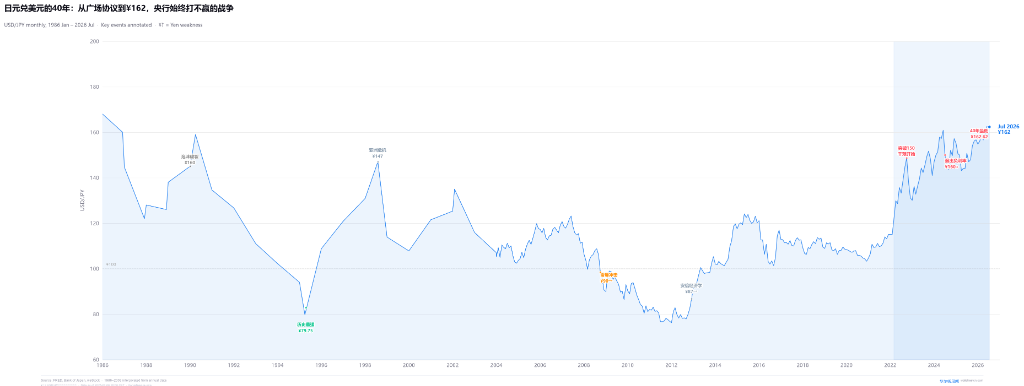
- 일본 재무성이 2026년 4~5월에 11조 7천억 엔을 투입해 환율을 개입했으며, 이는 월간 기준 사상 최대 기록이었으나, 엔화는 6주 만에 162.62엔까지 폭락하며 약 40년 만에 최저치를 기록했다.
- 달러와 엔화 간 275베이시스포인트(bp)의 금리 차이는 지속적인 캐리 트레이드 메커니즘을 촉발했으며, 헤지펀드의 엔화 순매도 포지션은 극단적인 수준에 이르렀다.
- 일본 2026 회계연도 예산에서 국채 상환 지출(국채비)은 31조 3천억 엔에 달해 재정 수입의 25%를 차지하며, 금리 인상은 이자 지출을 폭발적으로 증가시켜 '중앙은행 금리 인상, 재정 확장'이라는 상쇄 딜레마를 초래한다.
- 엔화 약세로 인해 2026년 상반기 중소기업 파산 건수는 5,346건으로 전년 동기 대비 7.1% 증가했으며, 이 중 환율 변동이 직접적인 원인이 된 파산 건수는 사상 최고치를 기록했다.
- 골드만삭스는 달러/엔 환율의 12개월 목표치를 165엔으로 상향 조정했으며, 시장은 2027년 6월 이전에 이 수준에 도달할 확률을 72%로 보고 있다.
Original Source: Wall Street CN
From April 28 to May 27, Japan's Ministry of Finance spent 11.7 trillion yen buying yen. This was the largest single-month intervention in Japan's foreign exchange intervention history.
On June 30, the yen fell to 162.62 against the dollar – its lowest level since December 1986. It touched this level again intraday on July 8. Today, it continues to trade above 162.
11.7 trillion yen held for less than six weeks.
It's not that the Bank of Japan didn't try. In June, the policy rate was raised to 1%, a 31-year high. Cumulatively, rate hikes since the end of negative interest rates in March 2024 have exceeded 100 basis points. Combined with the 9.8 trillion yen intervention round in 2024, the Ministry of Finance has spent over 21 trillion yen of its dollar reserves over the past two years.
Goldman Sachs isn't buying it. On July 6, strategist Karen Reichgott Fishman raised her one-year USD/JPY target directly from 155 to 165 – one of the most bearish predictions on Wall Street. Market pricing shows traders see a 72% probability of hitting 165 before June 2027.
This is not a matter of "another 25 basis points." The Bank of Japan is facing a war it was destined to lose from the start.
The 275 Basis Point Gravity
The forex market doesn't trade absolute values; it trades the spread.
The Fed funds rate is 3.50-3.75%, the BOJ's is 1%. The spread is 275 basis points. Latest CFTC data shows that hedge fund net short yen positions are at their most extreme levels in recent years.
275 basis points mean a trade repeated countless times daily: Borrow yen (with inflation over 3%, a 1% rate equals a negative real rate) – convert to dollars – buy US Treasuries yielding over 4.5%. Excluding exchange rate fluctuations, the annualized carry trade return exceeds 3%. For every yen depreciation, the return increases a bit more.
This is not "market sentiment." It's a mechanism. Carry trades don't care if the BOJ raised rates by 25 or 50 basis points. They only care about the yield differential between the US and Japan. As long as the Fed doesn't cut rates – and oil prices are surging, the Iran situation is escalating, and the shadow of US inflation is far from dissipating – the yen isn't just facing the BOJ; it's facing the gravitational field of the entire dollar system.
The 11.7 trillion yen intervention was absorbed by the market in less than six weeks, not because the amount was too small, but because the direction was wrong.
For Every 4 Yen Collected, 1 Yen Goes to Interest
More fatal than the US-Japan interest rate differential is Japan's fiscal situation – a chain tied to the BOJ's ankle, tightening with every struggle.
The total budget for FY2026 is 122.3 trillion yen, a record high. Of this, "national debt service" – expenditure for repaying principal and interest on government bonds – is 31.3 trillion yen, a full 3 trillion yen increase from last year's 28.2 trillion yen, consuming a quarter of the budget.
For every 4 yen the Japanese government collects in taxes, 1 yen goes to its creditors.
More troublesome is that this number is accelerating.
The 10-year JGB yield has risen from 0.25% in 2022 to 2.88% today. The Japanese government isn't repaying old debt; it's issuing new debt to pay off old debt – government debt exceeds 250% of GDP, maturing debt each year must be refinanced with new bond issuance, and the interest rate on new bonds is over ten times that of old debt. Within the 31.3 trillion yen national debt service, the interest portion is growing much faster than the principal repayment portion. Interest compounds on interest; the snowball grows by itself.
If the 10-year JGB yield rises another 100 basis points – which doesn't require aggressive action, just continued BOJ rate hikes or even just tapering bond purchases – the national debt service could easily exceed 35 trillion yen, heading towards 40 trillion yen. By then, for every 3 yen collected in taxes, 1 yen would go to interest payments.
This is the BOJ's ceiling for rate hikes. It's not that inflation or politics prevents hikes. It's that the Ministry of Finance has done the math: If you hike another 50 basis points, the yen might not appreciate by 100 points, but my interest bill increases by several trillion yen first. The market does this math too – so rate hikes don't boost the yen but instead convince the market that the BOJ will ultimately be tied down by the Ministry of Finance.
Brake and Accelerator
Prime Minister Ishiba's government's stance on fiscal policy is diametrically opposed to the BOJ's.
In the FY2026 budget bill, defense spending breaks through 9 trillion yen, increasing for the 14th consecutive year, reaching 2% of GDP in FY2025. If the ruling coalition's discussed suspension of the consumption tax on food takes effect, it would reduce revenue by 4 to 5 trillion yen annually. Various economic stimulus and household subsidies continue to increase. Nomura Securities warned earlier this year that this "Ishiba trade" model – rising Japanese stocks, falling yen, pressure on long-end JGBs – makes the market pricing logic identical to UK Prime Minister Truss's "mini-budget" in 2022: government spending without limits, the market doing the pricing.
There is only one difference. Truss lasted 45 days. Japan's fiscal expansion has lasted thirty years.
Rate hikes tighten monetary policy; bond issuance eases monetary policy. The central bank steps on the brakes, while the finance ministry steps on the accelerator. More ironically, the BOJ itself is the largest holder of JGBs – though its monthly multi-trillion yen bond purchasing program is being tapered, as long as it buys, every 1 yen of JGB purchased releases 1 yen into the market. Tightening liquidity by raising rates while easing liquidity by buying bonds – two actions canceling each other out.
The market doesn't need to be staffed by economists to understand: every card in the BOJ's hand is negated by another card.
5,346
Behind the numbers are real costs.
On July 8, Tokyo Shoko Research reported: in the first half of 2026, 5,346 companies with liabilities over 10 million yen went bankrupt in Japan, a 7.1% increase year-on-year, rising for the fifth consecutive year and exceeding 5,000 in the first half of the year for the first time in 12 years.
Forty-five companies went bankrupt directly due to yen depreciation, a 32.3% increase year-on-year, the highest since records began. The wholesale industry bore the brunt – accounting for 23 of the 45 companies, compared to only 14 in the same period last year. Additionally, bankruptcies due to labor shortages rose 37.7%, and those due to price increases rose 27.6%.
These figures reveal a fact obscured by "record high corporate profits at large firms": yen depreciation is not universally beneficial.
No Winning Scenario
Three paths, all with significant costs.
Don't raise rates. The yen continues to weaken, import costs continue to rise, and SMEs continue to fail. Social dissatisfaction continues to build.
Raise rates. National debt interest explodes, fiscal sustainability is threatened, and the market bets the central bank will eventually be reined in by the government – the yen continues to weaken because the market sees an "exit illusion," not tightening resolve.
Raise rates and shrink the balance sheet. JGB yields spike, global carry trades reverse, Japanese investors sell foreign assets and repatriate funds – the yen could strengthen in the short term, but the August 2024 script is on the table: that BOJ surprise rate hike didn't trigger a steady yen recovery; it triggered a global stock market crash.
All three paths are blocked because the problem isn't one that monetary policy can solve. Japan's 250% government debt, its persistently shrinking working-age population, its year-after-year expanding fiscal deficit – these are not things a 25 basis point rate adjustment can change.
On July 6, the day Goldman Sachs adjusted its target to 165, the market wasn't waiting for the next BOJ meeting. It was pricing in something deeper: whether the BOJ has any chance of winning.
The answer becomes increasingly clear: It was doomed from the start.
162.62 is not the end, and 165 likely isn't either. Unless fiscal discipline miraculously returns, or the Fed cuts rates significantly, this "impossible trinity" will only tighten further. And the direction of the yen doesn't depend on Tokyo, but on Washington, Riyadh, and the deeper currents of global capital flows.
What the Bank of Japan can choose, in this war it was destined to lose, is merely whether to lose slowly or lose badly.