7배 초과 청약, SK하이닉스가 반도체를 구할 수 있을까?


- 핵심 의견: SK하이닉스의 미국 상장이 7배 이상 초과 청약을 기록한 것은 장기 자금이 여전히 AI 인프라 투자 사이클을 긍정적으로 보지만, 반도체 섹터는 단기적으로 압박을 받고 있으며 시장은 기술 대기업들의 실적 발표를 기다리며 자본 지출 증가 속도가 지속될 수 있을지 확인하려 하고 있음을 반영한다.
- 핵심 요소:
- SK하이닉스 ADR 청약 배수가 7배를 초과했으며, 총 조달 금액은 약 245억 달러로, 자금은 한국 내 생산 능력 확장에 사용될 예정이다.
- 반도체 섹터는 최근 조정을 받았으며, 주된 이유는 시장이 AI 자본 지출 증가 속도 둔화를 우려했기 때문이다. 메타의 컴퓨팅 파워 매각 및 블랙스톤의 데이터센터 프로젝트 취소는 이러한 우려를 더욱 심화시켰다.
- 청약 수요는 주로 Baillie Gifford, Coatue Management 등 글로벌 장기 펀드에서 발생했으며, 특히 'AI 주식의 신'으로 불리는 Aschenbrenner의 펀드는 약 70억 달러의 의향을 보였다.
- SK하이닉스 주가는 6월 고점 대비 약 30% 하락했으며, 시장에서는 상장 전 조정이 상장 후 주가 상승 여력을 만들기 위한 것이라는 추측이 나온다.
- 마이크로소프트, 구글, 메타 등 기술 대기업들의 향후 분기 실적은 AI 투자 사이클의 지속 가능성을 판단하는 핵심 신호가 될 것이다.
Original | Odaily Planet Daily (@OdailyChina)
Author | Azuma (@azuma_eth)
Bloomberg reported this morning, citing sources, that the subscription multiple for the American Depositary Receipts (ADR) issued in the US by South Korean semiconductor giant SK Hynix has exceeded seven times, potentially becoming the largest foreign IPO project in US history.
Earlier at the end of June, SK Hynix submitted an F-1 prospectus to the US SEC, planning to list on the Nasdaq by issuing 177.9 million ADRs (each ADR representing one-tenth of an ordinary share). Based on the closing price of 2,076,000 won (approximately $1,380) on the Korean market Wednesday, the total fundraising amount is expected to reach about $24.5 billion. All funds raised will be used for capacity expansion in South Korea, including the Yongin wafer fab, Cheongju advanced packaging lines, and investment in EUV and related equipment.
As SK Heads to the US, the Semiconductor Sector is in a Downturn
While SK Hynix is preparing for its US listing, the entire semiconductor sector is experiencing a sharp correction.
Over the past two years, AI infrastructure investment has been the core driver pushing up the semiconductor sector. Benefiting from the continuously expanding capital expenditures of tech giants like Microsoft, Google, Meta, and Amazon, the industry chain represented by GPUs, HBM memory, and advanced process equipment has seen a massive performance explosion, propelling stock prices to new heights.
However, recently the market has begun to re-evaluate the sustainability of this logic. First, Meta was reportedly planning to sell some of its idle computing resources, interpreted by the market as a signal that tech giants intend to optimize their AI infrastructure spending. Subsequently, Blackstone's originally planned world's largest data center project was also canceled, further strengthening market concerns about a slowdown in data center demand growth.
These events do not fully equate to the end of the "AI investment cycle," but they have triggered a market repricing of a key question: After hundreds of billions of dollars in capital investment, can tech giants maintain the current growth rate of their AI capital expenditures?
Affected by this, the entire AI industry chain has recently come under pressure. From chips and memory to semiconductor equipment, market trading logic has shifted from "unlimited demand growth" to "whether future growth can be realized." SK Hynix's stock price has also seen a significant pullback, falling from its high of 2,917,000 won on June 25 to yesterday's closing price of 2,076,000 won, a maximum drawdown of nearly 30%.
Secondary Market Under Pressure, but Primary Market is Extremely Frenzied
Interestingly, while the secondary market is undergoing continuous adjustments, SK Hynix's US stock listing has received far more capital追捧 than expected.
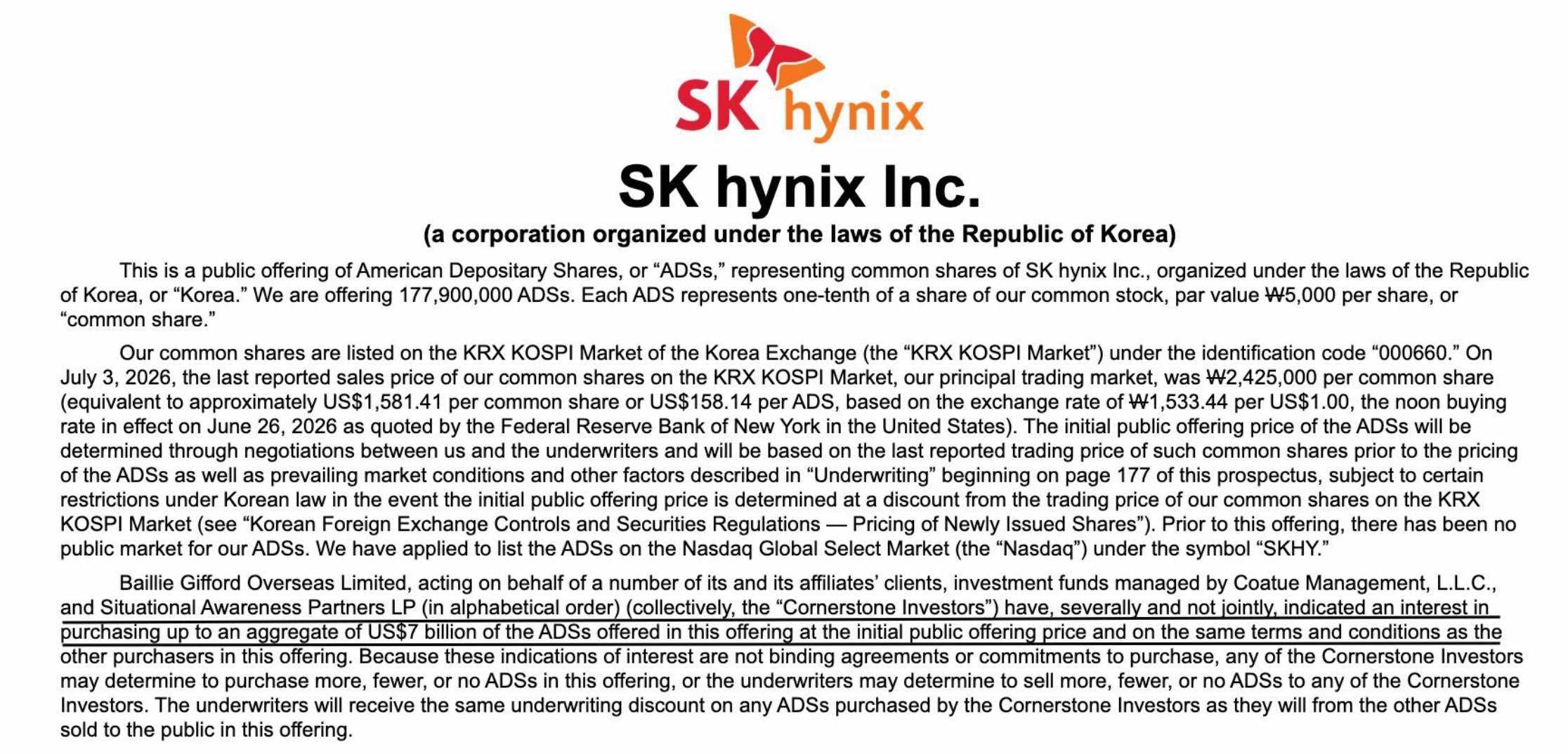
As mentioned earlier, the subscription multiple for this ADR issuance has already exceeded seven times, indicating very strong institutional enthusiasm. According to information disclosed in SK Hynix's roadshow materials, subscription demand comes mainly from various institutions including global long-term funds, technology-themed funds, sovereign wealth funds, and Asian-themed investors. Among them, institutions such as Baillie Gifford, Coatue Management, and Situational Awareness Partners have expressed subscription intentions totaling approximately $7 billion.
Note the Situational Awareness here. This is the fund controlled by the newly emerging "AI stock god" Leopold Aschenbrenner, arguably the fund with the most explosive performance in this AI cycle. For details, refer to SBF's Little Brother Turned $225 Million into $5.5 Billion in One Year and A Quick Look at the 24-Year-Old "AI Stock God's" Latest Layout: 60% of Positions Hedging Against Semiconductor Downturn.
The fervent pursuit by institutions means that, at least from a long-term capital perspective, the market has not completely denied the AI infrastructure investment cycle. In fact, the recent correction in the semiconductor sector is essentially more of an adjustment in valuation and expectations, rather than a reversal of the industry's fundamentals. Investors are worried about a potential slowdown in future capital expenditure growth, not about whether core products like current HBM and AI chips have lost demand.
Furthermore, it is worth mentioning that a speculation about the timing of SK Hynix's listing has been circulating in the market recently: Before landing on the Nasdaq, experiencing a clear round of stock price adjustment might be to pave the way for a better performance after listing, benefiting the company, underwriters, institutions, and retail investors alike...
This logic may not be fully verifiable, but on a trading level, it could indeed strengthen the market's optimistic expectations for the post-IPO trend. For the issuer, a lower valuation starting point is favorable for post-listing price performance; for subscribing institutions, it also implies greater potential upside.
Therefore, SK Hynix's US listing this time could very well become an important inflection point for short-term sentiment in the semiconductor market.
The Real Reversal Signal Depends on the Tech Giants' Next Report Card
However, the fervor of SK Hynix's US IPO alone does not seem to fully answer whether the correction in the semiconductor sector is over.
From an industry cycle perspective, the core of the current market debate is not whether the demand for AI still exists, but whether tech giants can continue to maintain their current level of capital investment. Over the past two years, companies like Microsoft, Google, Meta, and Amazon have continuously increased their AI infrastructure construction, pushing global data center investment into a phase of rapid expansion. According to previously announced plans by major tech giants, AI-related capital expenditures are expected to remain high for the next few years.
But at the same time, as the scale of investment continues to expand, investors are increasingly focusing on "when these massive capital investments can translate into actual commercial returns."
If AI application growth can match infrastructure investment, then the current adjustment in the semiconductor sector looks more like a digestion of valuations after a rally. However, if tech giants start to slow down data center construction and reduce GPU procurement pace, then the high growth expectations the market previously assigned to the AI industry chain will face a downward revision. Therefore, the financial reports of tech giants over the next few quarters will be key to determining the direction of the semiconductor market.
In other words, the SK Hynix listing might serve as a short-term sentiment catalyst for the semiconductor sector, but the decisive factor in whether the AI cycle can continue will ultimately be the clear answers provided by Microsoft, Google, Meta, Amazon, and other tech giants regarding their future capital expenditures.