苏州18年前投资的三千万,长成了AI的血管


- 核心观点:本文以中际旭创(原旭创科技)的成长历程为核心案例,阐述苏州是如何通过系统性、长期主义的产业投资策略,在AI算力浪潮中抓住光模块这一关键供应链环节,从而驱动城市产业升级、资本增值与人才聚集,形成可持续的“飞轮效应”。
- 关键要素:
- 2008年金融危机期间,元禾控股向冷门领域的光模块初创公司旭创科技投资3000万元,这笔投资在18年后转化为市值超1.5万亿的A股巨头中际旭创,市值超越茅台。
- 苏州在AI产业中精准押注光通信产业链,除了中际旭创,还培育了天孚通信、源杰科技等企业,它们覆盖了从光芯片、器件到模块、测试的完整环节。
- 苏州的投资逻辑在于“蹲在地上选项目”:在早期通过科技招商中心、链主基金等机制,利用市场化手段和懂行的人才,对生物医药、纳米、语音AI等冷门赛道进行长期布局。
- 苏州的务实源于其工业基础薄弱的“穷出身”,通过“星期日工程师”、自费开发区等方式嵌入上海产业链,形成了扎实的工业积累和自担风险的创业精神。
- 当企业成长后,苏州4.89万亿的工业产值和完整门类为工业AI提供了天然的数据与应用场景,算力成为公共服务,反哺产业,形成了城市与企业双向赋能的正循环。
Original Authors: Sleepy, Daria
Original Editor: Cozzy
Suzhou's most lucrative investment occurred during the global financial crisis.
In the autumn of 2008, Lehman Brothers collapsed, and venture capital across China ground to a halt. Some cut losses, others watched and waited, as the primary market entered a deep freeze. It was during this window that Suzhou Industrial Park's state-owned investment platform, Yuanhe Holdings, injected approximately 30 million RMB into a startup company.
The founder was Liu Sheng, a Tsinghua University graduate with a PhD from Georgia Tech. He had spent many years in North America working in optical communications, first at Lucent Technologies and then at Opnext. In 2008, he returned from Silicon Valley, registered Innolight Technology in Suzhou, and aimed to produce high-speed optical transceivers.
In the investment circles of 2008, optical transceivers were not just a niche; almost no investor was looking at this track. Domestic optical communication companies were all crowded into the telecom market and low-to-mid-end manufacturing. According to a LightCounting report, in 2010, only one Chinese company, WTD (later merged into Accelink Technologies), barely made it into the top ten global optical transceiver manufacturers. At that time, the judgment that "cloud computing data centers would require massive amounts of high-speed optical transceivers" was far from being a consensus.
Eighteen years later, that investment grew into Zhongji Innolight. Just before the Dragon Boat Festival in June 2026, its stock price surged to 1367.88 yuan, giving it a total market capitalization of 1.5 trillion yuan, placing it in the top ten of A-shares, surpassing Kweichow Moutai.
The Blood Vessels of AI
Optical transceivers are crucial in the entire AI industry. Without them, AI is just a collection of heat-generating silicon chips. Once signals leave the chip and need to travel between data centers via optical fiber, optical transceivers are essential.
Computing power is the heart; optical transceivers are the blood vessels.
In the A-share market, Eoptolink, Zhongji Innolight, and TFC Communication are known as the "Yi-Zhong-Tian" trio. These three optical transceiver giants have captured the most critical segment of the global AI computing supply chain. Two of them are based in Suzhou: Zhongji Innolight's operating headquarters is in Suzhou Industrial Park, as is TFC Communication's.
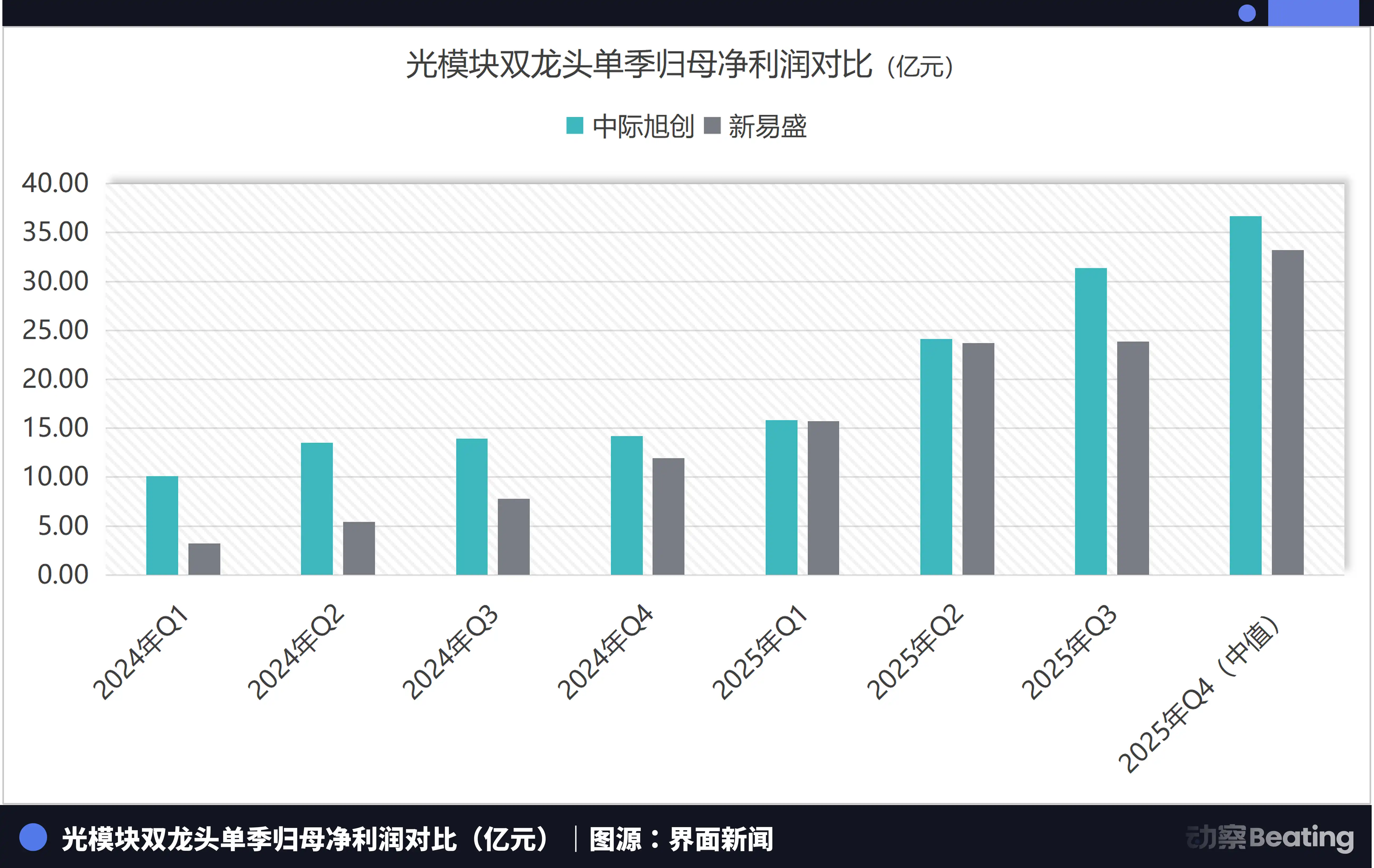
Furthermore, Suzhou-based Lianxun Instruments, which manufactures high-end optical communication testing equipment, saw its stock price surge over twenty times its initial public offering price less than two months after listing in 2026, claiming the title of the "King of A-shares." Yueneng Technology, a leading active optical chip company and a part of the supply chain invested in by Zhongji Innolight, saw its stock price touch 1712 yuan just before the Dragon Boat Festival, an increase of nearly four times in half a year.
Breaking down the AI data center, Suzhou didn't just bet on a few companies; it secured a chain of interconnected positions.
Further upstream are optical chip companies like Yueneng Technology. Further downstream is the optical device domain where TFC Communication specializes. Zhongji Innolight packages these devices into high-speed optical transceivers, sending them into data centers worldwide. Lianxun Instruments is responsible for testing whether these high-speed optical communication devices can operate stably.
According to a report from Xinhua Daily, the total market capitalization of A-share listed companies in Suzhou has exceeded 4 trillion yuan, ranking fourth nationwide, only behind Beijing, Shanghai, and Shenzhen.
Hangzhou's "Six Little Dragons" made it to the Spring Festival Gala and trending topics. Shenzhen's humanoid robots are dancing. Shanghai's three GPU companies are telling a grand story of domestic substitution. These stories are engaging, novel, and visual, making a name memorable in just a dozen seconds of video.
But Suzhou tells a different kind of story.
An optical fiber manufacturer in Wujiang saw its 2026 sales revenue increase by over 35% year-on-year, with production capacity scheduled into 2027. Multiple companies in Suzhou's industrial chain jointly invested and started construction on the nation's first 8-inch silicon photonics chip mass production line. Suzhou's optical communication industry has formed a cluster worth hundreds of billions. Enterprises have led the establishment of over 50 innovation consortia, and the industry's scale grew by over 60% in the first quarter of 2026.
In this wave of AI computing power explosion, the real money first flowed into the places building the "blood vessels."
For Suzhou, the growth of a leading optical transceiver company brings more than just market value. It brings along suppliers, testing equipment manufacturers, optical chip companies, funds, and talent. Its orders become the production capacity for upstream and downstream enterprises. Its listing becomes the credit for the local capital market. Its industry judgment, in turn, becomes the clues for Suzhou's next round of investment attraction and industrial investment.
Beyond the book profit from the investment, what Suzhou gained is an industrial chain that can continue to roll forward.
When the world suddenly discovered optical transceivers in 2024 and rushed into the secondary market to grab shares, Suzhou's name was already written on Innolight's earliest business registration, as an old shareholder from 2008.