






Apple与「美光们」的权力再平衡:拆解iPhone背后的利润账单


- 핵심 요점: 애플 아이폰의 수익 구조에서 애플 자체가 주도적입니다 (순이익률 약 25%). 반면, 메모리 등 핵심 부품 공급업체는 오랫동안 미미한 수익률(<3%)을 기록해 왔습니다. AI 수요로 인해 메모리 가격이 폭등하면서 수급 관계가 역전되었고, 메모리 업체들이 발언권을 장악하기 시작했습니다. 이로 인해 애플 등 단말기 기업은 원가 부담에 직면하여 가격을 인상할 수밖에 없게 되었습니다.
- 핵심 요소:
- 아이폰 수익 배분 불균형: 애플의 순이익률은常年 24% 이상을 유지하며 업계 전체 수익의 약 75%를 차지합니다. 반면, 마이크론 등 메모리 업체는 약 3%의 수익만을 가져가고, TSMC의 경우 약 4%-5%입니다.
- 메모리 비용이 '부품'에서 '핵심 부품'으로 변화: 2017년 아이폰 X에서 차지하던 비중 2%에서 2026년 아이폰 17 시리즈에서는 12%-15%(약 60-80달러)로 상승하여, 비용이 약 8배 증가했습니다.
- AI 수요가 가격 인상의 핵심 동력: AI 서버의 DRAM 수요는 일반 서버의 8배에 달하여, 삼성, SK하이닉스 등 업체들이 생산 능력을 고수익 HBM으로 전환하도록 강요했고, 이로 인해 소비자용 메모리 공급이 부족해졌습니다.
- 쿡과 머스크의 이례적인 발언: 팀 쿡은 메모리 가격 인상을 '40년 만에 보지 못한' 충격이라고 칭했으며, 애플은 이후 전 제품군의 가격을 인상했습니다. 일론 머스크 역시 공개적으로 이를 '본 적 없는 가장 가파른 가격 상승'이라고 표현했습니다.
- 메모리 업체 수익성 급증: 마이크론 3분기 재무제표에서 매출총이익률이 84.6%를 기록했고, 매출은 전년 동기 대비 346% 증가했습니다. 거시 데이터로는 2026년 1분기 DRAM 계약 가격이 분기 대비 93%-98% 상승했으며, 연간 평균 가격은 88% 오를 것으로 예상됩니다.
Original|Odaily Planet Daily (@OdailyChina)
Author|Wenser (@wenser2010 )
Have you ever wondered how the profit from selling an iPhone is distributed among its component suppliers?
Recently, overseas tech blogger @BluthCapital, mimicking the tone of Micron's CEO, joked about the "business model" behind the iPhone: "For over a decade, Apple has been buying chips from us (MU) for $5, putting them in a metal box, and selling them to consumers for $99. When we tried to raise the price to $7, they went into mock mode. But now, when we charge them $50, they raise the product price by $250." The implication is a clear disdain for Apple's recent price hikes and its tendency to blame memory manufacturers.
The post quickly sparked discussion on social media. This morning, @BluthCapital continued the thread, posting a cost structure diagram for the iPhone 18 to support his point:
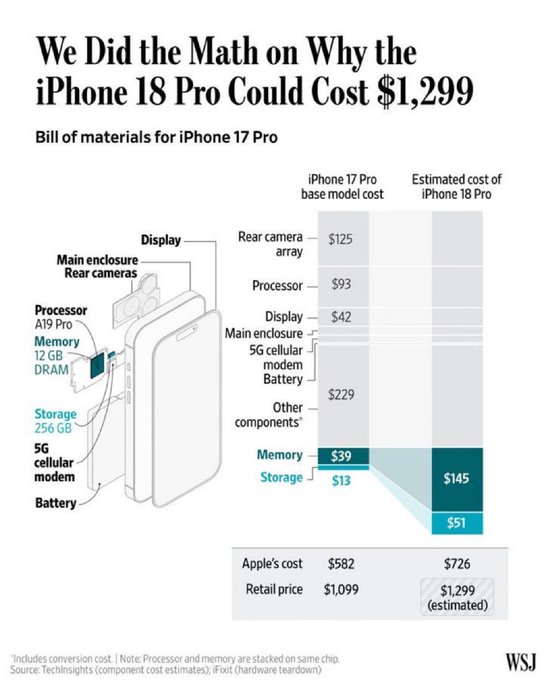
Previously, Micron's Chief Business Officer, Sumit Sadana, also mentioned in a Wall Street Journal interview that "during the memory industry downturn, some customers took advantage of the situation to drive down prices, resulting in negative profits for the company." Now, driven by robust demand from the AI and tech sectors, the memory industry has become the party with the upper hand. This has led to a complete reversal of fortunes along the entire supply chain.
Apple's iPhone Profit Structure: Apple Takes Nearly 25%, Micron and Other Memory Manufacturers Get Less Than 3%
Estimates suggest that for each iPhone sold, Apple pockets about a quarter of the profit, while memory giants get only about one-thirtieth. TSMC, due to its monopoly position, captures around 4-5% of the profit. The remainder covers other hardware suppliers, distribution channels, R&D, and taxes.
Looking Back at Apple's Financial Reports: Net Profit Margin Consistently Above 24%, Capturing 75% of Total Industry Profit
According to data from Counterpoint and other agencies, Apple has long held nearly 50% of the operating profit in the global smartphone market. IDC data for 2025 shows that with an 18% market share, it captured about 75% of the total industry profit.
Based on Apple's latest Q2 2026 data, iPhone revenue was $57 billion, with a net profit of $34 billion, and estimated shipments of around 61 million units. From this, it can be deduced that Apple's net profit per iPhone is approximately $320-$340, with a net profit margin of 33%-36%.
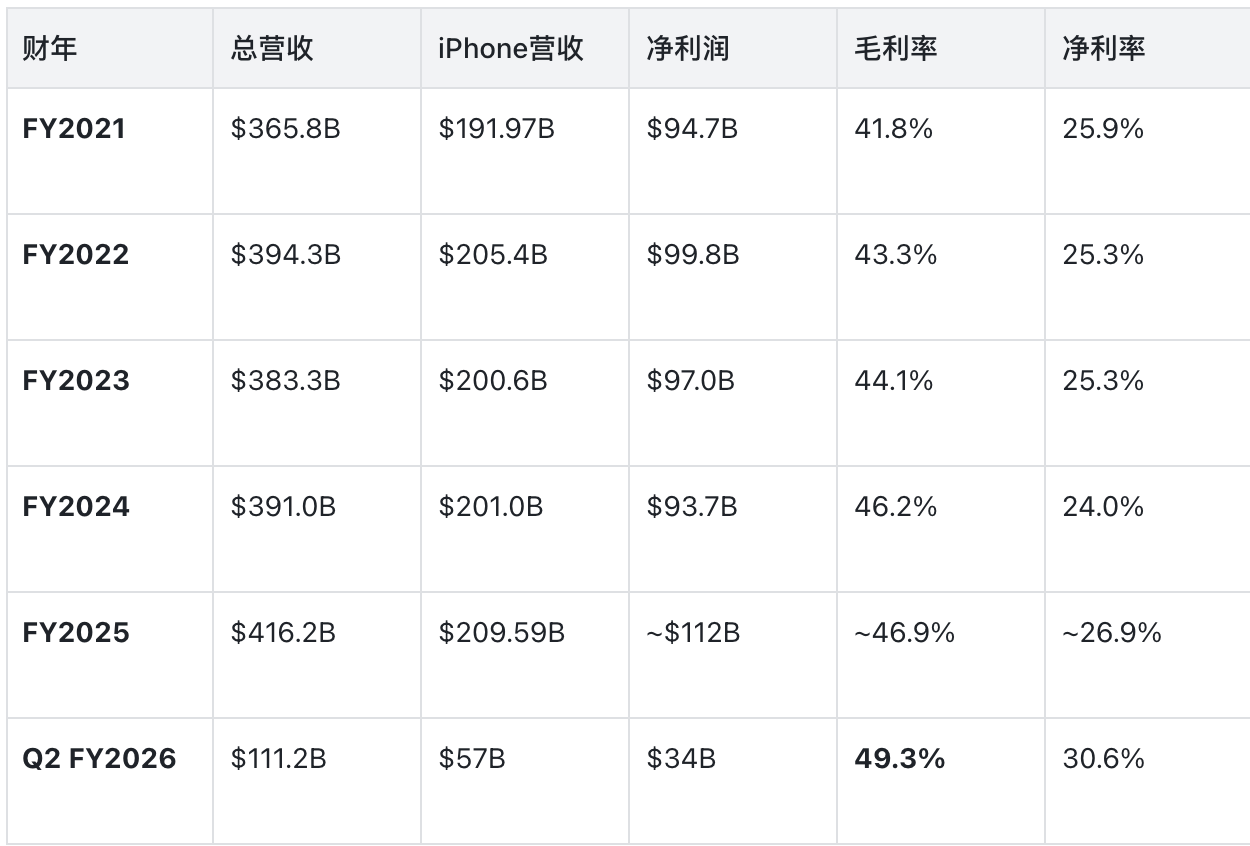
Comparing financial data over the past five years, we can clearly see that iPhone revenue has been relatively stable overall. Net profit has gradually increased from around $94 billion in 2021 to approximately $112 billion in 2025, while the net profit margin has remained relatively stable, typically around 25%.
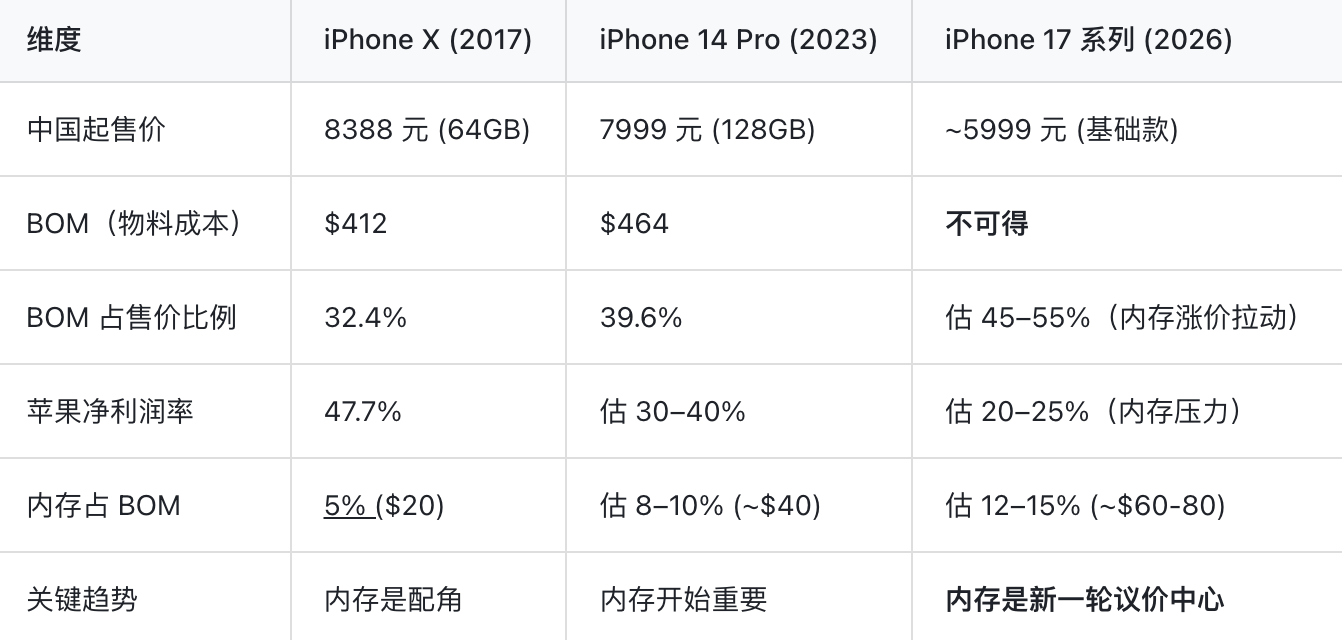
Looking at different models like the 2017 iPhone X, the 2023 iPhone 14 Pro, and the 2026 iPhone 17 series, their profit structures have changed due to varying memory costs.
From iPhone X to iPhone 17: Memory Costs Double
The role of memory costs in the iPhone has gone through three historical phases: from the initial "afterthought," to an "important component," and now to a "critical component."
2017 iPhone X Era: The "Afterthought" Period
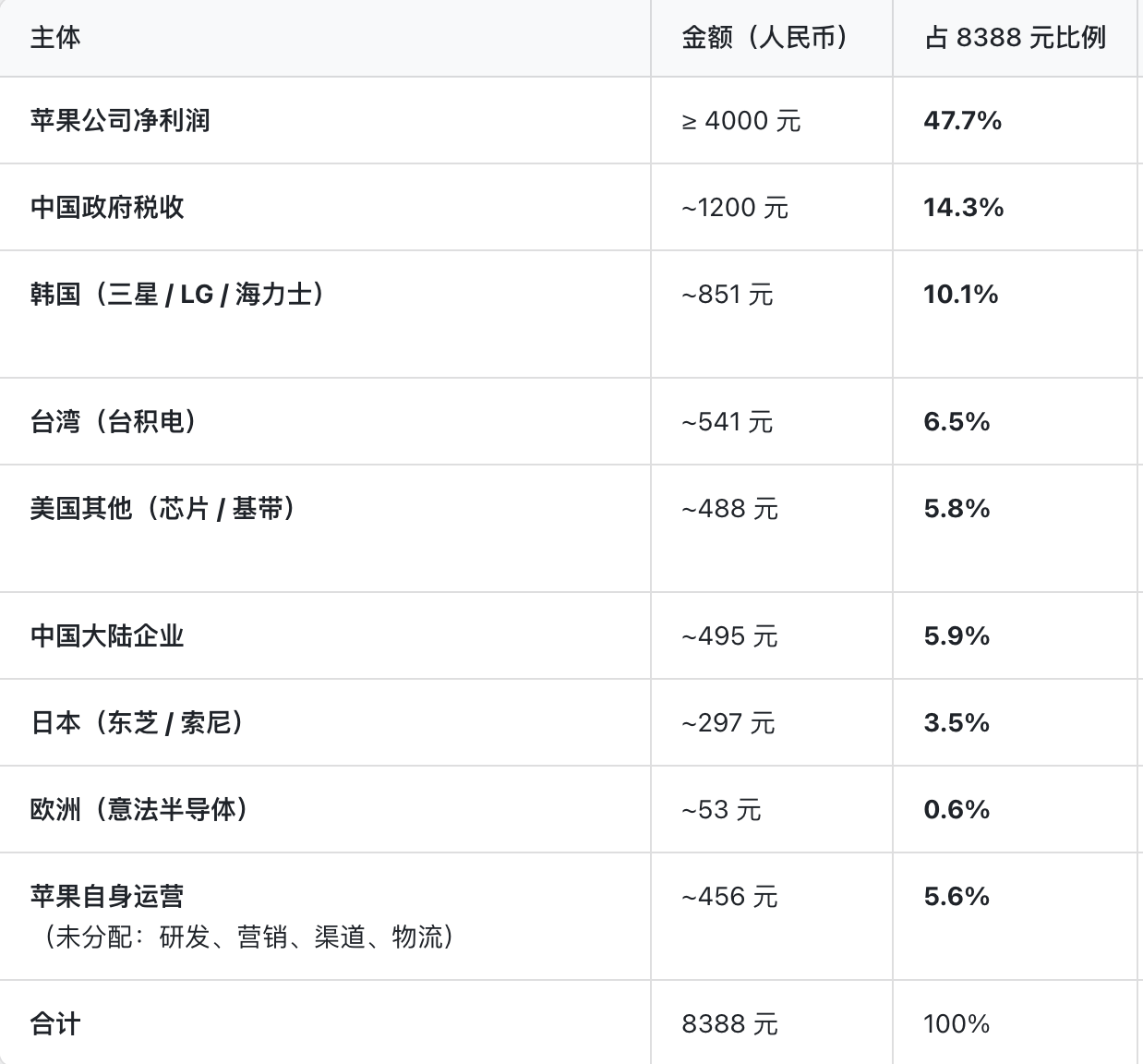
According to Counterpoint's teardown report from that time, during the iPhone X era, leveraging its brand advantage and upstream ecosystem position, Apple's net profit margin reached nearly 50%. In contrast, the profit share for Korean memory manufacturers like Samsung and SK Hynix was only about $17-$25, representing roughly 1.6%–2.3% of the total selling price of $1,099.
This was the "weight" of memory in the iPhone X era: about 2% of the cost, making it one of the least of Apple's concerns.
2023 iPhone 14 Pro Era: The "Important Component" Period
In 2023, the iPhone 14 series launched, and Apple's bill of materials (BOM) cost increased slightly. For the Pro model, the BOM cost reached around $464, accounting for nearly 40% of the selling price. Still, Apple's net profit margin remained around 40%.
According to tech media reports at the time, these figures were for the 128GB version. The cost increase for higher memory versions was minimal, but their selling prices were significantly higher. This was a period of rising costs for cameras and processors, so the overall profit for the iPhone 14 Pro was ultimately 3.7% lower than the iPhone 13 Pro.
2026 iPhone 17 Era: The "Critical Component" Period
Fast forward to 2025-2026, the iPhone 17 series is Apple's flagship model. Memory costs have doubled compared to a few years ago. It is currently estimated that memory costs account for 12%-15% of the BOM cost, approximately $60-$80.
In summary, the following table shows the cost and memory cost share for different iPhone generations.
Notably, TrendForce data shows that in Q1 2026, the contract price for general-purpose DRAM increased by 93% to 98% quarter-over-quarter. Citigroup expects DRAM average prices to rise by 88% for the full year of 2026. This aligns with the overall upward trend in memory costs. This phenomenon has also drawn comments from Apple CEO Tim Cook and Elon Musk.
Tim Cook: A Once-in-40-Years Memory Price Hike
On June 17, Apple CEO Tim Cook (Note from Odaily Planet Daily: He will step down as CEO this September, to be succeeded by John Ternus, former Senior Vice President of Hardware Engineering) mentioned the cost pressure from rising memory prices in an interview with the Wall Street Journal. He stated: "At a time when consumers need devices, supply has decreased, and memory manufacturers are passing on enormous price increases. We absolutely need memory pricing and supply to return to reasonable levels for consumer products. That's the bottom line."
However, he quickly changed his tone less than a week later.
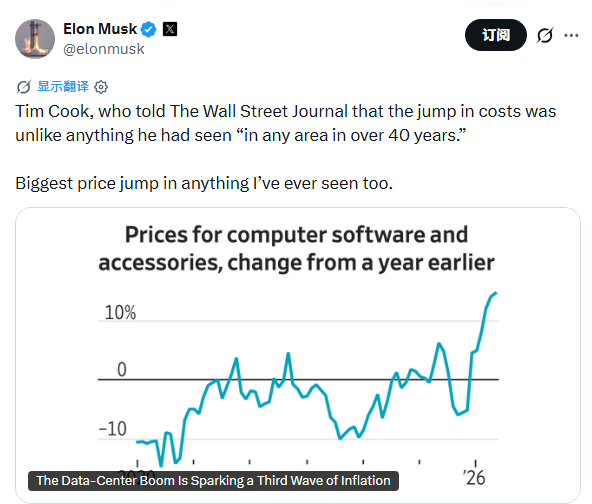
On June 25, Cook spoke to the Wall Street Journal again, calling the cost impact a "100-year flood." He said, "In over 40 years, I've never seen anything like this in any industry." Shortly after, Apple announced price increases across its product line, including the Mac, iPad, HomePod, Apple TV, and Vision Pro.
Following the announcement, Apple's stock price fell 6%, erasing $263 billion in market value, marking its biggest drop since April 2025.
Elon Musk: I've Never Seen Anything Like This Either
Cook's remarks resonated strongly with Elon Musk. Recently, Musk also posted: "Cook told the WSJ this cost surge is 'unlike anything he has seen in any industry in more than 40 years.' Same for me. This is the most aggressive price jump I have ever seen."
Thanks to AI Data Centers and HBM, Memory Has a Stronger Hand
Looking closely at the "memory bull market" that began last year, the key driving factor is the strong demand from the AI industry.
Industry estimates generally suggest that compared to standard servers, each AI server requires 8 times more DRAM and 3 times more NAND flash memory.
Given this market demand, the three major memory giants—Samsung, SK Hynix, and Micron—are naturally shifting more advanced process capacity towards high-profit HBM (High Bandwidth Memory) and high-end DDR5 products, while actively cutting back on consumer-grade lines like DDR4. This has led to a shortage of general-purpose DRAM.
Public information shows that the DRAM content per AI server is 8 to 10 times that of a traditional server. Combined with restocking needs for general-purpose servers and the普及 of AI PCs, the supply-demand gap for memory chips continues to widen.
Micron's astonishing Q3 gross margin of 84.6% and its revenue of $41.46 billion, a 346% year-over-year increase, showcased the earning power of monopolistic memory manufacturers. On the other hand, SK Hynix recently announced plans to list in the US, seeking to raise approximately $29 billion to further capitalize on memory demand.
It's no exaggeration to say that memory demand from the AI sector is squeezing and even cannibalizing the memory supply for consumer electronics. Data shows that the memory used in a single NVIDIA Vera Rubin AI server is equivalent to that in approximately 14,500 MacBook Neo units. This 1:14,500 ratio underscores the severe supply-demand imbalance for memory.
For memory manufacturers who have long suffered from price suppression by giants like Apple, this is their moment. It's no wonder there were reports that Apple is actively lobbying the Trump administration, seeking approval to purchase memory chips from Chinese chipmaker ChangXin Memory Technologies (CXMT).
As for whether CXMT can replicate the wealth-creation miracles of star companies like SK Hynix and Micron in the capital market, the answer may be revealed next month.
Related Reading
A Super Nova Explosion: Micron's Earnings Report Reignites Semiconductor Bull Run





