어떻게 Crypto의 기준 금리를 구현할 수 있을까?


- 핵심 의견: 암호화폐 시장에는 통일된 기준 금리가 부재하다. 다양한 금리 후보군(예: 무기한 선물 자금 조달 금리, 대출 금리)이 존재하지만, "광범위한 적용, 듀레이션 구조 보유, 거버넌스 독립성"이라는 기준을 동시에 충족하는 단일 지표는 없어, 전체 금융 시스템이 신뢰할 수 있는 가격 결정 기준점(앵커)을 결여하고 있다.
- 핵심 요소:
- 무기한 선물 시장의 폭발적 성장: BitMEX 보고서에 따르면, "전통 자산 무기한" 부문의 주간 분기 거래량이 5억 2,600만 달러에서 307억 달러로 급증하며 5,756%의 증가율을 기록했다.
- 적격 기준 금리는 다음 조건을 충족해야 한다: 실제 거래 기반, 시장 심도와 폭이 넓어 조작이 어려울 것, 거버넌스 독립성, 듀레이션 구조 보유. 이는 조 단위 미 국채 환매 거래를 기반으로 하는 전통 금융의 SOFR과 유사하다.
- LIBOR는 호가 은행 조작 스캔들로 폐지되었으며, 그 대체재인 SOFR은 실제 체결 데이터를 기반으로 하고 뉴욕 연방준비은행이 관리하여 이해 상충 문제를 해결했다.
- Bitfinex의 FRR(Flash Return Rate)은 실제 듀레이션 자금 조달 거래를 기반으로 하여 자연스러운 듀레이션 구조를 가지지만, 단일 거래소가 운영하고 Tether와 같은 모회사 iFinex에 속해 있어 집중도와 이해 상충 위험이 존재한다.
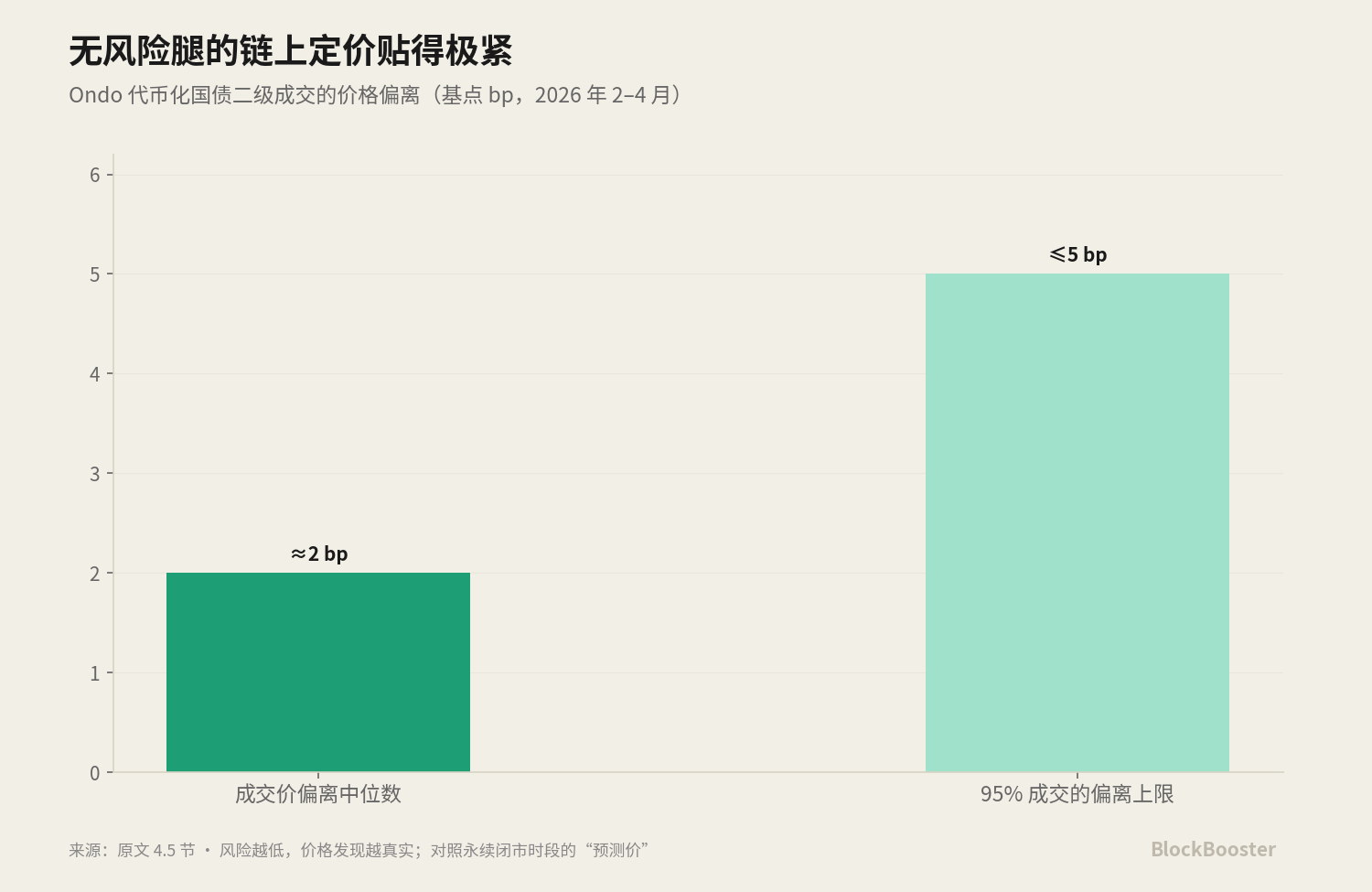
- 토큰화된 국채 수익률(예: BUIDL)은 미 국채 수익률에 밀접하게 연동되어 "암호화폐 무위험 금리"의 후보로 간주되며, 유통 시장 가격 결정이 정밀하여 괴리가 2~5bp에 불과하다.
- 기존 금리 스프레드는 구조적 위험을 반영한다: 무기한 선물 자금 조달 금리와 국채 수익률 간의 스프레드는 레버리지 변동성에 기인하며, Aave 금리는 스마트 계약 위험을 포함하고, Bitfinex FRR 프리미엄은 거래소 및 스테이블코인 카운터파티 위험을 나타낸다.
Original author: @BlazingKevin_, Blockbooster Researcher
1. Crypto Has No "Base Rate"
Leverage and financing in the crypto world—trillions of dollars in leveraged positions, collateralized lending, and yield products—operate without a unified base rate curve.
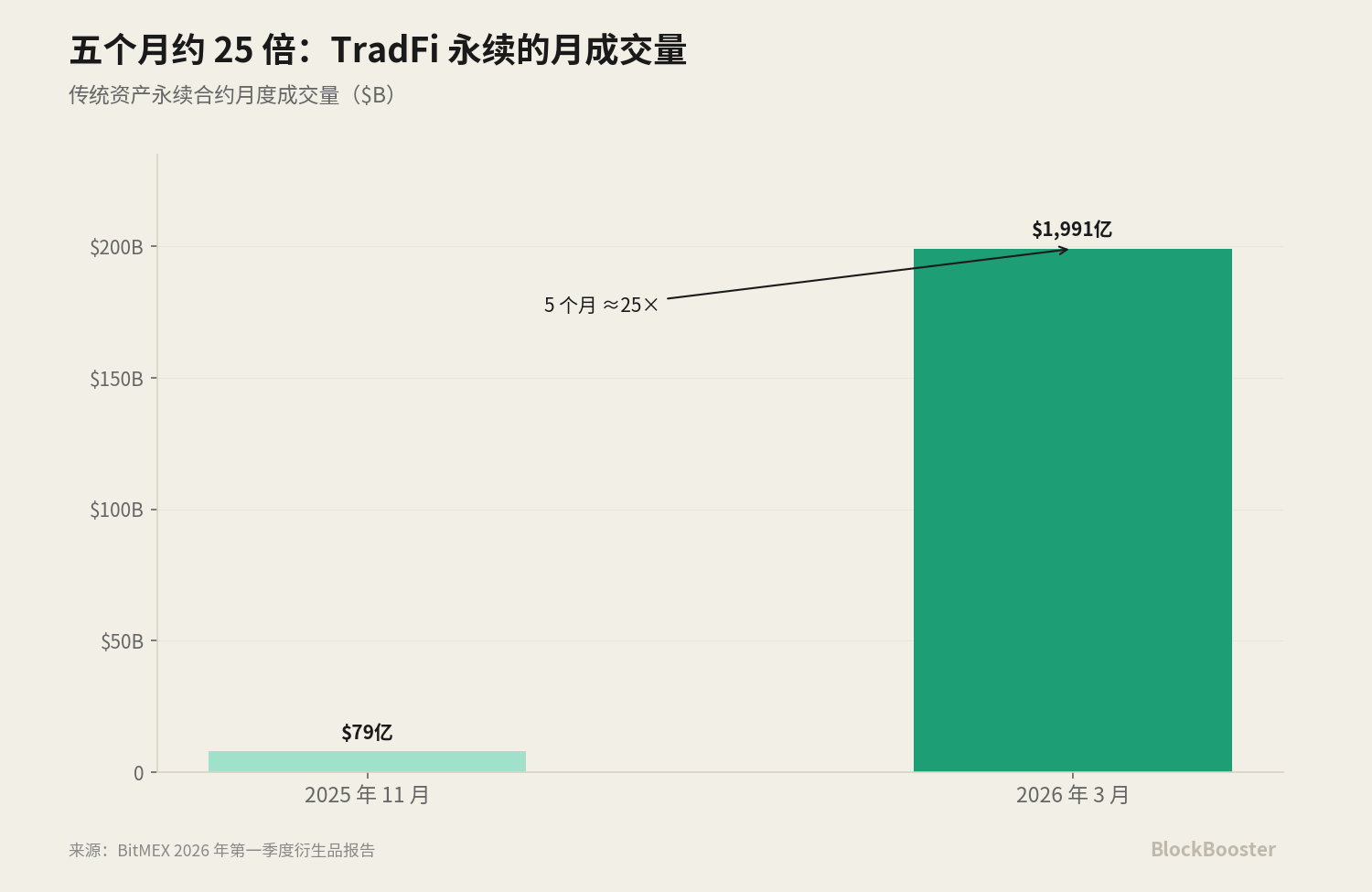
According to BitMEX's Q1 2026 derivatives report, for the nascent "traditional asset perpetuals" track alone, the single-quarter weekly trading volume surged from approximately $525.8 million at the end of 2025 to $30.7 billion by mid-March 2026, a quarterly increase of about 5,756%; monthly volume skyrocketed from $7.9 billion in November 2025 to $199.1 billion in March 2026, growing approximately 25-fold in five months.
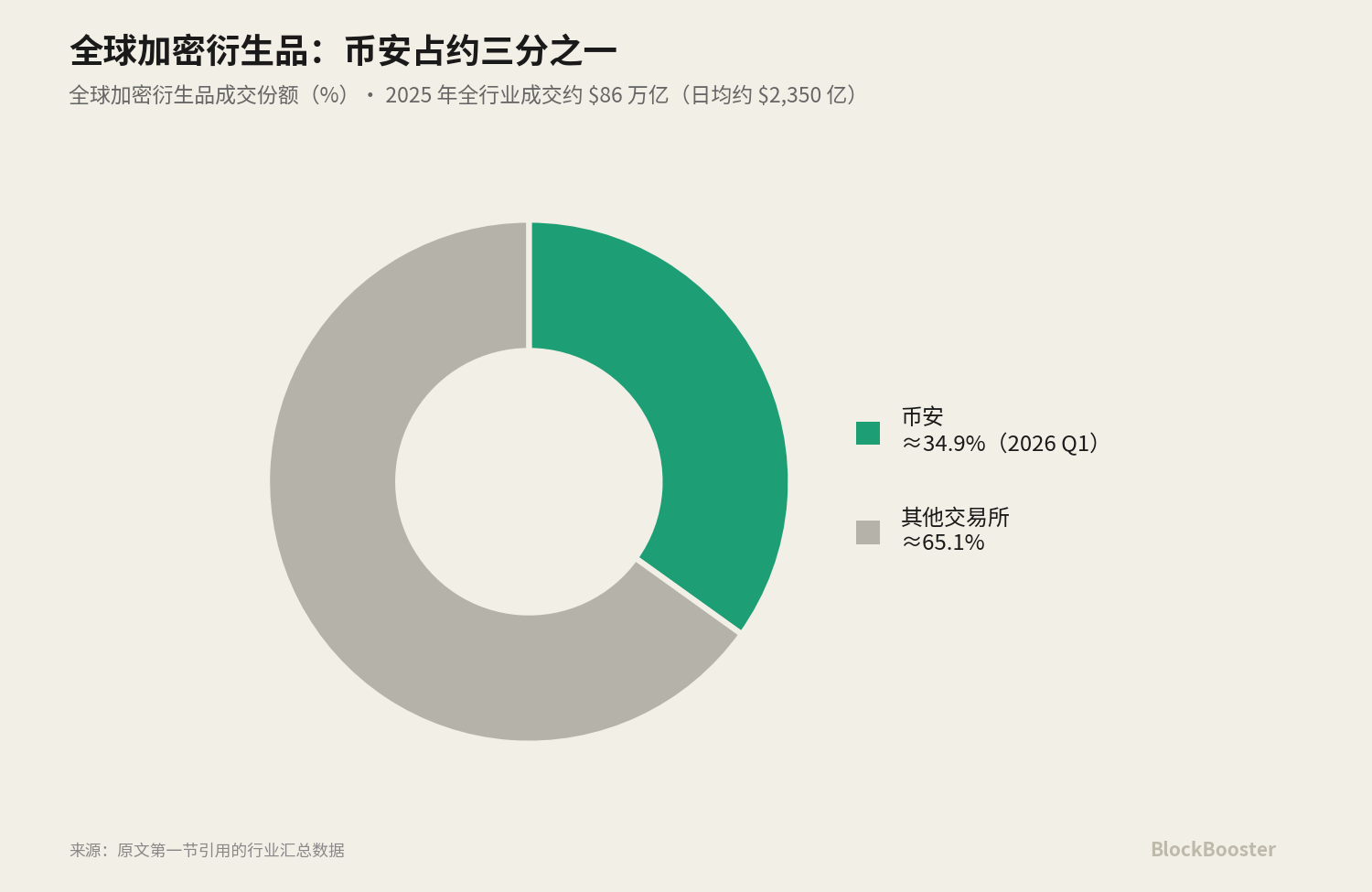
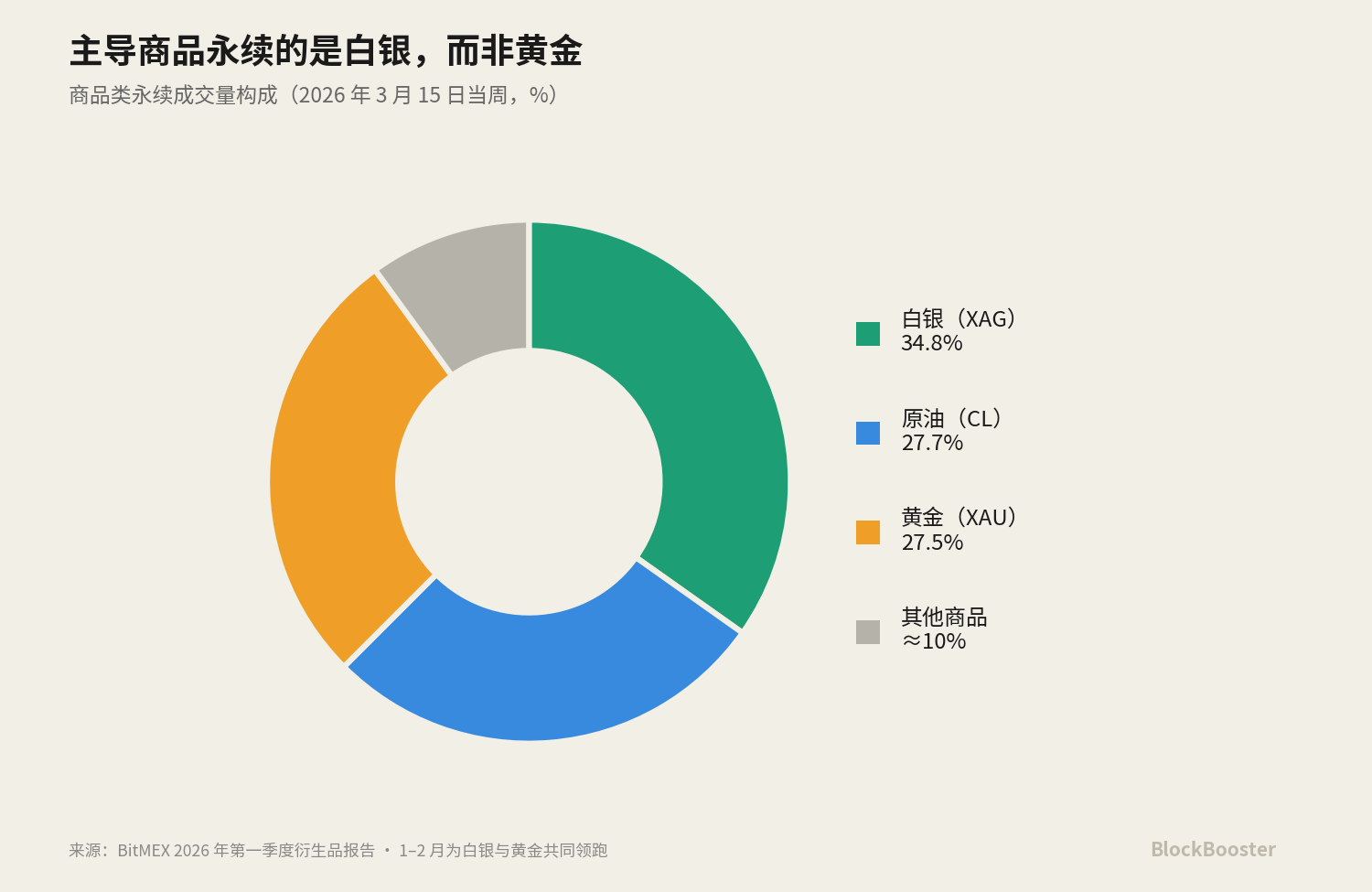
Based on DefiLlama's 30-day snapshot, Hyperliquid processed approximately $172.63 billion in perpetual volume, with open interest of about $9.13 billion. In Q1 2026, commodity perpetuals accounted for roughly 30% of Hyperliquid's open interest, primarily driven by demand for 24/7 crude oil trading.
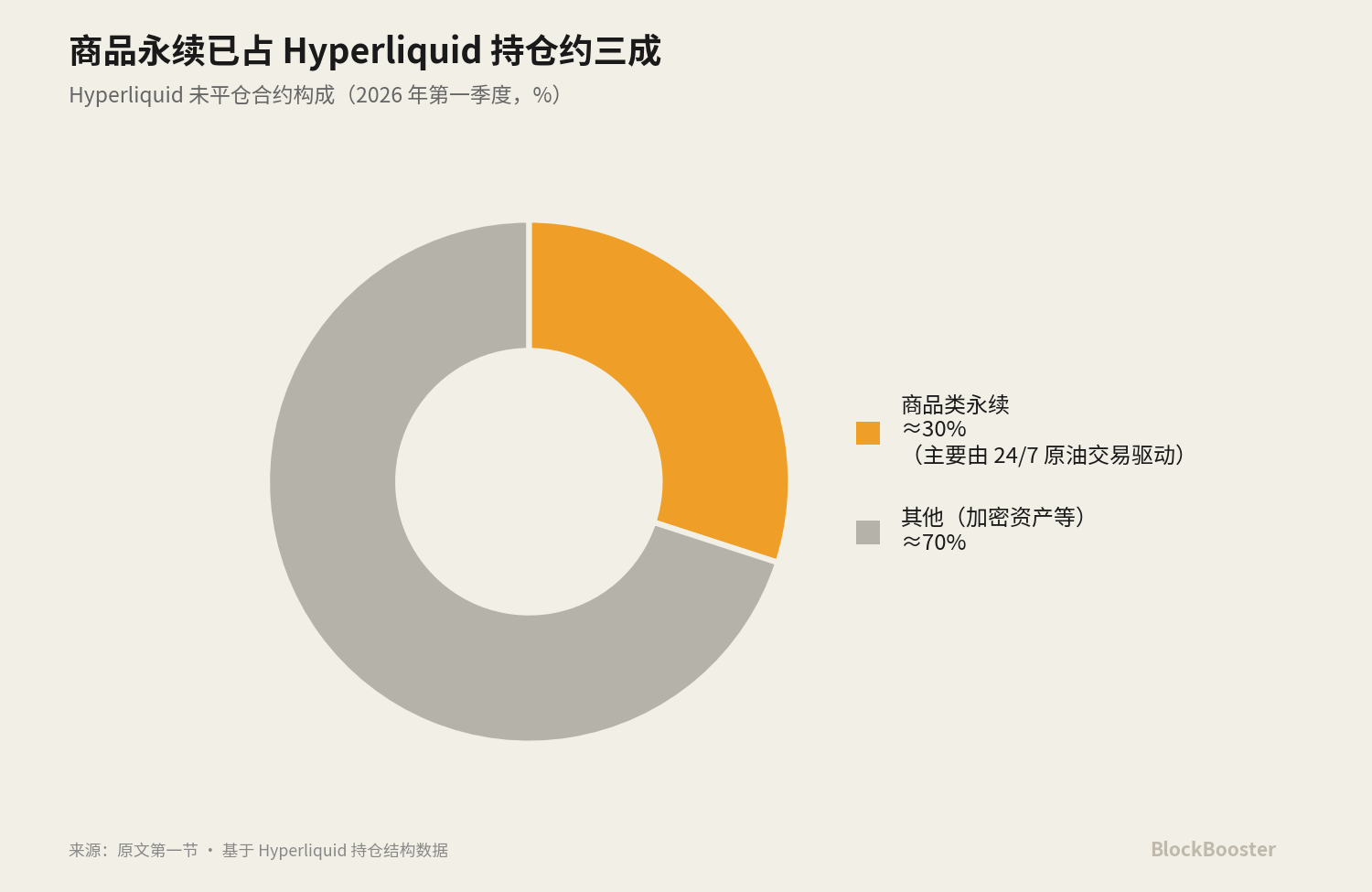
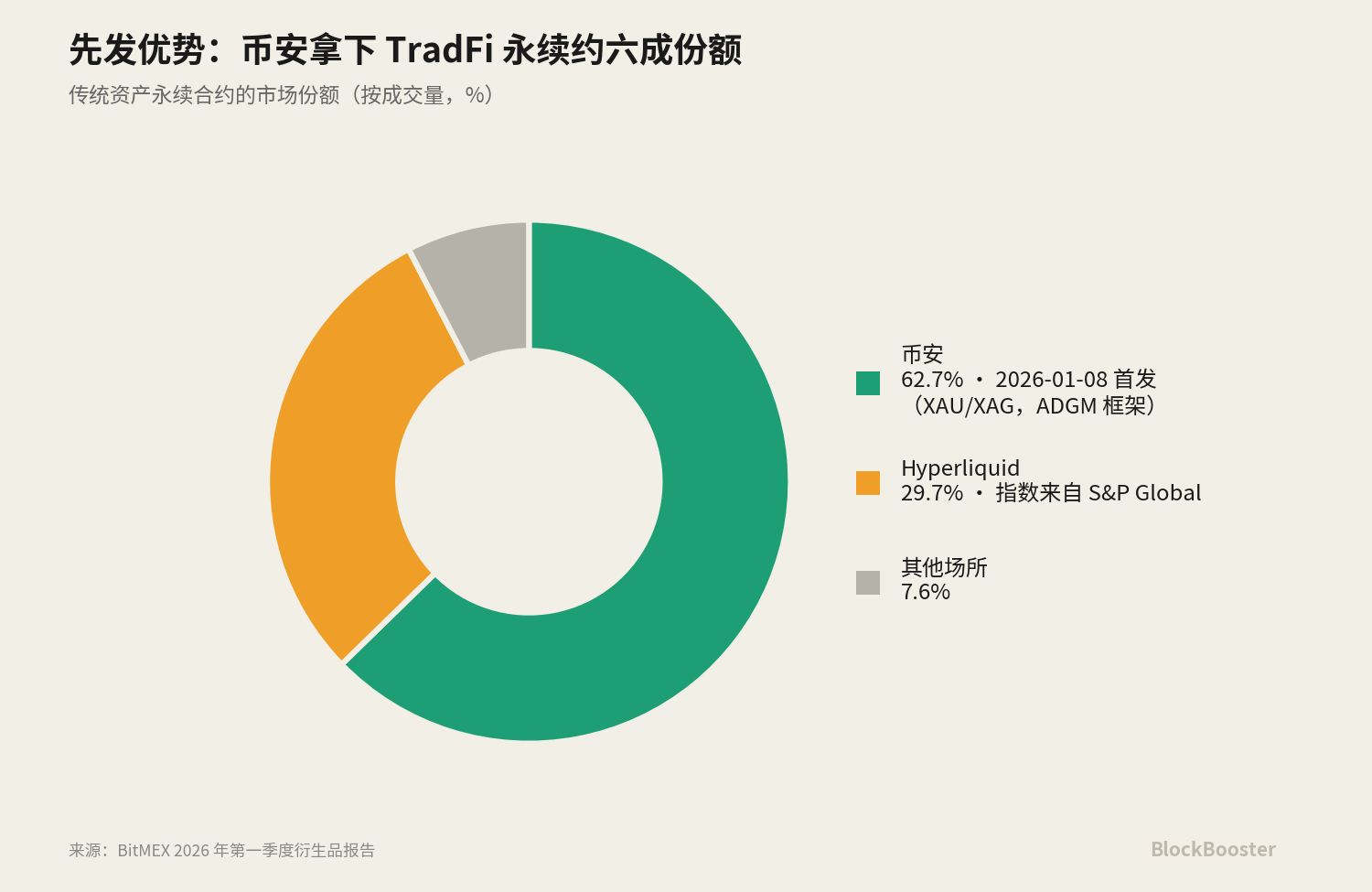
Regarding the "traditional asset perpetuals" track: Binance launched TradFi perpetual contracts on January 8, 2026, debuting with Gold (XAUUSDT) and Silver (XAGUSDT). Leveraging this first-mover advantage, Binance captured approximately 62.7% market share in TradFi perpetuals, followed by Hyperliquid with 29.7%.
Hyperliquid's index data for these traditional asset perpetuals comes from a partnership with S&P Global, and this collaboration—linking crypto perpetuals directly to traditional indices—is attracting regulatory scrutiny from the U.S. CFTC.
Meanwhile, Ethena's USDe market capitalization was in the range of approximately $4.5 billion to $5.9 billion in early June 2026.
Each of these products quotes a "rate" or "yield"—perpetuals have funding rates, lending protocols have borrowing APRs, sUSDe has a staking yield, tokenized Treasuries have coupons—but crypto still lacks its own SOFR. There is no widely accepted base curve that can serve as an anchor for pricing. Every exchange and every protocol has become a miniature funding market, quoting its own price, without a common, trusted frame of reference between them.
2. What Qualifies as a Crypto "Base Rate"?
Let's first examine three different sets of rate comparisons:
- Set One: Base Funding Rate vs. Product Yield vs. Derivatives Implied Rate. sUSDe's APY is a product yield—a return paid to holders; the perpetual funding rate is a derivatives implied rate—a fee paid between longs and shorts to keep the perpetual price anchored to the spot price; a benchmark funding rate should be a public reference that countless other products can quote and use for pricing. Product yields and derivatives implied rates are not benchmarks—they are "downstream" of the benchmark, the result of various premiums and structures layered on top of the base.
- Set Two: Overnight Rate vs. Term Rate. Perpetual funding rates settle every 1 or 8 hours, making them essentially an overnight rate—reflecting the cost of capital only for "now until the next settlement point," without a term structure. It cannot tell you the price difference between "borrowing for 30 days" and "borrowing for 90 days." Just as SOFR itself is an overnight rate and needs a futures market to construct Term SOFR with a term structure, a rate without a term structure cannot support any medium-to-long-term fixed-income market.
- Set Three: Real Lending Rate vs. Algorithmic/Implied Rate. Actual bilateral lending transactions (e.g., Bitfinex's margin funding book, where real lenders and borrowers match) and algorithmic utilization pricing (e.g., Aave, where rates are automatically calculated by a formula based on pool utilization) are two fundamentally different price generation mechanisms. The former is voted on by market participants with real money, while the latter is a curve written into code by protocol designers.
From these three distinctions, we can extract the criteria a qualified benchmark should meet:
Based on real transactions, anchored in a sufficiently broad and deep underlying market (hard to manipulate by a single participant), operating with independent governance (no conflict of interest between the administrator and the market being priced), and ideally possessing a term structure (to support medium-to-long-term pricing).
(SOFR's underlying is the real transaction volume of Treasury-backed overnight repo, with daily average volume "often exceeding $1 trillion." This is the actual transaction volume of overnight repo. This is entirely different from the notional amount supporting Term SOFR futures.)
Applying SOFR's logic to crypto reveals structural isomorphism. The Bank for International Settlements, in its research, likens on-chain collateralized lending markets to "crypto-native money markets," with operational mechanisms similar to traditional tri-party repo—over-collateralized, marked-to-market, rolling overnight. Since on-chain lending is structurally a form of repo-like secured financing, evaluating crypto benchmarks using SOFR's design—a benchmark built on actual repo transactions—is an appropriate isomorphic reference.
3. What Are the Characteristics of SOFR? Why Was LIBOR Discontinued?
LIBOR (London Interbank Offered Rate) was once the cornerstone of global finance. At its peak, approximately $300 trillion in financial contracts (including interest rate swaps, mortgages, student loans, corporate bonds, etc.) depended on LIBOR across five currency areas. But LIBOR had a fatal design flaw: it was not based on real transactions but on daily "self-reported" estimates of borrowing costs from a small panel of banks.
This flaw was fully exposed after the 2008 financial crisis. Regulatory investigations revealed that traders at several major global banks systematically manipulated LIBOR quotes to benefit their own derivatives positions.
The manipulation scandal directly led to LIBOR's abolition.
Its replacement is SOFR (Secured Overnight Financing Rate). SOFR's design is almost a "reverse engineering" of every LIBOR flaw: it doesn't use self-reported estimates but is based on actual transactions in the Treasury repo market; it takes the volume-weighted median of transactions across three repo markets (tri-party repo, GCF Repo, and bilateral repo cleared through FICC's DVP service), offering a broad, deep scope that is difficult for a single participant to manipulate; it is administered by the New York Fed, adhering to IOSCO principles, eliminating conflicts of interest between the administrator and the priced market.
But SOFR has an "inherent limitation": it is an overnight rate, without a term structure. The market needs not just "today's overnight cost" but also "expected funding costs for the next three months" to price medium-to-long-term loans. Thus, CME launched CME Term SOFR—a set of forward-looking rates covering four tenors: 1-month, 3-month, 6-month, and 12-month.
It uses trading data from SOFR futures to infer the market's expectation of the future SOFR path, thereby constructing a forward-looking term curve. (The representative notional amount of SOFR futures used to construct Term SOFR was approximately $2.3 trillion per day in Q4 2023.)
4. Some Candidate Rates Worth Discussing
There are many candidates in the market treated as "rates" or "yields." We will dissect them one by one, discussing in the meeting why some rates are clearly unsuitable as benchmarks and which ones have room for evolution.
A key axis running through all dissections is—"who has the right to decide": is it market-weighted, algorithmic utilization, or governance setting?
4.1 Perpetual Funding Rate (Hyperliquid / Binance)
The perpetual funding rate is the implied price of leverage, driven by the basis between the spot and perpetual prices: essentially an overnight rate, lacking a term structure.
When the spot market for a TradFi underlying asset is closed (e.g., stocks, precious metals on weekends), exchanges cannot obtain a real-time spot price to calculate the funding rate. Binance's approach is to freeze the index price at the last spot price and switch to an EWMA mark price with a ±3% cap; Hyperliquid also switches to EWMA on weekends with volatility caps per product. During closed market hours, the "anchor" for the perpetual price is essentially a predicted value, not a real transaction price. When the market reopens and the real price gaps beyond this cap, a limit-up/limit-down situation occurs. Thus, the price during closed hours is a prediction, not a real, arbitrageable anchor.
On May 29, 2026, the U.S. CFTC approved KalshiEX's Bitcoin perpetual contract (BTCPERP), the first truly no-expiration regulated Bitcoin perpetual within the United States. Concurrently, it released a policy statement on perpetual contracts, staff guidance on 24/7 trading and clearing, and a no-action position regarding Coinbase offering perpetuals via Deribit. The significance lies in: a regulated, centrally cleared perpetual means its funding rate and basis are generated in a compliant, clearing-backed environment—this could be a future candidate for a "crypto SOFR." This, along with the CFTC scrutiny of the Hyperliquid–S&P Global index partnership, signals that "regulation is closing in on crypto benchmarks."
4.2 Bitfinex Margin Funding + FRR
This is crypto's native USD term funding market.
The mechanism: Bitfinex operates a peer-to-peer margin funding market where lenders lend funds to margin traders to earn interest. The key design point is that funding terms range from 2 to 120 days (commonly 2, 7, 30 days), and both the rate and term must match for a trade to occur. This means Bitfinex's funding book naturally forms a real lending curve from the short to long end: 30-day money and 120-day money have different prices, matched by real supply and demand. This is one of the very few real lending markets in the crypto world that inherently possesses a term structure.
And the FRR (Flash Return Rate) is this market's reference rate: the FRR is the volume-weighted average rate of all active fixed-rate funding offers, updated hourly. Essentially, it's a "Bitfinex version of a benchmark reference rate"—an index reflecting the current average lending cost in the market. Lenders can choose to lend at the FRR, allowing their rate to automatically follow the market.
Bitfinex charges approximately 15% on lending earnings (18% for hidden orders); the minimum order amount is $150. The FRR is quoted as a daily rate, annualized from the daily rate: Bitfinex USD FRR is approximately 0.0136%/day, annualized to about 5.1%—on par with candidates like tokenized Treasuries, Aave, and SSR.
The critical issue is its volatility: USD lending has historically fluctuated wildly within a range of roughly 3%–20% APR, strongly correlated with leverage demand.
This daily rate curve unfolds across different terms from 2 to 120 days, forming crypto's native USD funding curve with a genuine term structure.
Bitfinex and Tether share the same parent company, iFinex, and have overlapping management. This gives Bitfinex the deepest USDT liquidity in the entire crypto world—a reason for its deep funding market; simultaneously, it concentrates counterparty risk and stablecoin issuer risk within the same entity. Borrowing Bitfinex's money, matched on Bitfinex, denominated in Tether, with the same parent company potentially providing a backstop in extreme scenarios—this is a highly self-contained structure.
Although Bitfinex's funding market is the oldest and deepest native USD term funding market in crypto, its absolute scale (stock of funding orders and daily matching volume) is still much smaller compared to the multi-trillion dollar trading volumes of the perpetual markets mentioned earlier.
Comparing FRR to LIBOR and SOFR: on the dimension of "based on real transactions," FRR is cleaner than LIBOR. FRR is calculated from real, executed fixed-rate funding orders, weighted by size, reflecting actual market behavior. However, FRR originates from a single exchange's order book (concentration), is operated by the same parent company iFinex that controls the largest stablecoin Tether (conflict of interest), and this operator also acts as the lender of last resort for existing positions in this market (further concentration and conflict). Therefore, FRR hits exactly the issues that SOFR was designed to eliminate in terms of concentration and conflicts of interest.
4.3 DeFi Lending Rates (Aave / Morpho)
This is a prime example of algorithmic utilization pricing: the rate is not determined by bilateral matching but is automatically calculated by a preset formula based on pool utilization—the higher the utilization, the higher the rate. It floats in real-time with borrowing demand.
Aave's mainnet USDC deposit rate floats between approximately 3.5%–6% depending on utilization; Morpho's curator-managed USDC vaults yield approximately 5%–7% after curator fees.
4.4 MakerDAO / Sky Savings Rate (DAI's DSR / USDS's SSR)
This is a "policy-like rate" set directly by protocol governance. DAI's DSR (Dai Savings Rate) and USDS's SSR (Sky Savings Rate) are widely referenced, functionally similar to a central bank's policy rate—it's not determined by market matching or algorithmic utilization triggers but by a governance vote by Sky's stakeholders.
DSR/SSR's governance setting, FRR's market weighting, and Aave's algorithmic utilization represent three fundamentally different interest rate generation mechanisms.
Governance setting vs. market weighting vs. algorithmic utilization—each mechanism has its own credibility issues and manipulation risks. A mature market's benchmark should ideally come from the one least susceptible to manipulation (market-weighted real transactions with sufficient breadth and depth). In terms of current values, the SSR was reduced by governance from 4.75% in late April 2026, settling around 3.6%–3.75% by early June (the "governance setting" mechanism follows the Fed's path); the circulating supply of USDS is approximately $11 billion.
4.5 Tokenized Treasury Yield (BUIDL / BENJI, etc.)
This is the ~4–5% "risk-free leg," a candidate qualified to serve as a "crypto risk-free benchmark." BlackRock's BUIDL, Franklin Templeton's BENJI, etc. bring Treasury coupon yields onto the chain. In terms of current values, major tokenized Treasury tokens (BUIDL, USDY, USDM, USYC, etc.) were paying approximately 4.1%–4.7% APY in April 2026, closely tracking the 3-month Treasury yield. Its yield can almost directly benchmark the traditional risk-free rate.
The secondary market pricing for this "risk-free leg" of tokenized Treasuries is very tight—using Ondo's tokenized Treasury as an example, between February and April 2026, the median deviation of its transaction price was only about 2 basis points, with 95% of transactions falling within 5 basis points. This shows that when the underlying asset is sufficiently standard and risk-free, on-chain price discovery can be very precise; in contrast, the "price" of high-risk products like perpetuals during closed market hours is full of predictive elements—the lower the risk, the more real the price; the higher the risk, the more the pricing resembles speculation.
4.6 Ethena sUSDe
This is a securitized product of perpetual funding rates + collateral yield. Its APY is highly dependent on the funding rate levels in the perpetual market, making it essentially a repackaging of implied rates, not a benchmark itself.
Looking at the seven candidates together: they each measure different things (leverage sentiment, real lending, algorithmic utilization, governance policy, risk-free coupons, institutional arbitrage), and each embeds different risks (liquidation, counterparty, smart contract, governance, credit), priced by different entities.
None simultaneously meet the