






Grabbing Equity, Competing for Infrastructure: The Great Korean Crypto Institution Scramble


- Key Insight: South Korean financial institutions are rapidly accelerating their entry into the crypto market through partnership agreements and exchange equity acquisitions. However, most projects remain at the letter-of-intent stage, with low implementation rates. Institutional strategy has shifted from competing for retail investors to vying for control over infrastructure such as stablecoins, STOs, and custody, leveraging this to influence future regulatory frameworks.
- Key Elements:
- Low Implementation Rate of Cooperation: Tiger Research found that among 196 partnerships involving 150 institutions, most are still at the letter-of-intent stage, with few actual commercial projects.
- Exchange Equity Competition: Giants like Hana Bank, Hanwha Investment & Securities, and Samsung are aggressively acquiring stakes in exchanges such as Upbit and Korbit, aiming to secure the gateway for digital financial traffic.
- Uneven Sector Development: Asset custody has seen the most progress, while RWA/STO and stablecoins are hampered by regulatory lag. Companies are either partnering with local allies or shifting focus overseas.
- Rise of Local Infrastructure: Companies like LG CNS, DSRV, and Altus are focusing on building Korea-specific financial infrastructure, reducing reliance on foreign technology and becoming core pillars for institutions.
- Market Shift in Focus: With retail trading volume down approximately 48% year-on-year, the market is transitioning from retail-driven to institution-driven. Overseas public chain strategies are also pivoting towards partnerships with local financial giants.
Original authors: Henry Kim, Ryan Yoon
Original compilation: Chopper, Foresight News
South Korean financial institutions are accelerating cooperation and equity acquisitions in the crypto space, but the industry landscape remains complex. Various cooperation agreements are frequently announced, yet truly commercialized projects are few and far between. This article will analyze the reasons for the low implementation rate of these partnerships and why institutions continue to increase their investments.
TL;DR
- Institutional crypto businesses in South Korea have moved from the letter of intent stage to actual operations and exchange equity acquisitions.
- Major institutions are competing for influence over key financial infrastructure, including STO standard-setting, stablecoin payment channels, and the asset custody market.
- Local infrastructure providers are emerging as core pillars for institutional businesses. Companies are building proprietary technology links based on the Bank of Korea's CBDC framework and local regulations, reducing reliance on overseas technology.
- The South Korean strategy of overseas Web3 public chain foundations has completely shifted. Traditional finance is gradually dominating the market. Overseas institutions are no longer focusing on retail community operations but are seeking partnerships with large corporations and financial institutions.
A Surge of Memorandums of Understanding, the Industry Enters a "Signing Competition"
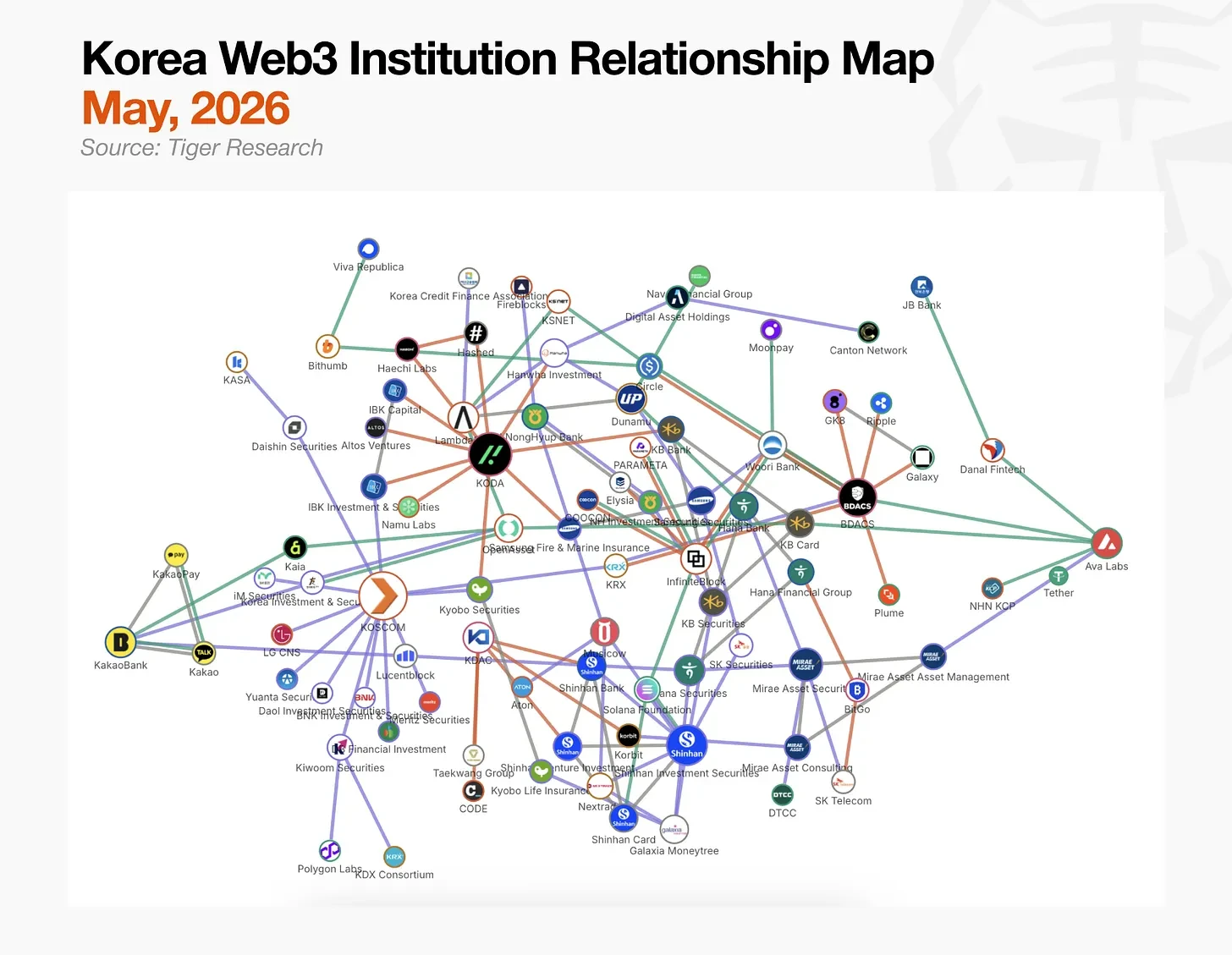
The above chart, compiled by Tiger Research, outlines the cooperation network of various institutions in the South Korean crypto market. The entire map is intricately intertwined, making it difficult for outsiders to distinguish which partnerships are operational and which remain at the intent stage. The boundaries between core industry players and peripheral participants are also very blurred.
This complex landscape accurately reflects the current state of the South Korean institutional crypto market. Tiger Research analyzed 150 institutions and 196 cooperation cases. Currently, no single entity has achieved absolute monopoly.
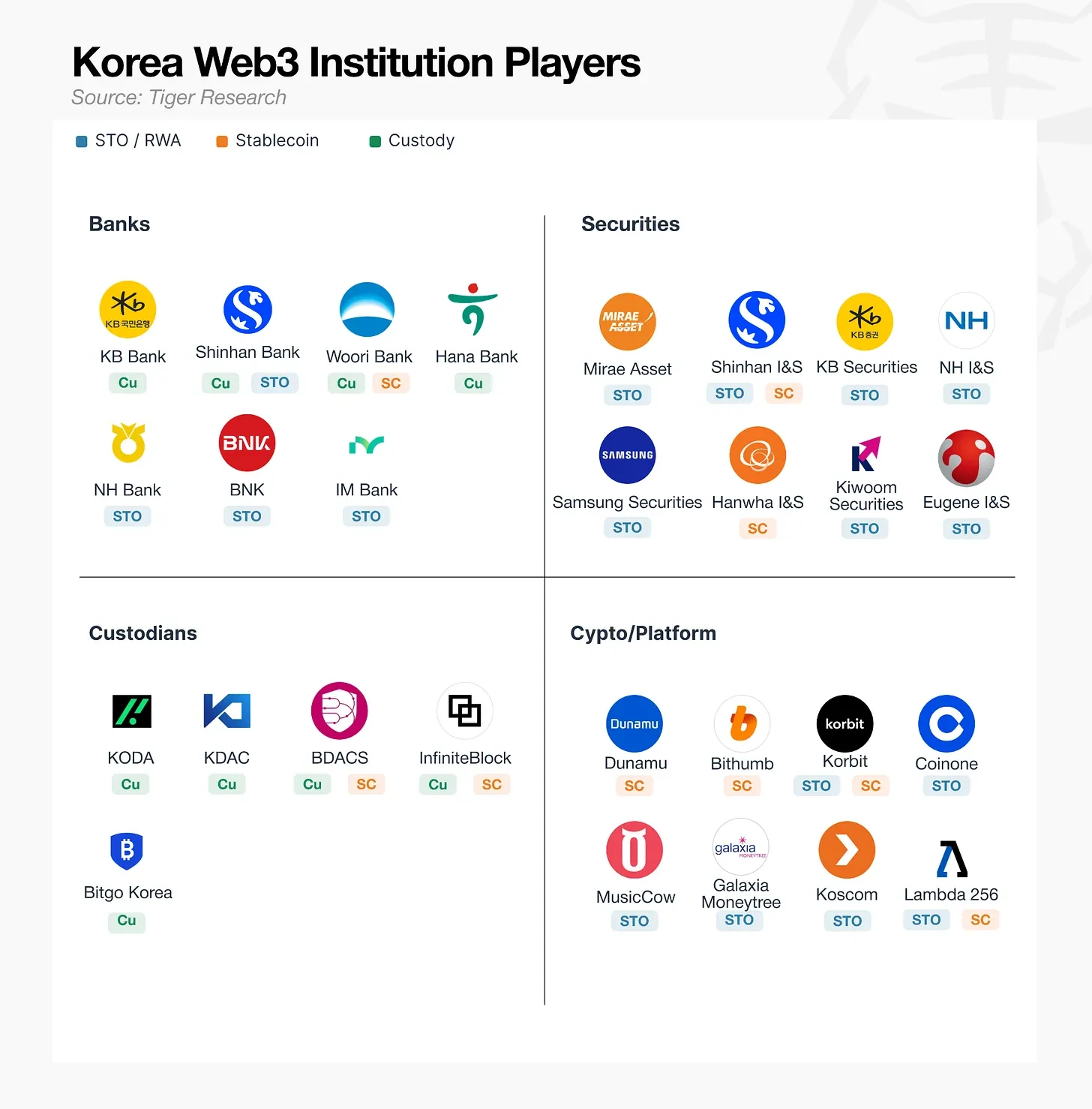
Before relevant regulatory rules are formally implemented, South Korean local institutions are actively staking their claims and securing positions. The current competition is mainly concentrated in three major areas: stablecoins, Security Token Offerings (STO), and crypto asset custody.
Another significant trend is the concentrated acquisition of crypto exchange equity by financial institutions. Industry insiders believe this is an act of institutions securing market positions before regulatory clarity emerges, signaling a long-term bullish outlook.
The Battle for Exchange Equity Heats Up
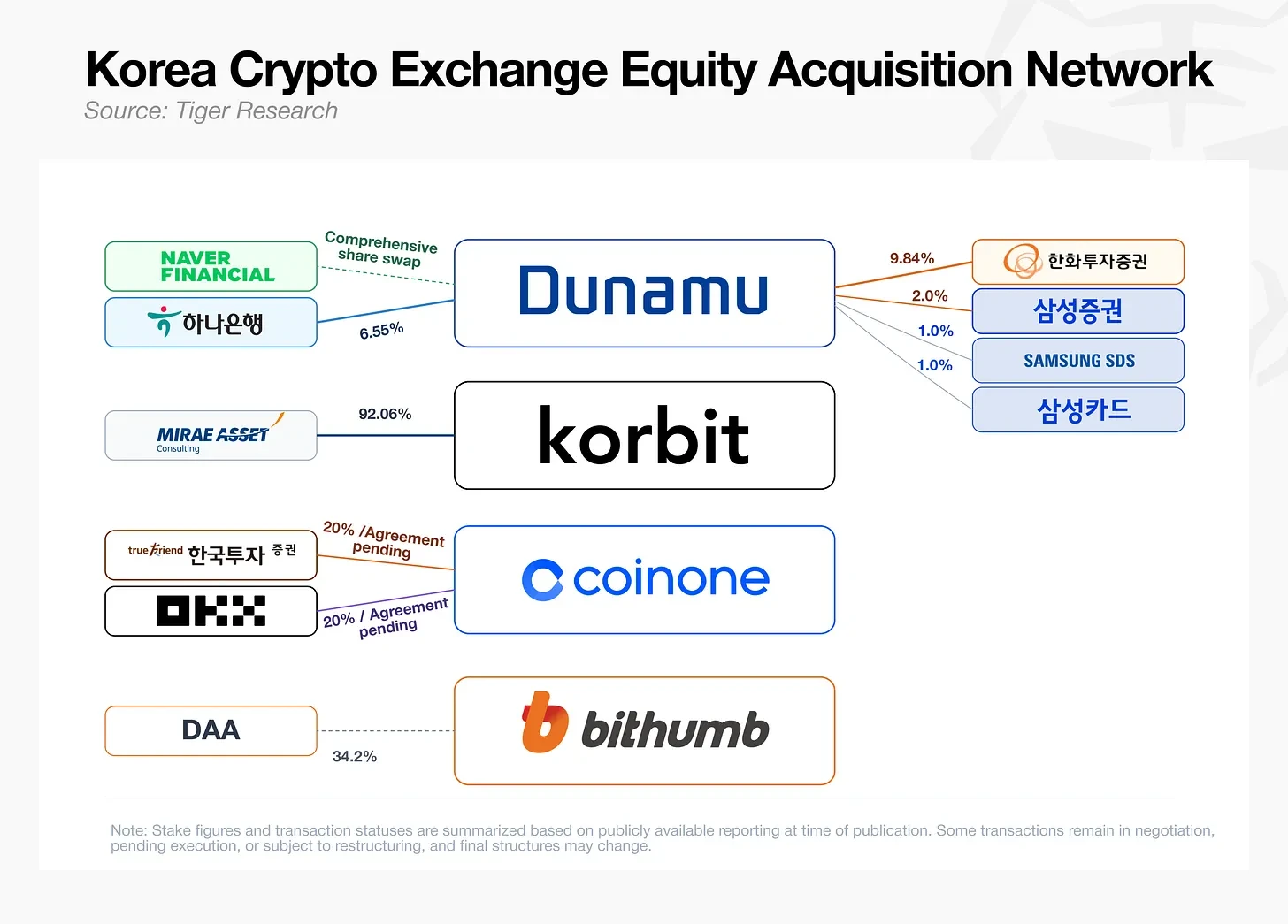
Hana Bank announced it would invest approximately KRW 1 trillion (about USD 720 million) to acquire a 6.55% stake in Dunamu, the operator of Upbit. Just ten days later, Hanwha Investment & Securities received approval to increase its stake by an additional 3.90%. On the 28th of the same month, Samsung Securities, Samsung SDS, and Samsung Card jointly acquired a 4.0% stake in the platform.
Mirae Asset Consulting signed an agreement back in February to acquire a 92.06% stake in the Korbit exchange. There are also reports that Korea Investment & Securities is in talks with global exchange OKX to jointly acquire Coinone.
The valuation logic of capital markets for crypto exchanges has changed. Exchanges are no longer just platforms for earning transaction fees. They have become core traffic gateways for distributing stablecoins, custody services, security tokens, and Real World Asset (RWA) tokenization products.
Banks and securities firms can indirectly obtain Virtual Asset Service Provider (VASP) qualifications through exchange equity holdings while firmly controlling the platform's user base and liquidity. This equity battle is fundamentally a game for control over the front-end traffic and distribution channels of digital finance.
Current Status of South Korean Crypto Sub-sectors
From the cooperation network, it is evident that development progress varies significantly across different crypto sectors. The asset custody sector has the most implemented projects, with numerous players having broken through regulatory barriers and officially launched services. RWA/STO projects mostly remain at the signing or intent stage, awaiting supporting legislation. The stablecoin sector is also progressing slowly, with no company currently having established industry standards or leading the market.
The developmental obstacles differ for each sector, and the strategies of various institutions to overcome them also diverge. Some companies are partnering with local allies, waiting for regulatory easing; others are turning to more mature overseas markets to find alternative paths. The following sections analyze the development bottlenecks and player strategies for each sector.
RWA/STO: Legislation in Place, Commercial Infrastructure is the Biggest Shortcoming
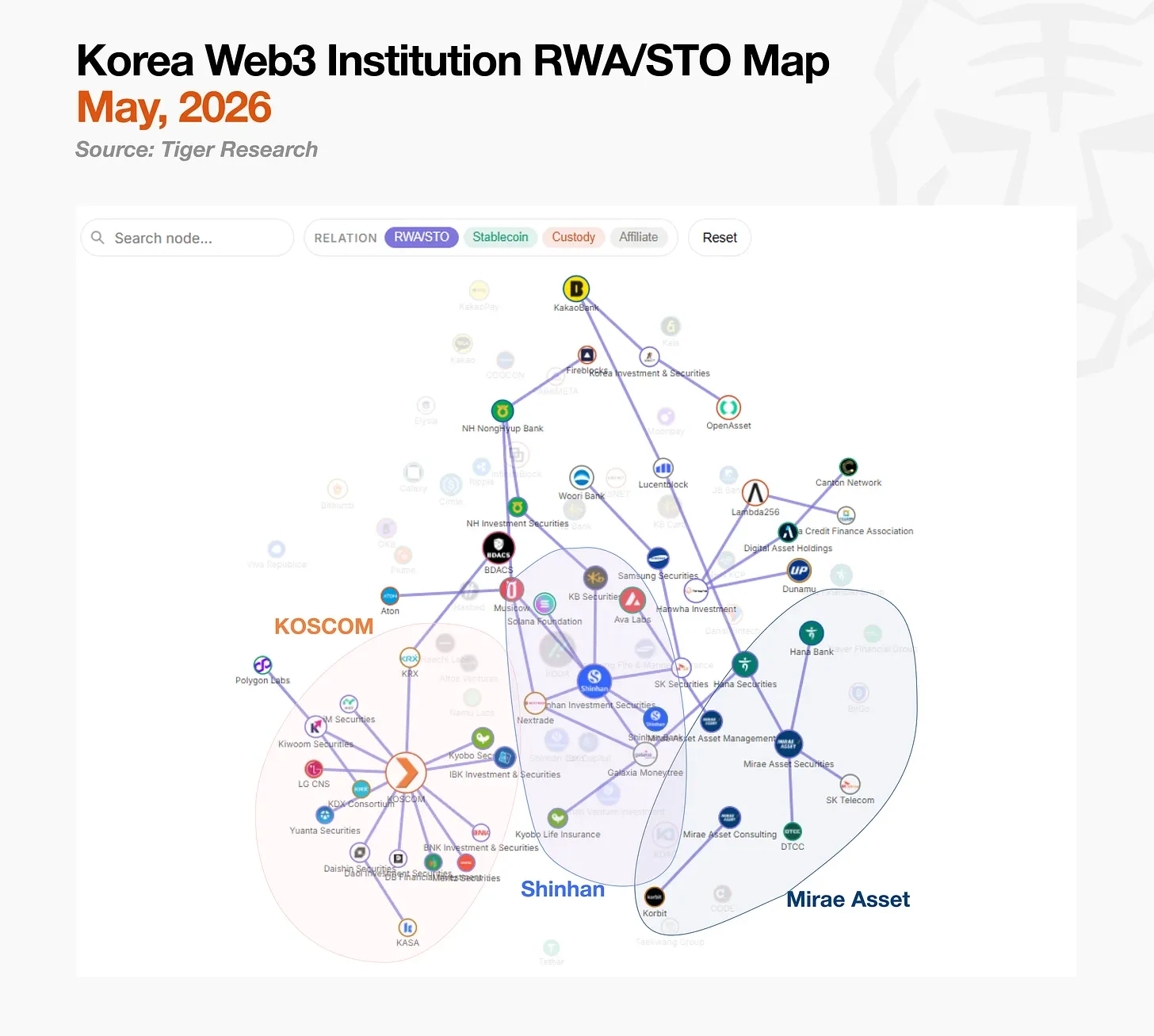
The local STO market in South Korea is currently divided into two main camps: the alliance led by Korea Securities Information Corporation (KOSCOM) and the fractional investment alliance led by Shinhan Investment Securities. Mirae Asset Securities is taking a different path, choosing to forgo waiting for local infrastructure development and directly deploying its business in overseas markets.
KOSCOM, 76.6% owned by the Korea Exchange (KRX), is a core financial network operator in South Korea. Its positioning is to build neutral shared infrastructure serving all securities firms. Instead of signing exclusive agreements with single issuers, it has onboarded 11 securities firms onto its platform. Its goal is to unify technical standards for STO issuance and circulation and integrate with the centralized custody system of the Korea Securities Depository.
Shinhan Investment Securities has rapidly built its own STO ecosystem. It completed a proof of concept with Lambda 256 in 2022, launched the integrated platform PULSE in 2024, and introduced a multi-platform account integration service in 2025. In 2025 alone, the institution participated in 10 investment contract-type security token offerings as an account manager and acquired a controlling stake in the OTC exchange NXT, establishing a channel from token issuance to circulation.
Mirae Asset Securities has completely bypassed local infrastructure and is fully focused on overseas expansion. The institution issued digital bonds in Hong Kong, obtained a virtual asset retail license from the Hong Kong Securities and Futures Commission, and plans to launch a smart trading system for local retail investors in June. In the US, it is the only South Korean securities firm to join the Depository Trust & Clearing Corporation (DTCC) tokenization working group, participating in global standard-setting alongside institutions like JPMorgan, Goldman Sachs, and BlackRock. This strategic deployment will give it compliance and negotiation advantages when the local STO system eventually aligns with global standards.
Stablecoins: Technology Matured, Regulation is the Main Barrier
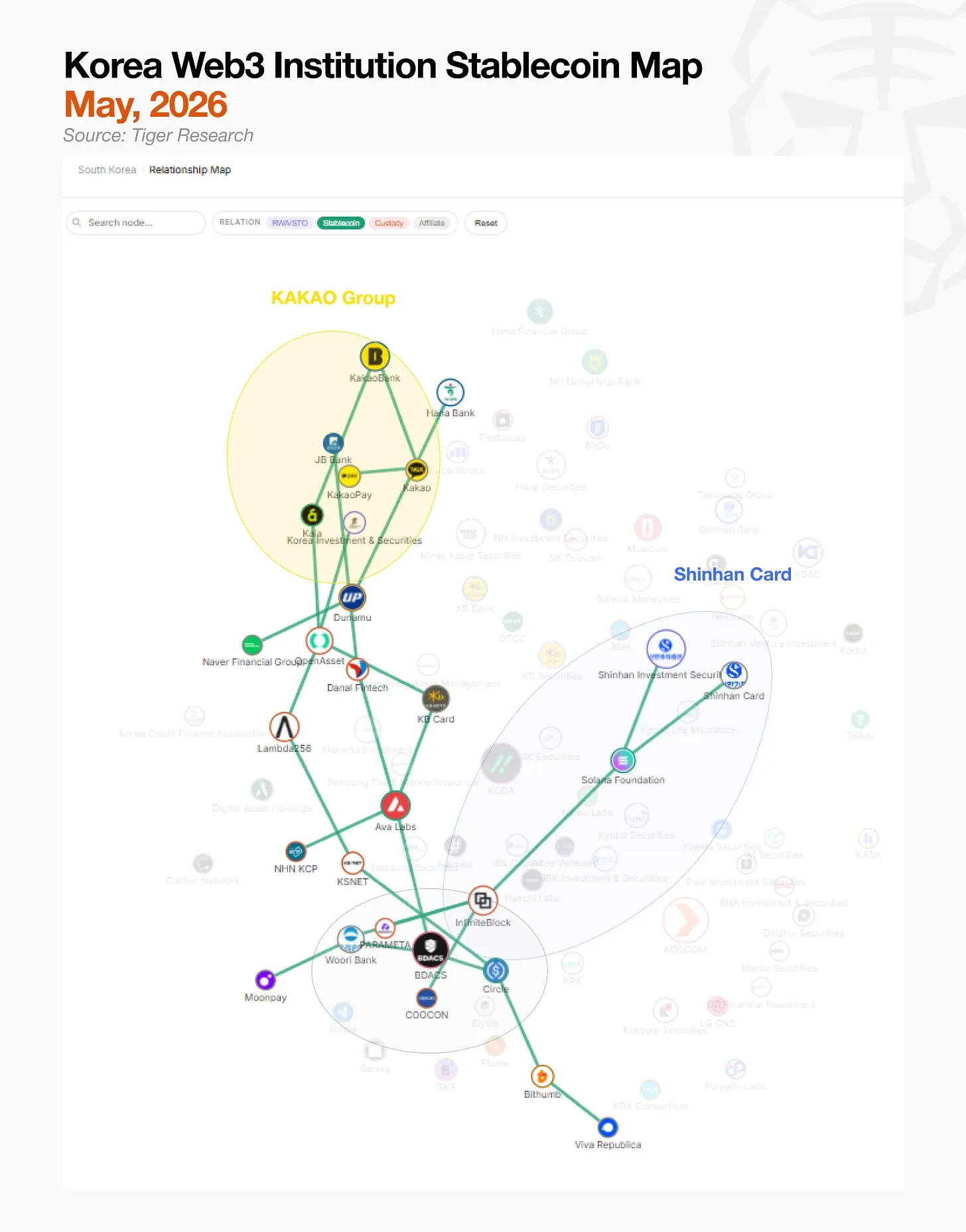
The stablecoin sector has the most diverse set of participants, including credit card companies, exchanges, fintech companies, and infrastructure providers, each leveraging their strengths to enter the market.
The Kakao group is the largest camp. Kakao, KakaoBank, and Kakao Pay have formed a joint task force to create a "super wallet" encompassing stablecoins, cryptocurrencies, and local currencies. The team's core advantage stems from the infrastructure capabilities accumulated over years of operating the Kaia public chain, which has already launched USDT and is conducting real-world payment tests.
Shinhan Card is migrating its existing payment network to a blockchain platform. The institution signed a memorandum of understanding with Solana in April this year, but the related technological development had already been implemented earlier. It had previously completed a proof of concept with Solana, Visa, Mastercard, and Fireblocks, and is now conducting in-depth testing across six modules, including wallets and smart contracts.
Due to regulatory delays for KRW stablecoins, the exchange camp is prioritizing the USD stablecoin track. Dunamu, in collaboration with Naver Financial, is developing a KRW stablecoin business based on its proprietary GIWA blockchain. Bithumb has paused its KRW stablecoin development, first establishing a USD stablecoin distribution network in partnership with Circle and WLF. It is also in talks with payment platform Toss for a joint KRW stablecoin issuance, but overall progress is slow.
Despite frequent actions by various camps, they are all constrained by the same regulatory hurdle. The Bank of Korea has proposed a 51% ownership rule, requiring the issuer of a KRW stablecoin to be a consortium where a bank holds a majority stake. Fintech companies have raised objections to this, and the resulting standoff has prevented the government from finalizing the issuance details. Once official rules are set, the camp with the most extensive front-end traffic channels is likely to dominate the market.
Asset Custody: Services Launched, but Still Needs Institutional Capital Inflow
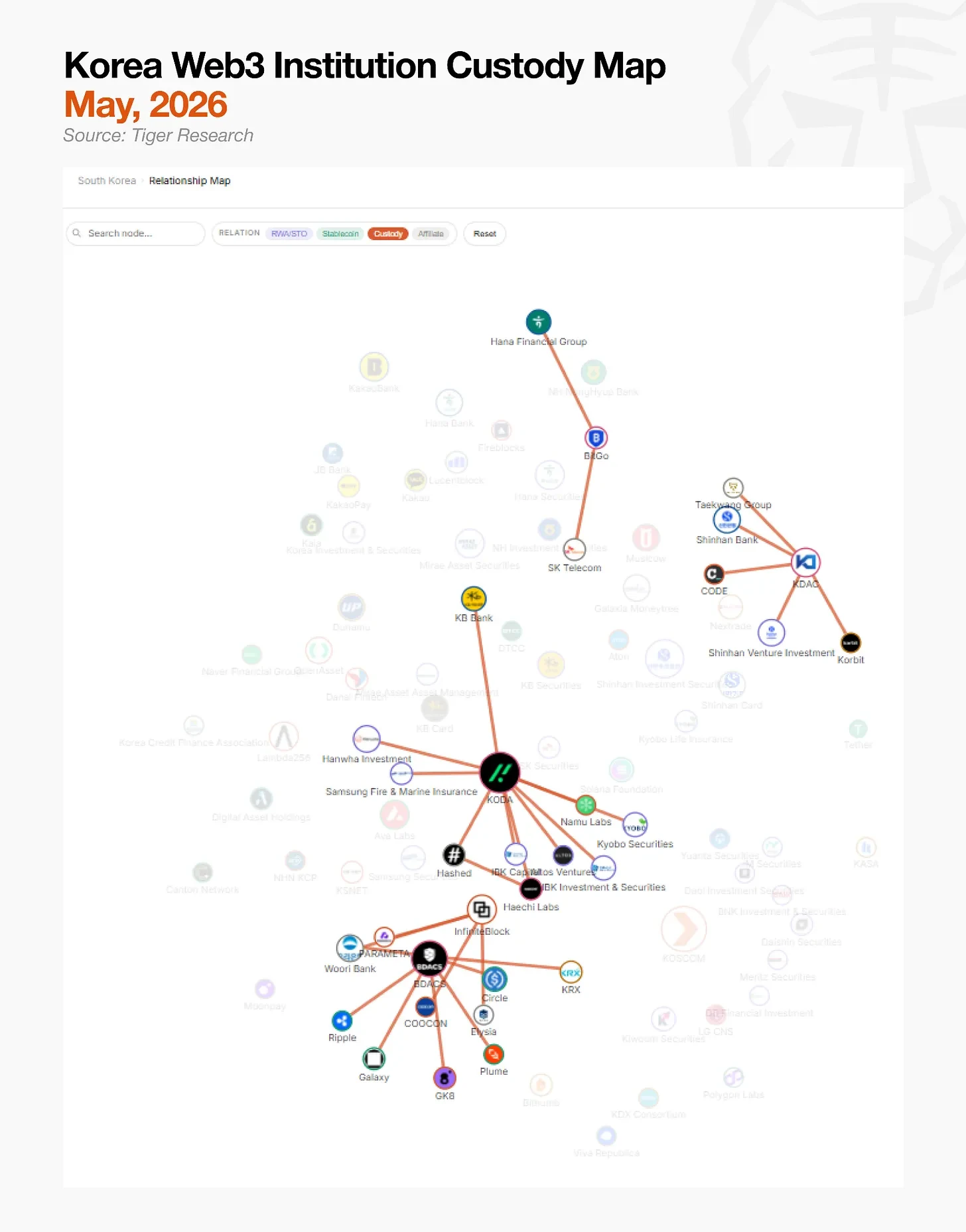
Compared to other sectors, the custody market landscape is clearer. The four major custody institutions have all solidified their market positions by partnering with domestic and international financial and tech partners.
KODA was jointly founded by Kookmin Bank (KB), crypto venture capital firm Hashed, and Haechi Labs. Subsequently, Hanwha Investment & Securities, IBK Capital, and Kyobo Securities acquired stakes. It also has an exclusive custody insurance agreement with Samsung Fire & Marine Insurance, providing a robust risk control system.
KDAC is a traditional finance-led custodian with Shinhan Bank and Nonghyup Bank as its two major shareholders. Nonghyup Bank originally invested in another custodian, Kardo, which merged and formally became part of KDAC. Currently, two of South Korea's top five banks are on its shareholder list.
BDACS focuses on technology and ecosystem partnerships, collaborating with domestic and international institutions like Woori Bank, Galaxy, and GK8 to expand custody and payment infrastructure. It has also partnered with Circle to issue the KRW stablecoin KRW1 based on Circle's Arc blockchain, currently undergoing proof of concept. BDACS is also the designated VASP and core custody partner for the KDX alliance led by the Korea Exchange (KRX), simultaneously developing both custody and payment businesses.
BitGo Korea entered the market leveraging its parent company's global technological strength. Its headquarters custody assets exceed USD 70 billion and facilitate approximately 20% of global Bitcoin on-chain transactions. Hana Financial Group and SK Telecom hold stakes, giving it a background in both financial and telecommunications capital.
Many financial institutions conduct business through the above custody providers. However, reports indicate that the four major custodians were all in a loss-making state last year. This suggests that while the industry's infrastructure has been built in advance, it has yet to attract the large-scale institutional capital needed to sustain operations.
Looking at the current state of the STO, stablecoin, and custody sectors reveals a common issue: although South Korean local institutions have established complete business frameworks, the underlying technology remains highly dependent on overseas solutions.
The Rise of Local Infrastructure Service Providers
Long-term reliance on overseas technology creates structural risks. As the industry grows, a significant portion of revenue would flow overseas as technology licensing fees. Furthermore, if overseas partners adjust policies or raise fees, local businesses will also face risks.
A deeper contradiction lies in the fact that scenarios like KRW stablecoin issuance, STO circulation rules, and corporate account connectivity require deep alignment with South Korean regulatory requirements and cannot directly adopt global solutions. For this reason, once relevant legislation is enacted and large-scale capital enters, local tech companies capable of independently designing and controlling the underlying technology stack will become essential for the industry.
Several local companies have already identified this technological gap and are deeply focused on building South Korea-specific financial infrastructure key players include:
LG CNS
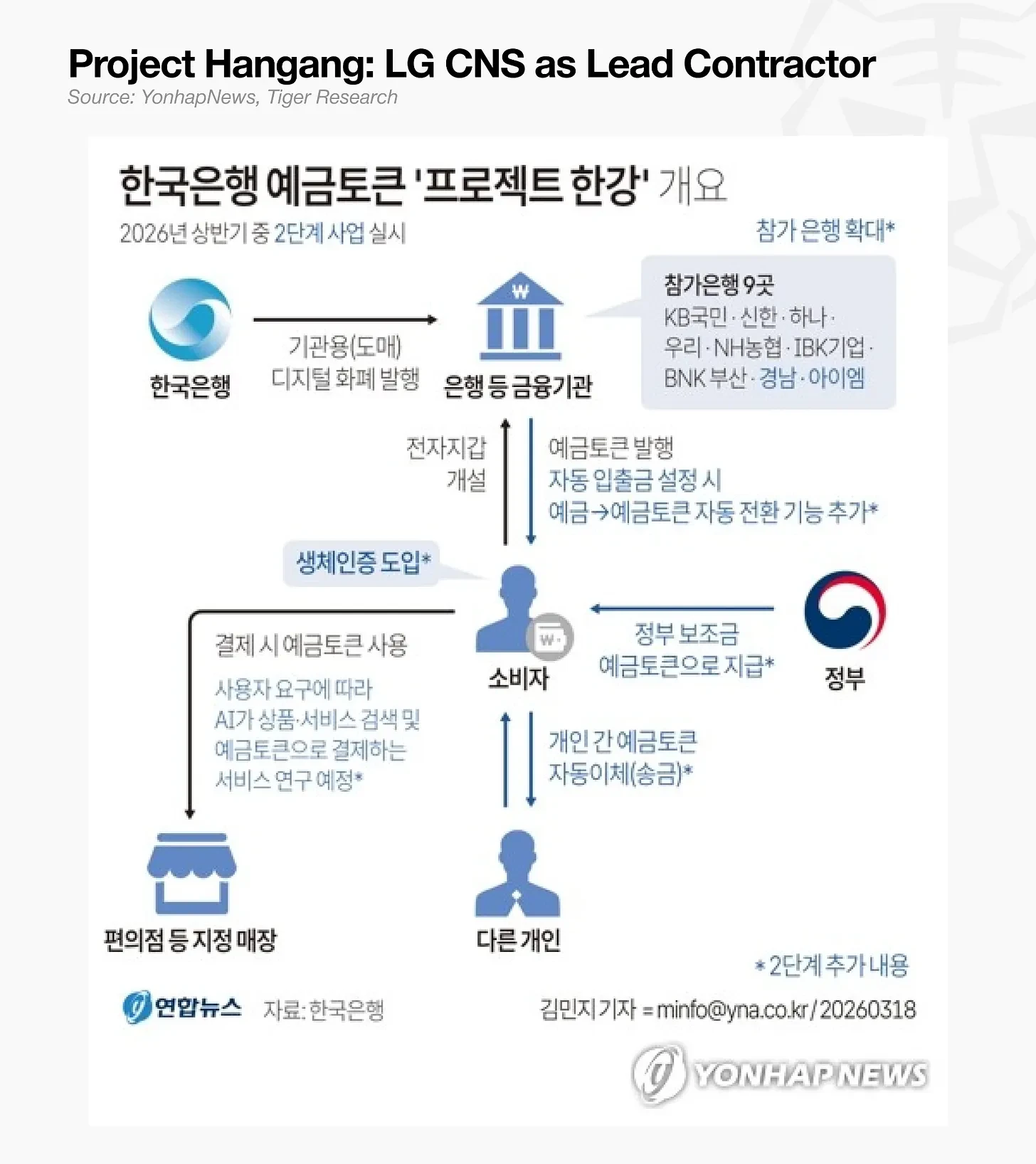
Among traditional IT service providers, LG CNS has the most prominent strategy. The company launched its proprietary blockchain platform Monachain in 2018. Leveraging local currency services for the Korea Minting, Security Printing & ID Card Operating Corporation, it has provided on-chain services to over 220 local governments, accumulating extensive operational experience.
Building on this technical expertise, LG CNS has secured projects related to the Bank of Korea's CBDC project "Hangang" and STOs. As the general contractor for the central bank's CBDC project, it is responsible for building a government subsidy distribution system based on deposit tokens, enabling institutional CBDCs and private digital assets to operate on the same network, effectively migrating the security standards and processes of traditional finance onto the blockchain.
Additionally, the company has undertaken the development of STO platforms for KOSCOM and Mirae Asset Securities. Its business layout focuses on three main directions: building token issuance and circulation platforms for banks, providing software services for credit card companies and payment institutions, and creating digital asset payment platforms for securities firms. Once regulations are in place, LG CNS is well-positioned to become a key winner in the local infrastructure market.
DSRV
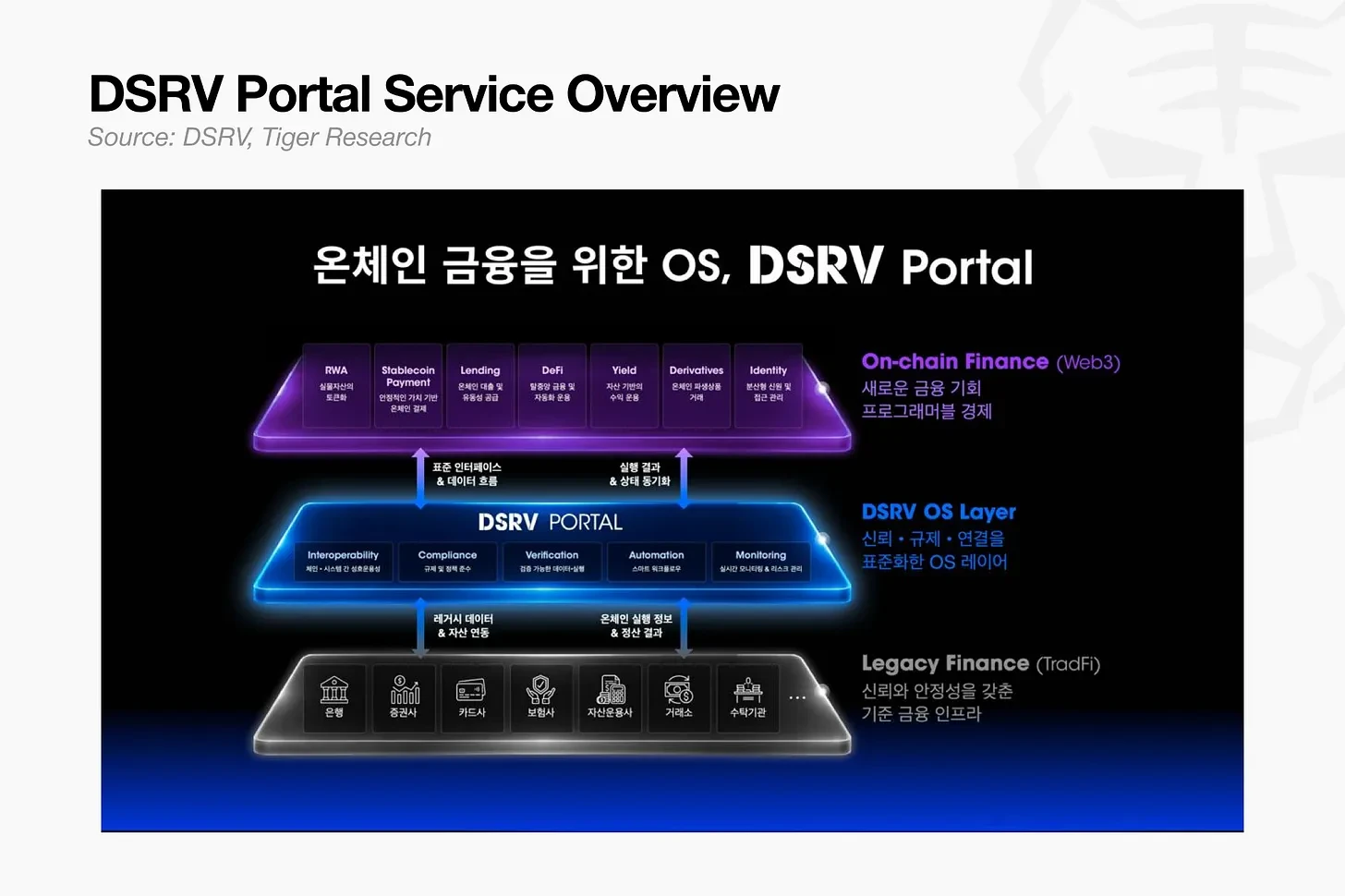
DSRV is a leading blockchain infrastructure provider, operating across more than 70 public chains. It manages assets exceeding KRW 4 trillion (approximately USD 2.9 billion) and ranks first in South Korea for Ethereum staking volume, placing it in the global top ten.
The company has evolved from a pure node operator to a one-stop institutional on-chain infrastructure provider. Its DSRV Portal allows financial institutions to use functions like wallets, payments, asset tokenization, custody, and staking through APIs and data dashboards. Financial institutions can quickly launch services such as personal/ institutional wallets, automatic payments, token issuance/burning/transfer/locking, asset custody, and staking without needing to build their own nodes and security systems.
DSRV has obtained several certifications, including VASP, Information Security Management System (ISMS), and SOC 1 Type 1, directly addressing the core requirements of financial institutions for compliance, security, and risk control. It takes on tasks that financial institutions are reluctant to handle, such as wallet security, internal controls, and operational risk.
Its partnership direction focuses on cross-border and on-chain payment rails: collaborating with SBI Ripple Asia to develop compliant cross-border remittance infrastructure between Korea and Japan; partnering with Circle to build an institutional-grade USDC issuance, redemption, and settlement system independent of exchanges; and working with BC Card to bridge traditional credit card networks with stablecoin payment channels. Recently, the company completed a KRW 30 billion (approximately USD 21.7 million) Series B funding round to accelerate technological development.
Altus (formerly B-Harvest)
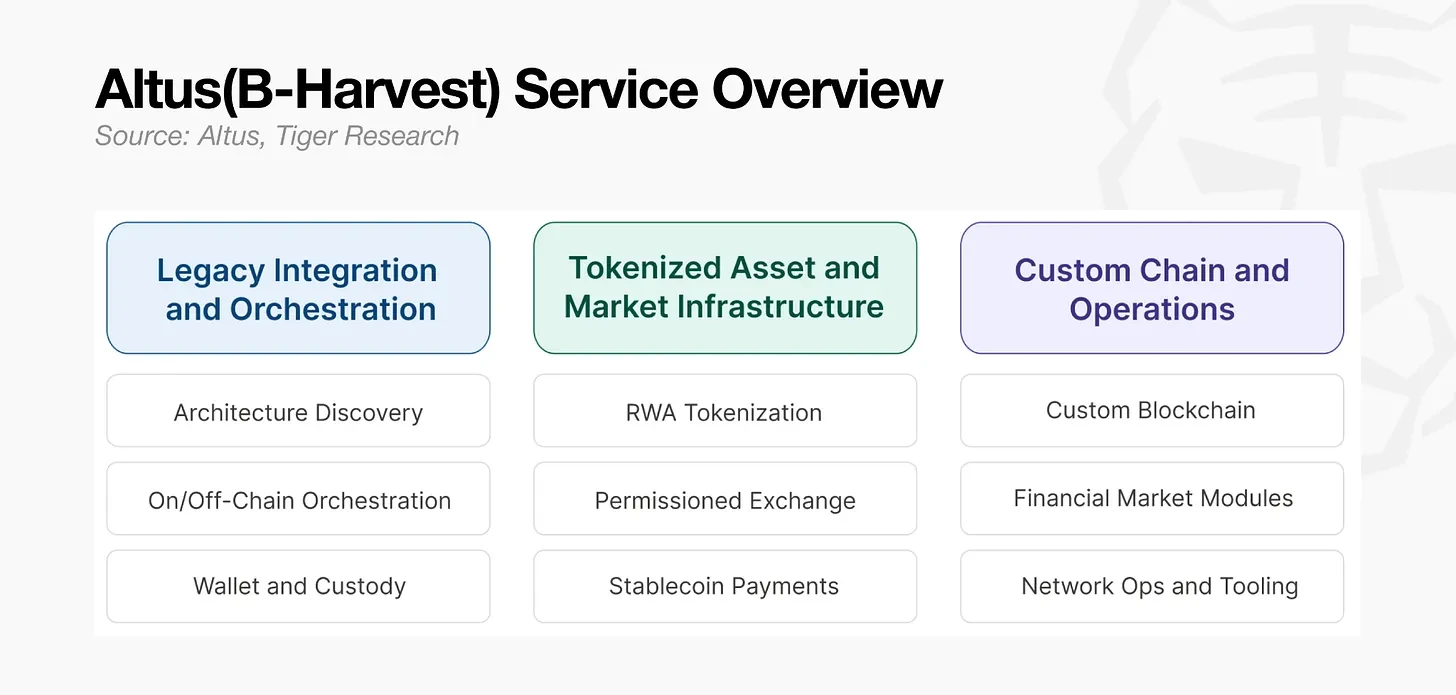
Altus specializes in the integration layer between traditional finance's legacy systems and blockchain. Founded in 2018, the team comprises over 40 engineers and researchers and has been deeply involved in the development of EVM-compatible public chains based on the Cosmos SDK, leading the construction of several commercial chains like Canto, Crescent, Stable, and Ault.
The company provides protocol development and underlying architecture design for Ault, an institutional-grade public chain focused on real-world assets, trading, and payments. It has also performed EVM adaptation, performance optimization, and security audits for the Bitcoin staking chain Babylon, ensuring its successful launch.
For financial institutions, Altus builds solutions from the ground up tailored to the needs of the financial industry: cross-chain orchestration layers connecting legacy systems to blockchain, RWA tokenization frameworks, permissioned exchanges, stablecoin payment and settlement systems, and institutional wallet and custody infrastructure.
Currently, Altus is simultaneously advancing two major R&D projects: the Canton network architecture supporting selective data disclosure between institutions, and the Commonware Stack, a modular blockchain framework targeting a throughput of 1 million transactions per second.
These three companies each have their strengths. LG CNS excels in traditional financial IT reputation, DSRV relies on its node and staking infrastructure, and Altus specializes in custom underlying protocol development. However, their goal is highly aligned: to secure control over core systems before the massive influx of institutional capital. The ultimate winner will depend on the commercial implementation experience each accumulates before the market fully opens.
Retail Fades Out, Institutions Dominate the Market
The recent flurry of cooperation agreements is not simply business expansion. It is a strategic positioning by institutions ahead of regulatory clarity, and even an attempt to influence the final regulatory framework. In the current competition for agreements, capturing market share is secondary; dominating the regulatory framework is the core objective.
In just six months, the landscape of the South Korean crypto market has been completely reshaped: custody camps have formed, STO alliances have emerged, and large financial holding companies have acquired exchange equity. Simultaneously, retail trading enthusiasm has cooled significantly, with the total trading volume of South Korea's five major exchanges dropping by approximately 48% year-on-year. The market's center of gravity is rapidly shifting from retail to institutions.
This market transformation has also rewritten the localization strategies of overseas Web3 public chain foundations. Cases like Shinhan Card choosing Solana and Mirae Asset Securities partnering with Avalanche are becoming more common. Overseas institutions are no longer relying on offline community events to attract retail investors. Instead, they are shifting their focus to connecting with local financial giants and large corporations. The traditional community operation model has proven ineffective.
Korea Blockchain Week (KBW 2026), to be held in Seoul this September, may showcase the results of this industry transformation. Based on the announced guest list


