






Support Rate Below 1%: Is BIP-110 Still Pushing Bitcoin Toward a Soft Fork?


- Core Argument: Bitcoin's BIP-110 proposal aims to restrict non-monetary data like inscriptions. Although facing forced activation due to low support, it could trigger a chain split. Its ultimate success or failure hinges on community consensus and miner hash power.
- Key Elements:
- Miner support is below 1%, and node support is only 14.64%, indicating extremely low backing for BIP-110.
- If the activation threshold of 55% is not met by August, the proposal will enter a mandatory window, where enforcing nodes will reject non-compliant blocks, potentially leading to a network fork.
- Proponents, led by developer Luke Dashjr, argue that inscriptions are "spam transactions" that crowd out Bitcoin's monetary use case and increase node burden.
- Opponents argue that BIP-110 does not completely solve the problem and could stifle innovation (e.g., BitVM), violate the principle of censorship resistance, and introduce risks of double-spending and chain splits.
- Ocean's hash power accounts for only 2.6%, while major mining pools like F2Pool are explicitly opposed. Driven by the interests of the majority of miners, the BIP-110 chain may face a "natural death" due to insufficient hash power.
- Currently, inscription transactions account for only 5% of the network. If activated with insufficient hash power, a minority chain is unlikely to become the "longest chain" and may ultimately fork independently into a new asset.
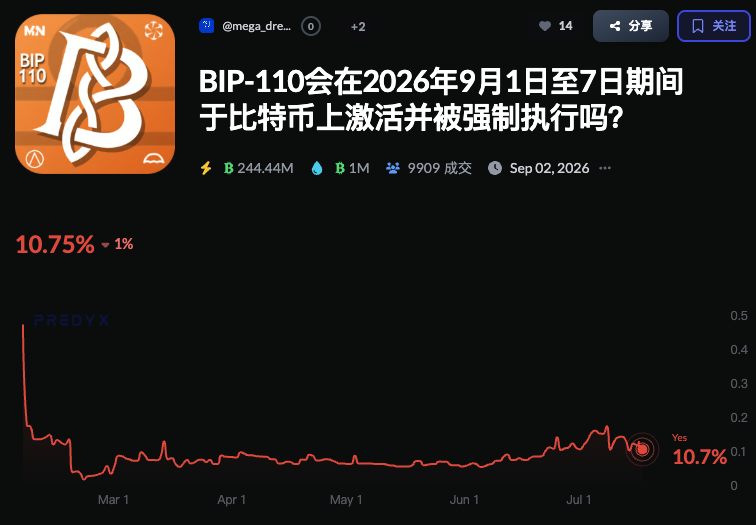
- Prediction markets indicate only a 10% probability of BIP-110 successfully activating, with opposition figures publicly betting on its failure.
Original by Odaily Planet Daily (@OdailyChina)
Author| Golem (@web3_golem)
As the August mandatory window period approaches, discussions surrounding the BIP-110 proposal have heated up once again.
BIP-110 was proposed in December 2025 by Dathon Ohm and has received support from Bitcoin Core developer Luke Dashjr. The proposal aims to restrict arbitrary/non-monetary data within Bitcoin transactions over the next year, primarily targeting large data storage like Ordinals, Bitcoin NFTs, etc., with the goal of reducing "junk transactions" on the network and allowing Bitcoin to focus on its monetary function.
The proposal has been controversial since its inception, but data shows that BIP-110 currently lacks mainstream miner and node support. The activation threshold for BIP-110 is 55%. Statistics indicate that miner support is less than 1%, and out of a total of 102,674 nodes on the network, only 15,035 are willing to enforce BIP-110, a ratio of 14.64%.
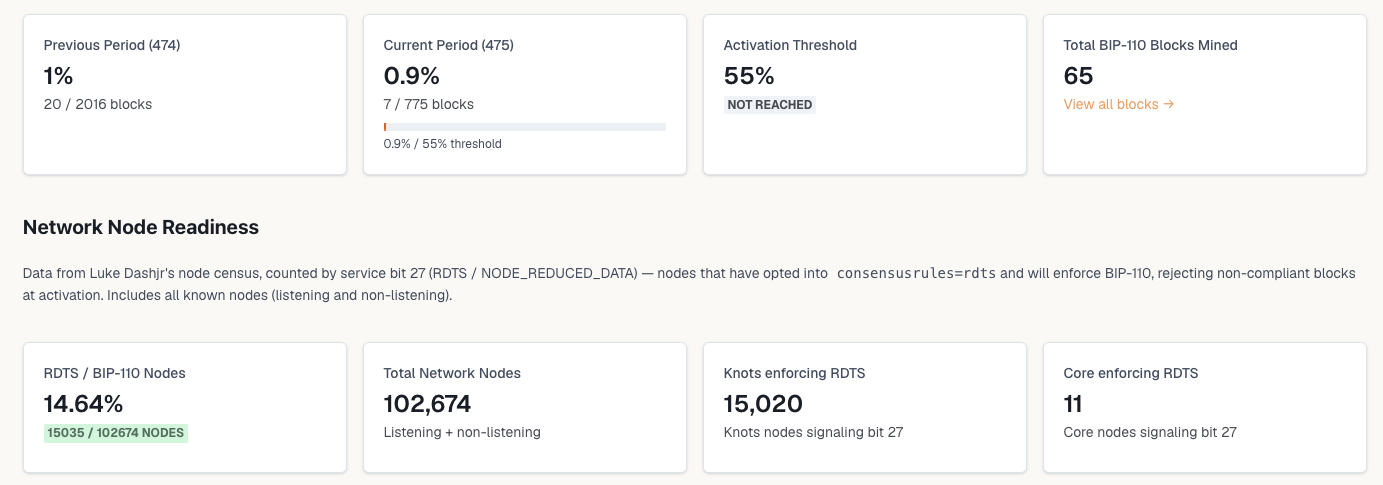
BIP-110 Miner and Node Support Rate
Typically, a proposal with such low support would not pass on the Bitcoin network. However, the contentious point of BIP-110 is that even without consensus, nodes supporting BIP-110 will enforce it. If BIP-110 does not reach the 55% activation threshold before block height 961,632, it will enter a mandatory window period (block heights 961,632 – 963,647). During this time, nodes running BIP-110 will reject blocks that do not comply, effectively forcing the adoption rate to 100%, ultimately leading to the forced activation of BIP-110 at block height 965,664.
Based on the current block production speed of the Bitcoin network, BIP-110 will enter the mandatory window period in early August. This means that although BIP-110 is a soft fork proposal, the Bitcoin network will experience a chain split (the minority chain supporting BIP-110 and the main chain that does not support BIP-110).
BIP-110 Continues to Stir Controversy
According to Bitcoin's "longest chain rule," only when the actual miner hashrate supporting BIP-110 constitutes the majority (>50%) will they become the longest chain, and the entire network will unify under the new rules, i.e., the soft fork succeeds. Therefore, although the forced activation of BIP-110 is seemingly inevitable, its long-term viability still depends on consensus. Otherwise, BIP-110 will likely meet the same fate as most Bitcoin soft forks in history: natural death.
Supporters: BIP-110 is Not a Change, but a Denial of Change
The main representative of the BIP-110 support camp is Luke Dashjr and his mining pool, Ocean. Luke Dashjr has long been an outspoken figure in the Bitcoin developer community against BRC-20 and inscriptions, and he provided the initial draft for the BIP-110 proposal.
Luke Dashjr is considered a representative figure of Bitcoin maximalism. They do not want to see Bitcoin block space used for any purpose other than Bitcoin transfers. The BIP-110 proposal views the inscriptions that emerged in 2022 as a "Bitcoin attack," arguing that allowing arbitrary data to be embedded in Bitcoin transactions imposes a huge and unnecessary burden on nodes. Furthermore, this "junk data" occupies a significant amount of block space, forcing monetary transactions to bid higher fees to be included in blocks, thereby crowding out Bitcoin's monetary use case.
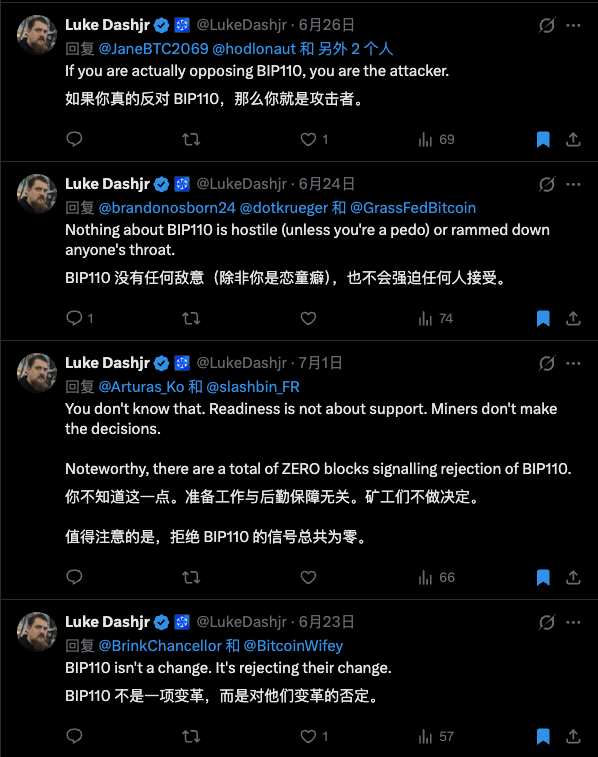
Therefore, Luke Dashjr posted on Platform X, stating that BIP-110 is not a change, but a denial of change. In response to opponents of BIP-110, he also displayed a somewhat sophomoric attitude. On one hand, he claims BIP-110 is not hostile and does not force anyone to accept it; on the other hand, he argues that anyone who opposes BIP-110 is the real Bitcoin attacker.
Moreover, despite the current very low miner vote in favor of BIP-110 (<1%), Luke Dashjr remains optimistic, asserting that the miner vote directly opposing BIP-110 is also nearly 0%. His implication is that miners are not making the decision; once BIP-110 is activated, they will simply follow.
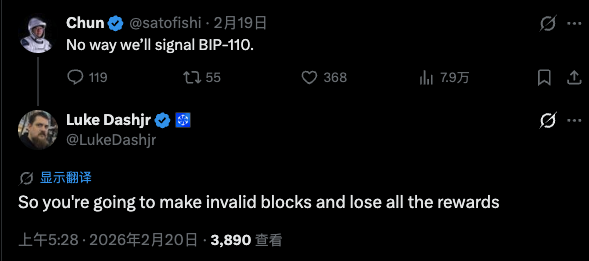
In reality, as of now, the only mining pool publicly supporting BIP-110 is Luke Dashjr's own Ocean. F2Pool co-founder Wang Chun publicly stated as early as February that he would absolutely not support BIP-110. Luke Dashjr confidently replied under his post, saying, "Well, then you'll be mining invalid blocks and losing all your rewards."
According to miningradar data, F2Pool is the third largest Bitcoin mining pool globally, with a hashrate share of 13.6%. Ocean's current hashrate is only 24.6 EH/s, accounting for 2.6% of the total network hashrate.
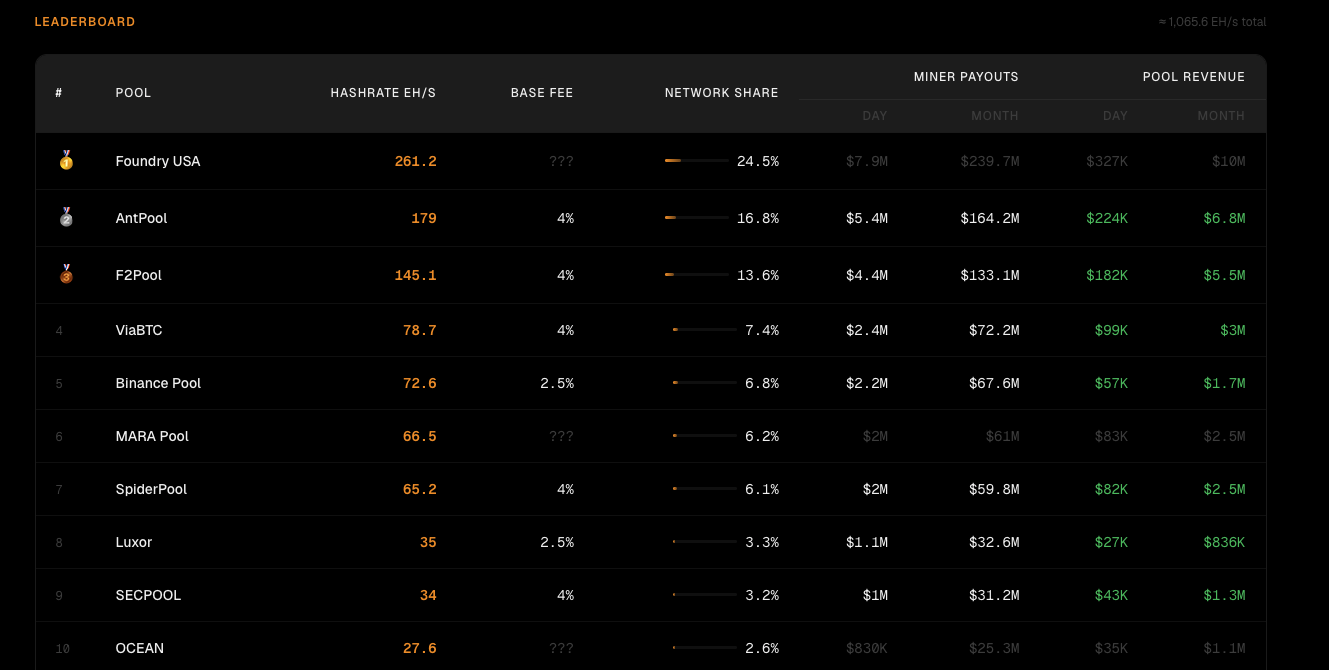
Bitcoin Mining Pool Rankings
If Ocean ends up being the only supporting pool on the fork, they would only produce 3-5 blocks per day. Such efficiency and block production speed would hardly make them the "longest chain" on the Bitcoin network.
Opponents: BIP-110 Doesn't Solve Problems, It Creates New Ones
Opponents of the BIP-110 proposal don't just focus on whether it will succeed after activation; they criticize its inability to solve the "junk transaction" problem on the Bitcoin network while simultaneously creating many potential new issues. In short, the strong opposition to BIP-110 stems from concerns about its numerous unintended consequences, not from any nostalgic attachment to Ordinals or inscriptions. Key representatives of the opposition include crypto punk pioneer Adam Back, Bitcoin Core developer Jameson Lopp, and Strategy founder Michael Saylor.
Firstly, opponents argue that BIP-110 cannot completely solve the "junk transaction" problem facing the Bitcoin network. The author of the BIP-110 proposal itself admits it can only provide temporary relief. Jameson Lopp believes that Bitcoin's block size limit and the competitive fee market for block space already mitigate the junk transaction problem to some extent. However, Bitcoin remains a target for various junk transaction attacks because hardly anyone genuinely uses the Bitcoin network, keeping fees low. Consequently, the fee pressure needed to deter most junk transactions hasn't formed.
Simultaneously, BIP-110 would stifle future innovation on Bitcoin. The proposal also acknowledges that restrictions on Taproot hinder the implementation of advanced features or complex covenants like BitVM on the Bitcoin network. Although BIP-110 is described as a temporary, one-year restriction, Jameson Lopp views it as a delaying tactic by Luke Dashjr. He warns that if these restrictions severely impede future Bitcoin upgrades, they could ultimately lead to a Bitcoin hard fork instead of a soft fork.
Adam Back focuses more on Bitcoin's censorship resistance and decentralized spirit. He argues that BIP-110 would subjectively censor transactions within blocks, making its fundamental purpose the policing of others. This contradicts the principles of neutrality and censorship resistance that Bitcoin has upheld since its inception, marking a dangerous step towards centralization and control. Adam Back uses Bitcoin maximalism to negate the maximalist's change to Bitcoin, effectively 'fighting fire with fire.'
Michael Saylor summarized BIP-110 as a "Bitcoin Iatrogenic Proposal," suggesting that the very "treatment" proposed by BIP-110 would harm Bitcoin rather than solve existing problems.
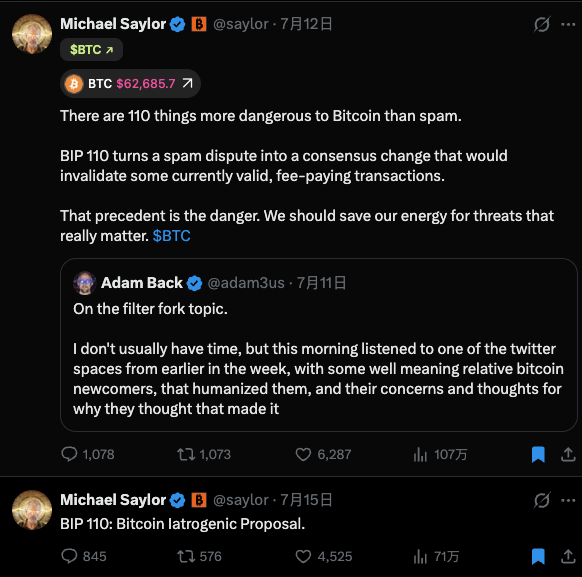
Furthermore, Michael Saylor believes that if BIP-110 were to become consensus, some valid fee-paying transactions would become invalid. Setting such a precedent for censorship is what he considers truly dangerous.
Another severe consequence feared by opponents is that BIP-110 activation could split the Bitcoin chain ecosystem. Two competing chains would emerge, vying for the title of "real Bitcoin." This situation carries the risk of Bitcoin double-spending due to the uncertainty of the fork outcome. Even without a double-spend, if BIP-110 ultimately evolves into a new chain, it would fragment Bitcoin's developer resources, hashrate, and monetary consensus.
Opponents argue that BIP-110 is trying to solve a cultural problem with a technical solution, which could lead to even more unpredictable problems.
Despite their concerns, opponents remain confident in BIP-110's failure. Jameson Lopp bet against BIP-110 back in February, with a minimum stake of 1 BTC. To date, no BIP-110 supporter has publicly accepted the bet.
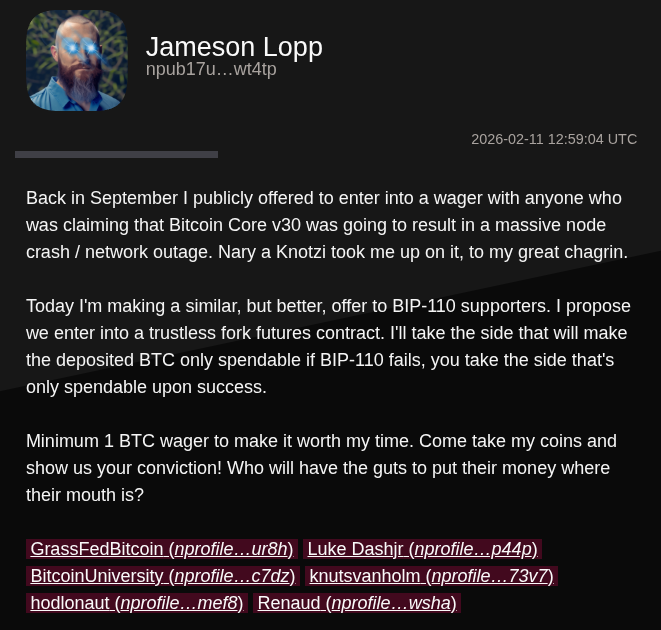
Jameson Lopp's Bet Invitation to BIP-110 Supporters
On the prediction market Predyx, the probability that "BIP-110 will be activated and enforced on Bitcoin between September 1st and 7th, 2026" is 10%. The "Yes" settlement condition requires the BIP-110 chain to become the "longest Bitcoin chain" accepted by the majority of nodes.
What Happens After BIP-110 Activation?
We can outline some hypothetical scenarios for what might happen when BIP-110 is eventually forced to activate at block height 965,664 (late August to early September).
Scenario One is as described above: upon reaching the activation height, BIP-110 nodes reject main chain blocks, but an insufficient proportion of miners produce new blocks compliant with BIP-110 rules. The BIP-110 chain's block production would be extremely slow, eventually ceasing altogether.
Scenario Two involves a certain percentage of miners supporting BIP-110. Supporters believe they have an "asymmetric advantage" because BIP-110's rules are stricter. While BIP-110 nodes would reject blocks containing non-compliant data (like inscriptions), non-BIP-110 nodes (mainstream Core nodes) would still consider blocks produced by BIP-110 nodes as valid.
Furthermore, inscription transaction ratios on Bitcoin block space have currently dropped to around 5%, with over 95% being traditional Bitcoin transfer transactions. BIP-110 nodes would still accept a large number of mainstream blocks. Hence, Luke Dashjr believes BIP-110 will eventually become the "longest chain" and unify the network.
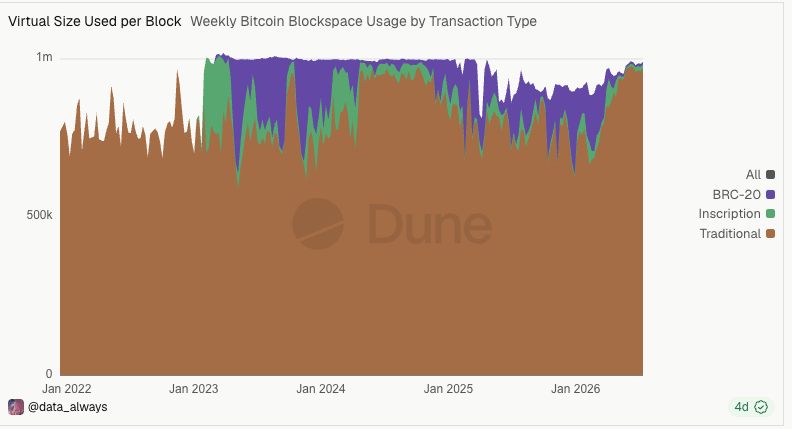
Bitcoin Block Space Usage by Transaction Type
Scenario Three is where a certain percentage of miners support BIP-110, but their hashrate can never surpass the existing majority chain. Typically, miners are highly rational. Once their machines start, they consume electricity. In a competition between two chains, miners would weigh the costs and benefits. Miners on the BIP-110 chain would be more likely to abandon their sunk costs (mining rewards on the minority chain) and join the majority chain, as the minority chain not only lags in length but also accumulates fewer Bitcoin rewards. This ultimately devolves into Scenario One.
But what if, assuming Luke Dashjr has immense persuasive power, miners become irrational and persist in mining on the BIP-110 chain? This chain would continue to operate independently, though block times would likely be very slow. Miners would be operating almost purely out of conviction, performing meaningless energy consumption. The most logical outcome for this scenario would be a permanent fork of the BIP-110 chain into an independent chain by its supporters, who would "manually" adjust the block difficulty and issue a new network token.
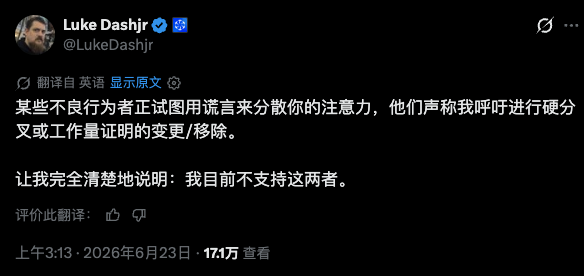
However, Luke Dashjr has repeatedly emphasized his refusal to hard fork for BIP-110, stating that the time for hard forks has not yet come. 'The water that bears the boat is the same that swallows it.' It's possible that Luke Dashjr himself might be swept along by popular will, forced into a situation where he has no choice but to proceed.
Therefore, while the minority chain run by BIP-110 supporters can technically continue to operate, it is highly unlikely to thrive. This depends on economic and ecosystem factors, including support from wallets, exchanges, and users. Bitcoin's history has many such examples; most end in failure. Even the successful ones, like BCH or BSV, have largely plateaued as separate coins.





